Metabolic Wastes and the Liver (OCR A-Level Biology A): Revision Notes
📚Revision Notes
Metabolic Wastes and the Liver
Introduction to excretion and metabolism
As warm-blooded, active organisms, mammals maintain high metabolic rates. Metabolism encompasses all chemical and physical changes occurring within the body, particularly biochemical processes including digestion, protein synthesis, and cellular respiration.
These metabolic activities generate waste products that must be eliminated. Excretion is the process by which metabolic waste products and any substances present in excess (such as water and ions) are removed from the organism. Without effective excretion, these wastes accumulate and cause cellular damage.
Metabolic waste products
Mammalian metabolism produces five main categories of excretory waste:
- Carbon dioxide (CO₂)
- Nitrogenous wastes: ammonia, urea, and uric acid
- Bile pigments derived from haemoglobin breakdown
Sources and harmful effects
Each metabolic waste originates from specific biochemical pathways and poses distinct risks when accumulated:
| Metabolic waste | Source in the body | Harmful effects if accumulated |
|---|---|---|
| Carbon dioxide | Decarboxylation reactions during aerobic respiration in mitochondria | Causes acidosis – blood pH falls below normal range, damaging cells and impairing enzyme function |
| Ammonia | Deamination of excess amino acids in hepatocytes | Raises cytoplasmic pH, disrupting metabolic processes (particularly respiration) and interfering with neurotransmitter receptors in the brain |
| Urea | Ornithine cycle in hepatocytes | Highly diffusible molecule that enters cells, lowering their water potential. Cells absorb water by osmosis, causing swelling and potential lysis |
| Uric acid | Breakdown of purine bases (adenine and guanine) in liver and other organs | Forms crystals in joints, causing gout – a painful form of arthritis |
| Bile pigments | Breakdown of haem groups from haemoglobin in hepatocytes | Accumulate in skin tissues, producing yellowish discolouration called jaundice |
Important
All these excretory substances are produced by the liver. Maintaining their concentrations below threshold levels is essential, as elevated levels disrupt metabolism by altering pH and reducing enzyme efficiency.
Liver structure and blood supply
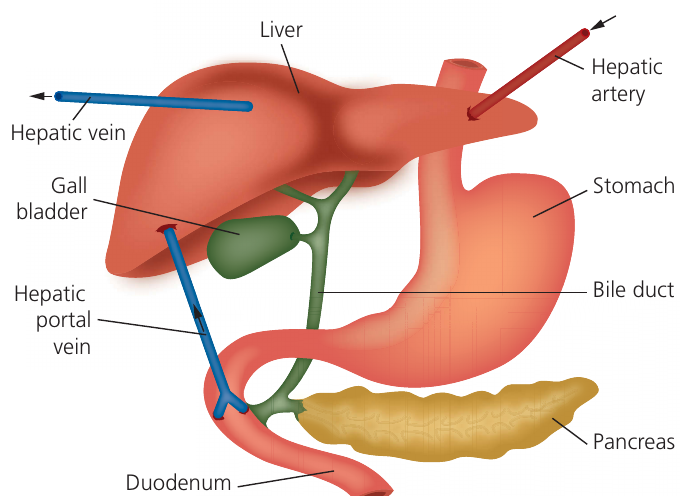
The liver functions as a major effector organ in homeostasis, maintaining body temperature, blood glucose concentration, and producing excretory waste products. To perform these roles effectively, it requires an abundant blood supply.
Dual blood supply
Note
Unlike most organs, the liver receives blood from two distinct sources, allowing it to simultaneously obtain oxygen and absorb nutrients from digestion.
- Hepatic artery: delivers oxygenated blood from the heart
- Hepatic portal vein: carries deoxygenated, nutrient-rich blood from the digestive system
This arrangement allows the liver to absorb and metabolise nutrients absorbed from the small intestine. Deoxygenated blood exits via the hepatic vein, returning to the heart. The liver produces bile (containing bile salts for fat digestion and bile pigments as waste products), which is stored in the gall bladder and released into the duodenum via the bile duct.
Microscopic structure: hepatic lobules
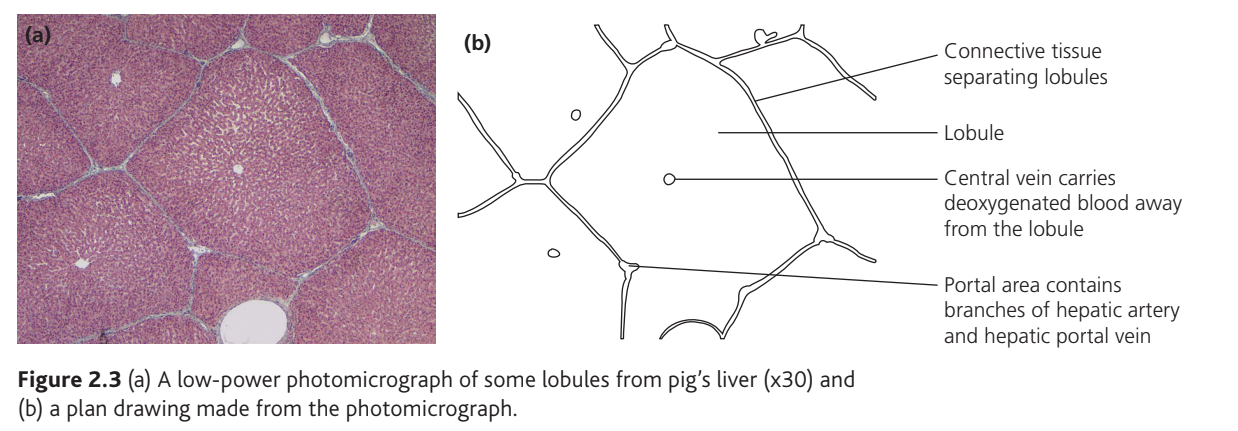
The liver exhibits a relatively simple internal organization, divided into numerous lobules separated by connective tissue. Connective tissue consists of cells that secrete an extracellular matrix, such as collagen fibres.
Rather than containing specialized cell types for different functions, nearly all liver functions occur within hepatocytes (liver cells). Each lobule represents the functional unit of the liver, meaning all organ functions occur within individual lobules.
Blood flow through lobules
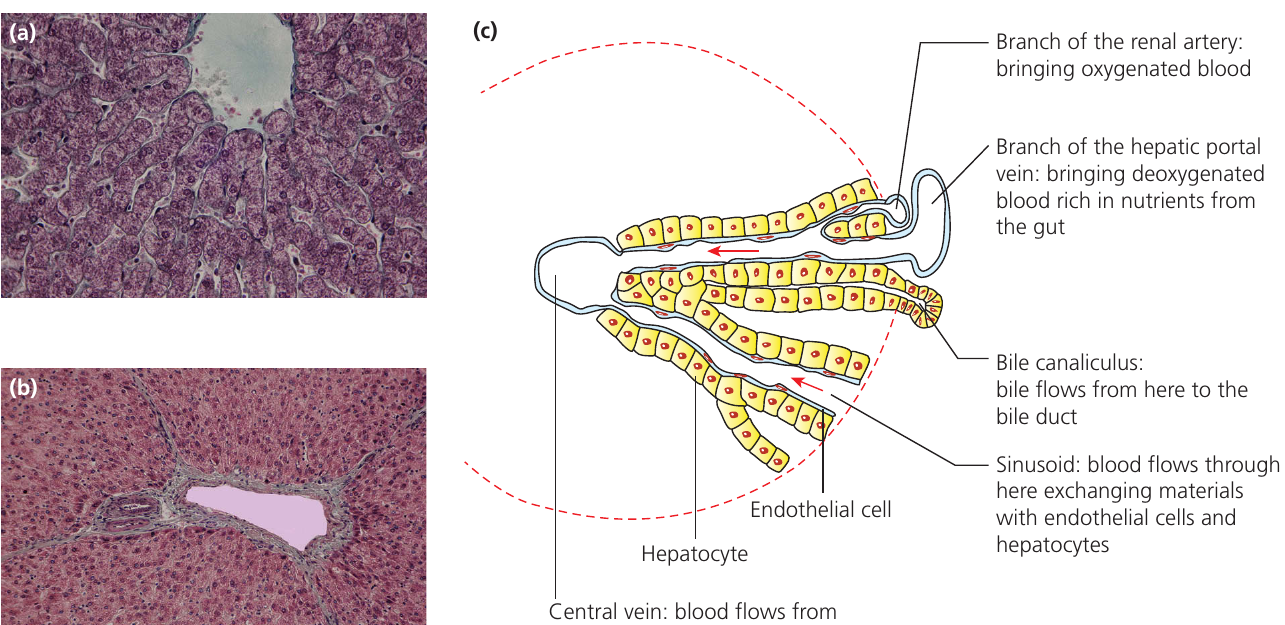
Each lobule receives blood from branches of both the hepatic artery and hepatic portal vein. This blood flows through wide capillaries called sinusoids. These sinusoids are lined by an incomplete layer of endothelial cells (the squamous cells that line all blood vessels), allowing direct contact between blood and hepatocytes. This arrangement facilitates efficient substance exchange.
Note
The incomplete endothelial lining of sinusoids is a key structural feature that maximizes the exchange of substances between blood and hepatocytes, enabling the liver's diverse metabolic functions.
A branch of the hepatic vein drains deoxygenated blood away from the central region of each lobule.
Hepatocyte functions
Hepatocytes perform multiple metabolic roles:
- Storage: glucose is stored as the polysaccharide glycogen
- Bile production: synthesize bile containing both bile salts (for fat emulsification) and bile pigments (excretory products)
- Metabolic processing: absorb and metabolize nutrients from the blood
- Detoxification: break down unwanted substances and produce excretory wastes
Each hepatocyte possesses a large surface area in contact with blood flowing through sinusoids, maximizing substance exchange efficiency. Bile components drain into small channels called canaliculi, which merge to form the bile duct connecting to the gall bladder and duodenum.
Amino acid metabolism and deamination
Dietary protein is digested into amino acids, which are absorbed into the bloodstream and transported directly to the liver via the hepatic portal vein.
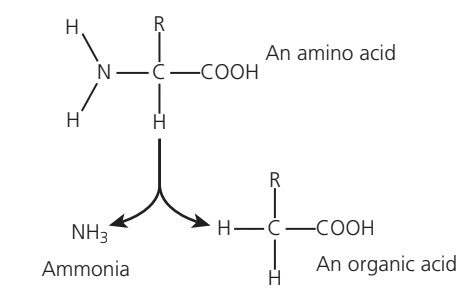
The body does not excrete excess amino acids. Since they represent valuable energy sources, their amine groups (−NH₂) are removed, allowing the remaining molecule to be utilized. This removal process is called deamination.
The deamination reaction
During deamination, the −NH₂ group is removed from each amino acid, forming:
- Ammonia (NH₃), which in cytoplasm exists as the ammonium ion (NH₄⁺)
- An organic acid that can be respired in the Krebs cycle or used for synthesizing other compounds
Important
Most deamination occurs in mitochondria, compartmentalizing ammonia production away from the main cytoplasm. This is crucial because ammonia is highly toxic and must be quickly converted to less harmful urea.
The ornithine cycle (urea cycle)
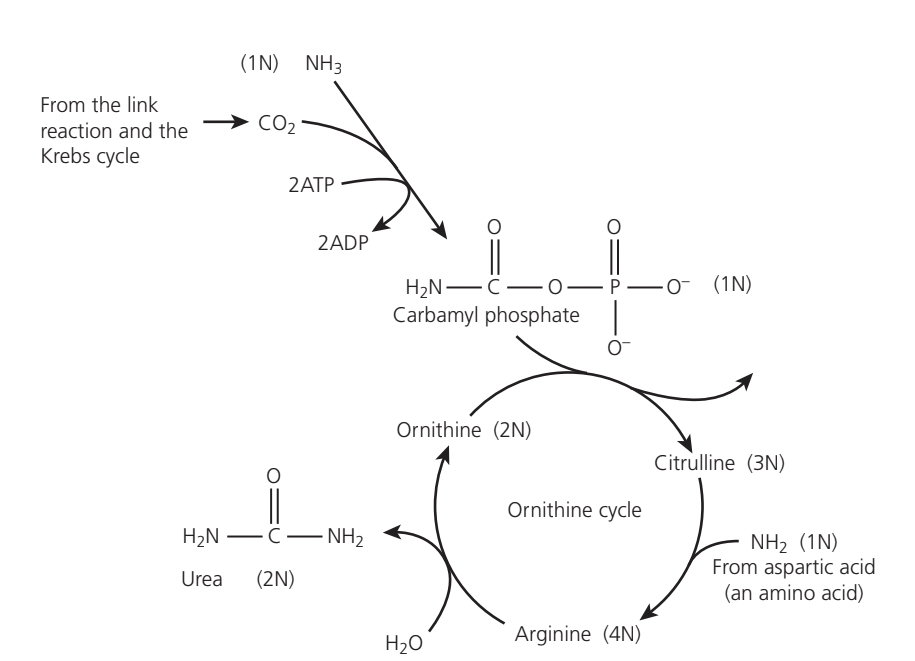
Ammonia is highly toxic, so hepatocytes rapidly convert it to the less harmful compound urea through a series of reactions forming a metabolic cycle.
Cycle overview
The ornithine cycle (also called the urea cycle) converts toxic ammonia into urea through the following sequence:
1. Carbamoyl phosphate synthesis (in mitochondria):
- Requires 2 ATP molecules, NH₃, and CO₂
- Produces carbamoyl phosphate (containing 1 nitrogen atom)
2. Citrulline formation (in mitochondria):
- Ornithine (2 nitrogen atoms) combines with carbamoyl phosphate
- Forms citrulline (3 nitrogen atoms)
3. Arginine synthesis (in cytosol):
- Citrulline receives an amino group from aspartate (formed from excess amino acids)
- Produces arginine (4 nitrogen atoms)
4. Urea production (in cytosol):
- Arginine is hydrolysed with water
- Releases urea (2 nitrogen atoms) and regenerates ornithine (2 nitrogen atoms)
Note
Tracking nitrogen atoms through the cycle:
The cycle efficiently processes nitrogen through the intermediates:
- Ornithine: 2N → Citrulline: 3N → Arginine: 4N → Urea: 2N + Ornithine: 2N
This pattern helps you remember the flow of nitrogen atoms through each stage.
Cycle efficiency
The ornithine cycle produces one molecule of urea from:
- One molecule of carbon dioxide
- Two amino groups from two amino acids
Important
The cyclic nature means only small quantities of intermediate compounds (ornithine, citrulline, arginine) are needed to process large quantities of waste amino groups and CO₂. This is a key advantage of cyclic metabolic pathways.
Properties of urea
Urea offers several advantages as an excretory product:
- Water soluble: easily transported in blood plasma
- Less toxic than ammonia
- Diffusible: readily crosses phospholipid bilayers, allowing it to leave hepatocytes and travel to the kidneys for excretion
Additional nitrogenous wastes
Beyond urea, the body produces small quantities of:
- Uric acid: formed from breakdown of purine bases (adenine and guanine)
- Creatinine: derived from creatine phosphate in muscle tissue
- Small amounts of ammonia that are directly excreted
Detoxification in the liver
Detoxification involves breaking down substances that are no longer required or are potentially toxic. The liver detoxifies several important substances:
- Lactate
- Alcohol (ethanol)
- Hormones
- Medicinal drugs
Lactate metabolism and the Cori cycle
Lactate is produced as the end product of anaerobic respiration in skeletal muscles during intense exercise when oxygen supply becomes insufficient. Lactate molecules diffuse from muscle tissue into the bloodstream.
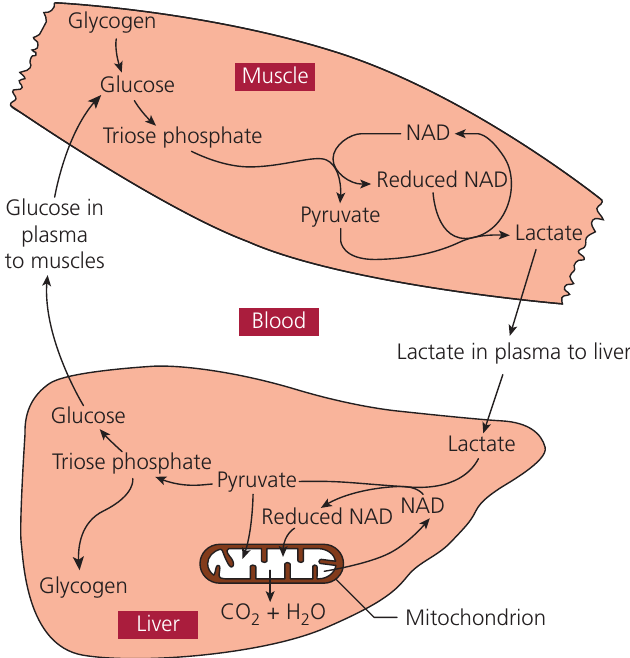
As an energy-rich compound, lactate serves as a respiratory substrate for cardiac muscle and other tissues. The liver absorbs remaining lactate from blood and metabolizes it through the following process:
1. Oxidation to pyruvate: Lactate is oxidized to pyruvate, with NAD reduced to reduced NAD (NADH)
2. Energy generation: Some pyruvate enters mitochondria for aerobic respiration, generating ATP
3. Gluconeogenesis: The ATP produced powers conversion of remaining lactate to glucose
4. Storage and release: Some glucose is stored as glycogen; the rest enters blood circulation, restoring normal blood glucose levels
Note
This cyclical process – lactate production in muscle, transport to liver, conversion to glucose, and return to muscle – is called the Cori cycle. This allows the body to recycle lactate as a valuable energy source rather than treating it purely as waste.
Alcohol metabolism
Ethanol is rapidly absorbed in the stomach and quickly distributed throughout the body, where it is absorbed by hepatocytes. Like lactate, ethanol provides a good energy source and is preferentially respired by hepatocytes over fat.
Metabolic pathway
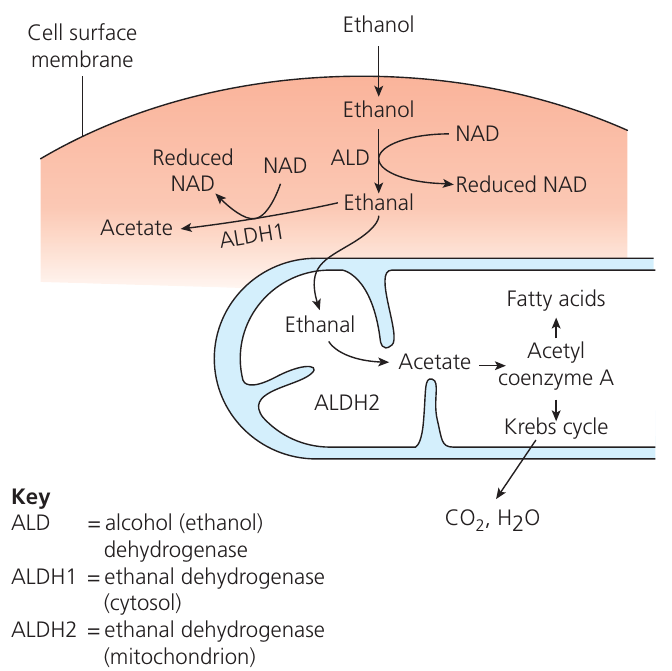
Most ethanol undergoes the following conversions:
1. Oxidation to ethanal: Ethanol (CH₃CH₂OH) is oxidized to ethanal (CH₃CHO) by alcohol dehydrogenase (ALD) in the cytosol
2. Conversion to acetate: Ethanal is further oxidized to acetate (CH₃COO⁻) by ethanal dehydrogenase (ALDH1 in cytosol, ALDH2 in mitochondria)
3. Acetyl coenzyme A formation: Acetate is converted to acetyl coenzyme A
4. Final metabolism: Acetyl coenzyme A can be respired in the Krebs cycle or used to synthesize fatty acids
Some ethanol is oxidized by enzymes in the smooth endoplasmic reticulum.
NAD involvement
Both oxidation steps are coupled with NAD reduction:
The reduced NAD is recycled through oxidation in mitochondria, generating ATP.
Fatty liver condition
Since ethanol metabolism generates substantial ATP, hepatocytes reduce fat utilization. Consequently, fat accumulates within liver cells, producing the condition known as fatty liver. Binge drinkers exhibit this condition for several days following heavy alcohol consumption.
Important
Warning: Long-term effects of fatty liver
Stored fat reduces hepatocyte efficiency in performing their numerous functions. Prolonged fatty liver can progress to life-threatening conditions such as cirrhosis (liver scarring), which is increasingly prevalent among young people who misuse alcohol in the UK.
Hormone metabolism
Hormones are removed from circulation and metabolized by the liver:
- Protein hormones (insulin, glucagon): hydrolysed into constituent amino acids
- Peptide hormones (anti-diuretic hormone): similarly broken down into amino acids
- Steroid hormones (oestrogen, testosterone): inactivated by conversion to other compounds, which are subsequently excreted in urine
Drug metabolism
Various medicinal drugs are also broken down in the liver, including:
- Paracetamol
- Steroids
- Antibiotics
Summary
Key Points to Remember:
-
The liver produces five main metabolic wastes: carbon dioxide, ammonia, urea, uric acid, and bile pigments – each has specific harmful effects if allowed to accumulate.
-
The liver's unique dual blood supply (hepatic artery and hepatic portal vein) enables it to receive both oxygenated blood and nutrient-rich blood from the digestive system.
-
Deamination removes toxic amino groups from excess amino acids, producing ammonia and organic acids; the ornithine cycle then converts ammonia and CO₂ into less toxic urea.
-
The ornithine cycle is a cyclic pathway requiring only small amounts of intermediates (ornithine, citrulline, arginine) to process large quantities of nitrogenous waste.
-
Detoxification processes in the liver metabolize lactate (via the Cori cycle), alcohol (to acetate then acetyl coenzyme A), hormones (by hydrolysis or conversion), and various drugs.