The Nerve Impulse, the Myelin Sheath, and Saltatory Conduction (OCR A-Level Biology A): Revision Notes
📚Revision Notes
The Nerve Impulse, the Myelin Sheath, and Saltatory Conduction
The resting potential
Neurones generate and transmit electrical impulses, a highly specialised function that requires significant adaptation. Even when inactive, neurones maintain constant electrical activity. The 'resting' neurone maintains an ionic imbalance across its cell membrane, creating what is known as a resting potential.
Resting potential is the electrical potential difference across a neurone membrane when the cell is not transmitting an impulse. This value is approximately , meaning the outside of the membrane is positively charged relative to the inside.
Establishing the resting potential
Note
In most cells, ionic imbalances across membranes are quickly eliminated through natural charge distribution. Positive ions repel each other while attracting negative ions, causing charge gradients to dissipate naturally. Neurones are unique because they actively maintain their charge imbalance through specific mechanisms.
The resting potential depends on the distribution of sodium ions (Na⁺) and potassium ions (K⁺) across the membrane. Two types of membrane proteins are involved:
- Channel proteins that allow ions to diffuse through
- Carrier proteins that function as sodium-potassium pumps
The sodium-potassium pump is a carrier protein that actively transports ions using ATP. Importantly, it does not exchange ions equally: the pump moves three sodium ions out for every two potassium ions in. This unequal exchange has several consequences:
- More positive ions accumulate outside the membrane, creating an electrochemical gradient
- Sodium ion concentration becomes higher outside, establishing a concentration gradient for sodium
- Potassium ion concentration becomes higher inside, establishing a concentration gradient for potassium
Important
The 3:2 Ratio is Critical
The sodium-potassium pump's unequal exchange (3 Na⁺ out for every 2 K⁺ in) is essential for establishing the resting potential. This creates a net movement of positive charge out of the cell, directly contributing to the negative interior. Remember: the pump both creates concentration gradients and directly affects membrane potential through this unequal exchange.
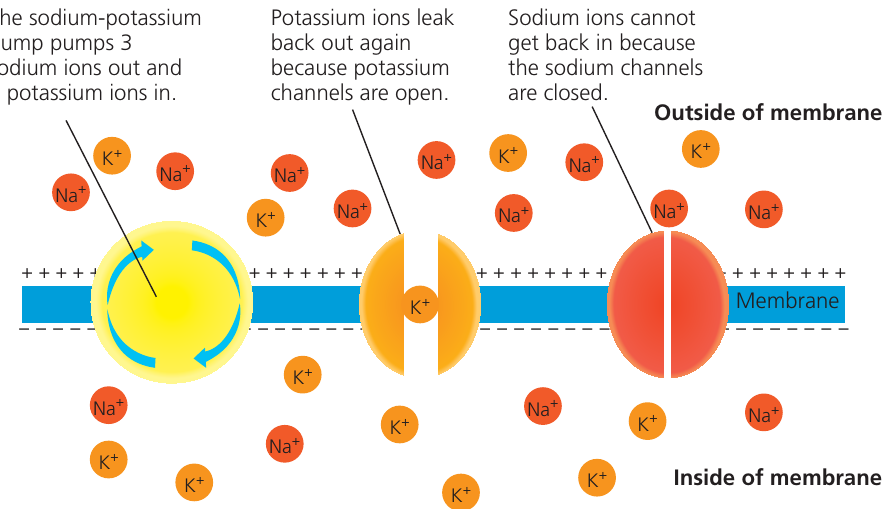
At rest, sodium channels are closed, preventing sodium ions from following their concentration gradient back into the cell. Potassium channels, although technically closed, are very 'leaky', allowing potassium ions to diffuse back out down their concentration gradient. The positive potassium ions move outward despite the electrochemical gradient pulling them toward the negative interior, because the concentration gradient effect is much stronger.
The overall result is an equilibrium state with more positive charge outside the membrane than inside, and a steep concentration gradient for sodium ions (high outside, low inside). This resting potential remains stable until a stimulus disrupts it.
Scientists consider that membrane permeability differences cause the resting potential. The membrane is much more permeable to potassium ions than sodium ions. The sodium-potassium pump primarily creates the necessary concentration gradients, though it also directly affects membrane potential through its unequal ion exchange.
The action potential
A nerve impulse begins when the resting potential converts into an action potential. This involves a rapid sequence of electrical changes triggered by a stimulus, which may be an electrical impulse from another neurone or a chemical change near the membrane.
Threshold potential and depolarisation
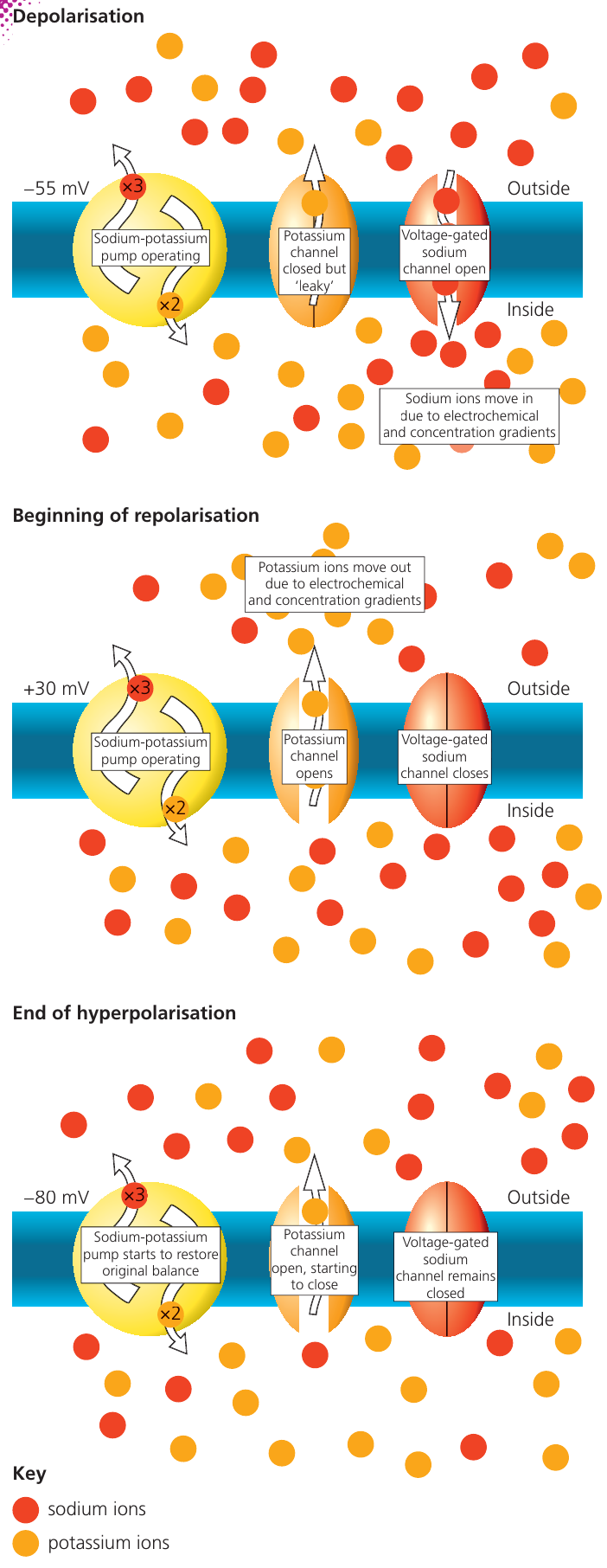
When stimulated, voltage-gated sodium channels begin opening. Both the sodium concentration gradient (high outside) and the electrochemical gradient (positive outside, negative inside) favour sodium entry. Once these channels open, sodium ions flood into the neurone, raising the membrane potential from .
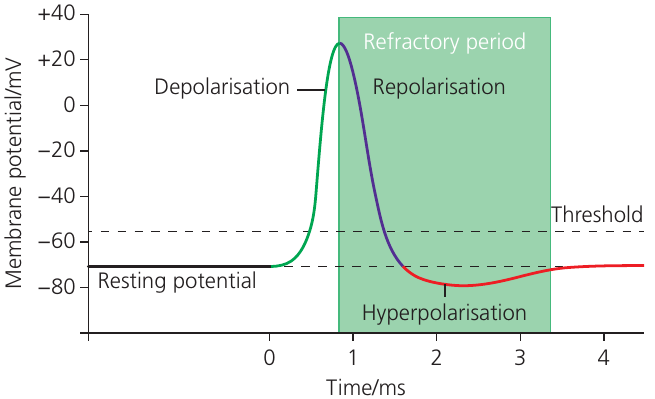
If the stimulus raises the membrane potential to approximately , this triggers wholesale opening of sodium channels, and sodium ions pour into the neurone. This demonstrates positive feedback: opening some channels causes a membrane potential rise, which opens more channels, causing further potential increases. The value that triggers this cascade is the threshold potential. Stimuli that fail to reach threshold will not generate an action potential.
Note
Understanding Positive Feedback in Action Potentials
Positive feedback is a self-amplifying process. Once enough sodium channels open to reach threshold, the resulting depolarisation causes even more channels to open, which causes more depolarisation, which opens still more channels. This cascade effect is why action potentials happen so rapidly once threshold is reached.
Once threshold is reached, so much sodium enters that the membrane potential reverses completely. The inside becomes more positive than the outside, reaching approximately . This reversal is called depolarisation, and it creates the electrical impulse that travels down the neurone.
Repolarisation
At around , sodium channels close and voltage-gated potassium channels open. Potassium ions then move out of the cell, driven by:
- The potassium concentration gradient (higher inside)
- The electrochemical gradient (now positive inside due to sodium entry)
This potassium efflux brings the potential difference back down toward resting level, a process called repolarisation.
Hyperpolarisation
Voltage-gated potassium channels remain open until the membrane potential reaches approximately — lower than the resting potential. This temporary 'overshoot' is termed hyperpolarisation.
Although the potential difference now resembles resting potential, the ionic distribution differs: excess sodium remains inside and excess potassium outside. The sodium-potassium pump and continued potassium leakage through channels restore the original resting state.
The refractory period
The refractory period is the time span during which the neurone cannot respond to a second stimulus. During this period, the voltage-gated sodium channels are recovering and cannot open again. The neurone must fully restore its resting potential and ionic balance before conducting another impulse.
Important
The Refractory Period Serves Two Critical Functions
-
Ensures unidirectional transmission: Because the region behind an action potential is in its refractory period, the impulse cannot travel backward. This guarantees impulses travel in one direction only along the axon.
-
Limits maximum firing frequency: The refractory period creates a maximum rate at which a neurone can fire action potentials, preventing continuous, uncontrolled firing.
Summary of action potential stages
| Stage | Inside membrane | Outside membrane | Potential | Sodium-potassium pump | Voltage-gated sodium channels | Voltage-gated potassium channels |
|---|---|---|---|---|---|---|
| Resting | High K⁺, low Na⁺ | Low K⁺, high Na⁺ | Working | Closed | Closed but leaking | |
| Depolarisation | High K⁺, high Na⁺ | Low K⁺, decreasing Na⁺ | to | Working | Open | Closed but leaking |
| Repolarisation | Decreasing K⁺, high Na⁺ | Increasing K⁺, relatively low Na⁺ | to | Working | Closing or closed | Open |
| Hyperpolarisation | Decreasing K⁺, Na⁺ starting to decrease | Low K⁺, Na⁺ increasing | to | Working | Closed | Closing |
The action potential in one region of the neurone acts as a stimulus for the adjacent membrane section, causing the impulse to propagate along the axon.
The all-or-nothing principle
Individual neurones cannot produce impulses of varying magnitude. This follows the all-or-nothing principle: if a stimulus reaches threshold, the neurone fires a full action potential; if the stimulus remains below threshold, no impulse occurs.
Larger stimuli do not create larger impulses. Instead, the neurone transmits information about stimulus intensity through impulse frequency — stronger stimuli cause more frequent action potentials.
Important
Individual Neurones vs Entire Nerves
The all-or-nothing principle applies to individual neurones — each one either fires fully or not at all. However, entire nerves (bundles of many neurones) can show graded responses. A stronger stimulus may activate more neurones within the nerve bundle, so while each individual neurone still follows all-or-nothing, the nerve as a whole can transmit information about stimulus strength through both frequency and the number of active neurones.
The myelin sheath and saltatory conduction
Many neurones possess axons covered by a myelin sheath, produced by Schwann cells wrapped around the axon. Most neurones lack myelin, however. Non-myelinated neurones are found in the grey matter of the central nervous system, typically where axons are short and impulses travel limited distances.
Function of the myelin sheath
The myelin sheath provides electrical insulation for the axon due to its lipid content. However, the gaps in this insulation — the nodes of Ranvier — are the key functional elements.
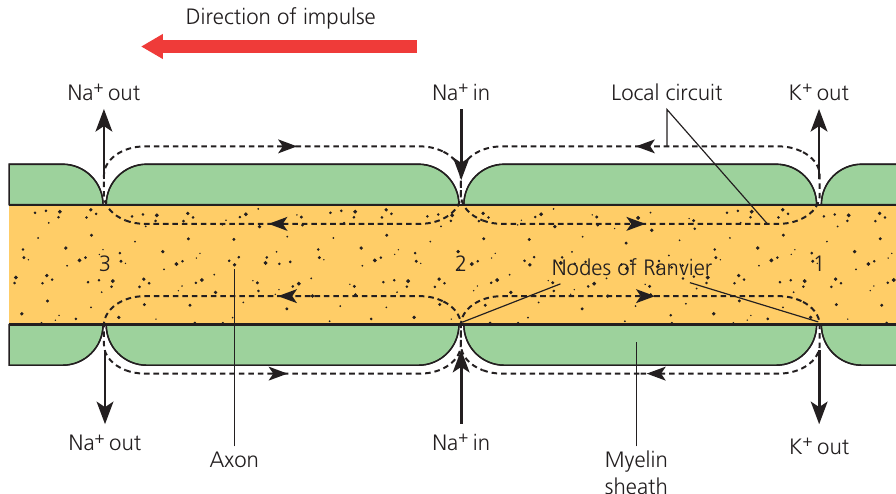
Action potentials create 'local circuits' in the axon that depolarise adjacent membrane sections. This occurs only in the forward direction because the refractory period prevents backward propagation. The process also involves attraction between oppositely charged ions on either side of the membrane in neighbouring regions.
In non-myelinated axons, impulses travel continuously along the entire axon, depolarising each section sequentially. In myelinated axons, the insulating myelin prevents depolarisation in covered regions. The action potential therefore 'jumps' from one node of Ranvier to the next.
Saltatory conduction
This 'jumping' transmission is called saltatory conduction (from the Latin saltare, meaning to jump or leap). Saltatory conduction produces much faster impulse transmission.
Note
How Much Faster?
While quantifying speed increases precisely is difficult (impulse speed also increases with axon diameter, and myelinated axons are typically thicker), myelin is estimated to speed impulse conduction by approximately 20 times compared to non-myelinated axons of similar diameter. This dramatic speed increase is why myelination is so important in neurones that need to transmit signals rapidly over long distances.
Summary
Key Points to Remember:
-
The resting potential of is maintained by the sodium-potassium pump (moving 3 Na⁺ out and 2 K⁺ in) and differential channel permeability.
-
An action potential involves three phases: depolarisation (to ), repolarisation (back toward ), and hyperpolarisation (to ), controlled by voltage-gated sodium and potassium channels.
-
The refractory period ensures unidirectional impulse transmission and limits firing frequency.
-
The all-or-nothing principle means individual neurones either fire fully or not at all; stimulus intensity is encoded by impulse frequency, not amplitude.
-
Saltatory conduction at nodes of Ranvier in myelinated neurones speeds transmission by approximately 20 times compared to non-myelinated axons.