Two Stages of Photosynthesis (OCR A-Level Biology A): Revision Notes
📚Revision Notes
Two Stages of Photosynthesis
Introduction
Photosynthesis occurs in two distinct stages: the light-dependent reactions and the light-independent reactions (Calvin cycle). The light-dependent stage captures light energy and converts it into chemical energy in the form of ATP and reduced NADP. These products then power the light-independent stage, where carbon dioxide is fixed into organic molecules. Both stages are essential and interdependent, working together to convert light energy into stable chemical energy stored in carbohydrates.
Note
The two stages of photosynthesis are completely interdependent. The light-dependent reactions produce ATP and reduced NADP, which are essential raw materials for the light-independent reactions. Without light, the Calvin cycle cannot proceed as it would run out of these vital energy carriers.
Light-dependent stage
Location and overview
Light-dependent reactions occur within photosystems located in the thylakoid membranes of chloroplasts. Photosystem II (PSII) sits on the inner membranes of granal stacks, while Photosystem I (PSI) is positioned on the outer surfaces of grana and the intergranal lamellae. These photosystems contain pigments that trap light energy and convert it into chemical energy.
The light-dependent stage involves several interconnected processes:
- Light absorption by pigment molecules in light-harvesting complexes
- Conversion of light energy into chemical energy
- Water splitting (photolysis) producing protons, electrons, and oxygen
- Electron transport through carrier molecules
- Proton pumping from stroma into thylakoid spaces
- ATP synthesis driven by a proton gradient
- Reduction of NADP to form reduced NADP
Note
Products of the light-dependent stage:
The products—ATP and reduced NADP—are then used in the light-independent reactions. Additionally, oxygen is released as a by-product of water splitting.
Light absorption and electron excitation
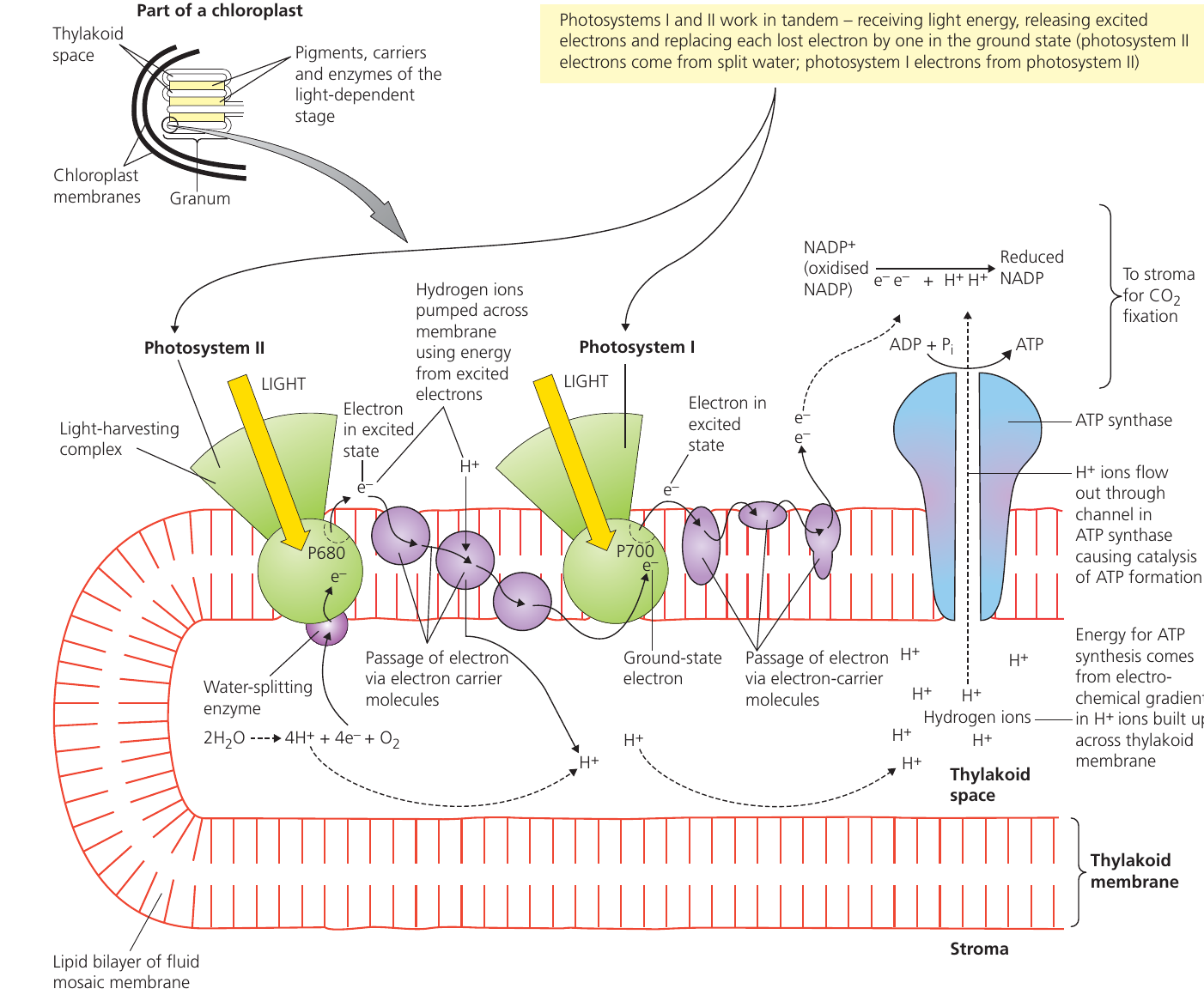
Light of various wavelengths is absorbed by pigments in the light-harvesting complexes surrounding both photosystems. This captured energy is funnelled to the reaction centre of each photosystem. In PSII, the reaction centre contains a special pair of chlorophyll a molecules called P680 (absorbs light at ). In PSI, the reaction centre is P700 (absorbs light at ).
When light energy reaches the reaction centre, it excites electrons to a higher energy level, providing sufficient energy for them to leave the chlorophyll molecule entirely. These high-energy electrons are then accepted by electron carrier molecules embedded in the thylakoid membrane.
Photolysis of water
The reaction centre of PSII catalyses the splitting of water molecules in a light-dependent process called photolysis. This reaction only occurs in the presence of light and is catalysed by a water-splitting enzyme associated with PSII.
This reaction serves three essential functions:
- Supplies electrons to replace those lost from PSII
- Provides protons ( ions) for the thylakoid space proton pool
- Releases oxygen as a by-product
Electron transport and energy release
As electrons pass from one carrier molecule to another along the electron transport chain, they undergo oxidation-reduction reactions. When an electron leaves a carrier, that carrier is oxidised; when a carrier accepts an electron, it becomes reduced (remember: OILRIG – Oxidation Is Loss, Reduction Is Gain).
Energy is released in small quantities as electrons move between carriers. This energy is not wasted—it drives the active transport of protons from the stroma into the thylakoid space, working against their concentration gradient.
Note
The electron carriers are protein-based molecules with iron-containing groups, structurally similar to cytochrome carriers found in mitochondrial respiration.
Chemiosmosis and ATP synthesis
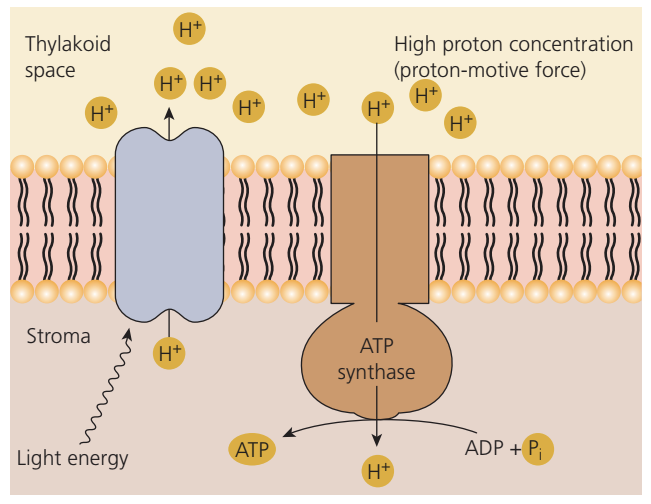
Chemiosmosis is the production of ATP using the flow of protons through ATP synthase enzymes across the thylakoid membranes in photosynthesis.
As protons are actively pumped into the thylakoid space, they accumulate and create a concentration gradient. The pH inside the thylakoid space drops to approximately , while the stroma remains at approximately . This creates both a concentration gradient and an electrical gradient (together forming an electrochemical gradient or proton-motive force).
Important
The thylakoid membrane is impermeable to protons except through channels in ATP synthase molecules. This selective permeability is crucial for maintaining the proton gradient that drives ATP synthesis.
Protons flow down their electrochemical gradient through ATP synthase by facilitated diffusion. As they pass through, part of the ATP synthase protein rotates, and this mechanical energy drives the phosphorylation of ADP:
Non-cyclic photophosphorylation
Photophosphorylation is the formation of ATP using light energy. In non-cyclic photophosphorylation, both photosystems work in sequence, and electrons flow in a linear pathway from water to NADP.
The sequence of events:
- Light energy excites electrons in PSII (P680), raising them to a high energy level
- Excited electrons leave PSII and are accepted by the first electron carrier
- Electrons lost from PSII are replaced by those released from photolysis of water
- Electrons pass along the electron transport chain, releasing energy used to pump protons into the thylakoid space
- Electrons reach PSI with reduced energy
- Light energy absorbed by PSI (P700) re-energises the electrons
- Excited electrons leave PSI and pass to another electron carrier
- Electrons move to NADP, which accepts two electrons along with two protons from the stroma
- NADP reductase (located on the outer surface of the thylakoid membrane) catalyses the reduction of NADP:
- ATP is synthesised via chemiosmosis as protons flow through ATP synthase
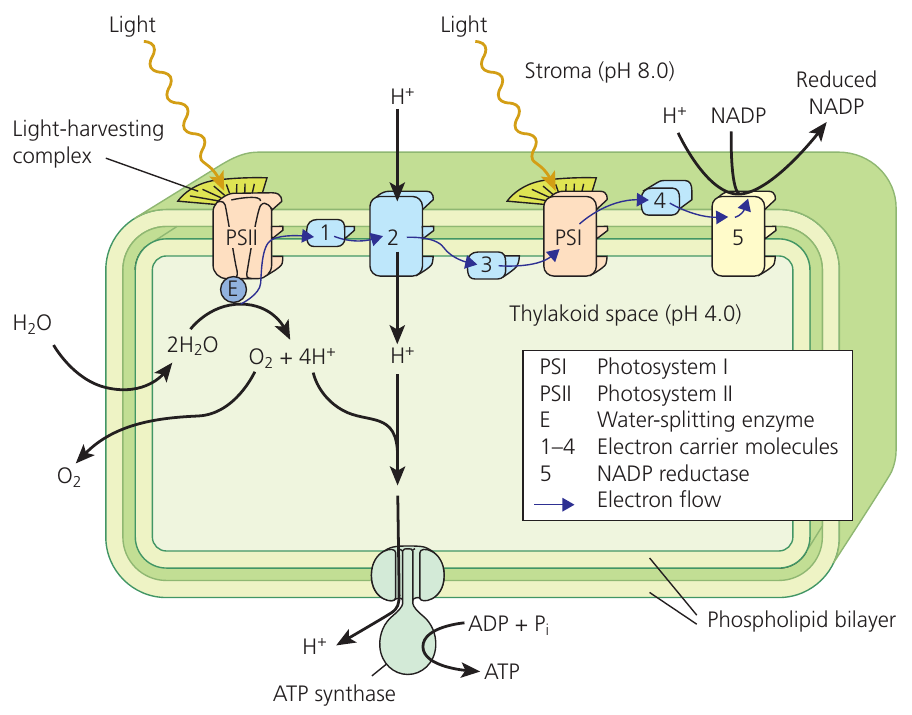
The complete pathway from water to NADP is often represented as a Z-scheme, which shows energy levels of electrons rising as they absorb light energy and falling as they release energy during electron transport.
Note
Products of non-cyclic photophosphorylation:
- ATP
- Reduced NADP
- Oxygen (from photolysis)
Cyclic photophosphorylation
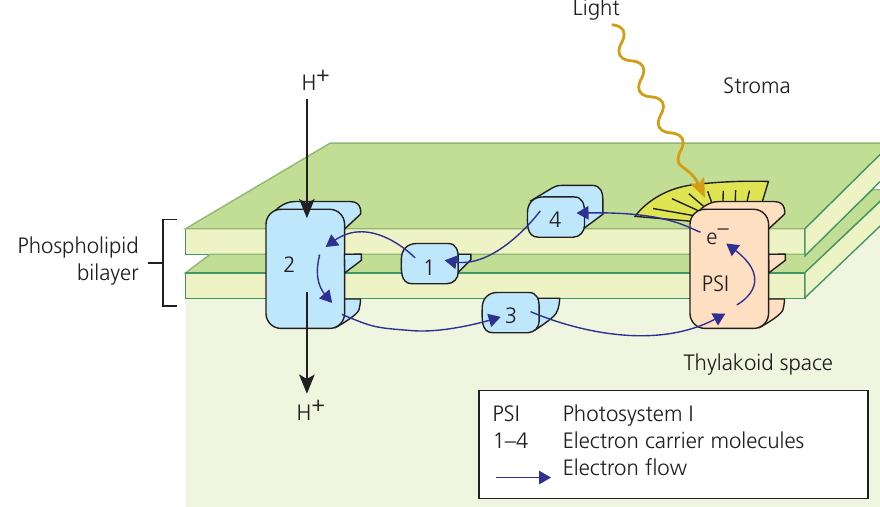
Cyclic photophosphorylation involves only PSI. Electrons excited by light energy leave PSI, pass along a short electron transport chain, and then return to the same PSI chlorophyll molecule from which they originated—hence the term "cyclic."
Key differences from non-cyclic photophosphorylation:
- Only PSI is involved (PSII is not used)
- No photolysis of water occurs
- No NADP is reduced
- Electrons cycle back to P700 in PSI
- Only ATP is produced
Note
This pathway allows the plant to generate additional ATP without producing reduced NADP or oxygen. This is useful when the Calvin cycle requires more ATP than reduced NADP.
Comparison of cyclic and non-cyclic photophosphorylation
| Feature | Cyclic photophosphorylation | Non-cyclic photophosphorylation |
|---|---|---|
| Photosystems involved | PSI only | PSI and PSII |
| Photolysis of water | Does not occur | Occurs |
| Electron donor | P700 in PSI | Water |
| Final electron acceptor | P700 in PSI | NADP |
| Products | ATP | ATP, reduced NADP, and oxygen |
Light-independent stage (Calvin cycle)
Location and overview
The light-independent reactions occur in the stroma of chloroplasts. Although called "light-independent," this stage depends indirectly on light because it requires ATP and reduced NADP from the light-dependent reactions. Without a continued supply of these products, the Calvin cycle cannot proceed.
This stage was discovered by Melvin Calvin, who used radioactive carbon dioxide () and unicellular algae to trace the pathway of carbon fixation.
The role of carbon dioxide and Rubisco
Carbon dioxide enters leaves through stomatal pores, dissolves in water, and diffuses into mesophyll cells and then into chloroplasts. In the stroma, is fixed (incorporated into organic molecules) by the enzyme Rubisco (ribulose bisphosphate carboxylase oxygenase).
Important
Rubisco is the enzyme involved in fixing carbon dioxide, a process known as carboxylation. Despite its long formal name, it is commonly called Rubisco and is one of the most abundant proteins on Earth. This abundance reflects its critical role in carbon fixation for virtually all life on Earth.
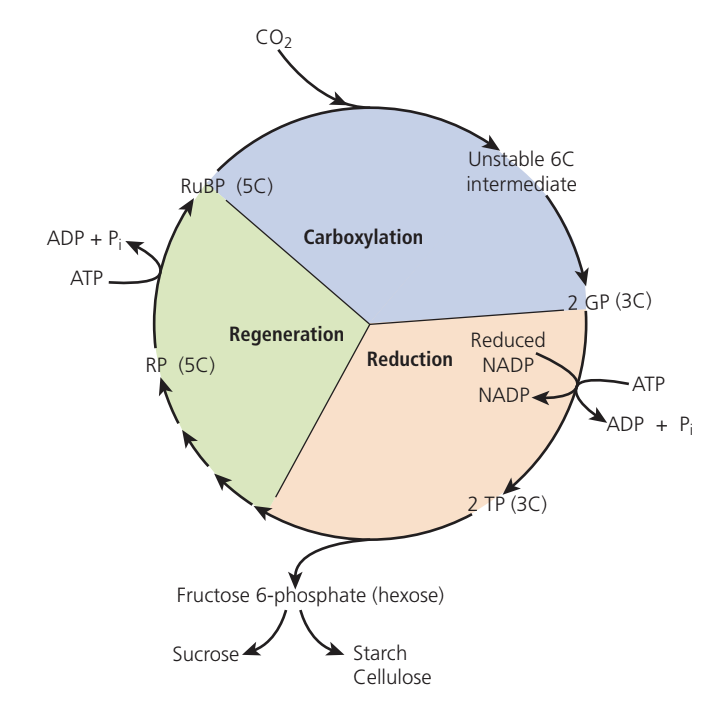
The Calvin cycle: carboxylation phase
The cycle begins with carbon fixation:
- Rubisco catalyses the combination of (1-carbon) with ribulose bisphosphate (RuBP), a 5-carbon molecule
- An unstable 6-carbon intermediate is formed
- This immediately breaks down into two molecules of glycerate 3-phosphate (GP), each containing 3 carbons
This step is called carboxylation because carbon dioxide has become fixed into an organic molecule.
Example
Worked Example: Carboxylation Phase
Starting materials:
- 1 molecule of (1 carbon)
- 1 molecule of RuBP (5 carbons)
Process:
- + RuBP → unstable 6-carbon intermediate
Products:
- 2 molecules of GP (3 carbons each)
- Total: 6 carbons (conserved from reactants)
The Calvin cycle: reduction phase
Both GP molecules are now reduced in a two-step process:
- Reduced NADP donates hydrogen atoms to GP (NADP becomes re-oxidised)
- ATP is hydrolysed to ADP P, releasing energy
- The energy and hydrogen convert GP into triose phosphate (TP), a 3-carbon sugar
Important
For every molecule fixed, one ATP and one reduced NADP are consumed. This demonstrates the direct link between the two stages of photosynthesis.
The Calvin cycle: regeneration phase
Most of the TP produced must regenerate RuBP to keep the cycle running:
- Five-sixths () of TP is used to regenerate RuBP
- This regeneration requires ATP (from the light-dependent stage)
- For every three molecules fixed, three RuBP molecules are regenerated from five TP molecules
Products and their uses
One-sixth () of the TP produced is available to form useful organic molecules:
- Hexose phosphates (6-carbon sugars) are formed by combining two TP molecules
- These hexoses can be converted into:
- Sucrose for transport throughout the plant
- Starch for energy storage in plastids
- Cellulose for cell wall construction
Additionally, TP can be exported from the chloroplast to the cytosol where it serves as a precursor for:
- Lipids (fatty acids and glycerols)
- Amino acids (by combining with ammonia or amine groups in a process called amination)
Photorespiration
Rubisco evolved when atmospheric oxygen concentrations were much lower than today. Consequently, it can catalyse reactions with both and . Under normal conditions with high in the chloroplast stroma, Rubisco primarily fixes carbon dioxide.
Note
When does photorespiration occur?
In hot conditions:
- concentrations decrease (due to stomatal closure reducing water loss)
- concentrations increase (from the light-dependent reactions)
- Oxygen competes with for Rubisco's active site
- This reduces carbon fixation efficiency—a process called photorespiration
Photorespiration is generally wasteful as it consumes energy without producing useful products.
Remember!
Summary
Key Points to Remember:
-
The light-dependent stage occurs in thylakoid membranes and converts light energy into chemical energy (ATP and reduced NADP), releasing oxygen from water splitting.
-
Non-cyclic photophosphorylation involves both photosystems in sequence (PSII → PSI) and produces ATP, reduced NADP, and oxygen, while cyclic photophosphorylation uses only PSI and produces ATP alone.
-
Chemiosmosis drives ATP synthesis as protons flow down their electrochemical gradient through ATP synthase, with the thylakoid space maintaining a much lower pH () than the stroma ().
-
The light-independent stage (Calvin cycle) occurs in the stroma and uses ATP and reduced NADP to fix into organic molecules through three phases: carboxylation (catalysed by Rubisco), reduction (forming TP), and regeneration (reforming RuBP).
-
For every six molecules fixed, five-sixths of the resulting TP regenerates RuBP while one-sixth forms glucose and other organic molecules essential for plant growth and metabolism.