Plant Hormones (OCR A-Level Biology A): Revision Notes
📚Revision Notes
Plant Hormones
Introduction to plant hormones
Plants produce chemical messengers that regulate various aspects of growth and development. These substances are called plant hormones or plant growth regulators.
Note
Plant hormones differ from animal hormones in several important ways:
- They are not synthesised in specific organs, though production may occur in restricted regions
- They are produced by unspecialised cells
- Their effects vary depending on circumstances
Plant hormones coordinate responses including:
- Tropisms (directional growth responses)
- Leaf abscission
- Stomatal closure
- Seed germination
- Flowering and fruit formation
- Fruit ripening
Auxins
The phototropic mechanism
Phototropism is coordinated by the plant hormone indole-3-acetic acid (IAA), which belongs to a group of hormones called auxins. Auxins influence gene expression by switching certain genes on and others off.
IAA is synthesised in the meristem and moves down the stem to stimulate extension growth. It works by activating proteins called expansins in the cell wall. Expansins increase cell wall flexibility by loosening bonds between cellulose fibres, enabling shoots to elongate.
Important
When light illuminates a shoot tip from one side, auxin redistributes to the far side away from the light source. Cells on the shaded side elongate more than those on the illuminated side, causing the tip to bend towards the light.
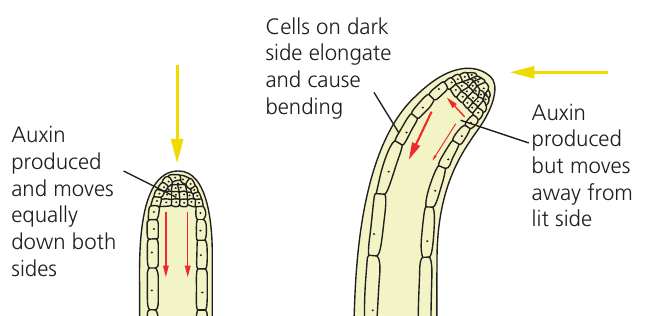
The precise mechanism of auxin transport across the tip remains under investigation. However, genetic studies on Arabidopsis thaliana have identified specialised channel proteins that appear to transport auxin across cell membranes.
Experimental evidence for auxin redistribution
Example
Worked Example: Testing Auxin Redistribution
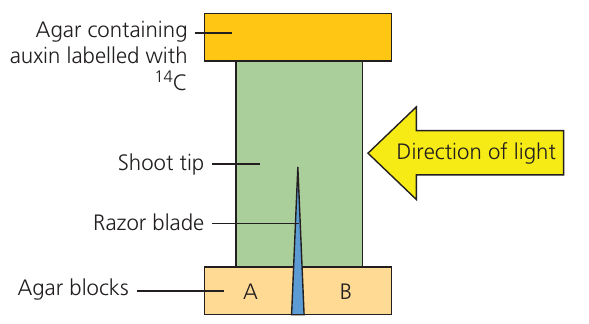
An experiment tested the hypothesis that unilateral illumination causes auxin to move to the dark side of a shoot tip.
Method:
- Oat seedling coleoptiles ( long) were cut and their lower ends separated by a razor blade
- Radioactively labelled auxin (containing ) was placed on the tip in an agar block
- The experiment used shoot tips illuminated by a bulb for seconds
- The experiment was repeated four times with randomised light direction
- Temperature was maintained between and
Results:
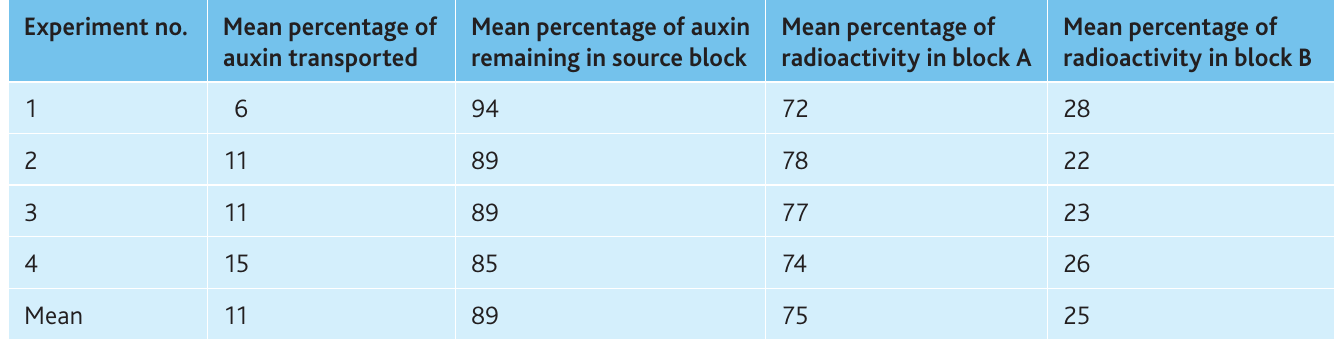
Radioactivity levels were measured in the source block and collection blocks A and B (where block A represents the side furthest from the light).
Conclusion: The results show that approximately 75% of transported auxin accumulated in block A (dark side), whilst only 25% remained in block B (light side). This provides strong evidence that auxin moves laterally away from the light source.
Geotropism in shoots and roots
Negative geotropism in plant stems results from auxin accumulation on the lower side. H.E. Dolk demonstrated this by growing coleoptiles horizontally until they showed a geotropic response. He then decapitated them and placed the tips laterally on agar blocks divided by a razor blade.
Measurements revealed significantly more auxin in the lower block than the upper block. Gravity appears to modify auxin distribution, causing accumulation on the lower side and increasing growth rate there.
Important
Key Difference in Geotropic Responses:
Positive geotropism in roots involves similar auxin distribution but produces the opposite response. Higher auxin concentrations inhibit root cell growth, causing the root tip to grow downwards, whereas the same concentrations promote shoot cell growth, causing shoots to grow upwards.
Apical dominance
Auxins produced at the apex (growing point) of a plant stem not only promote upward growth but also inhibit lateral bud development. This phenomenon is called apical dominance.
Note
Upward growth towards light is generally advantageous as it increases photosynthesis capacity. Sideways growth provides less benefit, so auxins ensure preferential upward growth. However, if the apex is removed (e.g., by herbivore grazing), the loss of auxin allows lateral buds to grow. These lateral shoots then curve towards light, continuing upward plant growth.
Experimental evidence demonstrates this effect: removing the apical bud allows lateral buds to grow, but immediately replacing the cut tip with an auxin-containing agar block restores lateral bud inhibition.
Gibberellins
Gibberellins are another group of plant hormones involved in growth regulation. They are produced in young leaves, seeds, and root tips.
Functions of gibberellins include:
- Stimulating seed germination
- Promoting stem elongation
- Triggering flowering
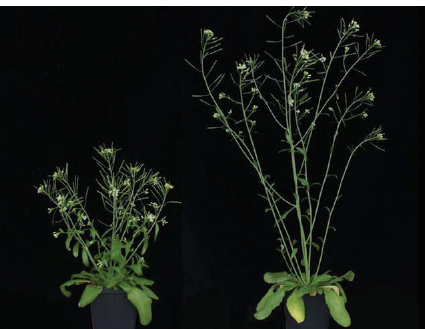
Dwarf plant varieties have very low gibberellin levels. Treating them with gibberellins causes them to grow to normal height, demonstrating the hormone's role in plant stature.
Note
Gibberellins and auxins work together in a synergistic manner to stimulate stem growth. Synergism describes a relationship where the combined effect of two factors exceeds the sum of their individual effects. Like auxins, gibberellins stimulate cell elongation, but they also promote cell division.
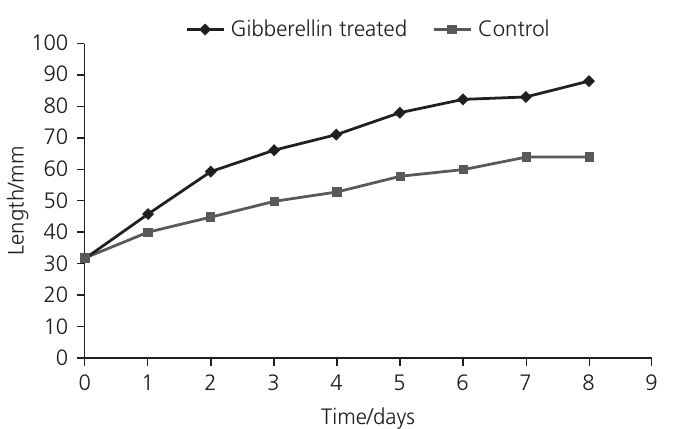
The graph shows that gibberellin-treated dwarf pea plants reached approximately after days, whilst control plants only achieved around – demonstrating the significant growth-promoting effect of gibberellins.
Hormones and leaf loss
Deciduous plants shed leaves during hot, dry conditions to reduce water loss. In temperate climates, leaf loss also occurs in winter when water absorption from frozen soils is difficult and photosynthesis is limited by low temperatures and reduced light.
Important
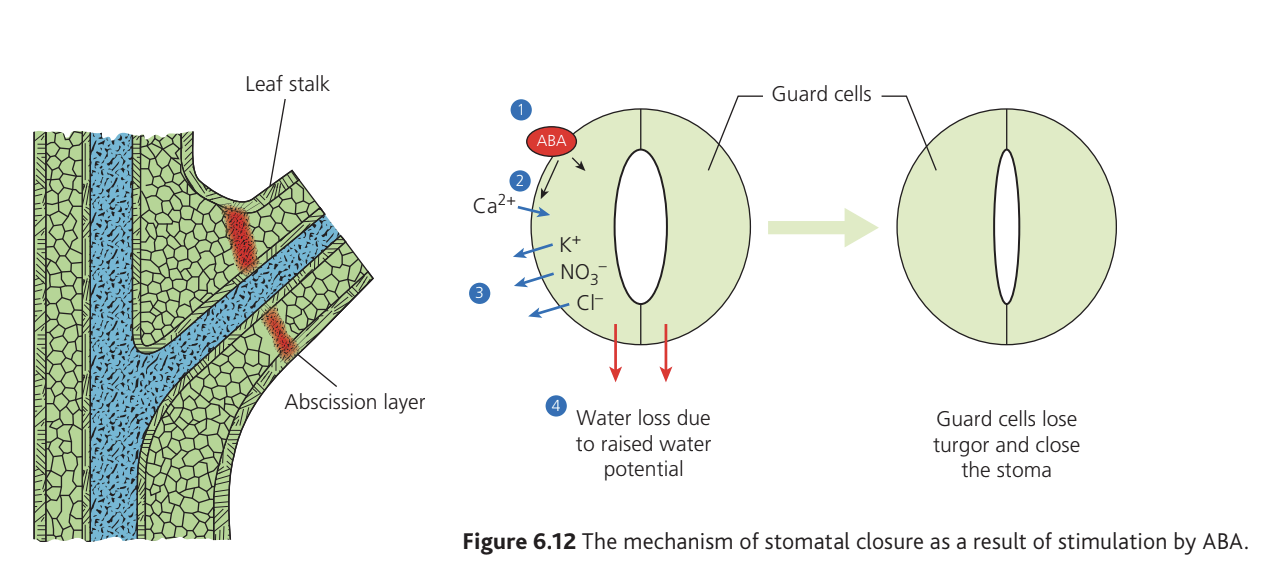
Hormones control this process, triggered in temperate regions by decreasing day length in autumn. Leaf loss occurs through development of an abscission layer at the leaf stalk base. This layer consists of parenchyma cells with thin walls, making them weak and easily broken.
The hormone ethene stimulates cell wall breakdown in the abscission layer, causing leaf detachment. Auxins also influence leaf loss – they normally inhibit abscission and are produced by young leaves, making leaf stalks insensitive to ethene. As leaves age, auxin concentration decreases, permitting ethene to trigger leaf loss.
Hormones and stomatal closure
Abscisic acid (ABA) regulates stomatal closure by guard cells. When soil dries out (decreased soil water potential), roots produce ABA which translocates to leaves, affecting guard cells. Guard cells lose water and turgor, causing stomata to close.
Example
Worked Example: The ABA Stomatal Closure Mechanism
The mechanism involves four sequential steps:
Step 1: ABA binds to receptors on guard cell surface membranes
Step 2: This triggers events opening calcium channels, allowing ions to enter whilst cytoplasm pH rises
Step 3: These changes cause , , and ions to leave the cell
Step 4: The resulting increased water potential causes water to move by osmosis into surrounding cells; turgor loss closes the stomata
Hormones and seed germination
Seed germination is a complex process involving food reserve mobilisation and growth promotion. Environmental factors like temperature and water availability are important, but many seeds possess dormancy mechanisms preventing germination even under favourable conditions.
Dormancy is a state where seeds will not germinate (despite suitable conditions) until receiving a specific environmental stimulus. Several plant hormones regulate germination, with gibberellins, abscisic acid, and auxins being most important.
Role of gibberellins
Gibberellins stimulate germination and break dormancy. Evidence includes:
- Mutant Arabidopsis strains producing no gibberellins can germinate if treated with gibberellins
- Grand Rapids lettuce seeds normally requiring light will germinate in darkness when treated with gibberellins
- In cereals (wheat and barley), gibberellins from the embryo travel to the aleurone layer (cells surrounding the endosperm), causing it to produce amylase
Amylase breaks down stored starch into sugar, providing energy for embryo growth and breaking dormancy.
The hormonal balance
Important
Abscisic acid has the opposite role, maintaining dormancy by inhibiting amylase production. The balance between gibberellins and abscisic acid determines when germination begins.
Note
Auxins are produced early in germination to stimulate cell growth, but this effect depends on auxin concentration (higher concentrations inhibit germination). Auxin and abscisic acid actions are interrelated, with the final outcome depending on hormone balance.
Commercial use of plant hormones
Since hormones control plant growth and development, they have numerous commercial applications:
Auxins as selective weed killers: Although auxins normally promote growth, high concentrations cause excessively rapid growth that distorts tissues (especially roots), creating damage and pathogen entry points. Synthetic auxins like are used at concentrations times higher than natural levels. This is particularly useful for cereal fields and lawns because grasses are far less sensitive than broadleaved weeds, so the treatment selectively kills weeds whilst leaving grass unharmed.
Note
Stimulating root growth: Lower auxin doses stimulate root growth in cuttings. They are commercially available as rooting powders.
Note
Fruit ripening: Ethene stimulates fruit ripening, which is useful for delicate fruits prone to transport damage (e.g., bananas and tomatoes). Fruits can be harvested unripe and harder, then transported and artificially ripened using ethene during transit or at destination.
Note
Seedless fruit production: Auxins and gibberellins can treat unpollinated flowers, causing fruit development. This produces seedless fruits (e.g., grapes). Fruits formed without fertilisation are called parthenocarpic fruits.
Note
Preventing fruit drop: Auxins inhibit both leaf and fruit abscission. In orchards, fallen fruit becomes unusable as it rapidly rots on the ground. Spraying auxins on fruit prevents premature dropping.
Summary
Key Points to Remember:
- Plant hormones are chemical messengers produced by unspecialised cells that coordinate growth and development responses
- Auxins (like IAA) cause phototropism by redistributing to the shaded side of shoots, promoting cell elongation through expansin activation
- Gibberellins work synergistically with auxins to promote stem growth and seed germination whilst breaking dormancy
- ABA triggers stomatal closure by causing ion movement out of guard cells, reducing turgor
- Plant hormones have extensive commercial applications including selective weed control, rooting stimulation, fruit ripening, and seedless fruit production