Types of Plant Response (OCR A-Level Biology A): Revision Notes
📚Revision Notes
Types of Plant Response
Plants interact continuously with their environment, detecting and responding to various stimuli. Unlike animals that can move freely, plants are sessile organisms that respond primarily through growth and physiological changes. These responses have evolved to maximise survival by helping plants access essential resources such as light, water, and nutrients, whilst also defending against threats.
Understanding plant responses
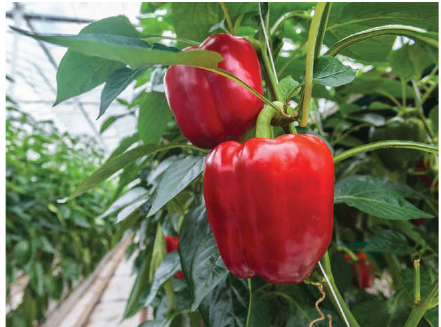
Plant responses can be categorised according to the type of stimulus they detect. Stimuli may be abiotic (non-living environmental factors) or biotic (living organisms). The nature of the response varies depending on whether the stimulus has a directional component.
Note
The key distinction between abiotic and biotic stimuli helps us understand how plants have evolved different response mechanisms for physical environmental factors versus interactions with living organisms. Both types of stimuli require specific detection and response systems within the plant.
Abiotic vs biotic stimuli
Abiotic stimuli include light, gravity, moisture, temperature, and chemicals in the soil. These are physical or chemical features of the environment that influence plant growth and development.
Biotic stimuli involve interactions with other organisms, such as herbivores feeding on plant tissue, pathogens causing disease, or insects visiting flowers for pollination.
Tropisms
Important
A tropism is a directional growth response to a stimulus. The direction of growth is determined by the direction from which the stimulus originates.
Tropisms can be:
- Positive – growth towards the stimulus
- Negative – growth away from the stimulus
Plants exhibit several types of tropism, each providing specific adaptive advantages.
Phototropism
Phototropism is a growth response to light. Plant shoots are positively phototropic, meaning they grow towards a light source. This behaviour ensures that leaves receive maximum light exposure for photosynthesis. When a plant grows in shade, phototropism drives the shoot to grow towards brighter areas.
Roots show weak negative phototropism, but this response is typically overridden by their stronger geotropic behaviour.
Geotropism
Geotropism (also called gravitropism) is a response to gravity. Shoots exhibit negative geotropism, growing upwards against the gravitational pull, whilst roots show positive geotropism, growing downwards. This ensures correct orientation during germination regardless of the seed's position in the soil.
Hydrotropism
Hydrotropism is a response to moisture gradients in the soil. Root tips grow towards areas of higher water availability, improving the plant's access to water for uptake and transport.
Thigmotropism
Thigmotropism is a response to physical contact or touch. This is particularly important for climbing plants, which use thigmotropism to detect solid supports and then curl their stems or tendrils around them. This allows the plant to grow upwards towards light without investing resources in thick, self-supporting stems.
Chemotropism
Chemotropism is a growth response to chemical gradients. A clear example occurs during fertilisation in flowering plants: pollen tubes grow down through the style towards the ovules in the ovary, guided by chemical signals released by the ovules.
Nastic movements
Important
Nastic movements are responses to stimuli that are non-directional. Unlike tropisms, the direction of the response does not depend on the direction of the stimulus. Many nastic movements involve rapid changes in cell turgidity rather than growth.
Mimosa pudica
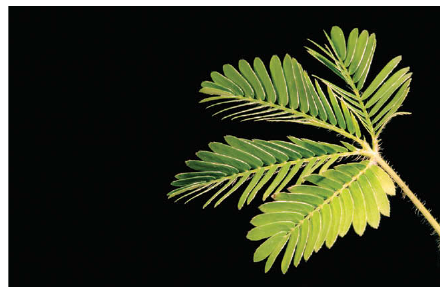
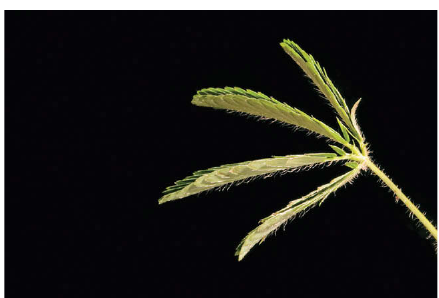
The sensitive plant Mimosa pudica demonstrates rapid thigmonastic movement. When its leaves are touched, the leaflets fold inward very quickly.
Note
This response is caused by rapid changes in water distribution within specialised cells at the base of each leaflet. Some cells rapidly take up water and expand, whilst adjacent cells lose water and collapse. The result is rapid folding of the leaflets.
Importantly, this movement is controlled by local bioelectrical signals transmitted through the plant tissue, not by plant hormones (which would act too slowly for such rapid responses).
The adaptive significance may include:
- Startling or deterring herbivorous insects
- Reducing water loss through transpiration when environmental conditions change
- Protecting delicate leaf tissue
Venus flytrap
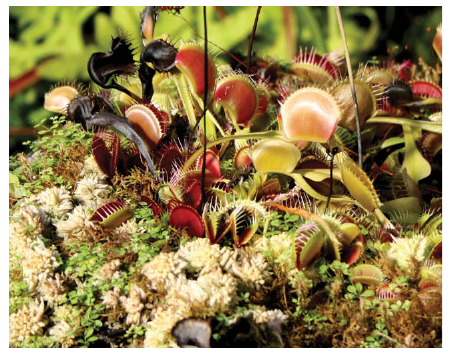
Another example of nastic movement with clear survival value is the Venus flytrap (Dionaea muscipula). When trigger hairs inside the trap are stimulated by an insect, the two lobes of the leaf snap shut rapidly. The trapped insect is then digested, providing the plant with organic nitrogen and other minerals that are scarce in its native acidic, nutrient-poor soil.
Responses to herbivory
Herbivory refers to the consumption of plant tissue by herbivores. It is analogous to predation in animals. Plants have evolved various chemical defences to deter herbivores or reduce the damage they cause. Some defensive chemicals are produced constitutively (always present), whilst others are induced by damage or stress.
Tannins
Tannins are water-soluble carbon-based compounds belonging to a group called flavonoids. They accumulate in the vacuoles of plant cells and have several defensive properties:
- They are toxic to insects, reducing herbivore populations
- They have a bitter taste, making plant tissue unpalatable
- They can be fatal to certain insects
Note
Originally, it was believed that tannins worked by inhibiting digestive protease enzymes in the insect gut. However, more recent research suggests that the toxic effect arises from the breakdown products of tannins, which produce harmful chemicals.
Alkaloids
Alkaloids are nitrogenous organic compounds derived from amino acids. Like tannins, they are bitter-tasting and often toxic. Common examples include:
- Caffeine – produced by tea, cocoa, and coffee plants; toxic to insects and fungi
- Nicotine – found in tobacco but also in tomatoes, potatoes, aubergines, and peppers; a potent neurotoxin (a chemical that interferes with nerve impulse transmission) that can be lethal to insects
- Capsaicin – produced in chilli peppers; creates a burning sensation that deters herbivores
These compounds provide effective chemical defences whilst allowing the plant to continue photosynthesis and growth.
Pheromones
Pheromones are signalling chemicals released by one individual that affect the physiology or behaviour of other individuals of the same species.
Ethene (also called ethylene) is a gaseous plant pheromone with multiple roles:
- Promotes fruit ripening in nearby plants
- Triggers leaf abscission (leaf fall)
- Coordinates other physiological changes
Note
In terms of defence, ethene plays a key regulatory role. Oxides of ethene are directly toxic to insects. More importantly, ethene acts as a hormone that activates genes responsible for producing other defensive chemicals, effectively switching on the plant's chemical defence system in response to herbivore attack.
Responses to abiotic stress
Plants face various forms of abiotic stress, including freezing temperatures, drought, increased soil salinity, and the presence of heavy metals. Plants have evolved physiological responses to cope with these challenges.
Drought stress
In response to water scarcity, plants may:
- Close stomata to reduce transpirational water loss
- Shed leaves entirely to minimise water loss
Freezing stress
Some plants produce chemicals that act like antifreeze. These compounds lower the freezing point of cellular fluids, making it harder for ice crystals to form. This is crucial because ice crystal formation physically damages cell membranes and organelles, often fatally.
Other abiotic stresses
Plants also respond to increased salinity and the presence of toxic heavy metals, though the mechanisms vary between species and are often complex.
Phototropism in plant shoots
Shoots exhibit positive phototropism, growing towards light to maximise photosynthetic capacity. Understanding the mechanism of phototropism developed gradually through a series of landmark experiments conducted over several decades.
Many experiments used coleoptiles – protective sheaths that surround the emerging shoot in grass seedlings – as convenient experimental material.
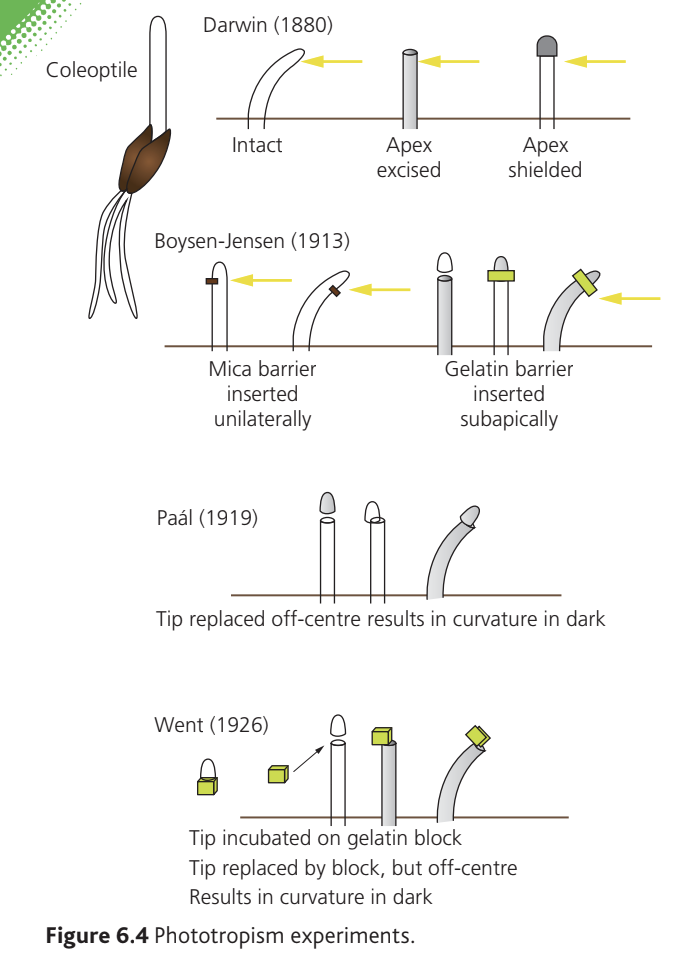
Darwin's experiment (1880)
Charles Darwin investigated which part of the coleoptile detected light.
Example
Darwin's Phototropism Investigation
Experiment 1 - Tip removal:
- When the coleoptile tip was cut off, the plant no longer bent towards unilateral light
Experiment 2 - Tip covering:
- When the tip was covered with an opaque cap, the phototropic response was also prevented
Conclusion: These results indicated that the tip of the coleoptile is the site of light detection, even though the bending response occurs lower down the shoot.
Boysen-Jensen's experiment ()
Boysen-Jensen conducted experiments to determine how the signal travelled from the tip to the region of bending.
Example
Boysen-Jensen's Signal Transmission Investigation
Experiment 1 - Gelatin barrier:
- A cut coleoptile tip was replaced with a thin gelatin barrier inserted between the tip and the rest of the shoot
- The phototropic response still occurred
- Since gelatin is permeable to chemicals, this suggested that the signal was a chemical substance (a hormone)
Experiment 2 - Mica barrier:
- Mica is impermeable to chemicals
- When a mica barrier was inserted halfway through the coleoptile:
- On the illuminated side: phototropism still occurred
- On the shaded side: phototropism was prevented
Conclusion:
- The signal is a chemical that diffuses down the shaded side of the shoot
- Growth is stimulated on the shaded side (rather than inhibited on the lit side)
Paál's experiment ()
Paál tested whether the chemical signal could cause growth in the absence of light.
Example
Paál's Growth Hormone Investigation
Experimental approach:
- Cut off coleoptile tips and replaced them off-centre in darkness
- The side with the tip grew more than the opposite side, causing the coleoptile to bend
Conclusion: This confirmed that a hormone diffuses from the tip through plant tissue and directly stimulates cell elongation and growth.
Went's experiment ()
Went quantified the relationship between hormone concentration and growth response.
Example
Went's Quantitative Hormone Investigation
Experimental procedure:
- He placed cut coleoptile tips onto gelatin blocks, allowing the hormone to diffuse into the gelatin
- These gelatin blocks were then placed off-centre on decapitated coleoptiles in darkness
- The coleoptiles bent towards the side without the block
Key finding: By varying the number of tips placed on the gelatin block, Went altered the hormone concentration. He found a positive correlation between hormone concentration and the degree of curvature.
Conclusion: This experiment provided quantitative evidence for the hormone theory and established that the magnitude of the response depends on hormone concentration.
Key conclusions from phototropism experiments
Important
The historical experiments established several important principles:
- The coleoptile tip detects the light stimulus
- A chemical signal (hormone) is produced in the tip
- The hormone diffuses down the shaded side of the shoot
- The hormone stimulates cell elongation, causing differential growth
- Greater hormone concentration produces greater curvature
- The hormone responsible was later identified as auxin
Remember!
Summary
Key Points to Remember:
-
Tropisms are directional growth responses; nastic movements are non-directional responses often involving rapid changes in cell turgidity
-
The five main tropisms are phototropism, geotropism, hydrotropism, thigmotropism, and chemotropism – each provides specific adaptive advantages
-
Plants defend against herbivory using chemicals such as tannins (flavonoids stored in vacuoles), alkaloids (nitrogenous compounds like caffeine and nicotine), and pheromones (like ethene)
-
Abiotic stress responses include stomatal closure during drought and antifreeze chemical production during freezing
-
Classical phototropism experiments by Darwin, Boysen-Jensen, Paál, and Went established that a chemical hormone produced in the shoot tip diffuses down the shaded side and stimulates cell elongation