Anaerobic Respiration (OCR A-Level Biology A): Revision Notes
📚Revision Notes
Anaerobic Respiration
Introduction to anaerobic respiration
Anaerobic respiration is the process of releasing energy from organic molecules without the presence of oxygen. When oxygen is unavailable, it cannot act as the final electron acceptor in the electron transport chain, causing this pathway to halt. This stoppage has a cascade effect:
Note
What happens when oxygen is unavailable:
- The electron transport chain cannot function
- Reduced NAD and reduced FAD accumulate
- The Krebs cycle stops due to the lack of oxidised NAD and FAD
- The link reaction also stops for the same reason
- Only glycolysis can continue
However, even glycolysis faces a limitation — it produces reduced NAD, which must be regenerated to NAD or the pathway will stop entirely. The regeneration of NAD is therefore essential for continued ATP production under anaerobic conditions.
Important
Critical Point: NAD Regeneration
Without a mechanism to regenerate NAD, even glycolysis would come to a halt. This is why cells have evolved fermentation pathways — not primarily to produce ATP, but to recycle NAD and keep glycolysis running when oxygen is unavailable.
In eukaryotic cells, there are two main types of anaerobic respiration that regenerate NAD:
- Lactate fermentation — occurs in animal muscle cells
- Ethanol fermentation — occurs in yeast, fungi, and plant cells
Both pathways allow glycolysis to continue by recycling NAD, but neither produces any additional ATP beyond that generated by glycolysis itself. Therefore, the net ATP yield from anaerobic respiration is just ATP molecules per glucose molecule, produced by substrate-level phosphorylation during glycolysis.
Lactate fermentation
Lactate fermentation takes place in rapidly respiring muscle cells, particularly during intense physical exercise. When muscles are working hard, oxygen cannot be delivered quickly enough to meet the high energy demands. Under these circumstances, anaerobic respiration provides a rapid — though temporary — ATP supply for explosive bursts of activity.
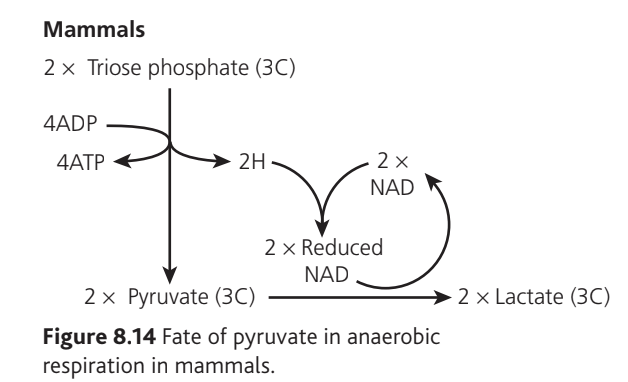
The lactate fermentation pathway
The biochemical steps of lactate fermentation are as follows:
Example
Worked Example: The Lactate Fermentation Pathway
Step 1: Glycolysis produces reduced NAD, ATP, and pyruvate
Step 2: Pyruvate acts as a hydrogen acceptor, receiving hydrogen atoms from reduced NAD
Step 3: The enzyme lactate dehydrogenase catalyses the reduction of pyruvate to lactate (lactic acid)
Step 4: Simultaneously, reduced NAD is oxidised back to NAD
Step 5: The regenerated NAD can now be reused in glycolysis, allowing the pathway to continue
Consequences and recovery
During intense exercise, lactate accumulates in muscle cells. If this accumulation continues, the resulting decrease in pH inhibits muscle function, causing fatigue and discomfort. This is why sustained high-intensity exercise becomes difficult.
Note
Understanding Oxygen Debt
After exercise stops, an oxygen debt must be repaid. This is achieved through deep breathing, which supplies the oxygen needed to convert lactate back into pyruvate in the liver. This is why you continue breathing heavily even after you stop running!
After the exercise stops, an oxygen debt must be repaid. This is achieved through deep breathing, which supplies the oxygen needed to convert lactate back into pyruvate in the liver. The pyruvate can then:
- Re-enter the respiratory cycle via the link reaction
- Be converted back to glucose and stored as glycogen
Until sufficient oxygen has been consumed to clear the lactate, further rapid exercise is impaired.
Ethanol fermentation
Ethanol fermentation occurs in yeast and some plant cells when oxygen is insufficient for aerobic respiration. Like lactate fermentation, it regenerates NAD to allow glycolysis to continue.
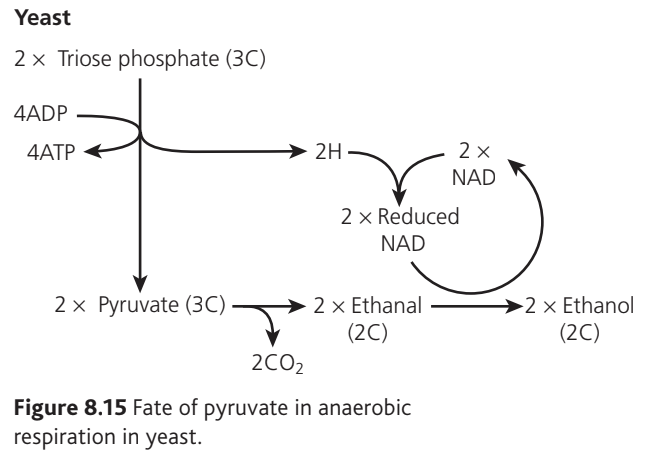
The ethanol fermentation pathway
The process involves an additional step compared to lactate fermentation:
Example
Worked Example: The Ethanol Fermentation Pathway
Step 1: Glycolysis produces reduced NAD, ATP, and pyruvate
Step 2: Pyruvate undergoes decarboxylation, catalysed by pyruvate decarboxylase
- This removes a carbon atom as carbon dioxide (CO₂)
- Ethanal (a 2-carbon compound) is formed
Step 3: Ethanal acts as a hydrogen acceptor, receiving hydrogen from reduced NAD
Step 4: The enzyme ethanol dehydrogenase catalyses the reduction of ethanal to ethanol
Step 5: Reduced NAD is oxidised back to NAD
Step 6: The regenerated NAD allows glycolysis to continue
Note
Practical Application
The release of CO₂ during this process is the reason yeast produces bubbles during fermentation, which is exploited in bread-making (causing bread to rise) and brewing (producing the fizz in beer and champagne).
Comparison of lactate and ethanol fermentation
Both types of anaerobic respiration share several features but differ in key aspects:
| Feature | Lactate fermentation | Ethanol fermentation |
|---|---|---|
| ATP molecules produced | ||
| Reduced NAD molecules used | ||
| CO₂ molecules released | ||
| Intermediate molecule | None | Ethanal |
| Enzymes involved | Lactate dehydrogenase | Pyruvate decarboxylase, Ethanol dehydrogenase |
| End products | Lactate (lactic acid) | Ethanol (alcohol) |
Important
Key Difference in Efficiency
Both pathways produce only ATP molecules per glucose, making them far less efficient than aerobic respiration (which produces approximately ATP). However, they serve an important biological role by allowing some energy release when oxygen is limited or absent.
Practical investigation: measuring respiration in yeast
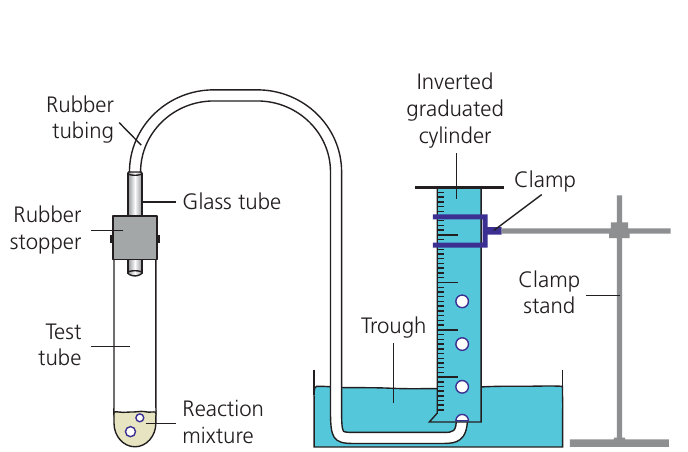
Gas production by respiring yeast can be measured using a gas collection apparatus. In a typical experiment:
- Yeast and glucose are mixed in a test tube
- Gas produced travels through rubber tubing to an inverted graduated cylinder
- The gas displaces water, allowing volume measurements
- Readings are taken at regular intervals (e.g. every seconds)
Comparing aerobic and anaerobic conditions
To investigate the difference between aerobic and anaerobic respiration in yeast:
Note
Experimental Setup:
Aerobic conditions: Use tap water for the glucose solution
Anaerobic conditions: Use boiled and cooled water (to remove dissolved oxygen) and add a thin layer of oil on top of the mixture to prevent oxygen entering
The rate of CO₂ production is typically higher under aerobic conditions because aerobic respiration releases more energy, allowing faster metabolic activity. However, CO₂ is produced in both conditions:
- In aerobic respiration, CO₂ is released during the link reaction and Krebs cycle
- In anaerobic respiration (ethanol fermentation), CO₂ is released during the decarboxylation of pyruvate
Controlling variables
To ensure valid results, several variables should be controlled:
Note
Control Variables:
- Temperature — use a water bath to maintain constant temperature
- Concentration of glucose — use the same mass of glucose dissolved in the same volume of water
- Mass of yeast — use the same mass of yeast in each trial
Remember!
Summary
Key Points to Remember:
-
Anaerobic respiration occurs when oxygen is unavailable, preventing the electron transport chain and Krebs cycle from functioning
-
Both lactate and ethanol fermentation produce only ATP per glucose molecule through glycolysis, making them far less efficient than aerobic respiration
-
Lactate fermentation occurs in animal muscle cells during intense exercise, creating an oxygen debt that must be repaid afterwards
-
Ethanol fermentation occurs in yeast and plants, involving decarboxylation of pyruvate and producing CO₂ and ethanol as waste products
-
The key purpose of both pathways is to regenerate NAD, allowing glycolysis to continue in the absence of oxygen