Reactions of Alcohols (OCR A-Level Chemistry A): Revision Notes
📚Revision Notes
Reactions of Alcohols
Introduction
Alcohols are versatile organic compounds that undergo several important types of reactions. Understanding these reactions and the conditions required is essential for A-Level chemistry. The main reaction types you need to know are:
- Combustion - complete burning in oxygen
- Oxidation - converting alcohols to aldehydes, ketones, or carboxylic acids
- Elimination - removing water to form alkenes (dehydration)
- Substitution - replacing the hydroxyl group with halogens
The products formed depend on the type of alcohol (primary, secondary, or tertiary) and the specific reaction conditions used.
Combustion of alcohols
When alcohols undergo complete combustion in a plentiful supply of oxygen, they produce carbon dioxide and water. This reaction releases significant amounts of energy, making alcohols useful as fuels.
The complete combustion of ethanol can be represented by the balanced equation:
This is an exothermic reaction that releases substantial heat energy. As the carbon chain length of the alcohol increases, the quantity of heat energy released per mole also increases. This is because longer chain alcohols contain more carbon-hydrogen bonds that can be broken and reformed as carbon dioxide and water, releasing more energy overall.
Note
Exam tip: You may be asked to write balanced combustion equations for different alcohols. Remember that the general pattern is: alcohol + oxygen → carbon dioxide + water. Count your carbons carefully!
Oxidation of alcohols
Overview of oxidation reactions
Both primary and secondary alcohols can be oxidised when treated with suitable oxidising agents. The most commonly used oxidising mixture in organic chemistry is acidified potassium dichromate(VI), written as .
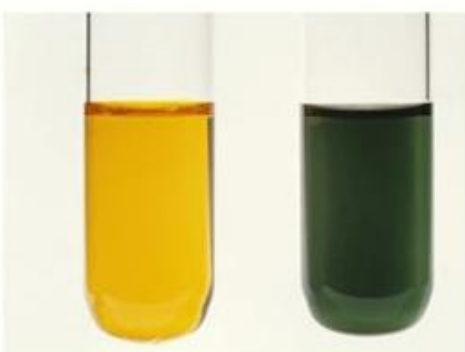
During oxidation reactions, a visible colour change occurs that serves as evidence the reaction has taken place:
- Orange dichromate(VI) ions, , are reduced to
- Green chromium(III) ions,
This distinctive colour change from orange to green is an important observation in practical work.
Note
Exam tip: When writing equations for oxidation reactions, use [O] in square brackets to represent the oxidising agent. This simplifies balancing equations significantly!
Oxidation of primary alcohols
Primary alcohols can undergo oxidation to form two different types of products depending on the reaction conditions employed:
- Aldehydes - formed under gentle heating with distillation
- Carboxylic acids - formed when heated under reflux with excess oxidising agent
The key factor determining which product forms is whether the aldehyde intermediate is allowed to remain in contact with the oxidising agent. Aldehydes are themselves susceptible to further oxidation to carboxylic acids, so careful control of conditions is essential.
Formation of aldehydes
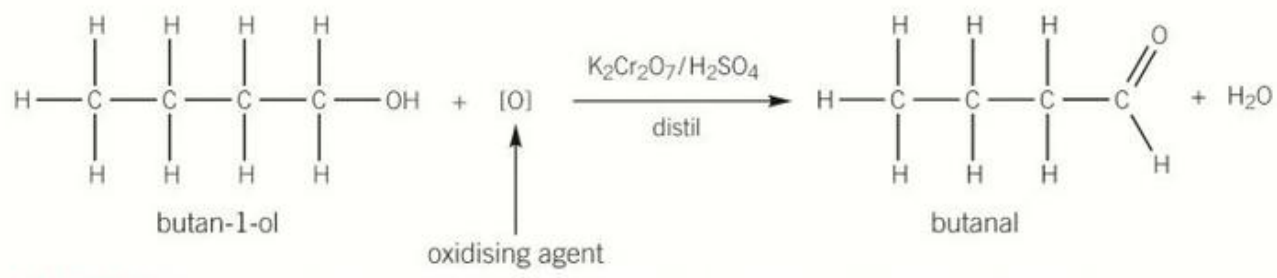
To prepare an aldehyde from a primary alcohol, the reaction mixture must be heated gently, and the aldehyde product must be removed from the reaction mixture as soon as it forms. This is achieved by distillation, which separates the aldehyde before it can undergo further oxidation.
The oxidation of butan-1-ol to butanal is shown below:
Example
Worked Example: Oxidation to Aldehyde
In this reaction:
- Butan-1-ol (a four-carbon primary alcohol) is the starting material
- Acidified potassium dichromate acts as the oxidising agent
- Distillation removes the aldehyde product (butanal) as it forms
- Water is produced as a by-product
- The dichromate ions change from orange to green
Note
Exam tip: When asked about preparing aldehydes, always mention distillation as the key technique. This prevents further oxidation of the aldehyde to a carboxylic acid.
Formation of carboxylic acids
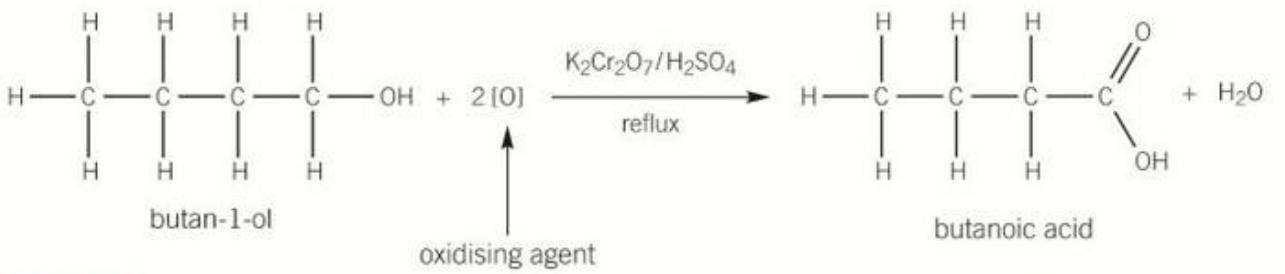
If a primary alcohol is heated strongly under reflux with an excess of acidified potassium dichromate(VI), a carboxylic acid is formed as the final product. The excess oxidising agent ensures complete oxidation, and reflux ensures that any aldehyde formed initially remains in the reaction mixture long enough to be further oxidised to the carboxylic acid.
The complete oxidation of butan-1-ol to butanoic acid is shown below:

Example
Worked Example: Complete Oxidation to Carboxylic Acid
In this reaction:
- Butan-1-ol undergoes complete oxidation
- Two oxygen atoms are effectively added (represented as 2[O])
- Butanoic acid (a four-carbon carboxylic acid) is formed
- Water is again produced as a by-product
- Excess oxidising agent is used to drive the reaction to completion
Summary of primary alcohol oxidation conditions:
| Product desired | Conditions required | Technique |
|---|---|---|
| Aldehyde | Acidified | Distillation (gentle heating) |
| Carboxylic acid | Excess acidified | Reflux (strong heating) |
The order of oxidation for primary alcohols is:
Important
Common mistake: Students often forget that aldehydes are intermediate products. A primary alcohol doesn't jump directly to a carboxylic acid - it goes through the aldehyde stage first.
Oxidation of secondary alcohols
Secondary alcohols are oxidised to form ketones when treated with acidified potassium dichromate(VI). Unlike primary alcohols, secondary alcohols cannot be oxidised further beyond the ketone stage under normal conditions. This is because ketones lack the hydrogen atom bonded to the carbonyl carbon that would be needed for further oxidation.
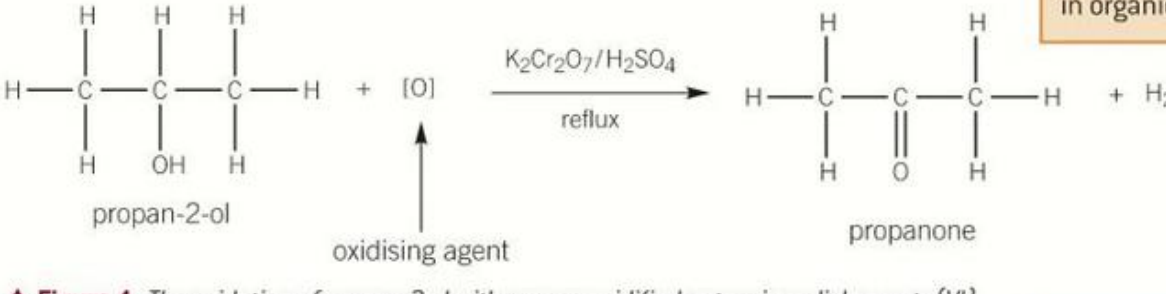
To ensure complete conversion of the secondary alcohol to the ketone, the reaction mixture is heated under reflux with the oxidising agent. Once again, the characteristic colour change from orange dichromate(VI) to green chromium(III) ions confirms that oxidation has occurred.
The oxidation of propan-2-ol to propanone is illustrated below:
Example
Worked Example: Oxidation of Secondary Alcohol
In this reaction:
- Propan-2-ol (a three-carbon secondary alcohol) is oxidised
- One oxygen atom is effectively added (represented as [O])
- Propanone (a ketone, also known as acetone) is formed
- Water is released as a by-product
- The reaction goes to completion under reflux conditions
Important
Key difference from primary alcohols: Secondary alcohols can only be oxidised to ketones - there is no further oxidation stage. This is an important distinction to remember.
Oxidation of tertiary alcohols
Tertiary alcohols are resistant to oxidation under normal laboratory conditions. When acidified potassium dichromate(VI) is added to a tertiary alcohol, no reaction occurs. The dichromate solution remains orange, showing that no oxidation has taken place and no reduction of the chromium ions has occurred.
This lack of reactivity is due to the structural features of tertiary alcohols - they have no hydrogen atoms bonded to the carbon carrying the hydroxyl group, which means the oxidation pathway available to primary and secondary alcohols is not possible.
Summary table for alcohol oxidation:
| Alcohol type | Product of oxidation | Observable colour change |
|---|---|---|
| Primary | Aldehyde (with distillation) → Carboxylic acid (with reflux + excess) | Orange to green |
| Secondary | Ketone | Orange to green |
| Tertiary | No reaction | Remains orange |
Note
Exam tip: A question about identifying an unknown alcohol can often be answered using oxidation tests. If acidified dichromate remains orange, the alcohol is tertiary. If it turns green, check the product type (aldehyde/carboxylic acid vs ketone) to distinguish primary from secondary alcohols.
Dehydration of alcohols
What is dehydration?
Dehydration is an elimination reaction in which a water molecule () is removed from an organic compound. When applied to alcohols, dehydration results in the formation of alkenes - unsaturated hydrocarbons containing a carbon-carbon double bond.
The general process involves:
- Removal of the hydroxyl group (-OH) from one carbon
- Removal of a hydrogen atom (H) from an adjacent carbon
- Formation of a double bond between these carbons
- Release of water as a small molecule
This type of reaction is classified as an elimination because a small molecule (water) is eliminated from the starting material, creating a double bond in its place.
Conditions for dehydration
To achieve dehydration of an alcohol, the following conditions are required:
- Acid catalyst: Either concentrated sulfuric acid () or concentrated phosphoric acid ()
- Heat under reflux: The mixture must be heated to provide activation energy for the reaction
The acid catalyst plays a crucial role in activating the alcohol molecule, making it easier for the hydroxyl group to leave. Reflux ensures that any volatile components don't escape before the reaction is complete.
Example: dehydration of cyclohexanol
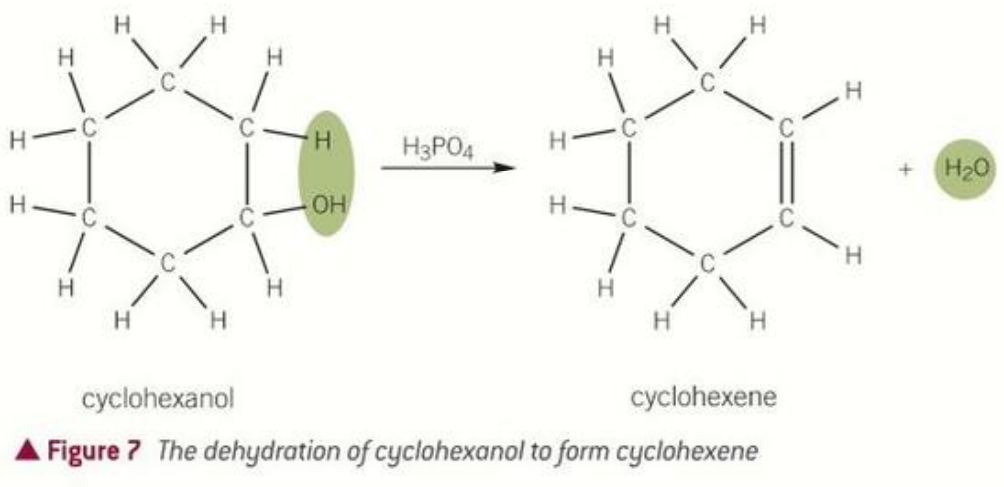
The dehydration of cyclohexanol to form cyclohexene demonstrates this reaction clearly:
Example
Worked Example: Dehydration of Cyclohexanol
In this reaction:
- Cyclohexanol (a cyclic alcohol) is the starting material
- Phosphoric acid () acts as the catalyst
- Cyclohexene (a cyclic alkene) is formed
- Water is eliminated from the alcohol structure
- The carbon ring loses its -OH group and gains a double bond
Note
Synoptic link: This elimination reaction is the reverse of the hydration of alkenes you may have studied earlier. Alkenes can be converted to alcohols by adding water (hydration), while alcohols can be converted to alkenes by removing water (dehydration).
Important
Don't confuse dehydration with oxidation! Dehydration (elimination forming alkenes) uses concentrated acid catalysts, while oxidation (forming aldehydes, ketones, or carboxylic acids) uses acidified dichromate. They are completely different reaction types with different reagents and products!
Substitution reactions of alcohols
Formation of haloalkanes
Alcohols undergo substitution reactions with hydrogen halides to produce haloalkanes. In these reactions, the hydroxyl group (-OH) of the alcohol is replaced by a halogen atom (such as bromine or chlorine), forming a new carbon-halogen bond.
When preparing a haloalkane from an alcohol, the hydrogen halide is typically generated in situ (meaning "in place" - formed in the reaction mixture rather than added directly). This is commonly achieved using a sodium halide salt combined with sulfuric acid.
Formation of hydrogen bromide in situ
For example, to generate hydrogen bromide (HBr) in the reaction mixture, sodium bromide is reacted with sulfuric acid:
The HBr produced immediately reacts with the alcohol present in the mixture, converting it to a bromoalkane.
Example: formation of 2-bromopropane
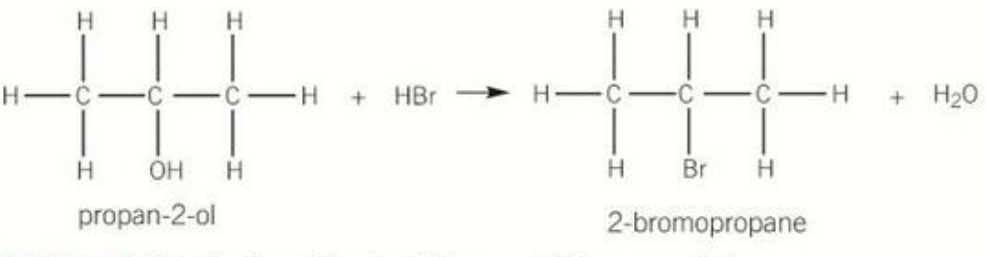
The substitution reaction of propan-2-ol with hydrogen bromide illustrates this process:
Example
Worked Example: Substitution to Form Haloalkane
In this reaction:
- Propan-2-ol (a secondary alcohol) reacts with HBr
- The hydroxyl group (-OH) is replaced by a bromine atom (Br)
- 2-bromopropane (a bromoalkane) is formed
- Water is released as a by-product
Overall reaction equation
The complete reaction of propan-2-ol with sodium bromide and sulfuric acid can be written as:
This equation shows:
- Propan-2-ol as the starting alcohol
- Sodium bromide and sulfuric acid generating HBr in situ
- 2-bromopropane as the organic product
- Sodium hydrogensulfate and water as by-products
Key points about substitution reactions:
- The hydroxyl group is replaced by a halogen
- The carbon skeleton remains unchanged
- The reaction typically requires heating under reflux
- Sulfuric acid acts as both a catalyst and a reactant (forming the hydrogen halide)
Note
Exam tip: When writing equations for these substitution reactions, make sure to include all the inorganic reagents (both the sodium halide and the sulfuric acid) and products (including sodium hydrogensulfate and water). These are often worth marks in exam questions!
Summary of key reactions
This table summarises the main reactions of alcohols you need to know:
| Reaction type | Reagent | Conditions | Product type | Colour change |
|---|---|---|---|---|
| Combustion | Oxygen () | Burn | and | - |
| Oxidation (primary alcohol) | Acidified | Distillation | Aldehyde | Orange → green |
| Oxidation (primary alcohol) | Excess acidified | Reflux | Carboxylic acid | Orange → green |
| Oxidation (secondary alcohol) | Acidified | Reflux | Ketone | Orange → green |
| Oxidation (tertiary alcohol) | Acidified | - | No reaction | Remains orange |
| Dehydration (elimination) | Conc. or | Reflux | Alkene + | - |
| Substitution | NaX + | Reflux | Haloalkane + | - |
Summary
Key Takeaways for Exam Success:
-
Alcohol oxidation depends on structure: Primary alcohols form aldehydes or carboxylic acids, secondary alcohols form ketones, and tertiary alcohols don't react with oxidising agents at all.
-
Control reaction conditions carefully: Use distillation to prepare aldehydes from primary alcohols, but use reflux with excess oxidising agent to prepare carboxylic acids. This distinction is frequently tested!
-
Watch for colour changes: Acidified potassium dichromate changes from orange to green when oxidation occurs. If it stays orange, no oxidation has happened (tertiary alcohol or no alcohol present).
-
Understand elimination vs substitution: Dehydration (elimination) uses concentrated acid catalysts and forms alkenes by removing water. Substitution uses hydrogen halides and forms haloalkanes by replacing -OH with a halogen.
-
Learn to write [O] in equations: Using [O] to represent the oxidising agent simplifies equation writing and balancing in exams. It's the standard notation for alcohol oxidation reactions.