Chemical Reactions of Alkanes (OCR A-Level Chemistry A): Revision Notes
📚Revision Notes
Chemical Reactions of Alkanes
Reactivity of alkanes
Alkanes are known for their low reactivity compared to other organic compounds. Understanding why they are so unreactive helps explain their uses and the conditions needed for them to react.
Why alkanes are unreactive
Alkanes show limited reactivity with most common laboratory reagents for three main reasons:
-
Strong σ-bonds: The carbon-carbon (C—C) and carbon-hydrogen (C—H) sigma bonds in alkanes require significant energy to break, making them stable and resistant to reaction
-
Non-polar C—C bonds: Carbon-carbon bonds are completely non-polar because they form between identical atoms with the same electronegativity
-
Effectively non-polar C—H bonds: Carbon and hydrogen have very similar electronegativities (2.5 and 2.1 respectively), meaning the C—H bond has such a small dipole that it can be considered non-polar for practical purposes
The non-polar nature of these bonds means alkanes do not attract polar reagents, and the bond strength means they resist breaking under normal laboratory conditions. This combination explains why alkanes are generally unreactive with acids, bases, oxidising agents, and reducing agents.
Note
The stability of alkanes makes them ideal for use as fuels and solvents, as they won't undergo unwanted reactions during storage or transport. However, this same stability means special conditions are needed when we want them to react.
Combustion of alkanes
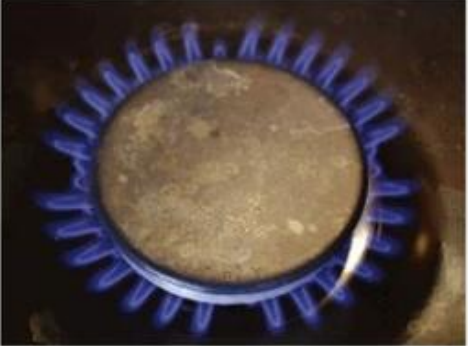
Although alkanes resist most reactions, they readily undergo combustion (burning) in the presence of oxygen. This reactivity makes them valuable as fuels.
Complete combustion
When sufficient oxygen is available, alkanes burn completely to produce carbon dioxide and water. This process releases substantial amounts of heat energy, which is why alkanes are used as fuels for heating, cooking, and transport.
The general word equation for complete combustion is:
Examples of complete combustion reactions include:
Methane (natural gas):
Ethane:
Propane:
Hexane (in petrol):
General equation for complete combustion
For any alkane with molecular formula , you can use this general equation:
Important
Exam tip: You don't need to memorise equations for individual alkanes. The carbon count in the alkane formula tells you how many CO₂ molecules form. Halving the hydrogen count gives you the number of H₂O molecules. Then balance the oxygen atoms to complete the equation.
Incomplete combustion
When oxygen supply is limited, alkanes cannot burn completely. In these conditions, hydrogen atoms still oxidise to water, but carbon oxidation is incomplete, producing toxic carbon monoxide (CO) or even solid carbon (soot).
Example
Worked Example: Combustion Outcomes for Heptane
Using heptane (a component of petrol) as an example, the three possible combustion outcomes are:
Complete combustion:
Incomplete combustion producing carbon monoxide:
Incomplete combustion producing carbon:
Notice how the oxygen requirement decreases from 11 moles for complete combustion to just 4 moles when only carbon is formed.
This explains why incomplete combustion occurs in enclosed spaces like car engines, faulty heating systems, or poorly ventilated rooms where oxygen supply cannot meet demand.
Important
Key point: Each unit in the homologous series of alkanes requires an additional molecules for complete combustion.
Real-world applications
The large amount of carbon dioxide produced during combustion contributes to environmental concerns. For instance, burning 1 kg of heptane (typical petrol component) in a car produces approximately 1680 dm³ of CO₂ at room temperature and pressure during just a 10-mile journey.
Important
Incomplete combustion is particularly dangerous in enclosed spaces because carbon monoxide is colourless, odourless, and highly toxic. It binds irreversibly to haemoglobin in blood, preventing oxygen transport around the body.
Reactions of alkanes with halogens
Alkanes undergo substitution reactions with halogens when exposed to ultraviolet (UV) radiation. These reactions are practically important for producing halogenoalkanes.
Halogenation conditions
For the reaction to proceed, two conditions must be met:
- UV light (or sunlight): Provides the high energy needed to break the halogen-halogen bond and initiate the reaction
- Suitable halogen: Only chlorine (Cl₂) and bromine (Br₂) are used in practice
- Fluorine is too reactive and would cause an explosive reaction
- Iodine is insufficiently reactive and barely reacts with alkanes
Note
The choice of halogen is critical for safety and practicality. Fluorine's extreme reactivity makes it dangerous to handle, while iodine's lack of reactivity makes it ineffective for these reactions.
Example reaction
Example
Worked Example: Bromination of Methane
When methane reacts with bromine in the presence of UV light, a substitution reaction occurs where a hydrogen atom is replaced by a bromine atom:
This is called a substitution reaction because one atom (hydrogen) has been substituted by another (bromine).
Mechanism for bromination of alkanes
The reaction between alkanes and halogens proceeds via a radical substitution mechanism. A mechanism shows the step-by-step movement of electrons during a reaction, helping us understand how products form from reactants.
What are radicals?
Important
Definition: Radicals
A radical is a highly reactive species containing an unpaired electron. Radicals are represented with a dot (•) to show the unpaired electron, for example Br• or •CH₃.
Because they have an unpaired electron, radicals are extremely reactive and readily participate in further reactions to achieve a stable electron configuration.
The three stages of radical substitution
Radical substitution mechanisms proceed through three distinct stages: initiation, propagation, and termination.
Stage 1: Initiation
The initiation stage starts the reaction by creating reactive radicals from stable molecules. UV radiation provides the energy needed to break the covalent bond in a bromine molecule by homolytic fission.
Note
Homolytic fission is the breaking of a covalent bond where each atom takes one electron from the shared pair, producing two radicals.
The UV radiation supplies sufficient energy to break the Br—Br bond, forming two highly reactive bromine radicals. Each bromine atom takes one electron from the bond.
Stage 2: Propagation
The propagation stage is where the main reaction occurs. It consists of two steps that form a chain reaction – the product of one step becomes the reactant for the next, allowing the cycle to repeat.
Propagation step 1:
A bromine radical attacks a C—H bond in methane, removing a hydrogen atom to form hydrogen bromide (HBr) and creating a methyl radical (•CH₃).
Propagation step 2:
The methyl radical reacts with another bromine molecule, forming the organic product bromomethane (CH₃Br) and regenerating a bromine radical.
Crucially, the bromine radical produced in step 2 can react with another methane molecule (step 1), allowing the propagation cycle to continue. In theory, these propagation steps could repeat until all reactants are consumed. Research suggests up to a million propagation cycles may occur before a termination step stops the reaction.
Important
Exam tip: Always ensure propagation step equations are balanced. Each step must show exactly one radical on both sides of the equation – this maintains the chain reaction. A common error is incorrectly writing •H instead of •CH₃ in the first propagation step.
Stage 3: Termination
The termination stage occurs when two radicals collide and combine, forming a stable molecule with all electrons paired. This removes radicals from the reaction mixture and stops the chain reaction.
Several termination reactions are possible, depending on which radicals meet:
When two radicals combine, both radicals are eliminated from the reaction mixture, halting further propagation steps in that reaction pathway.
Note
Termination reactions are less likely than propagation reactions because the concentration of radicals is very low. However, once termination occurs, that particular chain reaction pathway is stopped.
Limitations of radical substitution in organic synthesis
Although radical substitution provides a method for synthesizing halogenoalkanes, it has significant drawbacks that limit its usefulness for preparing a single pure organic compound.
Further substitution
Once bromomethane (CH₃Br) forms in the second propagation step, bromine radicals can attack it just as readily as they attack methane. This leads to further substitution, progressively replacing more hydrogen atoms:
The result is a mixture of products: CH₃Br (monobromomethane), CH₂Br₂ (dibromomethane), CHBr₃ (tribromomethane), and CBr₄ (tetrabromomethane), along with unreacted methane and bromine. Separating the desired product from this mixture requires additional purification steps.
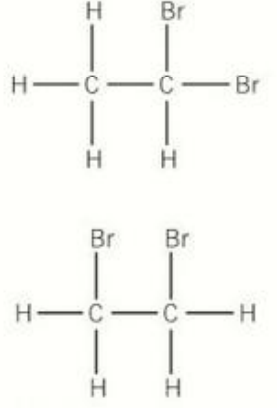
Substitution at different positions in carbon chains
For methane and ethane, only one monosubstituted product is possible because all hydrogen atoms are equivalent (bonded to the same carbon environment).
However, for alkanes with three or more carbon atoms, hydrogen atoms exist in different positions along the carbon chain. Radicals can substitute at any of these positions, creating a mixture of structural isomers (compounds with the same molecular formula but different structural arrangements).
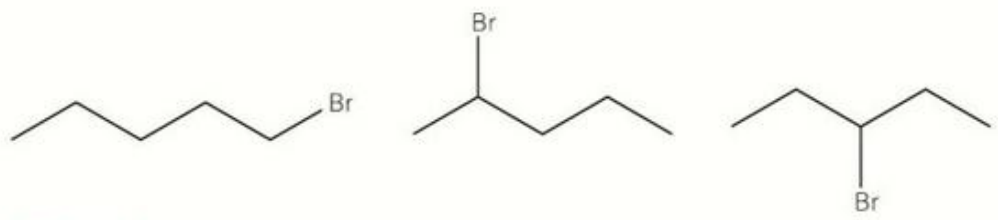
For example, pentane (C₅H₁₂) can form three different monosubstituted bromopentane isomers, depending on which hydrogen is replaced:

The three isomers show bromine attached to different carbon positions in the five-carbon chain. These are positional isomers of bromopentane, all with molecular formula C₅H₁₁Br but with different structures.
Important
The formation of multiple isomers further complicates product separation and purification, making radical substitution impractical for synthesizing a specific target molecule when positional isomers are possible.
Remember!
Summary
Key Points to Remember:
-
Alkanes are unreactive because C—C and C—H σ-bonds are strong and non-polar, preventing reaction with most common reagents
-
Complete combustion of alkanes in plentiful oxygen produces CO₂ and H₂O; incomplete combustion in limited oxygen produces toxic CO or soot (C)
-
Radical substitution occurs when alkanes react with Cl₂ or Br₂ in UV light, replacing H atoms with halogen atoms via a three-stage mechanism:
- Initiation (UV light breaks halogen bond)
- Propagation (chain reaction in two steps)
- Termination (two radicals combine)
-
Propagation steps always show one radical on each side, maintaining the chain reaction until termination occurs
-
Radical substitution has limitations for synthesis:
- Further substitution produces a mixture of products with different numbers of halogen atoms
- Substitution at different positions produces structural isomers