Properties of Alkanes (OCR A-Level Chemistry A): Revision Notes
📚Revision Notes
Properties of Alkanes
What are alkanes?
Alkanes are among the most important organic compounds in chemistry and everyday life. They are saturated hydrocarbons that form the major constituents of natural gas and crude oil. The remarkable stability of alkanes has allowed crude oil deposits to remain preserved in the Earth for millions of years without decomposition.
All alkanes belong to a homologous series, which means they follow a general molecular formula. This formula is , where represents the number of carbon atoms. For each carbon atom you add to the chain, you must add two hydrogen atoms to maintain the saturated structure. For example, methane is (where ), ethane is (where ), and propane is (where ).
Note
A homologous series is a family of compounds with the same general formula and similar chemical properties. Each successive member differs by a unit. This means that alkanes show predictable trends in their physical and chemical properties.
The primary use of alkanes is as fuels. Their combustion reaction with oxygen releases significant amounts of heat energy, making them ideal for heating, power generation, and transportation.
The bonding in alkanes
Alkanes are classified as saturated hydrocarbons because they contain only carbon and hydrogen atoms joined together by single covalent bonds. There are no double or triple bonds present in their structure, which is why we describe them as "saturated" - each carbon atom is bonded to the maximum number of hydrogen atoms possible.
Sigma bonds
The single covalent bonds in alkanes are specifically called sigma bonds (written as -bonds). Understanding sigma bonds is crucial to understanding alkane structure and behavior.
A covalent bond forms when two atoms share a pair of electrons. A sigma bond is created through the direct overlap of two atomic orbitals, with one orbital coming from each of the bonding atoms. Each orbital that overlaps contains one electron, so the completed sigma bond contains two electrons shared between the bonding atoms.
Important
The key characteristic of a sigma bond is that it is positioned along a straight line directly between the nuclei of the two bonding atoms. This direct overlap creates a strong covalent bond and allows for free rotation around the bond axis.
Each carbon atom in an alkane forms exactly four sigma bonds. These can be either carbon-carbon bonds () or carbon-hydrogen bonds (). This arrangement ensures that each carbon atom satisfies the octet rule by having eight electrons in its outer shell.
The shape of alkanes
The three-dimensional shape of alkane molecules is determined by the arrangement of bonds around each carbon atom. Understanding this shape is essential for predicting alkane properties and behavior.
Tetrahedral geometry
Each carbon atom in an alkane is surrounded by four pairs of bonding electrons distributed in four sigma bonds. According to electron pair repulsion theory, these four electron pairs arrange themselves as far apart as possible in three-dimensional space. This results in a tetrahedral arrangement around each carbon atom.
In a tetrahedral geometry, the bond angle between any two bonds is approximately 109.5°. This angle represents the optimal arrangement that minimizes repulsion between the electron pairs while maximizing the distance between bonding atoms.
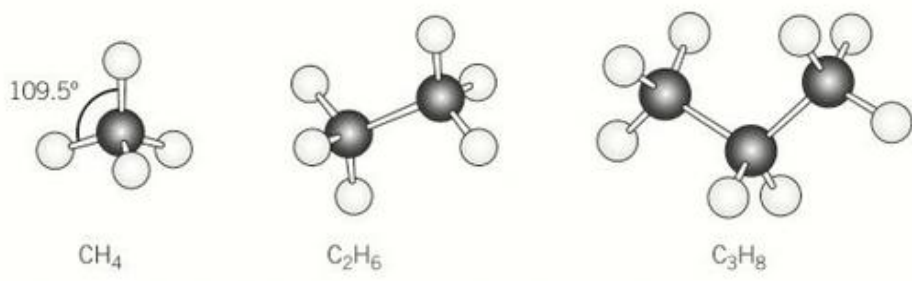
The figure above shows the three-dimensional structures of the first four alkanes. Notice how each carbon atom sits at the center of a tetrahedral arrangement. The grey spheres represent carbon atoms, while the white spheres represent hydrogen atoms.
Note
An important property of sigma bonds is that atoms can freely rotate around them. This means that alkane molecules are not rigid structures - they can twist and change their overall shape while maintaining their basic tetrahedral geometry at each carbon atom. For example, butane can exist in different conformations by rotating around its carbon-carbon bonds, sometimes appearing in a zigzag shape and sometimes in a more U-shaped conformation.
Variations in the boiling points of alkanes
The boiling points of alkanes vary significantly depending on their structure. Understanding why these variations occur requires knowledge of intermolecular forces and molecular structure.
Fractional distillation and alkane separation
Crude oil contains hundreds of different alkanes mixed together. Industrial facilities called oil refineries separate crude oil into useful fractions through a process called fractional distillation. This process takes place in tall distillation towers where crude oil is heated to approximately .
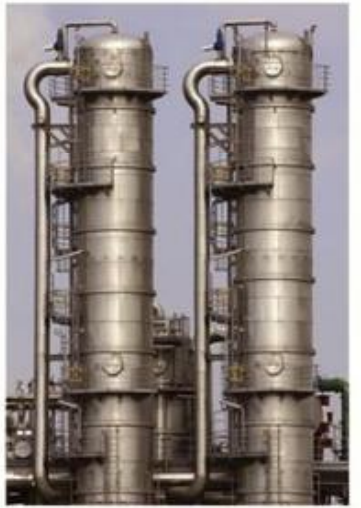
As the crude oil is heated, different alkanes vaporize at different temperatures based on their boiling points. The hydrocarbon gases rise up through the tower and condense at different levels depending on their boiling points. Alkanes with lower boiling points condense near the top of the tower, while those with higher boiling points condense lower down. This separation is only possible because the different alkanes have different boiling points.
Boiling point data
The table below shows how boiling points change across the first ten members of the alkane homologous series:

Examining this data reveals clear patterns. The smallest alkanes (methane through butane) are gases at room temperature, with boiling points well below . As the carbon chain lengthens, boiling points increase dramatically. Pentane through decane are liquids at room temperature, with progressively higher boiling points.
Effect of chain length on boiling point
The boiling point of an alkane increases as the carbon chain length increases. This trend occurs due to weak intermolecular forces called London forces (also known as London dispersion forces or van der Waals forces).
London forces are temporary attractive forces that hold molecules together in solids and liquids. When molecules have enough thermal energy to overcome these forces, they separate from each other and the substance becomes a gas. Therefore, stronger intermolecular forces result in higher boiling points because more energy is required to overcome them.
Note
In alkanes, London forces act between molecules that are in close surface contact. As the chain length increases, the molecules have a larger surface area available for contact with neighboring molecules. More surface contact means more points of interaction between molecules, which leads to stronger overall London forces between them.
Because longer chain alkanes experience stronger London forces, more thermal energy is required to separate the molecules and convert the liquid into a gas. This explains why boiling points increase with chain length - you need to supply more heat energy to overcome the stronger intermolecular forces.
Example
Worked Example: Chain Length and Boiling Points
Compare methane () with octane ():
- Methane has a boiling point of (a gas at room temperature)
- Octane has a boiling point of (a liquid at room temperature)
The difference of nearly is due to the much greater surface area of octane molecules. Octane's longer chain provides significantly more points of contact between molecules, resulting in much stronger London forces that require substantially more energy to overcome.
Effect of branching on boiling point
Structural isomers are molecules with the same molecular formula but different structural arrangements. When we compare the boiling points of alkane isomers, we find that branched isomers have lower boiling points than their straight-chain counterparts, even though they have identical molecular masses.
Consider the isomers of pentane (). Straight-chain pentane has a boiling point of . However, 2-methylbutane (with one branch) has a boiling point of only , and 2,2-dimethylpropane (with two branches) has an even lower boiling point of just . This means that at room temperature, 2,2-dimethylpropane is a gas, 2-methylbutane would only be a gas on warm days, while pentane remains a liquid under normal UK temperatures.
The explanation for this trend again lies with London forces. Branched molecules have a more compact, spherical shape compared to the elongated shape of straight-chain molecules. This compact shape means there are fewer points of surface contact between adjacent molecules.
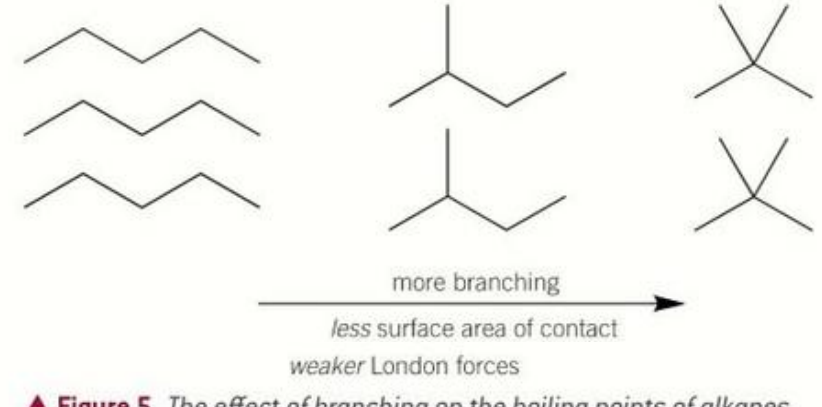
The diagram above illustrates this concept. Straight-chain molecules can lie alongside each other with extensive surface contact. As branching increases, the molecules become more spherical and the branches physically prevent close approach between molecules. This geometric effect reduces the surface area in contact between molecules, which weakens the London forces. Weaker intermolecular forces mean less energy is required to separate the molecules, resulting in lower boiling points.
Important
Common Mistake to Avoid:
Students often think that branched molecules have stronger intermolecular forces because the molecule itself is more compact. This is incorrect! The compactness actually reduces the surface contact between separate molecules, which weakens the London forces and lowers the boiling point.
Summary
Key Points to Remember:
- Alkanes are saturated hydrocarbons with the general formula , containing only single carbon-carbon and carbon-hydrogen bonds
- All bonds in alkanes are sigma bonds (-bonds) formed by direct orbital overlap between bonding atoms
- Each carbon atom has a tetrahedral geometry with bond angles of approximately , and molecules can rotate freely around sigma bonds
- Boiling points increase with chain length because longer molecules have greater surface area, leading to stronger London forces between molecules
- Branched isomers have lower boiling points than straight-chain isomers because branching reduces the surface contact between molecules, weakening the London forces
- The mnemonic "LONGER = STRONGER = HIGHER" helps remember that longer chains have stronger London forces and higher boiling points
- The mnemonic "BRANCHES BLOCK CONTACT" helps remember that branching reduces intermolecular contact