Alkenes (OCR A-Level Chemistry A): Revision Notes
📚Revision Notes
Polymerisation in Alkenes
Introduction to polymers
Polymers are very large molecular structures built from many thousands of smaller repeating units called monomers. These giant molecules have extremely high molecular masses and form the basis of many materials we use every day, from plastic bags to non-stick frying pans.
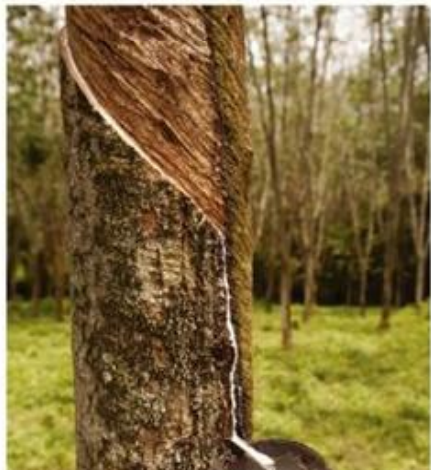
The concept of polymers is not new. Natural rubber is a polymer that has been harvested from rubber trees for centuries. The milky latex collected from these trees contains long polymer chains that give rubber its elastic properties.
Note
The discovery of synthetic polymers revolutionized materials science. The first synthetic polymer, known as Bakelite, was created in 1907 by Leo Baekeland and used as an electrical insulator. However, it was not until the 1920s that common addition polymers like poly(vinyl chloride), or PVC, were produced on an industrial scale. Today, polymers are essential materials in modern society.
Addition polymerisation
The polymerisation process
Addition polymerisation is a chemical reaction in which unsaturated alkene molecules join together to form long saturated polymer chains. During this process, the carbon-carbon double bond () in each monomer opens up, allowing the molecules to link together. The resulting polymer chain contains only single carbon-carbon bonds () and no double bonds remain.
The key features of addition polymerisation are:
- High molecular mass: Addition polymers typically contain thousands of monomer units, resulting in molecules with very large relative molecular masses
- Polymer naming: Synthetic polymers are named after their monomer, with the prefix "poly" added. For example, ethene polymerises to form poly(ethene)
- Industrial conditions: Industrial polymerisation is carried out at high temperature and high pressure using catalysts to speed up the reaction
General equation for addition polymerisation
A general equation can be written to represent any addition polymerisation reaction. This equation shows how monomers with a carbon-carbon double bond transform into a polymer chain.
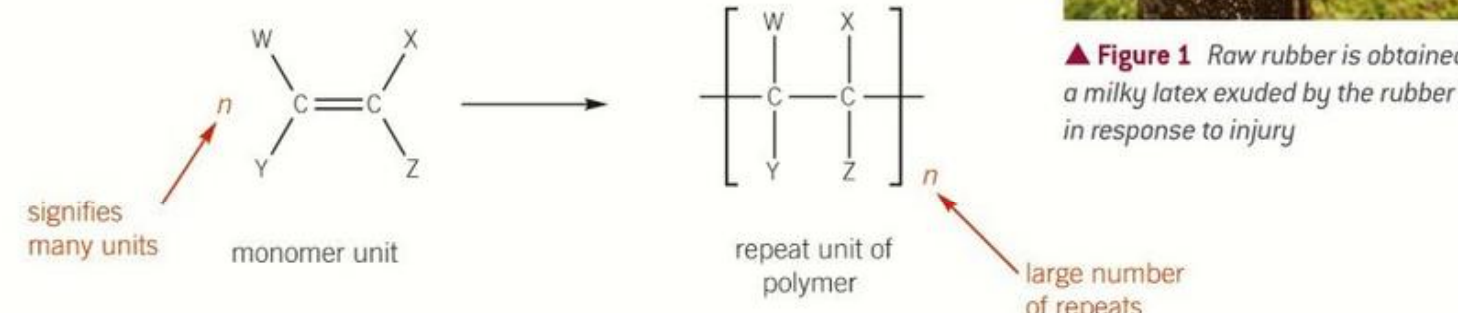
In this equation:
- The left side shows monomer units, where represents a very large number (typically thousands)
- Each monomer contains a carbon-carbon double bond with substituents labelled W, X, Y, and Z
- The arrow represents the polymerisation reaction conditions
- The right side shows the polymer structure with the repeat unit enclosed in square brackets
- The subscript after the brackets indicates a large number of these units are joined together
Understanding repeat units
The repeat unit is the specific pattern of atoms in the polymer molecule that repeats over and over again throughout the chain. This is the smallest section of the polymer structure that, when repeated many times, generates the entire polymer molecule.
Important
Critical Rules for Repeat Unit Notation:
- The repeat unit must always be written inside square brackets [ ]
- A subscript is placed after the closing bracket to show there are many repeats (typically thousands)
- The repeat unit shows how the atoms from the monomer are arranged after the double bond has opened
- You must ensure the equation is balanced - the number of each type of atom must be the same on both sides
Drawing polymerisation equations
When writing equations for addition polymerisation, you need to include before the monomer structure and outside the bracket after the repeat unit in the polymer structure. This notation is essential for showing that many monomer molecules join together to form one long polymer chain.
Example
Worked Example: Writing a Polymerisation Equation
To write a complete polymerisation equation:
Step 1: Write before the monomer structure
Step 2: Draw an arrow showing the reaction conditions (high temperature, high pressure)
Step 3: Draw the polymer with the repeat unit in square brackets
Complete equation:
Common addition polymers
Poly(ethene)
Poly(ethene), also known as polyethylene, is one of the most widely used polymers globally. It is produced by heating ethene monomers () at high temperature and high pressure.
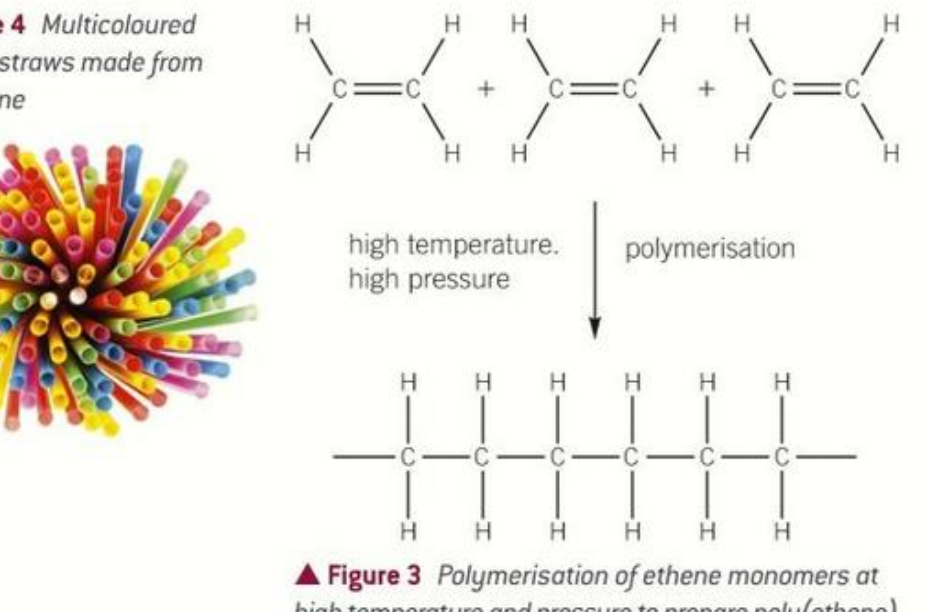
The polymerisation reaction can be represented as:
Poly(ethene) comes in different forms depending on the manufacturing process:
- High-density poly(ethene) (HDPE) has linear polymer chains packed closely together, giving it strength. HDPE is used for children's toys, detergent bottles, and water pipes
- Low-density poly(ethene) (LDPE) has branched chains that cannot pack as tightly, resulting in a flexible material with less strength. LDPE is ideal for plastic films and carrier bags
You will encounter poly(ethene) in everyday items such as supermarket bags, shampoo bottles, and children's toys.
Poly(chloroethene) - PVC
Poly(chloroethene), commonly known as poly(vinyl chloride) or PVC, is a versatile polymer that can be manufactured in either flexible or rigid forms. The monomer chloroethene (vinyl chloride) has the formula .
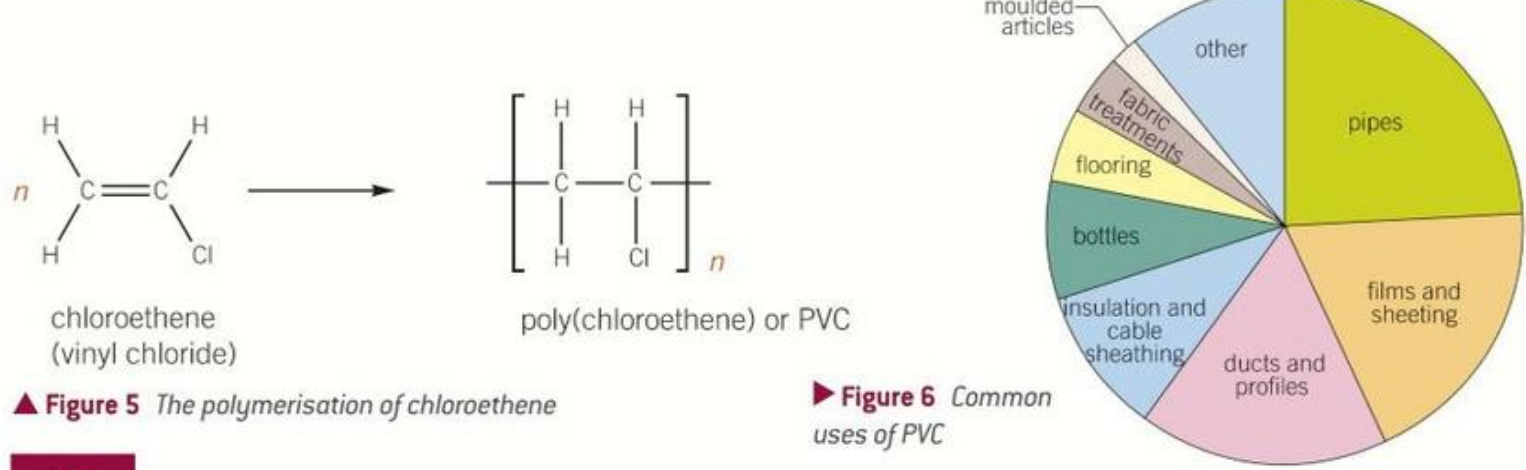
The polymerisation equation for PVC formation is:
PVC has numerous commercial applications, including:
- Pipes (the largest use, shown in yellow in the pie chart)
- Films and sheeting
- Bottles and containers
- Flooring and fabric treatments
- Electrical insulation for cables
- Window frames and door profiles
- Moulded articles
The wide range of uses demonstrates PVC's versatility as a polymer material. However, its disposal presents environmental challenges, which we will discuss later in these notes.
Other important addition polymers
Several other alkene monomers can undergo addition polymerisation to produce useful materials. The table below shows three important examples:
| Monomer | Polymer | Key applications |
|---|---|---|
| Propene () | Poly(propene) | Children's toys, packing crates, guttering, uPVC windows, rope fibres |
| Phenylethene/styrene (contains benzene ring) | Poly(phenylethene) or polystyrene | Packaging materials, food trays and cups (thermal insulation properties) |
| Tetrafluoroethene () | Poly(tetrafluoroethene) - PTFE or Teflon | Non-stick pan coatings, permeable membranes for clothing and shoes, cable insulation |
Each polymer has unique properties determined by its chemical structure, making it suitable for specific applications.
Poly(tetrafluoroethene) - PTFE
PTFE, commonly known by the brand name Teflon, deserves special mention due to its remarkable properties. The fluorine atoms bonded to the carbon backbone create an extremely unreactive and slippery surface.

Note
PTFE applications include:
- Non-stick coatings for cookware
- Waterproof breathable membranes for outdoor clothing
- Electrical cable insulation
- Bearings and seals in engineering
The strong carbon-fluorine bonds make PTFE highly stable and resistant to chemical attack, contributing to its widespread use in demanding applications.
Identifying monomers from polymers
When you are given the structure of a polymer, you should be able to work backwards to identify the original monomer from which it was made. This is an important skill for examination questions.
Example
Worked Example: Identifying the Monomer from a Polymer
The process for identifying the monomer involves these steps:
Step 1: Identify the repeat unit in the polymer chain - this is the section shown in square brackets
Step 2: Copy the repeat unit structure and remove the bonds that extend beyond the brackets
Step 3: Convert the single bond in the middle of the copied structure into a double bond ()
Step 4: Check your monomer structure - it should be a small molecule with one carbon-carbon double bond
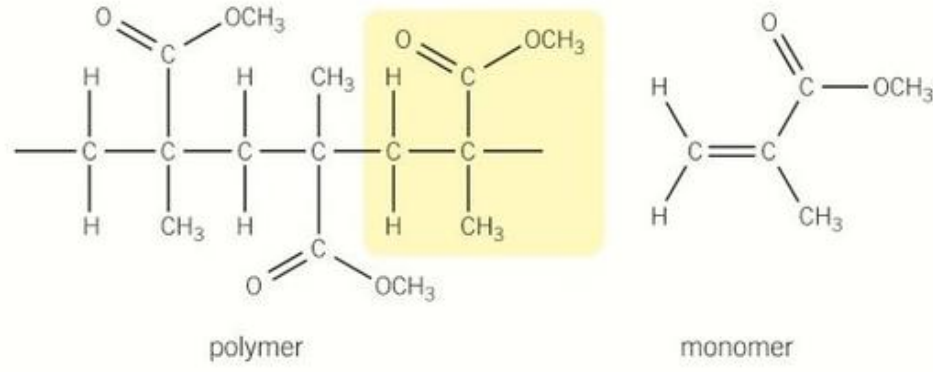
The image above shows an example where the polymer structure is displayed on the left with its repeat unit highlighted, and the corresponding monomer with the double bond is shown on the right. Notice how the single bond in the polymer chain becomes a double bond in the monomer structure.
Important
This method works for any addition polymer because polymerisation always involves opening the double bond in the monomer to create single bonds that link the chain together.
Environmental concerns
Disposing of waste polymers
Polymers offer many advantages in modern life - they are readily available, inexpensive to produce, and more convenient than alternatives such as glass bottles, metal containers, paper bags, and cardboard packaging. However, the properties that make polymers so useful for storing food and chemicals also create significant disposal challenges.
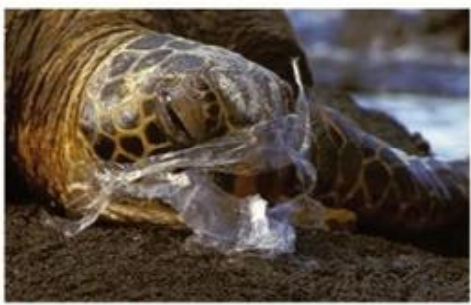
The lack of reactivity that makes polymers suitable for safe storage means that many alkene-based polymers are non-biodegradable. They do not break down naturally in the environment. The accumulating amount of polymer waste has serious environmental consequences, particularly for marine ecosystems.
Important
Environmental Impact of Polymer Waste:
Plastic waste in oceans can entangle marine animals or be mistaken for food, causing injury and death to wildlife. Microplastics have also been found throughout marine food chains, raising concerns about long-term ecological impacts.
Recycling
Recycling helps reduce the environmental impact of polymers by conserving finite fossil fuel resources and decreasing the volume of waste sent to landfill sites. However, effective recycling requires careful sorting of different polymer types.
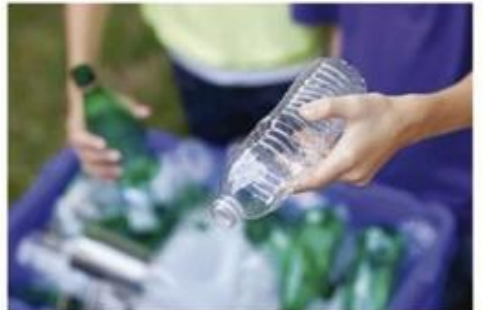
The recycling process involves several stages:
- Sorting: Discarded polymers must be separated by type, as mixing different polymers renders the recycled product unusable
- Processing: Once sorted, polymers are chopped into small flakes
- Cleaning: The polymer flakes are washed to remove contaminants
- Drying: Moisture is removed from the clean flakes
- Melting: The dried polymer is melted down
- Reforming: The melted polymer is cut into pellets that manufacturers use as raw material for new products
This process conserves resources and reduces waste, but it requires significant energy input and relies on proper sorting at collection.
PVC recycling challenges
The disposal and recycling of PVC presents particular hazards due to its high chlorine content and the range of additives present in the polymer formulation. Several issues arise:
- Landfill disposal is unsustainable as PVC does not decompose
- Burning PVC releases hydrogen chloride (), a corrosive gas, along with toxic dioxins and other pollutants
- Traditional recycling involved grinding PVC and reusing it directly to manufacture new products
Note
Modern recycling technology has improved the process. New methods use solvents to dissolve the polymer, then recover high-grade PVC by precipitation from the solution. The solvent can be reused, making this approach more efficient and safer than older methods.
Using waste polymers as fuel
Some polymers are difficult to recycle effectively. Since many polymers are derived from petroleum or natural gas, they possess high stored energy values. This characteristic allows waste polymers to be incinerated to produce heat energy.
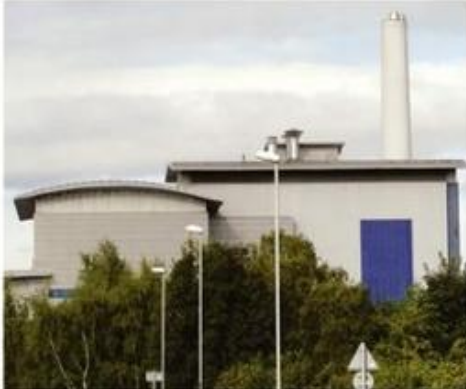
The combustion of waste polymers generates heat that can:
- Create steam to drive turbines that produce electricity
- Heat buildings directly through district heating systems
Note
For example, Sheffield has an energy recovery facility that incinerates non-recyclable materials, including waste polymers. The heat generated supplies electricity to the National Grid and provides heating for buildings across the city centre. This waste-to-energy approach recovers value from polymers that cannot be recycled through conventional methods.
Feedstock recycling
Feedstock recycling describes chemical and thermal processes that can reclaim monomers, gases, or oil from waste polymers. Unlike mechanical recycling, feedstock recycling breaks down the polymer chains chemically.
The products obtained from feedstock recycling can include:
- Original monomers that can be re-polymerised
- Gases suitable for chemical synthesis
- Oils resembling crude oil that can be processed in refineries
These recovered materials serve as raw materials for manufacturing new polymers, effectively closing the materials loop. A major advantage of feedstock recycling is its ability to handle unsorted and unwashed polymer waste, making it more flexible than traditional recycling methods.
Biodegradable and photodegradable polymers
Bioplastics and sustainability
Bioplastics are produced from renewable resources such as plant starch, cellulose, plant oils, and proteins. These materials offer a sustainable alternative to oil-based polymers, with several environmental benefits:
- Protection of the environment through use of renewable resources
- Conservation of valuable oil reserves for other applications
- Reduced carbon footprint in production and disposal
Biodegradable polymers
Biodegradable polymers are designed to be broken down by microorganisms into water, carbon dioxide (), and biological compounds. These polymers differ from traditional plastics in their composition and structure.
Most biodegradable polymers are manufactured from:
- Starch extracted from plants
- Cellulose from plant cell walls
- Modified structures that include additives allowing microorganism breakdown
Note
Poly(lactic acid) - A Renewable Alternative
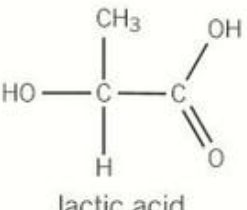
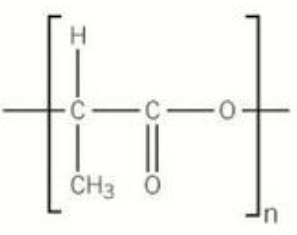
Poly(lactic acid) or PLA is becoming increasingly common as an alternative to traditional alkene-based polymers. The structure shows ester linkages in the polymer backbone, which are susceptible to breakdown by microorganisms. Importantly, PLA polymerises through a different mechanism from the polyalkene addition polymers studied in this topic.
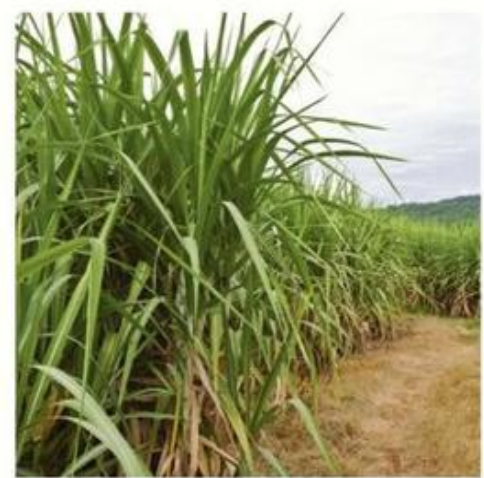
Lactic acid, the monomer for PLA production, can be obtained from fermentation of plant sugars derived from sugar cane or corn. This makes PLA a renewable polymer with a lower environmental impact than petroleum-based plastics.
Applications of biodegradable polymers include:
- Compostable bags: Supermarket bags made from plant starch can be used as bin liners for food waste. Both the bag and its contents can be composted together
- Food packaging: Compostable plates, cups, and food trays made from sugar cane fibre are replacing expanded polystyrene
- Advanced applications: As the technology develops, bioplastics are finding uses in packaging, electronics, and manufacturing more fuel-efficient and recyclable vehicles
Important
Compostable polymers degrade completely, leaving no visible or toxic residues in the environment.
Photodegradable polymers
In situations where plant-based polymer production is not feasible, photodegradable polymers offer another solution. These oil-based polymers are engineered to break down when exposed to light.
Photodegradable polymers work through two main approaches:
- Bonds weakened by light absorption: The polymer structure includes chemical bonds that absorb light energy, which weakens the bonds and initiates degradation
- Light-absorbing additives: Special additives mixed into the polymer absorb light and trigger breakdown of the polymer chains
Note
While photodegradable polymers still derive from fossil fuels, they offer an advantage over conventional plastics by degrading more quickly in the environment when exposed to sunlight. However, they may not break down in dark conditions such as buried landfill sites.
Remember!
Summary
Key Points to Remember:
-
Addition polymerisation joins alkene monomers by opening the double bond to form long saturated polymer chains with very high molecular masses
-
The general equation uses monomers to produce repeat units: , where the repeat unit must always be shown in square brackets with subscript outside
-
Common addition polymers include poly(ethene) (bags, bottles), PVC (pipes, bottles, flooring), PTFE (non-stick coatings), polypropene (toys, windows), and polystyrene (packaging)
-
To identify the monomer from a polymer structure, copy the repeat unit and convert the central single bond into a double bond
-
Environmental challenges include non-biodegradable waste accumulation and marine pollution, addressed through recycling, incineration for energy recovery, and feedstock recycling
-
Biodegradable polymers made from plant materials (starch, cellulose) are broken down by microorganisms, while photodegradable polymers contain bonds weakened by light to trigger degradation
-
Sustainable alternatives like poly(lactic acid) from plant sugars offer renewable options that reduce dependence on fossil fuels and minimise environmental impact