Properties of Alkenes (OCR A-Level Chemistry A): Revision Notes
📚Revision Notes
Properties of alkenes
Introduction
Alkenes belong to the family of unsaturated hydrocarbons, which means they contain fewer hydrogen atoms than the corresponding saturated alkanes. This characteristic arises from the presence of at least one carbon-carbon double bond (C=C) within their molecular structure. Understanding the properties of alkenes is essential because this functional group determines their chemical behavior and reactivity.
Note
The double bond in alkenes is the key feature that distinguishes them from alkanes. This structural difference not only affects the hydrogen count but also dramatically influences their chemical reactivity and physical properties.
The double bond in alkenes makes them more reactive than alkanes and gives them distinctive geometric and bonding characteristics that we'll explore in detail.
Structure of alkenes
General formula and naming
Aliphatic alkenes that contain a single double bond follow the general formula , where represents the number of carbon atoms in the molecule. This formula shows that alkenes have two fewer hydrogen atoms than the corresponding alkane (), which is a direct consequence of the double bond.
The first three members of the alkene homologous series demonstrate this pattern clearly:
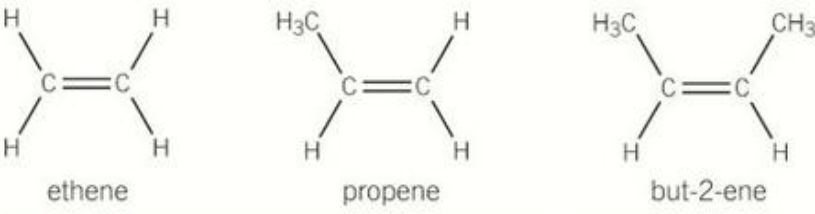
Each of these molecules contains exactly one C=C double bond:
- Ethene (): The simplest alkene with two carbon atoms
- Propene (): Contains three carbon atoms with the double bond between C1 and C2
- But-2-ene (): A four-carbon alkene with the double bond between the second and third carbon atoms
Structural variations in alkenes
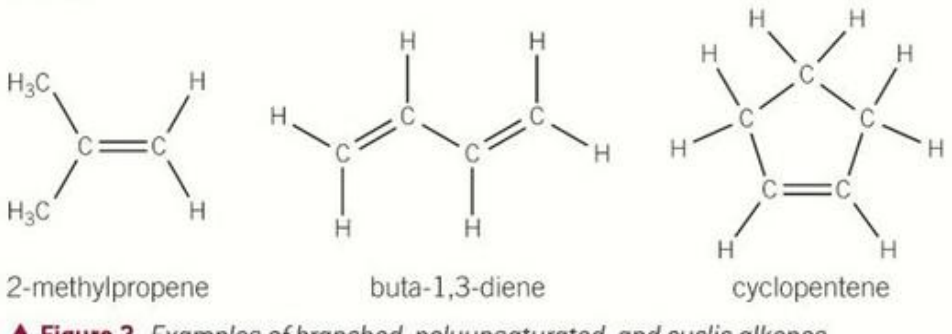
While simple straight-chain alkenes follow the formula, alkenes can exist in several different structural forms that don't necessarily obey this pattern. Understanding these variations is important for recognizing the diversity of alkene chemistry.
Important
Not all alkenes follow the simple formula. The presence of rings, branches, or multiple double bonds can change the hydrogen count, so always consider the complete structure when determining molecular formulas.
Branched alkenes such as 2-methylpropene maintain the general formula because branching doesn't affect the hydrogen count—only the arrangement of carbon atoms changes.
Polyunsaturated alkenes contain more than one double bond in their structure. For example, buta-1,3-diene has two double bonds and therefore has the formula rather than . Each additional double bond removes two more hydrogen atoms from the molecule.
Cyclic alkenes like cyclopentene have a ring structure combined with a double bond. These compounds also deviate from the simple formula because the ring structure itself removes two hydrogen atoms from what would be expected in a straight-chain molecule.
Nature of the carbon-carbon double bond
Bonding in carbon atoms
To understand why alkenes behave differently from alkanes, we need to examine the bonding around the carbon atoms in the double bond. Each carbon atom has four electrons in its outer shell that it can use to form covalent bonds with other atoms.
In the carbon-carbon double bond, each carbon atom uses three of its four outer electrons to form three sigma bonds (σ-bonds). One of these sigma bonds connects to the other carbon atom of the double bond, while the other two sigma bonds connect to additional atoms (which may be hydrogen, carbon, or other elements).
Note
Each carbon atom in a double bond forms exactly three sigma bonds: one to the other carbon in the double bond, and two to other atoms. This leaves one electron available for forming the second bond—the pi bond.
This bonding arrangement leaves one electron on each carbon atom of the double bond that is not involved in sigma bonding. This remaining electron occupies what we call a p-orbital, and it's this electron that participates in forming the second bond between the two carbon atoms.
Formation of the pi bond
The second bond in the C=C double bond forms through a completely different mechanism than the sigma bond. This bond, called a pi bond (π-bond), forms through the sideways or lateral overlap of the p-orbitals from each carbon atom.
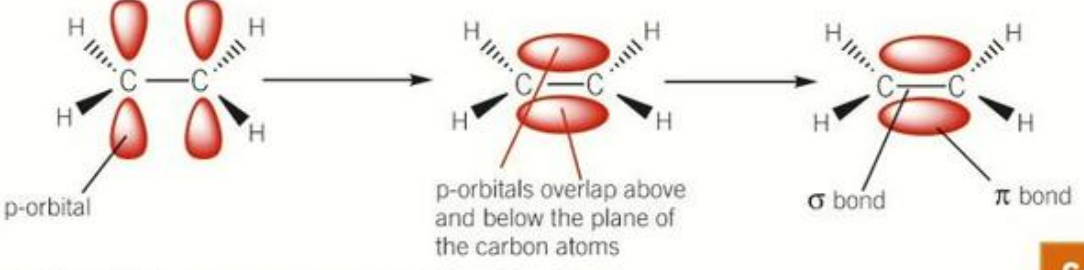
When two p-orbitals overlap sideways, the electron density becomes concentrated in two regions: one above the plane of the carbon-carbon sigma bond and one below it. Each carbon atom contributes one electron to this shared electron pair, creating a region of high electron density that extends above and below the line joining the nuclei of the bonding atoms.
This arrangement is fundamentally different from a sigma bond, where electron density is concentrated directly between the two bonded nuclei along the bonding axis.
Consequences of pi bonding
Important
The pi bond restricts rotation around the carbon-carbon double bond. While atoms connected by only a sigma bond (as in alkanes) can rotate freely relative to each other, the pi bond locks the two carbon atoms in a fixed position. This is because rotating one carbon atom relative to the other would require breaking the sideways overlap of the p-orbitals, which would destroy the pi bond.
This restricted rotation is responsible for the existence of E-Z isomerism (geometric isomerism) in alkenes, where different groups attached to the double bond can be arranged on the same side or opposite sides, creating distinct isomers that cannot interconvert at room temperature.
Molecular geometry around the double bond
Trigonal planar shape
The shape around each carbon atom in the double bond is trigonal planar, which means the three bonded groups around each carbon are arranged in a flat, triangular pattern. This geometry arises because there are three regions of electron density around each carbon atom in the double bond:
- One region from the sigma bond to the other carbon atom
- Two regions from the sigma bonds to the other attached atoms (hydrogen or carbon)
Note
According to electron-pair repulsion theory, regions of electron density arrange themselves to minimize repulsion. Three regions achieve maximum separation when positioned at 120° angles in the same plane.
According to electron-pair repulsion theory, these three regions of electron density repel each other and position themselves as far apart as possible in three-dimensional space. This maximum separation occurs when the three regions are arranged at 120° angles to each other in the same plane.
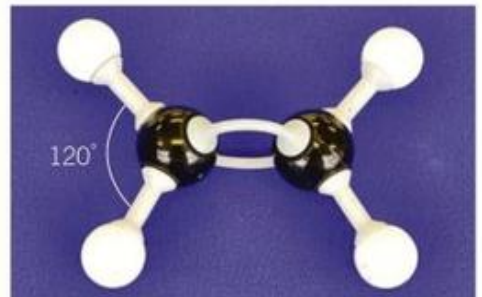
The pi bond doesn't count as a separate region of electron density for determining shape because the pi electron density is simply an extension of the region already created by the sigma bond between the two carbons.
Planar structure
An important consequence of the trigonal planar arrangement around both carbon atoms of the double bond is that all the atoms directly attached to the double bond lie in the same plane. This planar structure, combined with the restricted rotation, makes the geometry around the double bond rigid and fixed.
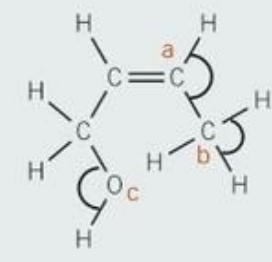
Worked example: Predicting shapes in molecules
Example
Worked Example: Analyzing Molecular Geometry in but-2-en-1-ol
When analyzing molecules that contain both double bonds and other functional groups, we can apply electron-pair repulsion theory to predict shapes around different atoms:
Carbon atom 'a' (in the double bond): This carbon has three bonded regions and no lone pairs, creating a trigonal planar shape with bond angles of 120°.
Carbon atom 'b' (tetrahedral carbon): This carbon has four bonded electron pairs with no lone pairs. The four regions repel each other equally, creating a tetrahedral shape with bond angles of approximately 109.5°.
Oxygen atom 'c': This oxygen has two bonded pairs and two lone pairs (total of four electron pairs). The lone pairs repel more strongly than bonded pairs, compressing the bond angle to approximately 104.5° and creating a non-linear (bent) arrangement around the oxygen.
Alkenes in the natural world
Beta-carotene and pigmentation
Alkenes play fascinating roles in nature, often contributing to colors, scents, and important biological functions. One striking example is the bright pink-orange coloration of flamingo feathers.

Flamingos obtain their distinctive color from their diet. These birds consume algae and crustaceans that contain pigment molecules called carotenoids. In the flamingo's liver, enzymes convert these carotenoids into pink and orange pigments that are then deposited in the growing feathers.
Note
Beta-carotene, the compound responsible for the orange color of carrots, is structurally related to these flamingo pigments. This molecule contains multiple carbon-carbon double bonds (making it highly unsaturated) and serves as a crucial building block that our bodies use to manufacture vitamin A.
The extended system of alternating single and double bonds (called conjugation) in beta-carotene is responsible for its ability to absorb certain wavelengths of light, producing its characteristic orange color.
Limonene in citrus fruits
Another naturally occurring alkene is limonene, a cyclic alkene with the molecular formula . This compound is found naturally in the rinds of citrus fruits such as oranges and lemons, where it serves as the primary contributor to their characteristic smell and flavor.
Limonene's pleasant fragrance has led to its widespread use in perfumes, household cleaning products, and air fresheners. This demonstrates how the chemical properties of alkenes—particularly their distinctive structures and resulting aromas—make them valuable in both nature and commercial applications.
Note
The presence of the double bond in limonene's structure not only contributes to its chemical reactivity but also influences its interaction with odor receptors in the nose, producing the fresh, citrus scent we associate with these fruits.
Key takeaways
Summary
Key Points to Remember:
- Alkenes are unsaturated hydrocarbons containing at least one C=C double bond; simple alkenes follow the general formula
- The C=C double bond consists of a sigma bond (head-on overlap) and a pi bond (sideways overlap of p-orbitals)
- The pi bond creates a region of electron density above and below the plane of the bonding atoms and restricts rotation around the double bond
- Each carbon atom in the double bond has a trigonal planar shape with bond angles of 120° due to three regions of electron density
- All atoms directly attached to the C=C double bond lie in the same flat plane, giving alkenes their characteristic rigid geometry