Stereoisomerism (OCR A-Level Chemistry A): Revision Notes
📚Revision Notes
Stereoisomerism
Introduction to stereoisomers
Stereoisomers are molecules that share identical structural formulas but differ in their three-dimensional spatial arrangement of atoms. This means they have the same atoms bonded together in the same sequence, but these atoms occupy different positions in space.
You will encounter two main types of stereoisomerism in organic chemistry:
- E/Z isomerism – occurs exclusively in molecules containing a carbon-carbon double bond (C=C)
- Optical isomerism – can occur in a much broader range of compounds, including saturated molecules with no functional groups
Note
This topic focuses specifically on E/Z isomerism and its nomenclature systems. Optical isomerism is covered in a separate topic.
E/Z isomerism
The origin of E/Z isomerism
E/Z isomerism arises because rotation around a carbon-carbon double bond is restricted. Unlike single bonds, which allow free rotation, the double bond locks the attached groups in fixed positions relative to each other. This rigidity occurs because of the double bond's electron density distribution above and below the plane of the σ-bond.
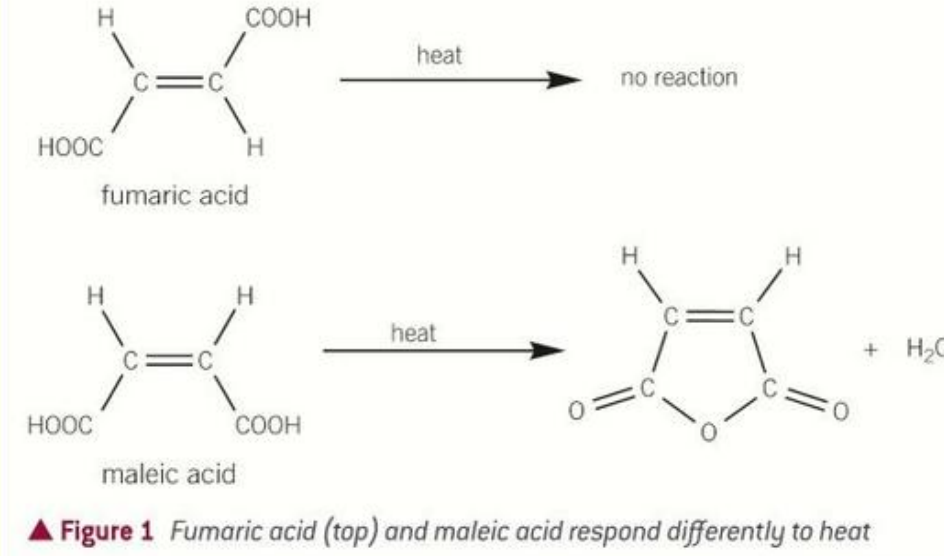
The restriction of rotation means that if different groups are attached to each carbon atom of the double bond, these groups can be arranged in different spatial configurations, creating distinct isomers.
Conditions required for E/Z isomerism
Important
For a molecule to exhibit E/Z isomerism, it must satisfy both of these conditions:
- The molecule must contain a C=C double bond
- Each carbon atom in the double bond must be attached to two different groups
Many students remember the first condition (the double bond) but forget the second. Both conditions are essential for E/Z isomerism to exist.
Example: but-1-ene vs but-2-ene
Consider these two butene isomers:
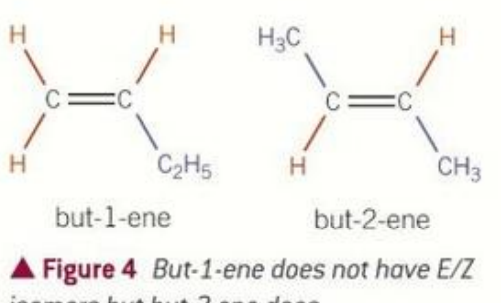
But-1-ene has a terminal double bond (at the end of the carbon chain). The left-hand carbon atom of the double bond is attached to two hydrogen atoms. Because this carbon has two identical groups attached, but-1-ene does not satisfy the second condition. Therefore, but-1-ene cannot exhibit E/Z isomerism.
But-2-ene has an internal double bond. Each carbon atom in the double bond is attached to both a methyl group (CH₃) and a hydrogen atom. Since each carbon has two different groups attached, but-2-ene does satisfy both conditions and can exist as E and Z isomers.
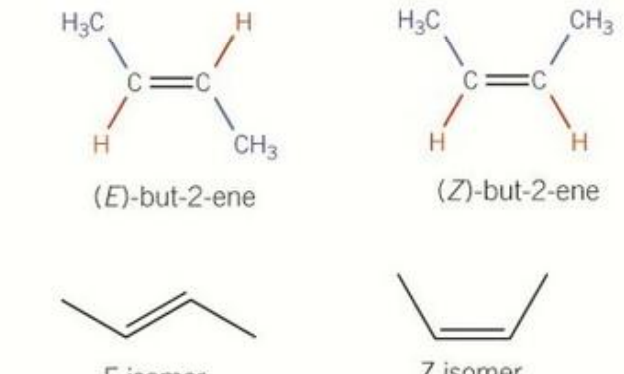
The E and Z notation provides a systematic way to distinguish between these spatial arrangements, which you will learn about in the Cahn-Ingold-Prelog nomenclature section.
Cis-trans isomerism
Understanding cis-trans isomerism
Cis-trans isomerism represents a special case of E/Z isomerism. For the cis-trans naming system to apply, molecules must meet all the requirements for E/Z isomerism, plus one additional criterion:
- One of the attached groups on each carbon atom of the double bond must be hydrogen
This system provides simpler nomenclature when applicable, but it cannot be used for all geometric isomers.
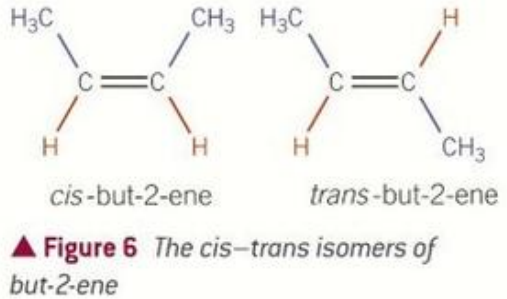
Cis and trans configurations
The terms cis and trans describe the spatial relationship between groups:
- Cis isomer: The hydrogen atoms attached to each carbon of the double bond lie on the same side of the molecule
- Trans isomer: The hydrogen atoms lie diagonally opposite each other across the double bond
Relationship between cis-trans and E/Z nomenclature
When molecules can be named using both systems, there is a direct correspondence:
- The cis isomer is equivalent to the Z isomer
- The trans isomer is equivalent to the E isomer
Note
The E/Z system is more versatile and can be applied to a wider range of molecules, including those where the cis-trans system fails. This is why the Cahn-Ingold-Prelog system was developed.
Cahn-Ingold-Prelog nomenclature
Why a universal naming system was needed
Before 1951, naming geometric isomers around double bonds was inconsistent and confusing. Consider a molecule like 3-methylpent-2-ene:
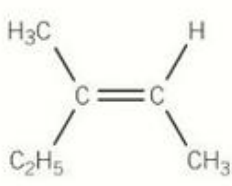
Some chemists would call this molecule cis because the two larger groups (ethyl and isopropyl) appear on the same side. Other chemists would call it trans because the two methyl groups lie on opposite sides diagonally across from each other. This ambiguity made communication difficult.
Robert Sidney Cahn, Christopher Kelk Ingold, and Vladimir Prelog developed a systematic nomenclature system that eliminates this confusion. Their method, now called the Cahn-Ingold-Prelog (CIP) priority rules, assigns priorities to groups based on objective criteria.
The basic principle
Important
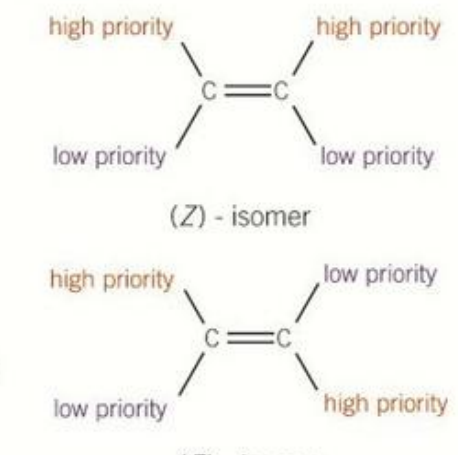
The Cahn-Ingold-Prelog system assigns priorities to atoms attached to each carbon of the double bond according to their atomic number. The atom with the higher atomic number receives the higher priority.

Once priorities are established:
- If the groups of higher priority are positioned on the same side of the double bond, the compound is designated the Z isomer (from German zusammen meaning "together")
- If the groups of higher priority are positioned diagonally opposite each other across the double bond, the compound is designated the E isomer (from German entgegen meaning "opposite")
Assigning priorities to groups
Step 1: Direct comparison of atomic numbers
Begin by examining the atoms directly bonded to each carbon atom of the double bond. Compare their atomic numbers to determine which has higher priority.
The priority sequence for common atoms in organic molecules increases with atomic number:
H < C < N < O < Cl < Br
(Lower priority → Higher priority)
Worked example 1: 2-bromo-1-chloropropene
Example
Worked Example: Determining E/Z Configuration
Consider the molecule 2-bromo-1-chloropropene:
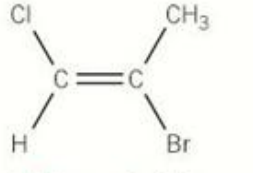
Step 1: Examine the left-hand carbon of the double bond. It is attached to a chlorine atom (Cl, atomic number 17) and a hydrogen atom (H, atomic number 1). Chlorine has the higher atomic number and therefore receives the higher priority.
Step 2: Examine the right-hand carbon of the double bond. It is attached to another carbon atom (C, atomic number 6) and a bromine atom (Br, atomic number 35). Bromine has the higher atomic number and therefore receives the higher priority.
Step 3: Now identify the positions of the two higher-priority groups (Cl and Br). They are located diagonally opposite each other across the double bond.
Step 4: Since the higher-priority groups are diagonally opposite, this molecule is designated (E)-2-bromo-1-chloropropene.
Step 2: Point of difference method
Sometimes the atoms directly attached to the double bond carbons are identical. When this occurs, you must examine the atoms further along each substituent chain until you reach the first point of difference.
The group containing the atom with the higher atomic number at this first point of difference receives the higher priority.
Worked example 2: Allocating group priorities at a point of difference
Example
Worked Example: Using the Point of Difference Method
Consider this molecule:
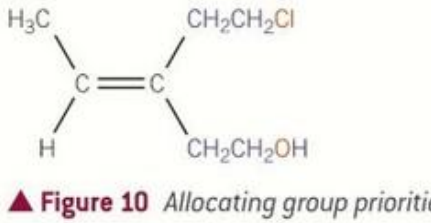
Step 1: On the left-hand carbon atom of the double bond, we compare a carbon atom (from CH₃) with a hydrogen atom. Carbon has the higher atomic number, so the CH₃ group has higher priority than H.
Step 2: On the right-hand carbon atom, the atoms immediately attached to the double bond are both carbon atoms (one from CH₂CH₂Cl and one from CH₂CH₂OH). Since these are identical, we cannot assign priority yet.
Step 3: Continue along both chains to find the first point of difference. In the CH₂CH₂Cl chain, the second carbon is bonded to chlorine (Cl, atomic number 17). In the CH₂CH₂OH chain, the second carbon is bonded to oxygen (O, atomic number 8). This is the first point of difference between the two chains.
Step 4: Chlorine (atomic number 17) has a higher atomic number than oxygen (atomic number 8). Therefore, the CH₂CH₂Cl group receives the higher priority over the CH₂CH₂OH group.
Step 5: Now we can assign the isomer name. The two higher-priority groups (CH₃ on the left and CH₂CH₂Cl on the right) are positioned on the same side of the double bond. Therefore, this molecule is the Z isomer.
Common mistakes to avoid
Important
Common Pitfalls to Watch Out For:
Mistake 1: Forgetting the second condition for E/Z isomerism. Many students remember that a molecule needs a C=C double bond but forget that each carbon must also be attached to two different groups.
Exam tip: When asked whether a structure has E/Z isomerism, always check both conditions systematically.
Mistake 2: Confusing Z with E. Remember: Z = Zame side (high-priority groups together), E = oppositE (high-priority groups apart).
Mistake 3: When using the point of difference method, stopping too early or going too far along the chain. Always stop at the first point where the chains differ.
Mistake 4: Comparing the wrong groups. Always compare the higher-priority group on one carbon with the higher-priority group on the other carbon (not with lower-priority groups).
Remember!
Summary
Key Points to Remember:
-
Stereoisomers have identical structural formulas but different spatial arrangements of atoms in three-dimensional space
-
E/Z isomerism requires TWO conditions: (1) a C=C double bond present, and (2) two different groups attached to each carbon atom of the double bond
-
Restricted rotation around the double bond causes the fixed spatial arrangement that creates geometric isomers
-
Cis-trans isomerism is a special case of E/Z isomerism where one group on each carbon must be hydrogen; cis corresponds to Z and trans corresponds to E
-
Cahn-Ingold-Prelog priority rules assign priorities based on atomic number (higher atomic number = higher priority); if atoms are identical, follow the chain to the first point of difference
-
Z isomer has higher-priority groups on the same side of the double bond; E isomer has higher-priority groups diagonally opposite