Isomerism (OCR A-Level Chemistry A): Revision Notes
📚Revision Notes
Isomerism
Introduction to isomers
When two or more compounds share an identical molecular formula but are actually distinct substances with different properties, we call them isomers. This phenomenon is surprisingly common in organic chemistry and becomes increasingly important as molecules get larger and more complex. Understanding isomerism is essential because it explains why a single molecular formula can represent multiple different compounds with unique characteristics.
Note
Isomerism becomes more prevalent as molecular complexity increases. For instance, the molecular formula has only 2 isomers, but has 75 possible isomers! This demonstrates why understanding how to identify and draw isomers is such a crucial skill in organic chemistry.
There are several categories of isomerism in organic chemistry, but this note focuses specifically on structural isomerism, which is the most fundamental type you'll encounter at A-Level.
Structural isomerism
Structural isomers occur when molecules have the same molecular formula but their atoms are connected in different arrangements. In other words, the atoms are bonded together in a different order or pattern, creating distinct structural formulae even though the overall molecular formula remains identical.
Important
Structural isomers can have significantly different physical and chemical properties despite containing exactly the same atoms. The way atoms are connected makes all the difference to how the molecule behaves. This is why understanding structural arrangements is just as important as knowing molecular formulas.
Types of structural isomerism
There are three main categories of structural isomerism that you need to understand: chain isomerism, positional isomerism, and functional group isomerism. Each type involves a different way of rearranging the atoms while keeping the molecular formula constant.
Note
The Three Types of Structural Isomerism:
- Chain isomerism - Different carbon skeleton arrangements (straight vs. branched chains)
- Positional isomerism - Functional group in different positions on the same carbon chain
- Functional group isomerism - Different functional groups entirely (different homologous series)
A helpful memory aid: "C-P-F" for Chain, Position, Function!
Chain isomerism
Chain isomerism occurs when the carbon skeleton of a molecule can be arranged in different ways. The most common example of this is when a straight carbon chain can be rearranged into a branched structure. This type of isomerism is frequently observed in alkanes and other homologous series.
Consider the molecular formula . This formula doesn't uniquely identify a single structure because there are two possible ways to arrange four carbon atoms and ten hydrogen atoms. You can either arrange the carbons in a straight chain, creating butane (also called n-butane), or you can create a branched structure with three carbons in the main chain and one carbon as a branch, forming 2-methylpropane (also called isobutane).
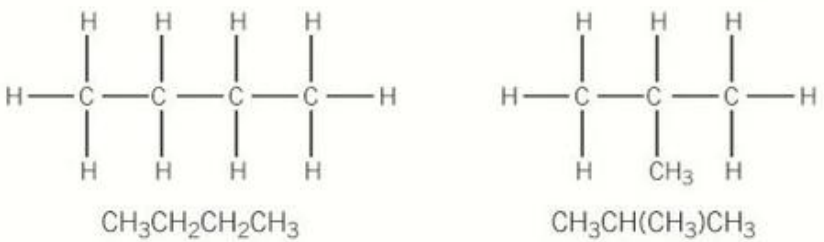
Both molecules contain exactly four carbon atoms and ten hydrogen atoms, but their physical properties differ. For example, butane has a higher boiling point than 2-methylpropane because the straight-chain molecule has a larger surface area for intermolecular forces to act upon.
Positional isomerism
Positional isomerism happens when a functional group can be attached at different positions along the carbon chain. The carbon skeleton remains the same, but the location of the functional group changes, creating distinct isomers.
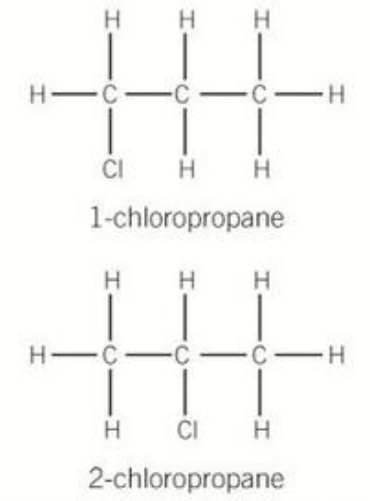
A clear example of positional isomerism can be seen with the molecular formula , which represents chloropropane. The chlorine atom can be attached to either the first carbon or the second carbon of the three-carbon chain. When the chlorine is bonded to the end carbon (carbon-1), the compound is called 1-chloropropane. When the chlorine is bonded to the middle carbon (carbon-2), the compound is called 2-chloropropane.
Note
These two compounds are structural isomers because they have the same molecular formula but different structural arrangements. The position of the chlorine atom affects the molecule's reactivity and physical properties, particularly its rate of substitution reactions.
This concept extends to other functional groups as well. Alcohols provide another excellent example of positional isomerism. The molecular formula can represent four different alcohol isomers, each with the hydroxyl group () attached to a different position on the carbon chain.
Functional group isomerism
Functional group isomerism is perhaps the most dramatic type of structural isomerism because the compounds involved contain completely different functional groups. Despite having the same molecular formula, these molecules belong to different homologous series and therefore exhibit very different chemical properties.
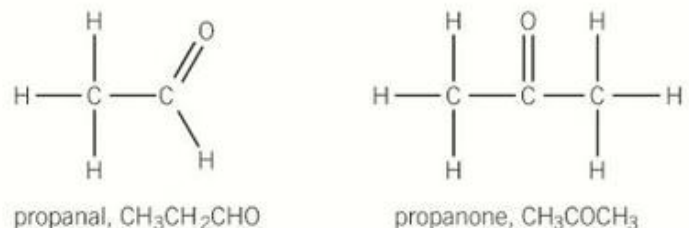
A classic example involves aldehydes and ketones with the same number of carbon atoms. Both aldehydes and ketones contain a carbonyl group (), but in aldehydes this group is located at the end of the carbon chain, while in ketones it's positioned within the chain. When they have the same number of carbon atoms, they share the same molecular formula.
The molecular formula can represent either propanal (an aldehyde) or propanone (a ketone). In propanal, the carbonyl group is attached to a terminal carbon atom, giving it the characteristic aldehyde structure. In propanone, the carbonyl group is attached to the middle carbon atom, creating a ketone structure.
Important
Different Functional Groups = Dramatically Different Chemistry
These two compounds have vastly different chemical behaviours:
- Aldehydes are easily oxidised to carboxylic acids using common oxidising agents like acidified potassium dichromate
- Ketones are resistant to oxidation under the same conditions
This demonstrates how functional group isomerism creates compounds with fundamentally different properties and reactivities.
Worked example: Drawing structural isomers
Example
Worked Example: Drawing All Alcohol Isomers of
Let's work through a systematic approach to drawing all structural isomers of a given molecular formula. We'll use the molecular formula and focus specifically on isomers that are alcohols.
Understanding the task:
We need to draw all possible structures where four carbon atoms, ten hydrogen atoms, and one oxygen atom are arranged to form alcohols. Remember that in alcohols, the oxygen is part of a hydroxyl group () attached to a carbon atom.
Step 1: Identify possible carbon chain arrangements
First, consider the different ways four carbon atoms can be connected. There are two main possibilities:
- A straight chain of four carbons
- A branched chain with three carbons in the main chain and one carbon as a branch
Step 2: Add the hydroxyl group in different positions
For each carbon chain arrangement, place the group on different carbon atoms to generate all possible isomers. The hydroxyl group must be attached to a carbon atom, and each different position creates a new isomer.
Step 3: Draw all possibilities systematically
When you work through this systematically, you'll find there are four structural isomers of that are alcohols:
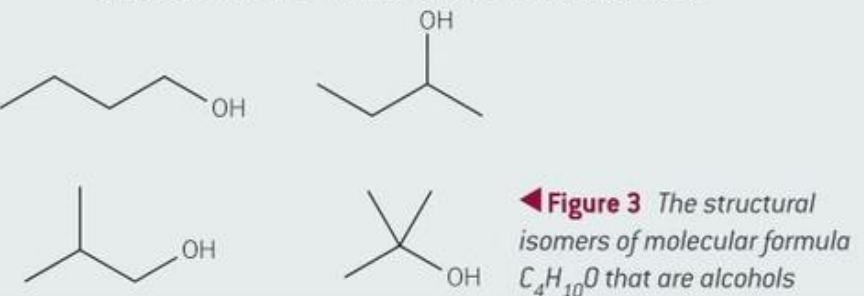
This methodical approach ensures you don't miss any isomers. The key is to first vary the carbon skeleton (chain isomerism) and then vary the position of the functional group (positional isomerism).
Real-world application: Isomers in nature
Isomerism isn't just a theoretical concept—it has real and often surprising consequences in the natural world. One fascinating example involves two structural isomers found in plants: linalool and geraniol. Both compounds have the molecular formula and both are unsaturated alcohols used in perfumes.
Note
The Amazing Difference Between Structural Isomers
Despite having identical molecular formulas and both being alcohols, these two compounds smell completely different:
- Linalool has the characteristic scent of lavender, giving that flower its distinctive aroma
- Geraniol has the smell of roses and is a key component of rose fragrance
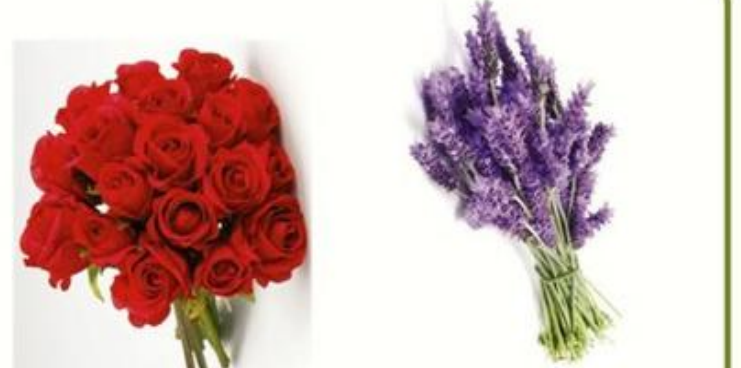
This dramatic difference in smell demonstrates how the arrangement of atoms in a molecule can profoundly affect its properties and interactions with biological receptors. The receptors in your nose detect the specific three-dimensional shape of molecules, which differs between structural isomers even though they contain the same atoms.
The systematic names for these compounds reveal their complex structures:
- Linalool: 3,7-dimethylocta-1,6-dien-3-ol
- Geraniol: 3,7-dimethylocta-2,6-dien-1-ol
This example illustrates why understanding isomerism is crucial in fields like fragrance chemistry, pharmaceuticals, and flavour science, where small structural differences can create enormous changes in how compounds interact with living systems.
Summary
Key Points to Remember:
-
Isomers are different compounds that share the same molecular formula. The same collection of atoms can be arranged in multiple ways to create distinct substances.
-
Structural isomers have the same molecular formula but different structural formulae. This means their atoms are connected in different orders or patterns.
-
There are three main types of structural isomerism:
- Chain isomerism - Different carbon skeleton arrangements (straight vs. branched chains)
- Positional isomerism - Functional group in different positions on the carbon chain
- Functional group isomerism - Different functional groups entirely (different homologous series)
-
To find all structural isomers systematically: First vary the carbon chain arrangement, then vary the position of any functional groups for each chain arrangement.
-
Structural isomers can have very different properties despite containing identical atoms, as demonstrated by linalool and geraniol having completely different smells even though they share the same molecular formula .