Reacting Quantities (OCR A-Level Chemistry A): Revision Notes
📚Revision Notes
Reacting quantities
Introduction to stoichiometry
Stoichiometry is the study of the quantitative relationships between reactants and products in chemical reactions. When we balance a chemical equation, the coefficients (balancing numbers) tell us the mole ratios of each substance involved in the reaction.
Example
Example: Combustion of Hydrogen
In the combustion of hydrogen:
The stoichiometry shows us that:
- 2 moles of hydrogen react with 1 mole of oxygen to produce 2 moles of water
- The mole ratio is 2:1:2
Chemists use stoichiometry to:
- Calculate the quantities of reactants needed to prepare a specific amount of product
- Predict the quantities of products that will form from given amounts of reactants
- Scale reactions up or down as needed
Calculating reacting quantities
When solving stoichiometry problems, we follow a systematic three-step approach that works for most calculations:
Note
The Three-Step Method for Stoichiometry Problems
Step 1: Calculate the amount in moles of the substance you know
Step 2: Use the balanced equation to determine the amount in moles of the unknown substance
Step 3: Calculate the required information (mass, volume, concentration, etc.)
Worked example: calculating mass of product
Example
Worked Example: Calculating Mass of Aluminium Oxide
Let's calculate the mass of aluminium oxide formed when 8.10 g of aluminium completely reacts with oxygen.
Step 1: Calculate the amount of aluminium that reacts
Step 2: Use the balanced equation to find the amount of Al₂O₃ produced

From the equation, 4 moles of Al produce 2 moles of Al₂O₃
Therefore: 0.300 mol of Al produces 0.150 mol of Al₂O₃
Step 3: Calculate the mass of Al₂O₃ formed
Rearranging:
Important
Common Mistake to Avoid
Students often forget to halve the moles when going from 4 mol Al to 2 mol Al₂O₃. Always check the mole ratio carefully!
Worked example: mass, gas volumes, and concentration
Example
Worked Example: Mass, Gas Volumes, and Concentration
This example shows how to calculate both concentration and gas volume from a reaction. Consider the reaction: 0.552 g of lithium reacts with water to form 125 cm³ of lithium hydroxide solution and hydrogen gas.
Step 1: Calculate the amount of lithium that reacts
Step 2: Use the equation to find the amounts of LiOH and H₂ formed

From the equation:
- 0.0800 mol of Li produces 0.0800 mol of LiOH
- 0.0800 mol of Li produces 0.0400 mol of H₂
Step 3: Calculate the concentration of LiOH(aq) and volume of H₂(g)
For concentration of LiOH:
Rearranging:
For volume of H₂ at RTP (room temperature and pressure):
Rearranging:
Note
Key Formula at RTP
1 mole of any gas occupies 24 dm³ (24000 cm³) at room temperature and pressure.
Identifying an unknown metal (practical application)
Stoichiometry can be used to identify unknown substances through experimental measurements. The apparatus below shows how to measure the volume of hydrogen gas produced when a metal reacts with acid:
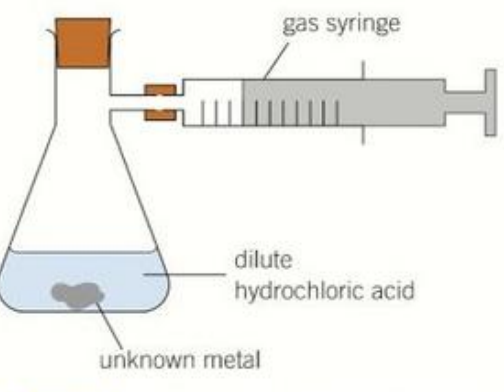
The experimental procedure involves:
- Setting up the gas collection apparatus with a conical flask and gas syringe
- Weighing a sample of the unknown metal and adding it to the flask
- Adding excess dilute hydrochloric acid (e.g., 25.0 cm³ of 1.0 mol dm⁻³)
- Quickly replacing the bung and measuring the maximum volume of gas collected
Example
Worked Example: Identifying an Unknown Group 2 Metal
If 0.14 g of an unknown Group 2 metal X produces 84 cm³ of hydrogen:
Step 1: Calculate moles of H₂ produced
Step 2: Use the equation to find moles of metal X
From the 1:1 mole ratio: 0.00350 mol of H₂ means 0.00350 mol of X reacted
Step 3: Calculate the molar mass
From the periodic table, calcium has a relative atomic mass of 40.1, so X is calcium.
Percentage yield
In real chemical reactions, we rarely obtain the maximum possible amount of product. The theoretical yield is the maximum amount of product that could form if the reaction went to completion with perfect efficiency.
However, the actual yield obtained is usually lower due to several factors:
Note
Factors Affecting Percentage Yield
- Incomplete reactions - the reaction may not have gone to completion
- Side reactions - other unwanted reactions may occur alongside the main reaction, consuming some reactants
- Product loss during purification - some product may be lost when separating and purifying it
The percentage yield allows us to compare the efficiency of different reactions:
Worked example: percentage yield calculation
Example
Worked Example: Percentage Yield Calculation
Calculate the percentage yield when 1.15 g of sodium reacts with excess chlorine to form 1.872 g of sodium chloride.
Step 1: Calculate moles of sodium
Step 2: Calculate theoretical yield of NaCl in moles

From the 2:2 mole ratio, 0.0500 mol of Na should produce 0.0500 mol of NaCl (theoretical yield)
Step 3: Calculate actual yield of NaCl in moles
Step 4: Calculate percentage yield
Important
Exam Tip: Using Moles for Percentage Yield
Always use moles (not masses) when calculating percentage yield, unless specifically told otherwise. This avoids errors from different molar masses.
The limiting reagent
When two or more reactants are mixed, one reactant is often added in excess to ensure the other reacts completely. The reactant that is not in excess is called the limiting reagent - it gets completely used up first and stops the reaction.
The limiting reagent determines the maximum amount of product that can form, so all calculations must be based on this reagent.
Identifying the limiting reagent
If you're not told which reactant is in excess, you need to calculate the moles of each reactant and compare them with the stoichiometry of the equation.
Example
Example: Hydrogen and Oxygen Reaction
When hydrogen and oxygen react to form water:
The equation shows that 2 moles of H₂ are required for every 1 mole of O₂.
If equal molar amounts of hydrogen and oxygen are allowed to react:
- Hydrogen will be used up completely first
- Half the oxygen will remain unreacted
- Hydrogen is the limiting reagent
Important
Exam Tip: Identifying the Limiting Reagent
Questions often state which reactant is "in excess" to help you identify the limiting reagent. Always base your calculations on the limiting reagent.
Atom economy
Atom economy is a measure of how efficiently atoms are used in a chemical reaction. It indicates the proportion of reactant atoms that end up in the desired product rather than in waste products.
Reactions with high atom economy:
- Produce a large proportion of desired products with few unwanted waste products
- Are important for sustainability as they make the best use of natural resources
- Are more economical and environmentally friendly
The atom economy is calculated using:
Note
Important Notes About Atom Economy
- It's calculated from the balanced equation only (theoretical calculation)
- It assumes 100% yield
- Unlike percentage yield, no experimental results are needed
- The denominator includes ALL products, not just the desired ones
Worked example: atom economy
Example
Worked Example: Atom Economy for Hydrogen Production
Hydrogen is produced industrially from the reaction of carbon with steam:
Step 1: Write the equation and calculate molar masses
Products:
- Desired product: 2H₂ with total molar mass = 2 × 2.0 = 4.0
- All products: 2H₂ + CO₂ with total molar mass = 4.0 + 44.0 = 48.0
Step 2: Calculate atom economy
Important
Remember: Account for Coefficients
When balancing numbers appear in the equation, you must account for them when calculating total molar masses. Here, the coefficient 2 means we have 2 × 2.0 = 4.0 g mol⁻¹ of hydrogen.
Sustainability considerations
The worked example above reveals a poor atom economy of only 8.3%. This means:
- Only 8.3% of the reactant atoms end up in the desired hydrogen product
- 91.7% ends up as carbon dioxide waste
- Assuming 100% yield, the actual overall efficiency will be even lower
- Carbon dioxide is a greenhouse gas contributing to global warming
Note
Factors Beyond Atom Economy
However, atom economy is only part of the sustainability picture:
- The reactants (carbon from coal, steam from water) are readily available and relatively cheap
- Energy is needed to produce steam, adding to costs
- Other reactions may have higher atom economy but lower percentage yields
- Both factors must be considered together when assessing industrial processes
In an ideal sustainable chemical process:
- All products would be useful (100% atom economy)
- Raw materials would be efficiently converted (high percentage yield)
- Waste would be minimized and safely processed
Improving atom economy makes industrial processes more efficient, preserves raw materials, and reduces harmful waste production.
Summary
Key Points to Remember
- Stoichiometry shows mole ratios from balanced equations - these ratios are key to all reacting quantity calculations
- The three-step method: (1) calculate moles of known substance, (2) use equation to find moles of unknown, (3) calculate required information
- At RTP: one mole of any gas occupies 24 dm³ (24000 cm³)
- Percentage yield = (actual yield / theoretical yield) × 100% - it's always less than 100% in real reactions due to incomplete reactions, side reactions, and losses during purification
- Limiting reagent is the reactant that gets used up completely - all calculations must be based on this reagent
- Atom economy = (molar mass of desired products / molar mass of all products) × 100% - calculated from the balanced equation assuming 100% yield; high atom economy is important for sustainability
Exam focus checklist
✓ Can you balance equations and identify stoichiometric ratios?
✓ Can you convert between mass, moles, and molar mass using ?
✓ Can you calculate gas volumes at RTP using (in cm³)?
✓ Can you identify the limiting reagent when given amounts of multiple reactants?
✓ Do you know the difference between theoretical and actual yield?
✓ Can you calculate percentage yield from experimental data?
✓ Can you calculate atom economy from a balanced equation?
✓ Can you explain why atom economy and percentage yield are both important for sustainability?