Amino Acids, Amides and Chirality (OCR A-Level Chemistry A): Revision Notes
📚Revision Notes
Amino acids, amides and chirality
Amino acids
Structure and general formula
Amino acids are organic molecules that serve as the fundamental building blocks of proteins. Each amino acid contains two essential functional groups:
- An amine group ()
- A carboxylic acid group ()
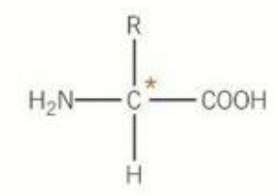
The human body utilizes 20 common amino acids for protein synthesis. These are classified as α-amino acids because the amine group is attached to the α-carbon atom (the carbon adjacent to the carboxylic acid group).
Note
The prefix "α" (alpha) indicates that the amine group is attached to the first carbon atom next to the carboxylic acid group. This positioning is crucial for protein formation and distinguishes these amino acids from β-amino acids (amine on third carbon) or γ-amino acids (amine on fourth carbon).
The general formula for an α-amino acid can be written as:
where R represents the side chain that differs between amino acids. Less common amino acids exist where the amine group is connected to the β-carbon (third carbon) or γ-carbon (fourth carbon) atoms.
Chemical properties of amino acids
Because amino acids possess both an acidic carboxylic acid group and a basic amine group, they exhibit dual chemical behaviour and can react with both acids and bases. This amphoteric nature makes them versatile in biological systems.
Note
Amphoteric Behaviour
The ability to react with both acids and bases makes amino acids excellent biological buffers. The amine group can accept protons (acting as a base), while the carboxylic acid group can donate protons (acting as an acid). This dual functionality is essential for maintaining pH balance in biological systems.
Reactions of amino acids
Reactions of the amine group
The amine group in amino acids is basic and readily accepts protons from acids. When an amino acid reacts with an acid, a salt forms through protonation of the amine group.
Example
Worked Example: Reaction of Alanine with Hydrochloric Acid
When alanine (2-aminopropanoic acid) reacts with hydrochloric acid, an ammonium salt is produced:

The reaction can be represented as:
The amine group gains a proton to form , creating a positively charged ion that pairs with the negative chloride ion.
Important
Remember: The amine group gains a proton to form , creating a positively charged ion that pairs with the negative chloride ion. This is a common exam question where students may forget to add the positive charge.
Reactions of the carboxylic acid group
The carboxylic acid group in amino acids undergoes typical acid reactions, forming salts with bases and esters with alcohols.
Reaction with aqueous alkalis
When an amino acid reacts with an aqueous alkali such as sodium hydroxide or potassium hydroxide, a salt and water are formed. The carboxylic acid group is deprotonated.
Example
Worked Example: Glycine Reacting with Sodium Hydroxide
Glycine (aminoethanoic acid) reacts with sodium hydroxide:
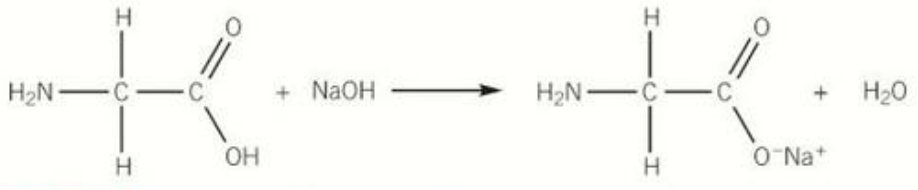
The general equation is:
The carboxylic acid group loses a proton (H⁺) to form the carboxylate ion (), which pairs with the sodium ion ().
Esterification with alcohols
Amino acids undergo esterification when heated with an alcohol in the presence of concentrated sulfuric acid as a catalyst. The carboxylic acid group is converted to an ester while the amine group becomes protonated under the acidic conditions.

Example
Worked Example: Esterification of Serine
When serine reacts with excess ethanol and a catalytic amount of sulfuric acid:
The carboxylic acid group forms an ester linkage with ethanol, while the acidic conditions protonate the amine group to form .
Important
Common Mistake to Avoid
Students often forget that the acidic conditions protonate the basic amine group, so the product contains rather than . Always remember that concentrated sulfuric acid creates an acidic environment that will protonate any basic groups present.
Zwitterions and the isoelectric point
Zwitterion formation
Within an amino acid molecule, an internal proton transfer can occur from the acidic carboxylic acid group to the basic amine group. This forms a dipolar ion called a zwitterion, which contains both positive and negative charges on the same molecule.
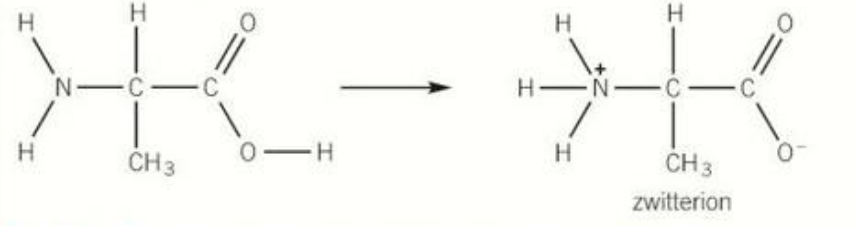
The transformation can be shown as:
Note
Zwitterions have no overall charge because the positive and negative charges cancel out. This internal salt structure is the predominant form of amino acids in neutral aqueous solution. The term "zwitterion" comes from the German word "zwitter," meaning hybrid or hermaphrodite, reflecting its dual charged nature.
The isoelectric point
The isoelectric point (pI) is the specific pH value at which an amino acid exists predominantly as a zwitterion with no net electrical charge. Each amino acid has its own characteristic isoelectric point.
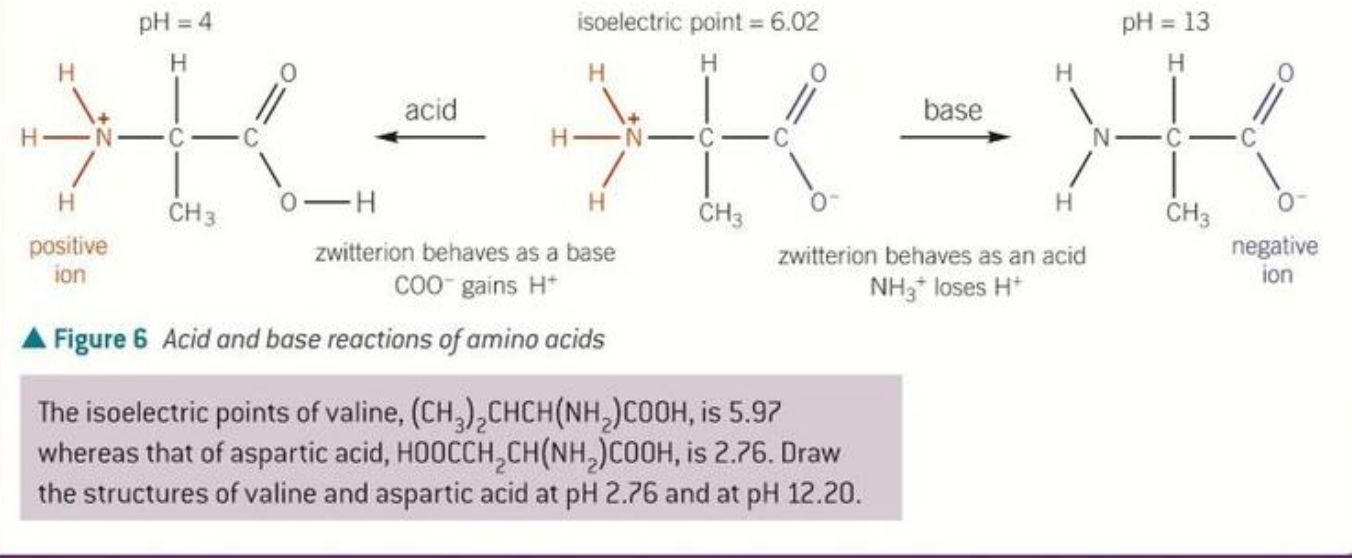
The behaviour of amino acids at different pH values:
Important
pH-Dependent Behaviour of Amino Acids
At pH below the isoelectric point:
- The solution is acidic
- The amino acid acts as a base and gains a proton
- The carboxylate group () is protonated to form
- The molecule carries a net positive charge:
At the isoelectric point:
- The amino acid exists as a zwitterion
- The molecule has both and groups
- No net charge:
At pH above the isoelectric point:
- The solution is basic
- The amino acid acts as an acid and loses a proton
- The ammonium group () is deprotonated to form
- The molecule carries a net negative charge:
Example
Worked Example: pH and Amino Acid Forms
The isoelectric point of valine is 5.97, while aspartic acid has an isoelectric point of 2.76.
- At pH 2.76, aspartic acid exists predominantly as a zwitterion
- At pH 12.20, aspartic acid would exist as a negatively charged species because the pH is well above its isoelectric point
This demonstrates how the same amino acid can exist in different ionic forms depending on the pH of its environment.
Amides
Structure and classification
Amides are formed when acyl chlorides react with ammonia or amines. In biological systems, amide groups (also called peptide bonds) link amino acids together in proteins.
Note
Amide Classification System
Amides are classified based on the number of carbon atoms bonded to the nitrogen atom. This classification is important for understanding their chemical properties and reactivity:
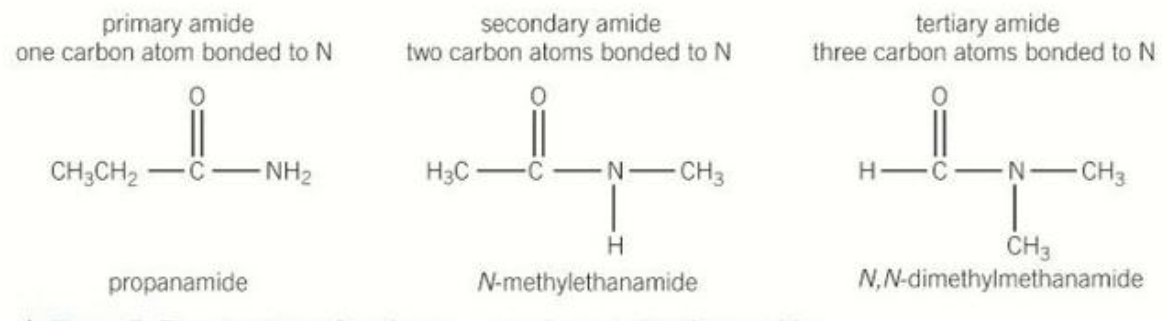
Primary amides:
- One carbon atom bonded to nitrogen
- General structure:
- Example: propanamide,
Secondary amides:
- Two carbon atoms bonded to nitrogen
- One N-H bond remains
- General structure:
- Example: N-methylethanamide,
Tertiary amides:
- Three carbon atoms bonded to nitrogen
- No N-H bonds
- General structure:
- Example: N,N-dimethylmethanamide,
Important
Classification Tip
The classification depends on how many carbon atoms are directly bonded to the nitrogen, not the total number of carbons in the molecule. Always count the carbonyl carbon as one of these. This is a common source of confusion in exams.
Optical isomerism and chirality
Understanding stereoisomerism
Stereoisomers are molecules with the same structural formula but different three-dimensional arrangements of atoms in space. Optical isomerism is a type of stereoisomerism that occurs in molecules containing a chiral centre.
Chiral centres
A chiral centre (or chiral carbon atom) is a carbon atom bonded to four different atoms or groups. The presence of a chiral centre in a molecule leads to the existence of two non-superimposable mirror image structures called optical isomers or enantiomers.
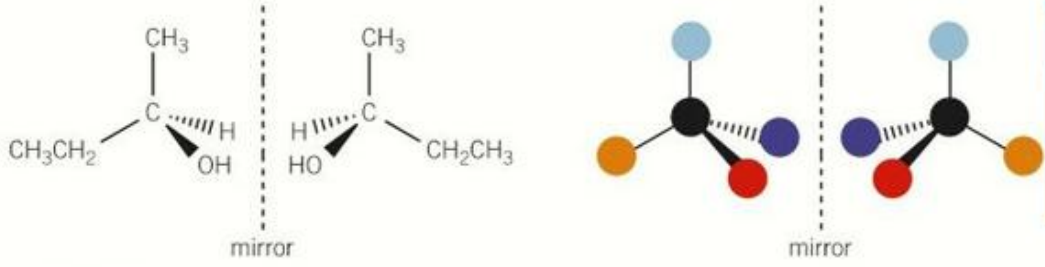
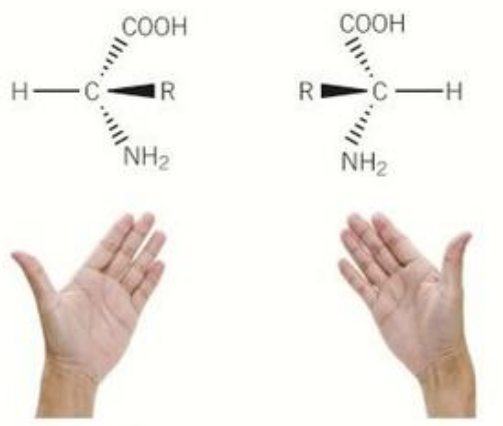
For each chiral carbon atom, there is always exactly one pair of enantiomers. These two molecules are mirror images of each other but cannot be superimposed, just like left and right hands.
Important
Understanding Chirality
Chirality is not limited to carbon atoms. Any centre that holds attachments arranged in two non-superimposable mirror image forms exhibits chirality.
The analogy with hands helps understand this concept - optical isomers are like right- and left-handed forms, where one cannot be superimposed on the other. No matter how you rotate your right hand, it will never look exactly like your left hand when placed on top of it.
Chirality in α-amino acids
With the exception of glycine (), all α-amino acids contain a chiral carbon atom. The general formula shows that the α-carbon is bonded to four different groups:
- An amino group ()
- A carboxylic acid group ()
- A hydrogen atom (H)
- A variable side chain (R)
Note
This chiral centre is marked with an asterisk (*) in structural diagrams to help identify it quickly. Glycine is the only α-amino acid that is NOT chiral because its R group is simply another hydrogen atom, meaning the α-carbon is bonded to two identical groups (two hydrogen atoms).
Chiral carbon atoms are found widely in naturally occurring organic molecules. All sugars, proteins, and nucleic acids contain multiple chiral centres, which is crucial for their biological function.
Biological importance of chirality
Optical isomers can have dramatically different biological properties. This occurs because chiral molecules interact differently with receptor sites in our bodies, which are themselves chiral.
Example
Real-World Examples of Chirality in Biology
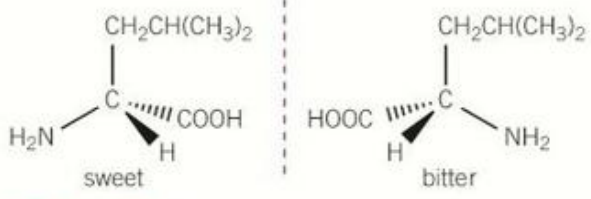
Leucine enantiomers and taste: The two enantiomers of the amino acid leucine have different tastes - one isomer tastes sweet while its mirror image tastes bitter. This demonstrates how our sensory receptors can distinguish between optical isomers.
Carvone enantiomers and smell: Carvone exists as two optical isomers depending on its natural source. One enantiomer has the smell of caraway seeds, while the other smells of mint. This difference arises from how each isomer interacts with different receptor sites in our noses.
Pharmaceutical applications: Many drugs exist as optical isomers, and often only one isomer has the desired therapeutic effect. This is why pharmaceutical companies must carefully control which optical isomer is present in medications. In some cases, one enantiomer is therapeutic while the other may be inactive or even harmful.
Drawing optical isomers
Optical isomers are drawn to show the three-dimensional tetrahedral arrangement of the four different groups around the central chiral carbon atom. Once one isomer has been drawn, the other isomer is drawn as a mirror image, reflecting the first structure.
For butan-2-ol (), the two optical isomers show the mirror image arrangement of the four groups (methyl, ethyl, hydrogen, and hydroxyl) around the chiral carbon.
Note
Drawing Technique for Optical Isomers
- Draw one isomer showing the 3D tetrahedral arrangement using wedges (bonds coming toward you) and dashes (bonds going away from you)
- Draw a vertical dashed line to represent a mirror
- Draw the second isomer as the mirror image of the first
- Ensure all bond angles and positions are reflected accurately
The key is to swap the positions of the groups on either side of the mirror line while maintaining the correct 3D perspective.
Identifying chiral carbon atoms
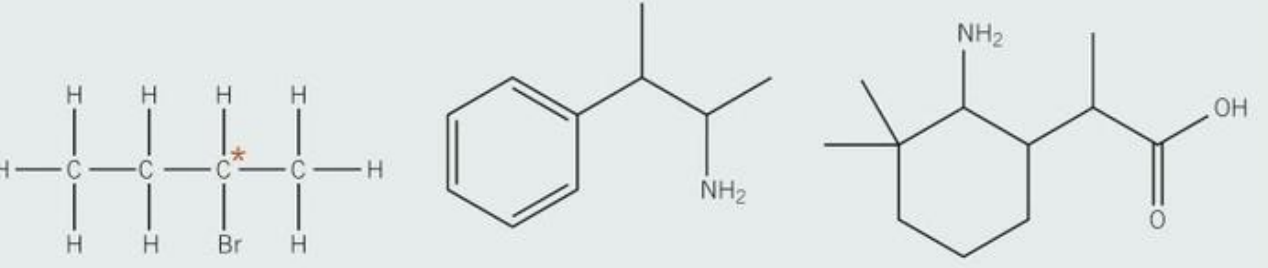
To identify chiral centres in any organic molecule, follow this systematic approach:
Step 1: Look for carbon atoms in the molecule
- Remember that hydrogen atoms are often not shown in skeletal structures but are still present
Step 2: Check each carbon atom to see if it is bonded to four different atoms or groups
- If a carbon has four different groups attached, it is chiral
- Mark chiral carbon atoms with an asterisk (*)

Important
Common Mistakes to Avoid When Identifying Chiral Centres
- Don't label carbon atoms that have two identical groups (e.g., two methyl groups) as chiral centres
- Be careful with cyclic structures where the ring attachment counts as one group
- In skeletal structures, remember that unlabeled vertices represent carbon atoms with hydrogen atoms attached
- Double-check that all four groups are genuinely different - sometimes groups that appear different at first glance may actually be the same when you trace them through the structure
Note
Systematic Approach for Exams
When identifying chiral centres, systematically work through each carbon in the molecule. Check whether all four groups attached to each carbon are different. If you're unsure, write out the full structural formula to see all the groups clearly. This methodical approach will help you avoid missing chiral centres or incorrectly identifying non-chiral carbons.
Summary
Key Points to Remember
• Amino acid structure: All α-amino acids (except glycine) have the general formula and contain both an amine and carboxylic acid functional group on adjacent carbons.
• Amphoteric behaviour: Amino acids react with both acids (amine group gains H⁺) and bases (carboxylic acid group loses H⁺), and can be esterified with alcohols under acidic conditions.
• Zwitterions: At their isoelectric point, amino acids exist as dipolar ions with both and groups, having no overall charge. The predominant ionic form changes with pH.
• Amide classification: Amides are classified as primary, secondary, or tertiary based on the number of carbon atoms bonded directly to the nitrogen atom (one, two, or three respectively).
• Chirality and optical isomers: A chiral centre is a carbon bonded to four different groups, resulting in two non-superimposable mirror image molecules (enantiomers). All α-amino acids except glycine contain a chiral centre at the α-carbon.
• Biological significance: Optical isomers can have dramatically different biological properties because they interact differently with chiral receptor sites in living organisms.