Condensation Polymers (OCR A-Level Chemistry A): Revision Notes
📚Revision Notes
Condensation polymers
Introduction to condensation polymerisation
Condensation polymerisation is a process where monomers join together to form a polymer, with the elimination of a small molecule at each linkage. This small molecule is usually water () or hydrogen chloride ().
Note
Key difference from addition polymerisation: Condensation polymerisation requires monomers to have two different functional groups, whereas addition polymerisation involves monomers with double bonds.
The two main types of condensation polymers are:
- Polyesters - joined by ester linkages
- Polyamides - joined by amide linkages
Both of these polymers are produced on an industrial scale and have numerous practical applications. Carboxylic acids and their derivatives are the common starting materials for making these polymers.
Polyesters
Polyesters are formed when monomers join together through ester linkages. The polymer chain is created by repeated esterification reactions between functional groups on the monomers.
Polyesters from one monomer with two functional groups
When making a polyester from a single monomer, that monomer must contain both a hydroxyl group () and a carboxyl group (). This allows the molecule to react with itself to form the polymer chain.
Poly(glycolic acid) (PGA)
Glycolic acid () is the simplest monomer used to make this type of polyester. It contains both a hydroxyl group and a carboxyl group on the same molecule.
During polymerisation, the carboxylic acid group of one glycolic acid molecule reacts with the alcohol group of another glycolic acid molecule. This condensation reaction forms an ester linkage and releases a water molecule.
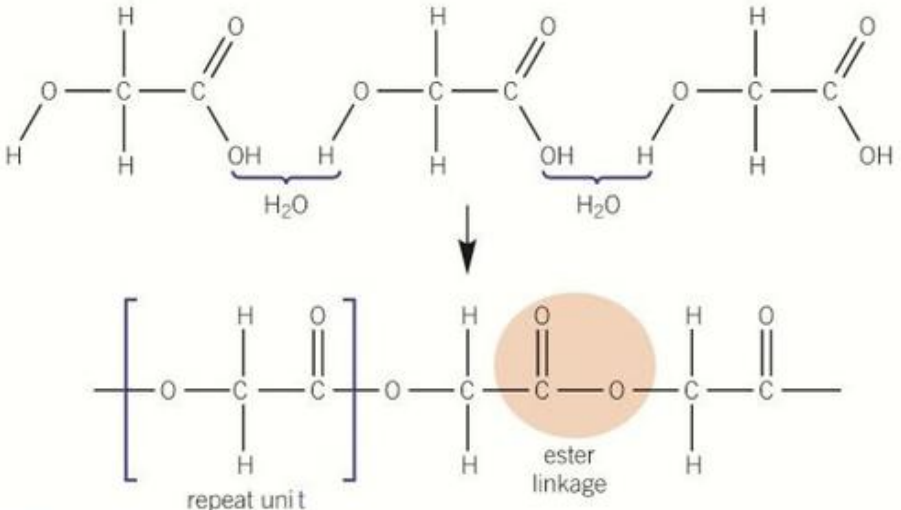
The reaction continues along the chain, with each esterification releasing water. The resulting polymer contains a repeating unit that includes both the ester linkage and the carbon backbone from the original monomer.
Poly(lactic acid) (PLA)
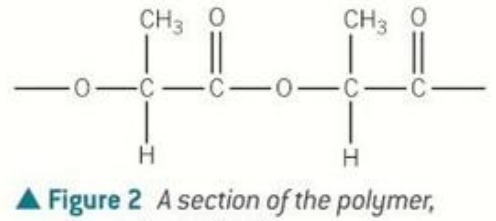
Lactic acid () also undergoes condensation polymerisation to form poly(lactic acid). The structure is similar to PGA but with an additional methyl group.
Note
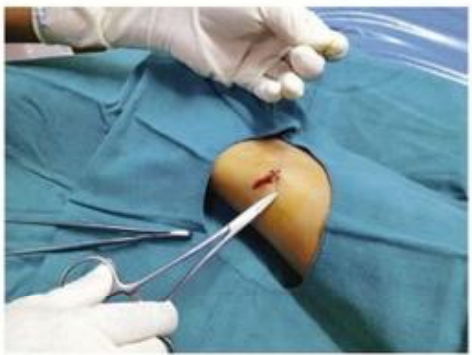
Both PLA and PGA are biodegradable polymers, meaning they can be broken down naturally by microorganisms. Lactic acid is derived from maize (corn), making PLA production much more sustainable than polymers derived from fossil fuels. These polymers have important medical applications, particularly in dissolvable surgical sutures.
Polyesters from two monomers each with two functional groups
This type of polyester requires two different monomers:
- A diol - containing two hydroxyl groups ()
- A dicarboxylic acid - containing two carboxyl groups ()
Terylene (Polyethylene terephthalate or PET)
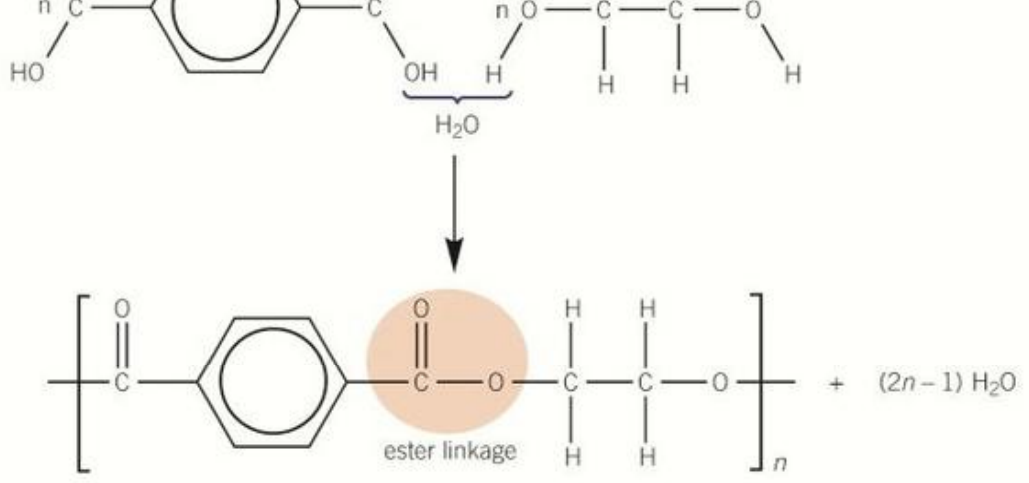
Terylene is made from the condensation reaction between:
- Benzene-1,4-dicarboxylic acid ()
- Ethane-1,2-diol ()
During the condensation reaction, a hydroxyl group on the diol reacts with a carboxyl group on the dicarboxylic acid, forming an ester linkage and releasing water.
Terylene (often shortened to PET) has diverse applications ranging from clothing fibres to plastic bottles. Polyesters are also widely used for electrical insulation.
[IMAGE
]Alternative synthesis using diacyl chlorides
Note
Polyesters can also be made using a diacyl chloride instead of a dicarboxylic acid. In this case, hydrogen chloride () is eliminated instead of water during the condensation reaction.
Polyamides
Polyamides are condensation polymers where monomers are joined together by amide linkages (also called peptide bonds in biological contexts). Like polyesters, polyamides can be formed from either one monomer or two different monomers.
Polyamides from one monomer with two functional groups
Amino acids and proteins
Amino acids are molecules that contain both an amine group () and a carboxylic acid group (). When amino acids undergo condensation polymerisation, they form polypeptides or proteins.
During protein formation, the carboxyl group of one amino acid reacts with the amine group of another amino acid. This condensation reaction forms an amide bond (peptide bond) and releases a water molecule.
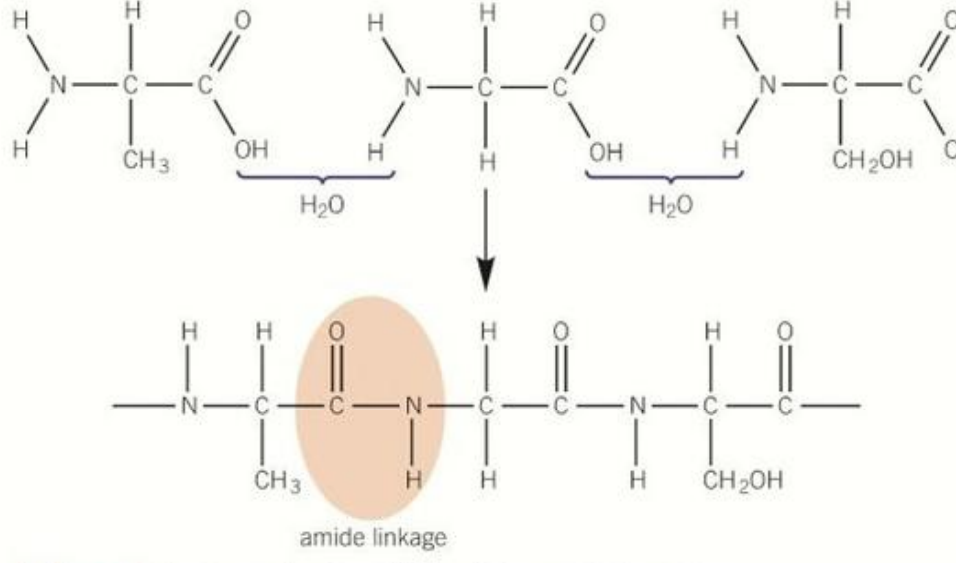
Note
A protein is a long chain polymer containing many different amino acids all linked together by amide bonds. Natural proteins contain 20 different amino acids arranged in specific sequences.
Polyamides from two monomers each with two functional groups
This type of polyamide formation requires:
- A dicarboxylic acid (or diacyl chloride) - containing two carboxyl groups
- A diamine - containing two amine groups
Nylon
Nylon is a synthetic polyamide with high strength properties. It can be manufactured in different forms by varying the carbon chain length in the monomers.
Nylon from dicarboxylic acid and diamine:
Nylon can be synthesised from hexanedioic acid and 1,6-diaminohexane. The condensation reaction occurs when an amine group on one monomer reacts with a carboxyl group on the other monomer, forming an amide bond and releasing water.
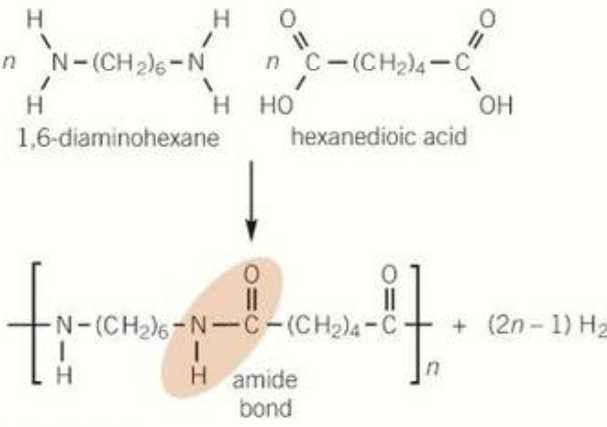
Nylon from diacyl chloride and diamine:
Note
Alternatively, nylon can be made from hexanedioyl chloride and 1,6-diaminohexane. In this reaction, hydrogen chloride is eliminated instead of water.
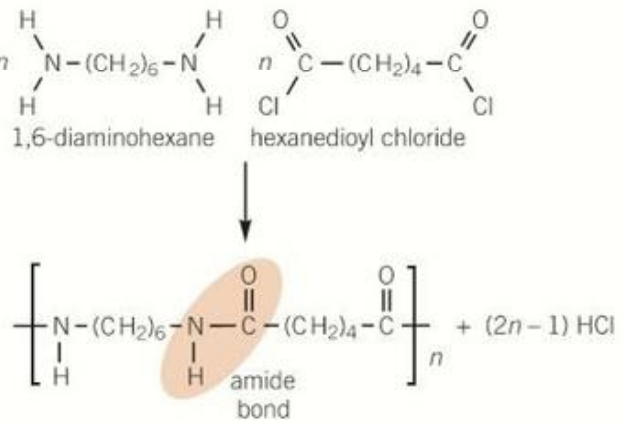
Nylon has been used for making fishing nets, ropes, parachutes, and fabrics. It has also been used for classical guitar strings since the mid-1940s.

Hydrolysis of condensation polymers
Condensation polymers can be broken down by hydrolysis reactions. Hydrolysis is the reverse of condensation - water is added back to break the linkages in the polymer chain.
Important
Both acid hydrolysis (using hot aqueous acid like ) and base hydrolysis (using hot aqueous alkali like ) can be used to break down condensation polymers.
Hydrolysis of polyesters
Poly(Trimethylene Terephthalate) (PTT)
PTT is a polyester used in carpets and clothing fabrics. When PTT undergoes hydrolysis, the ester linkages are broken.
Base hydrolysis: Using produces the sodium salt of the dicarboxylic acid and the diol.
Acid hydrolysis: Using produces the dicarboxylic acid and the diol.
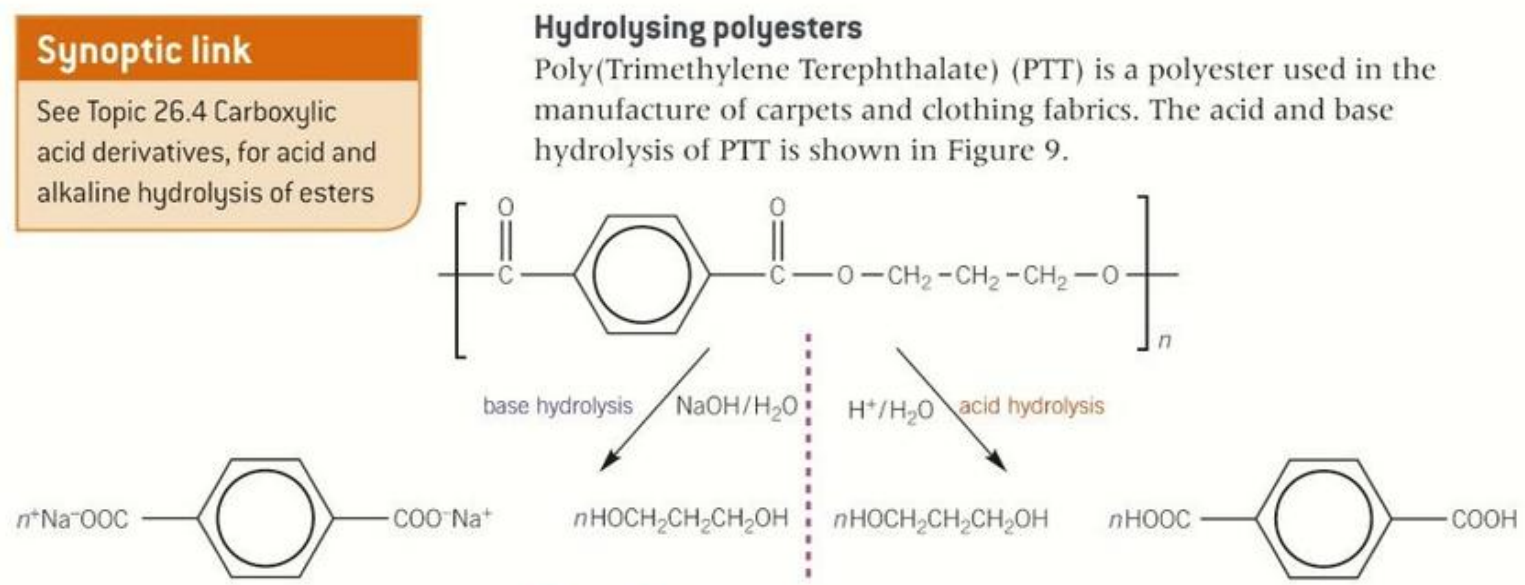
Hydrolysis of polyamides
Nomex
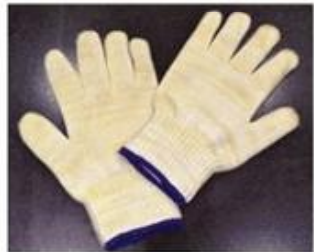
Nomex is a synthetic heat and fire-retardant polyamide used in oven gloves and fire-protective suits for Formula 1 racing drivers and pit crews.
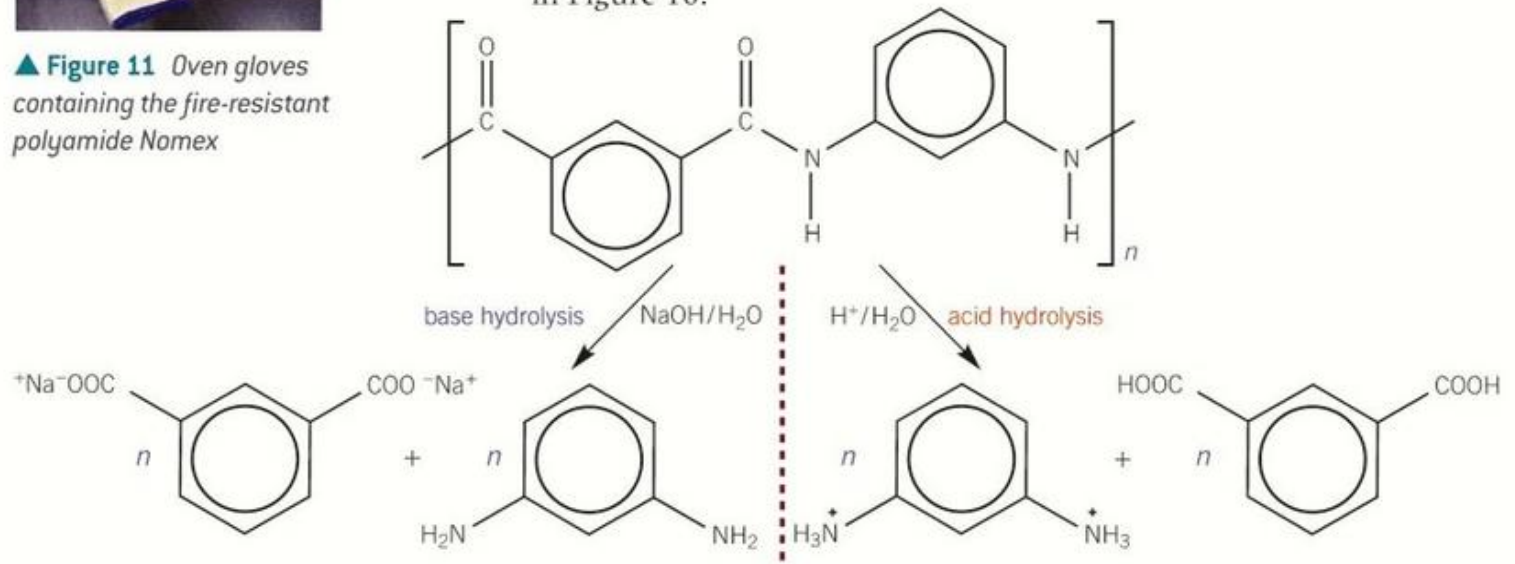
When Nomex undergoes hydrolysis, the amide linkages are broken:
Base hydrolysis: Using produces the sodium salt of the dicarboxylic acid and the diamine.
Acid hydrolysis: Using produces the dicarboxylic acid and the diammonium salt (diamine in protonated form).
Identifying monomers and repeat units in polymers
You need to be able to identify whether a polymer was formed by addition or condensation polymerisation, and to determine the monomers and repeat units.

| Type | Characteristics | Example monomer(s) |
|---|---|---|
| Addition polymerisation | Monomer contains a double bond. Backbone of polymer is a continuous chain of carbon atoms. | |
| Condensation polymerisation | Two monomers, each with two functional groups, OR one monomer with two different functional groups. Polymer contains ester or amide linkages. | and OR |
Key identification tips:
-
Check the polymer backbone:
- Continuous carbon chain → addition polymer
- Contains ester () or amide () linkages → condensation polymer
-
For condensation polymers, identify the linkage type:
- Ester linkages → polyester
- Amide linkages → polyamide
-
Identify the repeat unit:
- The repeat unit is the smallest section that repeats along the polymer chain
- It should be bracketed with open bonds at each end to show continuation
- For condensation polymers, the repeat unit includes the linkage (ester or amide bond)
-
Determine the monomers:
- For polyesters: identify the diol and dicarboxylic acid (or single monomer with both groups)
- For polyamides: identify the diamine and dicarboxylic acid (or amino acid)
- Add back the water that was eliminated during polymerisation
Important
Common exam mistakes:
- Forgetting that condensation polymers eliminate a small molecule
- Not recognizing ester and amide linkages in polymer structures
- Drawing incorrect repeat units without proper open bonds at each end
- Confusing the functional groups needed for each type of polymer
Summary
Key Points to Remember:
- Condensation polymerisation involves joining monomers with the loss of a small molecule (usually water or HCl), requiring two different functional groups
- Polyesters contain ester linkages () formed from alcohols and carboxylic acids
- Polyamides contain amide linkages () formed from amines and carboxylic acids
- Both polyesters and polyamides can be hydrolysed using hot aqueous acid or alkali to break them down into their monomers
- To identify polymer type, look for ester/amide linkages (condensation) or continuous carbon backbone (addition)
- The repeat unit is the smallest repeating section and should show open bonds at each end