Disubstitution and Directing Groups (OCR A-Level Chemistry A): Revision Notes
📚Revision Notes
Disubstitution and Directing Groups
Introduction to disubstitution
When a benzene ring already has one substituent attached to it, further electrophilic substitution reactions can occur. This is called disubstitution because the benzene ring ends up with two substituent groups.
Some substituted aromatic compounds react more readily than benzene itself when undergoing a second substitution. In contrast, other substituted benzenes react less easily and require more extreme conditions (such as higher temperatures or longer reaction times).
Note
The reactivity of a substituted benzene ring depends entirely on the nature of the first substituent. This determines both how easily the second substitution occurs and where the new substituent will attach to the ring.
Activation and deactivation of the benzene ring
The ease with which a substituted benzene undergoes further electrophilic substitution depends on the nature of the first substituent already present on the ring.
Activating groups
An activating group increases the reactivity of the benzene ring toward electrophiles. This means the ring reacts more readily than benzene itself.
Example
Example: Rapid Bromination of Phenylamine
Phenylamine (aniline) contains an amino group () which activates the benzene ring. When phenylamine reacts with bromine, the reaction happens rapidly without needing a halogen carrier catalyst:
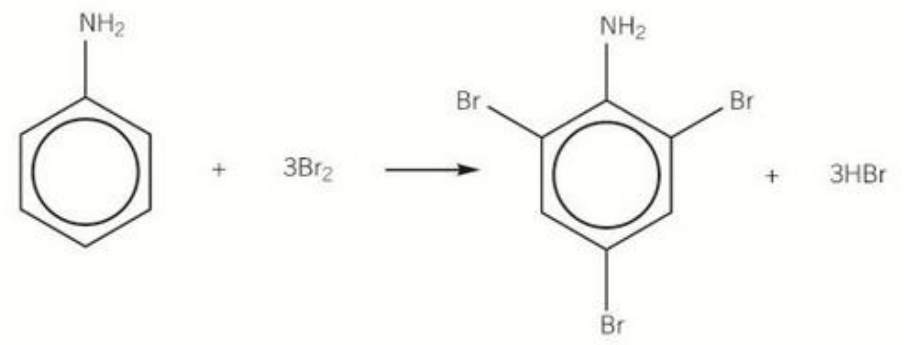
The reaction proceeds so readily that three bromine atoms substitute onto the ring, producing 2,4,6-tribromophenylamine. The equation for this reaction is:
Note: No catalyst or heating is required - the activated ring reacts spontaneously with bromine!
Deactivating groups
A deactivating group decreases the reactivity of the benzene ring toward electrophiles. This means the ring reacts less readily than benzene itself, requiring harsher conditions.
Example
Example: Slow Bromination of Nitrobenzene
Nitrobenzene contains a nitro group () which deactivates the benzene ring. When nitrobenzene reacts with bromine, the reaction is slow and requires both a halogen carrier catalyst (like or ) and heating:
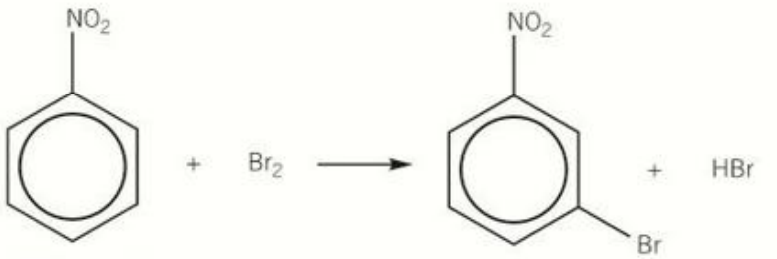
Only one bromine atom substitutes onto the ring, producing 3-bromonitrobenzene (also called meta-bromonitrobenzene). The equation for this reaction is:
Note: The need for a catalyst and heating demonstrates how much the ring has been deactivated!
Key differences
Important
Critical Comparison: Activated vs Deactivated Rings
The examples of phenylamine and nitrobenzene demonstrate three key differences:
- Rate of reaction: Activated rings react faster, deactivated rings react slower
- Extent of substitution: Activated rings may undergo multiple substitutions more easily
- Position of substitution: The position on the benzene ring where substitution occurs is different
Position of substitution: ortho, meta, and para
When a benzene ring already has one substituent, the second substituent can add to different positions on the ring. These positions have specific names based on their relationship to the first substituent.
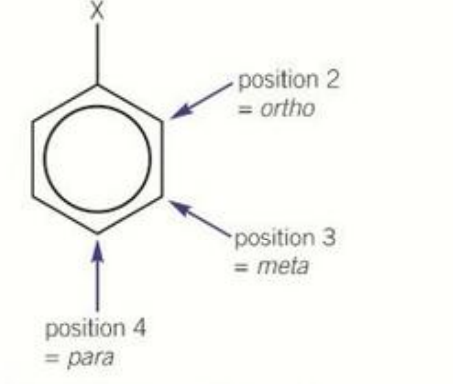
The positions are defined as follows:
- Ortho (o-): positions 2 and 6, adjacent to the first substituent
- Meta (m-): positions 3 and 5, one carbon away from the first substituent
- Para (p-): position 4, directly opposite the first substituent
Note
This naming system provides an alternative to numbering systems, especially useful when describing isomers of disubstituted benzene compounds. You'll often see both naming conventions used interchangeably in chemistry.
Examples of nomenclature
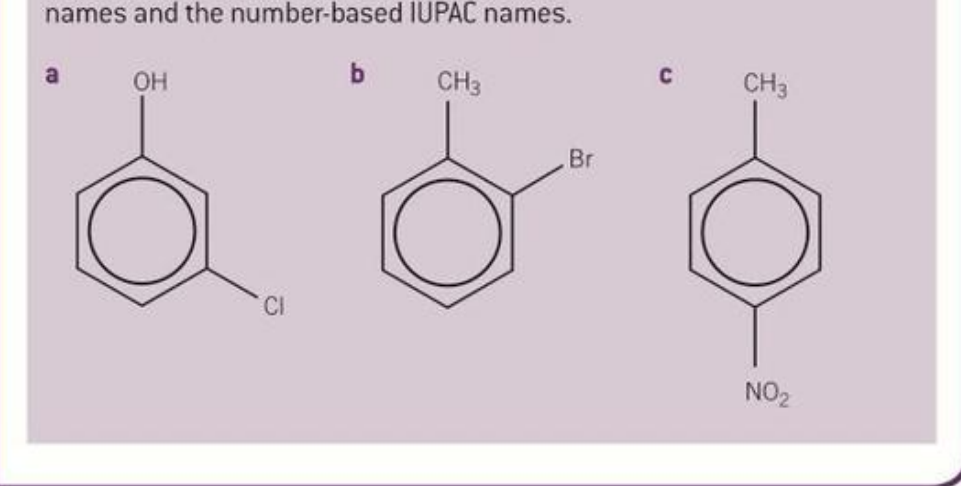
Common names often use ortho, meta, and para prefixes:
- A compound with substituents at positions 1 and 2 might be called ortho-chlorophenol
- A compound with substituents at positions 1 and 3 might be called meta-bromotoluene
- A compound with substituents at positions 1 and 4 might be called para-nitrotoluene
The IUPAC systematic names use numbering (e.g., 2-chlorophenol, 3-bromotoluene, 4-nitrotoluene).
Directing effects of substituent groups
Different substituent groups already present on a benzene ring have a directing effect - they influence where the next substituent will add during electrophilic substitution.
2- and 4-directing groups (ortho-para directors)
Some groups direct the incoming electrophile predominantly to the ortho (position 2/6) and para (position 4) positions. These are called 2- and 4-directing groups or ortho-para directors.
All 2- and 4-directing groups are activating groups (with the exception of halogens, which are deactivating but still ortho-para directing).
3-directing groups (meta directors)
Other groups direct the incoming electrophile predominantly to the meta (position 3/5) position. These are called 3-directing groups or meta directors.
All 3-directing groups are deactivating groups.
Table of directing groups
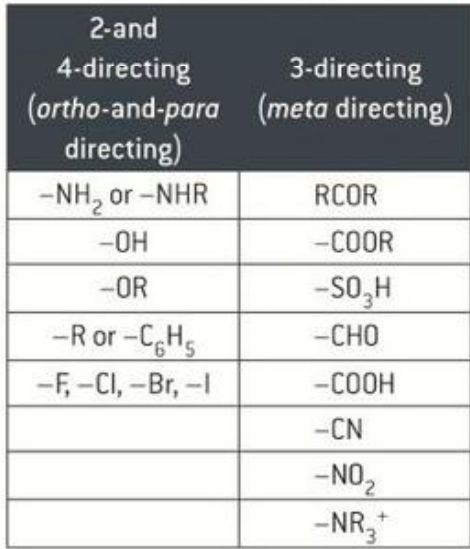
Note
Quick Reference: Directing Groups
2- and 4-directing groups (ortho-para):
- or (amino and alkylamino groups)
- (hydroxyl group)
- (alkoxy groups)
- or (alkyl and phenyl groups)
- (halogens) - note: these are deactivating despite being ortho-para directors
3-directing groups (meta):
- (ketone groups)
- (ester groups)
- (sulfonic acid group)
- (aldehyde group)
- (carboxylic acid group)
- (cyano/nitrile group)
- (nitro group)
- (quaternary ammonium group)
Important
The Halogen Exception
Halogens () are the only deactivating groups that are also ortho-para directors. All other ortho-para directors are activating, and all meta directors are deactivating. This makes halogens unique and important to remember!
Predicting substitution products
Understanding directing effects allows you to predict which products will form when a substituted benzene undergoes further electrophilic substitution.
Example
Worked Example: Nitration of Benzoic Acid
When benzoic acid () undergoes nitration with a mixture of concentrated nitric acid () and concentrated sulfuric acid (), we can predict the product:
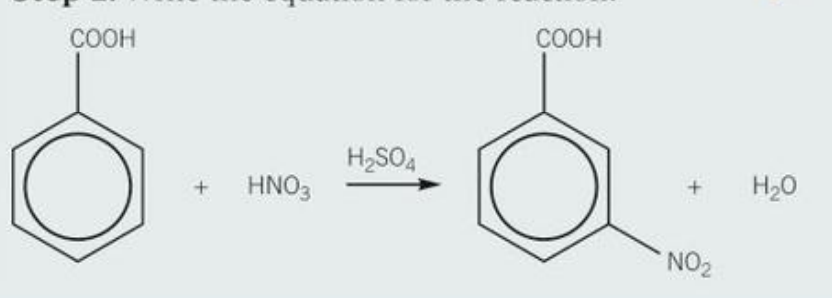
Step 1: Identify the directing group The group is a 3-directing (meta-directing) group.
Step 2: Predict the substitution position Therefore, the group will substitute at position 3 (the meta position), forming 3-nitrobenzoic acid.
Equation:
Example
Worked Example: Bromination of Methylbenzene (Toluene)
When methylbenzene reacts with bromine, the situation is more complex because multiple positions are available:
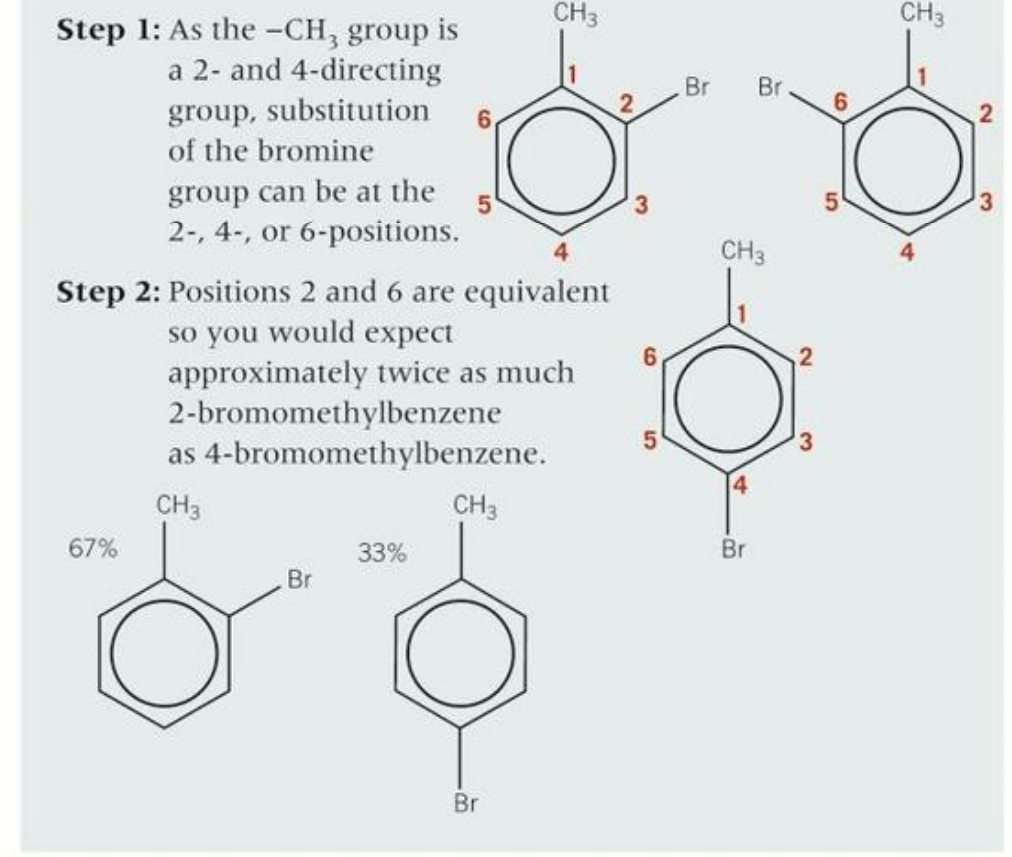
Step 1: Identify the directing group The group is a 2- and 4-directing group (ortho-para director), so bromination can occur at positions 2, 4, or 6.
Step 2: Consider equivalent positions Positions 2 and 6 are equivalent (both ortho positions), so you would expect approximately twice as much substitution at the ortho positions combined compared to the para position.
Step 3: Actual product distribution In practice, methylbenzene produces approximately:
- 67% ortho product (2-bromomethylbenzene)
- 33% para product (4-bromomethylbenzene)
This ratio is close to the expected 2:1 ratio based on the number of available positions. However, other factors such as steric effects (where large substituent groups physically get in the way) can alter these proportions.
Using directing effects in organic synthesis
The directing effects of substituent groups are extremely important when planning multi-step organic syntheses. When you need to add more than one substituent to a benzene ring, the order in which you add them matters.
Important
The Order of Substitution is Critical!
The first substituent you add will direct where the second one goes. If you add substituents in the wrong order, you'll produce the wrong isomer. Always plan your synthesis pathway carefully by working backwards from the target molecule.
Planning synthesis pathways
To synthesise a disubstituted benzene compound, you must consider which substituent to add first. The first substituent will direct where the second one goes.
Example
Worked Example: Synthesising 1,4-Dichloronitrobenzene
Suppose you want to synthesise 1,4-dichloronitrobenzene (with chlorine at position 1 and nitro group at position 4) from benzene:
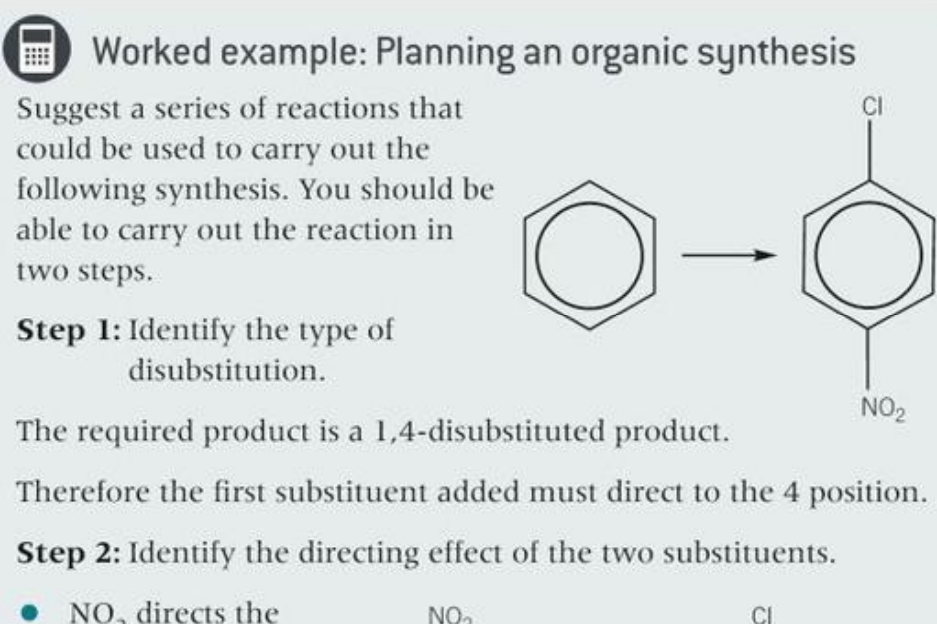
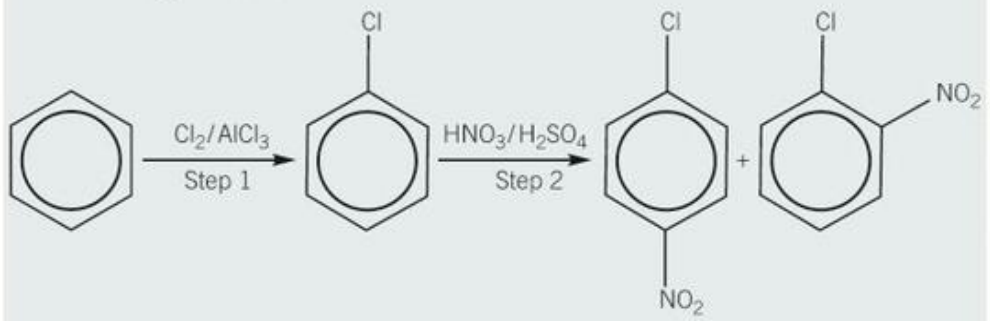
Step 1: Identify the substitution pattern The product is a 1,4-disubstituted compound (para-substituted).
Step 2: Determine which substituent should be added first
- The group is 3-directing (meta-directing)
- Chlorine () is 2- and 4-directing (ortho-para directing)
Step 3: Decide on the correct order To get para substitution, chlorine must be added first because it directs to the para position (position 4).
Synthesis Route:
Step 1: Chlorination of benzene
Step 2: Nitration of chlorobenzene
This produces a mixture of 2-chloronitrobenzene (ortho) and 4-chloronitrobenzene (para), which could be separated by distillation if they are liquids, or by recrystallisation if they are solids.
Wrong Order Alert: If you added the substituents in the wrong order (nitration first, then chlorination), the nitro group would direct chlorine to the meta position, giving the wrong isomer (1,3-dichloronitrobenzene).
Application: Synthesis of TNT (trinitrotoluene)
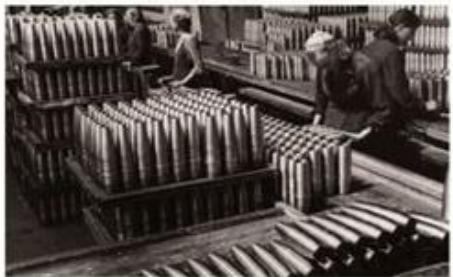
An important real-world application of directing groups is the industrial synthesis of 2,4,6-trinitrotoluene (TNT), which was historically used as an explosive.
Example
Worked Example: Progressive Nitration to Form TNT
The synthesis of TNT demonstrates progressive nitration, where the directing effects of the methyl group and subsequent nitro groups determine the substitution pattern:
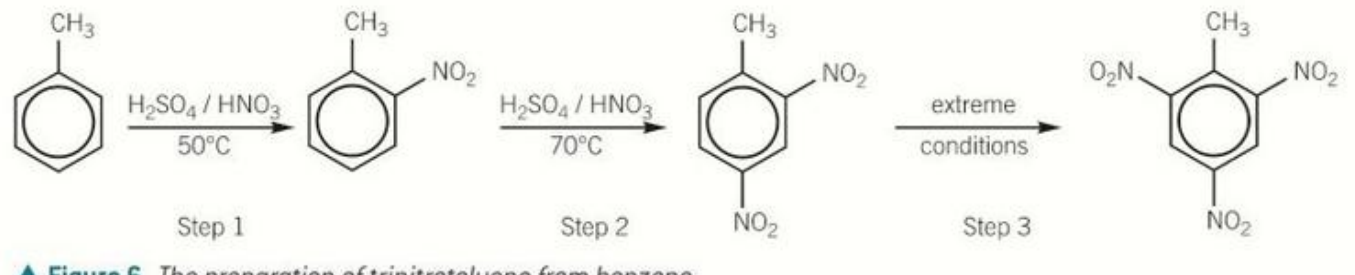
Step 1: First nitration at 50°C
At 50°C, methylbenzene (toluene) reacts with a mixture of and to form 2-nitrotoluene. The group is 2- and 4-directing, favouring substitution at the ortho positions.
Step 2: Second nitration at 70°C
At 70°C, further nitration produces 2,4-dinitrotoluene. The product is less reactive than toluene because the group deactivates the benzene ring. However, the group (2- and 4-directing) is stronger than the group (3-directing), so substitution occurs at the para position.
Step 3: Third nitration under extreme conditions
Under extreme conditions, a third nitration produces 2,4,6-trinitrotoluene (TNT). The second group further deactivates the benzene ring, making this step very difficult and requiring extreme conditions. The group continues to direct to ortho/para positions, favouring the remaining ortho position.
Safety Note: This synthesis must be carefully controlled because accidental overheating could result in an explosion.
Note
Competing Directing Effects in TNT Synthesis
Notice how each successive nitration requires higher temperatures and harsher conditions because the ring becomes progressively more deactivated. The methyl group's ortho-para directing effect dominates over the meta-directing effect of the nitro groups, ensuring the correct substitution pattern.
Key exam tips
Important
Common Mistakes to Avoid:
- Confusing which groups are activating vs deactivating
- Forgetting that halogens are deactivating but still ortho-para directing (they're the exception!)
- Not considering the order of substituent addition in multi-step synthesis
- Forgetting that deactivated rings require harsher conditions (higher temperature, catalyst)
Exam Technique:
- Always identify whether a group is 2- and 4-directing or 3-directing before predicting products
- Draw out the numbered benzene ring to help identify positions clearly
- When planning syntheses, work backwards from the target molecule to determine which substituent must be added first
- Remember that mixed products (ortho and para) may form with 2- and 4-directing groups
Remember!
Summary
Key Points to Remember:
-
Activating groups increase the reactivity of the benzene ring toward electrophiles (e.g., , , ), while deactivating groups decrease reactivity (e.g., , , ).
-
2- and 4-directing groups (ortho-para directors) direct the incoming substituent to positions 2, 4, and 6. Most are activating, except halogens which are deactivating but still ortho-para directing.
-
3-directing groups (meta directors) direct the incoming substituent to positions 3 and 5. All are deactivating groups.
-
In multi-step synthesis, the order of substituent addition is crucial - the first substituent directs where the second one goes. Plan carefully to achieve the desired substitution pattern.
-
The synthesis of TNT (2,4,6-trinitrotoluene) demonstrates progressive nitration, with the methyl group directing ortho-para and each subsequent nitration requiring harsher conditions due to ring deactivation.