Electrophilic Substitution of Benzene (OCR A-Level Chemistry A): Revision Notes
📚Revision Notes
Electrophilic substitution of benzene
Introduction to electrophilic substitution
Benzene and its derivatives undergo substitution reactions where a hydrogen atom on the aromatic ring is replaced by another atom or group. The characteristic reaction type for benzene is electrophilic substitution, where an electron-deficient species (electrophile) attacks the ring.
The general form of an electrophilic substitution reaction can be represented as:
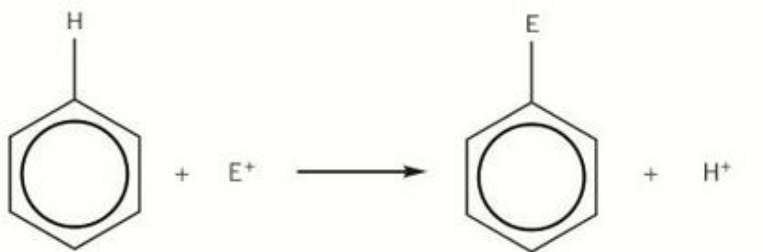
In this process, an electrophile replaces one hydrogen atom on the benzene ring, producing a substituted benzene and a hydrogen ion .
Important
The aromatic ring system is preserved throughout the reaction, which is crucial for maintaining the stability of the benzene structure. This preservation of the aromatic system is the key reason why benzene undergoes substitution rather than addition reactions.
Nitration of benzene
The nitration reaction
Benzene undergoes nitration when it reacts with concentrated nitric acid to produce nitrobenzene. However, the reaction proceeds slowly and requires specific conditions to achieve a reasonable rate.
Note
Reaction Conditions for Nitration:
- Catalyst: concentrated sulfuric acid ()
- Temperature: 50°C
- Temperature control: a water bath maintains steady temperature
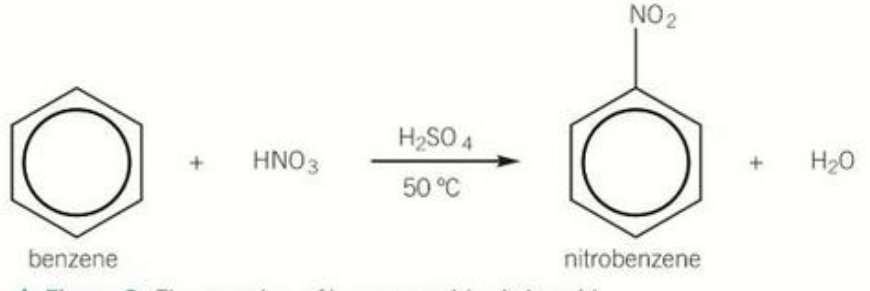
During nitration, a hydrogen atom on the benzene ring is substituted by a nitro group (), forming nitrobenzene and water as a byproduct.
Important
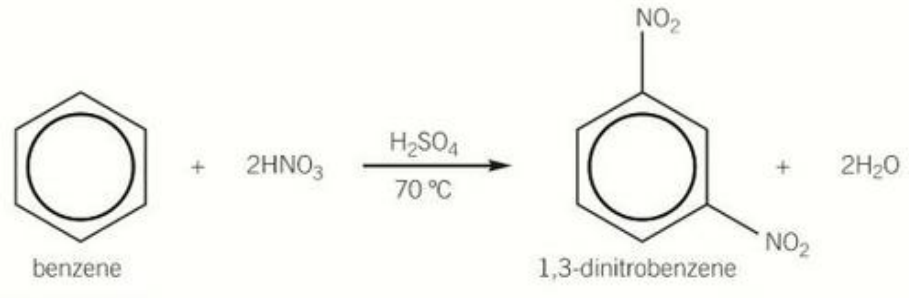
Importance of temperature control: If the temperature exceeds 50°C, further substitution can occur, leading to the formation of 1,3-dinitrobenzene. This demonstrates why precise temperature control is essential in organic synthesis.
Mechanism of nitration
The nitration mechanism proceeds through three distinct steps involving the generation and attack of the nitronium ion electrophile.
Step 1: Generation of the nitronium ion
The actual electrophile in this reaction is not nitric acid itself, but the nitronium ion (). This is formed when concentrated nitric acid reacts with concentrated sulfuric acid:
The sulfuric acid acts as a catalyst by generating the electrophile needed for the reaction.
Step 2: Electrophilic attack and intermediate formation
The positively charged nitronium ion is attracted to the electron-rich benzene ring. The accepts a pair of electrons from the delocalised π-electron system, forming a dative covalent bond with a carbon atom on the ring.
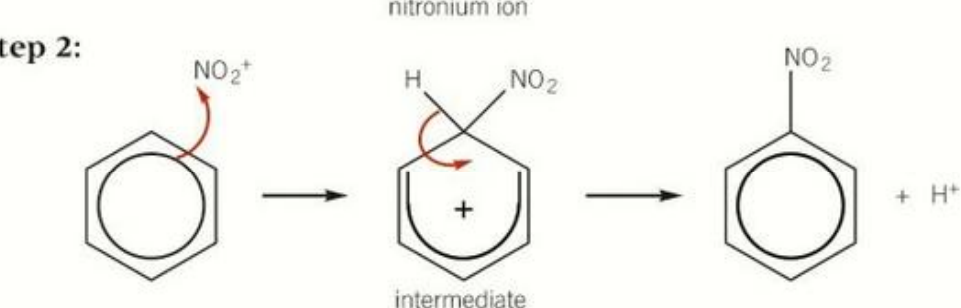
This creates an unstable positively charged intermediate (sometimes called an arenium ion or σ-complex). The intermediate is unstable because the aromatic delocalisation has been disrupted. One carbon atom now has both a hydrogen and a nitro group attached, and the positive charge is delocalised around the remaining part of the ring.
Step 3: Regeneration of the catalyst
The intermediate rapidly loses a proton () to reform the stable aromatic ring system. The hydrogen ion reacts with the ion from Step 1, regenerating the sulfuric acid catalyst:
This completes the catalytic cycle, and the final products are nitrobenzene and water.
Note
Industrial importance: Nitrobenzene is a valuable starting material for manufacturing dyes, pharmaceuticals (including paracetamol), and pesticides, making this reaction economically significant.
Halogenation of benzene
Halogens (chlorine and bromine) do not react directly with benzene under normal conditions. This is because benzene is too stable, and the non-polar halogen molecules are not sufficiently electrophilic to attack the ring.
Important
A halogen carrier catalyst is required to generate a suitable electrophile. Without this catalyst, no reaction occurs between benzene and halogens at room temperature.
Bromination of benzene
Reaction conditions
To brominate benzene, the following conditions are used:
Note
Bromination Conditions:
- Reagent: bromine ()
- Catalyst: a halogen carrier such as iron(III) bromide () or aluminium bromide ()
- Temperature: room temperature and pressure
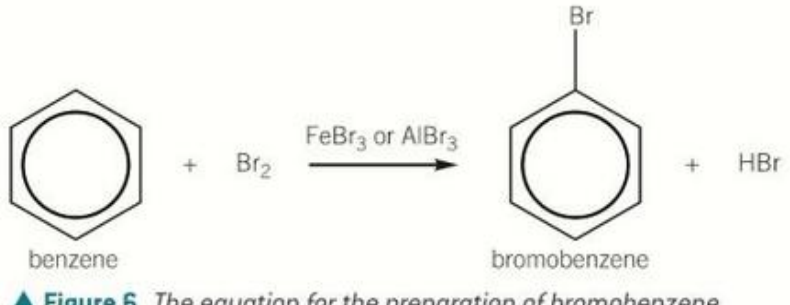
The product is bromobenzene, with hydrogen bromide formed as a byproduct.
Mechanism of bromination
The bromination mechanism closely parallels that of nitration, proceeding through three steps.
Step 1: Generation of the bromonium ion electrophile
The halogen carrier catalyst reacts with bromine to generate the bromonium ion ():
The bromonium ion is the actual electrophile that attacks the benzene ring.
Step 2: Electrophilic attack
The ion accepts a pair of electrons from the delocalised π-electron system of benzene, forming a dative covalent bond. This produces an unstable positively charged intermediate with both hydrogen and bromine attached to one carbon atom. The aromatic stabilisation is temporarily lost.
Step 3: Regeneration of the catalyst
The intermediate loses a proton, which reacts with the ion from Step 1:
This regenerates the iron(III) bromide catalyst and produces hydrogen bromide. The aromatic ring system is restored in the final product, bromobenzene.
Chlorination of benzene
Chlorination follows an identical mechanism to bromination. The halogen carrier catalysts used are iron(III) chloride () or aluminium chloride (), which can be generated in situ by adding iron or aluminium metal to chlorine.
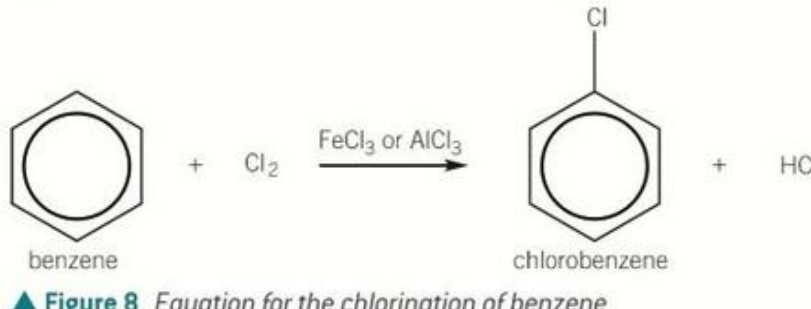
The reaction produces chlorobenzene and hydrogen chloride. The mechanism involves:
- Generation of by reaction of with the halogen carrier
- Attack of on the benzene ring
- Loss of and regeneration of the catalyst
Friedel-Crafts reactions
Friedel-Crafts reactions are named after the two chemists who discovered them. These reactions allow carbon chains or functional groups to be added to the benzene ring, making them powerful tools in organic synthesis.
Friedel-Crafts alkylation
Alkylation involves substituting a hydrogen atom on benzene with an alkyl group, thereby increasing the length of any carbon chains attached to the ring.
Note
Alkylation Reaction Conditions:
- Reagent: a haloalkane (e.g., chloroethane, )
- Catalyst: aluminium chloride () acting as a halogen carrier
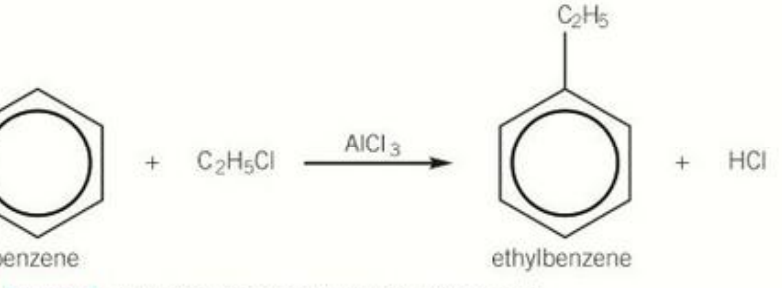
The alkylation forms carbon-carbon bonds, which is valuable in organic synthesis for building more complex molecules. For example, reacting benzene with chloroethane produces ethylbenzene.
Friedel-Crafts acylation
Acylation involves substituting a hydrogen atom with an acyl group to form an aromatic ketone. This is another example of electrophilic substitution.
Note
Acylation Reaction Conditions:
- Reagent: an acyl chloride (e.g., ethanoyl chloride, )
- Catalyst: aluminium chloride ()
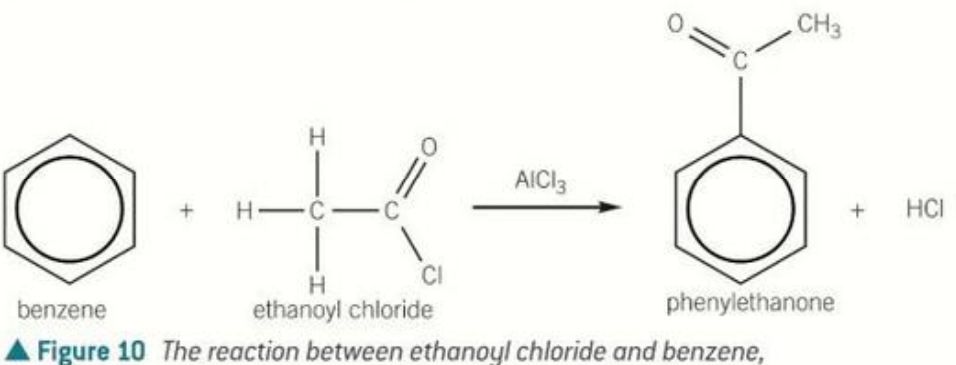
The product is an aromatic ketone. For example, the reaction between benzene and ethanoyl chloride produces phenylethanone (also called acetophenone), along with hydrogen chloride.
Note
Industrial application: Phenylethanone is used in the perfume industry as it has pleasant aromatic properties. It contributes to fragrances that resemble almond, cherry, honeysuckle, jasmine, and strawberry.
Comparing benzene reactivity with alkenes
Why benzene and alkenes react differently
Although both benzene and alkenes contain carbon-carbon double bonds, they show markedly different reactivity patterns. Understanding these differences is crucial to grasping the unique nature of aromatic systems.
Alkenes undergo electrophilic addition:
Alkenes react readily with bromine by electrophilic addition. For example, cyclohexene decolourises bromine water rapidly at room temperature:
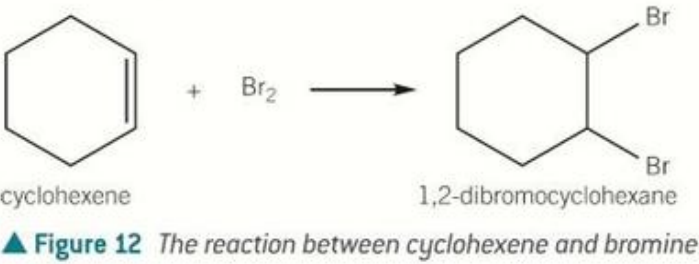
The mechanism involves the π-electrons in the double bond creating a region of high electron density. These localised electrons induce a dipole in the bromine molecule, making it behave as an electrophile. The bromine adds across the double bond, forming a dibrominated product.
Benzene requires electrophilic substitution:
In contrast, benzene does not react with bromine unless a halogen carrier catalyst is present. This fundamental difference arises from the delocalised nature of benzene's π-electron system.
Important
In benzene, the π-electrons are delocalised above and below the plane of all six carbon atoms in the ring. This delocalisation creates an area of electron density, but it is spread out over the entire ring rather than concentrated between two carbon atoms.
The electron density around any two carbon atoms in benzene is significantly lower than that in a double bond in an alkene.
This means:
- The delocalised π-electrons in benzene cannot effectively polarise a non-polar bromine molecule
- The bromine molecule remains non-polar and cannot act as an electrophile
- No reaction occurs without a halogen carrier to generate
Additionally, the delocalised electron system in benzene provides extra stability (approximately 150 kJ mol⁻¹). Addition reactions would disrupt this delocalisation and destroy the aromatic stability. Substitution reactions preserve the aromatic ring system, which is energetically favourable.
Example
Comparing Reactivity: Alkenes vs. Benzene
When bromine water is added to:
- Cyclohexene (alkene): The orange-brown bromine water is rapidly decolourised at room temperature through electrophilic addition
- Benzene (aromatic): No reaction occurs - the bromine water remains orange-brown unless a halogen carrier catalyst is added
This simple test demonstrates the fundamental difference in reactivity between localised and delocalised π-electron systems.
This explains why:
- Alkenes undergo electrophilic addition (bromine adds across the double bond)
- Benzene undergoes electrophilic substitution (only with a catalyst, and the ring system is maintained)
Summary
Key Points to Remember:
-
Electrophilic substitution is the characteristic reaction of benzene where an electrophile replaces a hydrogen atom while preserving the aromatic ring system.
-
Nitration requires concentrated and concentrated catalyst at 50°C. The electrophile is the nitronium ion (), and temperature control prevents multiple substitution.
-
Halogenation (bromination and chlorination) requires a halogen carrier catalyst (e.g., , , , ) to generate the electrophile ( or ). The catalyst is regenerated at the end of the mechanism.
-
Friedel-Crafts reactions use as a catalyst. Alkylation adds alkyl groups using haloalkanes, while acylation adds acyl groups using acyl chlorides to form aromatic ketones.
-
Benzene undergoes substitution rather than addition because its delocalised π-electrons create lower electron density than the localised π-bond in alkenes, making it less reactive toward electrophiles. Substitution also preserves the stable aromatic system.