The Chemistry of Phenol (OCR A-Level Chemistry A): Revision Notes
📚Revision Notes
The Chemistry of Phenol
What are phenols?
Phenols are organic compounds where a hydroxyl group (-OH) is bonded directly to a benzene ring. This direct attachment to the aromatic ring makes phenols fundamentally different from alcohols. The simplest member of this family is phenol itself, with the molecular formula .
Note
The key structural requirement for a phenol is that the -OH group must be attached straight onto the aromatic ring. If the hydroxyl group is instead attached to a carbon atom in a side chain (even if that side chain is connected to a benzene ring), the compound is classified as an alcohol, not a phenol.
For example, 2-phenylethanol () is an aromatic alcohol because the -OH group is on a carbon side chain rather than directly on the ring.
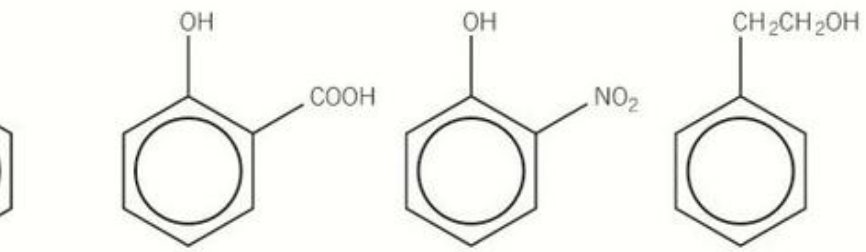
This structural distinction is crucial because phenols and alcohols show different chemical properties. The proximity of the -OH group to the delocalised π-system of the benzene ring significantly influences the behaviour of phenols, particularly their acidity and reactivity in substitution reactions.
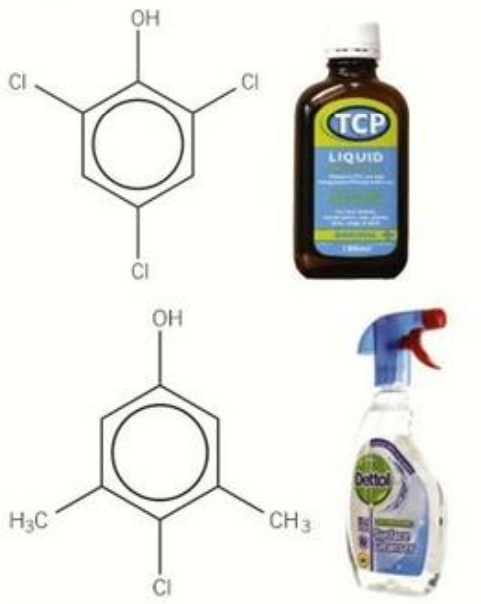
Phenols have important practical applications. They are used in manufacturing disinfectants, detergents, plastics, paints, and even medicines like aspirin. Many commercial antiseptics contain chlorinated phenol derivatives as their active ingredients.
The manufacture of phenol
Phenol is an important industrial chemical, and several methods have been developed to produce it from benzene.
Historical method
Historically, phenol was manufactured from benzene through a multi-stage process involving sulfonation. The benzene was first treated with sulfuric acid, then with sodium hydroxide. The overall equation for this process is:
This method is now considered obsolete due to the development of more efficient routes.
Current industrial method
Today, the majority of phenol is manufactured using the cumene process (also called the cumene-to-phenol process). This involves reacting benzene with propene in the presence of oxygen:
Note
Key advantage of the cumene process:
This reaction achieves an 86% yield of phenol from benzene. The other product formed is propanone (, also known as acetone), which is itself a valuable chemical with many industrial uses. The formation of a useful co-product makes this process economically attractive.
Possible future method
Research chemists are investigating an alternative route using benzene and nitrogen(I) oxide (, also called nitrous oxide):
Note
Advantages of the nitrogen oxide route:
This reaction offers several benefits. It has a 95% yield of phenol from benzene, which is higher than the current method. Additionally, nitrogen(I) oxide is a gaseous waste product from nylon production that normally cannot be released into the atmosphere because it is a greenhouse gas. Using it to make phenol means this waste can be converted into a useful product while producing nitrogen gas as a byproduct. This approach improves the atom economy of nylon production by making use of the waste nitrogen oxide.
Phenol as a weak acid
Phenol is less soluble in water than typical alcohols due to the presence of the non-polar benzene ring. However, when phenol does dissolve in water, something interesting happens - it partially dissociates to release protons ( ions).
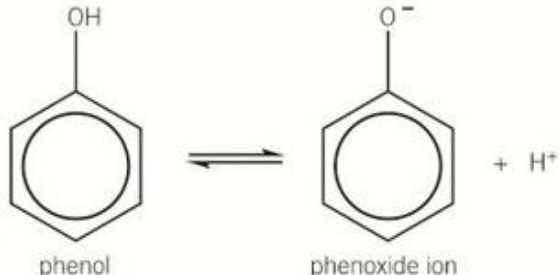
This partial dissociation can be represented by an equilibrium:
In this equilibrium, phenol splits into a phenoxide ion () and a proton. Because phenol can release protons in solution (even though only partially), it is classified as a weak acid. The term "weak" indicates that only a small proportion of phenol molecules dissociate at any given time - most remain as neutral molecules.
Comparing acid strengths
We can compare the acidity of different compounds by looking at their acid dissociation constants (). The larger the value, the stronger the acid.
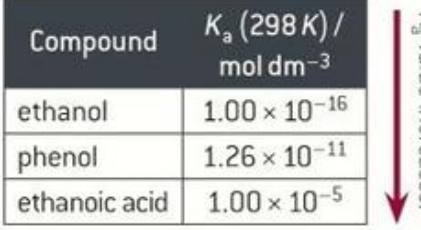
| Compound | at 298 K / mol dm⁻³ | Acid strength |
|---|---|---|
| Ethanol | Weakest | |
| Phenol | Intermediate | |
| Ethanoic acid | Strongest |
Important
Understanding acid strength order:
This comparison reveals that phenol is more acidic than alcohols (like ethanol) but less acidic than carboxylic acids (like ethanoic acid). The position of phenol between these two groups makes its behaviour distinctive. Notice the value for phenol () is significantly larger than ethanol but much smaller than ethanoic acid.
Reactions with bases
The intermediate acidity of phenol determines which bases it will react with:
-
Ethanol does not react with sodium hydroxide (a strong base) or sodium carbonate (a weak base). It is too weak an acid to donate protons even to strong bases.
-
Phenol reacts with strong bases like sodium hydroxide and aqueous sodium hydroxide, but does not react with the weak base sodium carbonate.
-
Carboxylic acids are strong enough acids to react with both strong bases (like sodium hydroxide) and weak bases (like sodium carbonate).
Note
Chemical test to distinguish phenols from carboxylic acids:
If you add sodium carbonate to a solution and carbon dioxide gas is evolved, you have a carboxylic acid present. If no reaction occurs, you likely have a phenol. This is a useful diagnostic test in practical chemistry.
Reaction with sodium hydroxide
When phenol reacts with sodium hydroxide solution, a neutralisation reaction occurs. This is an acid-base reaction where phenol acts as the acid and sodium hydroxide as the base:
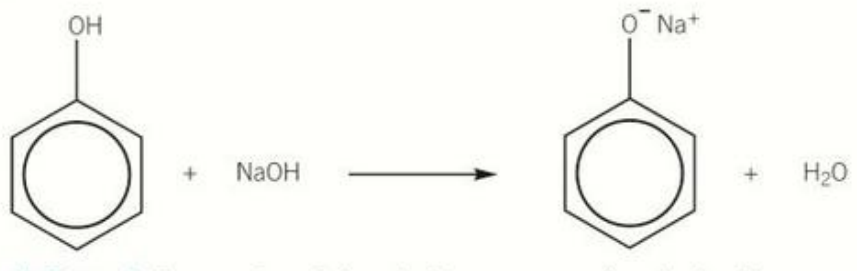
The products formed are sodium phenoxide (which exists as sodium ions and phenoxide ions in solution) and water. This reaction demonstrates that phenol behaves as an acid by donating a proton to the hydroxide ion from sodium hydroxide.
The formation of the phenoxide salt is complete when excess sodium hydroxide is present, as the strong base drives the equilibrium towards products.
Electrophilic substitution reactions of phenol
Phenols, like benzene, contain an aromatic ring and can undergo electrophilic substitution reactions. However, phenol is much more reactive than benzene towards electrophiles. The reactions occur under milder conditions and proceed more readily.
Why is phenol more reactive than benzene?
Important
Mechanism of enhanced reactivity:
The increased reactivity of phenol results from the electron-donating effect of the hydroxyl group. The oxygen atom in the -OH group has lone pairs of electrons in its p-orbital. These lone pair electrons are donated into the delocalised π-system of the benzene ring through resonance.
This electron donation increases the electron density of the benzene ring in phenol compared to benzene itself. Since electrophiles are attracted to regions of high electron density, the aromatic ring in phenol attracts electrophiles more strongly than benzene does.
The enhanced electron density in phenol is sufficient to allow reactions to occur that would require much harsher conditions with benzene, or would not occur at all.
Bromination of phenol
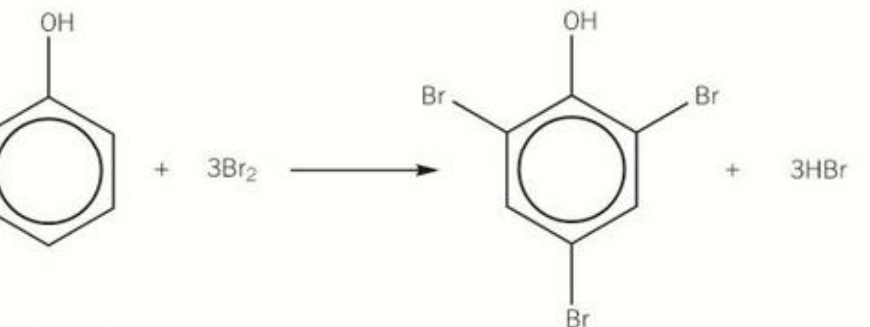
When bromine water (an aqueous solution of bromine) is added to phenol, an immediate reaction occurs at room temperature. No halogen carrier catalyst is required, unlike the bromination of benzene which needs a catalyst like iron(III) bromide.
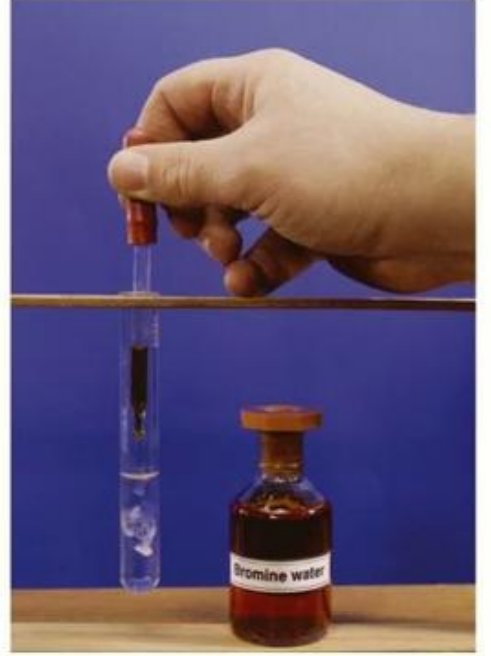
The reaction produces 2,4,6-tribromophenol as a white precipitate:
Note
Observations and conditions:
Observations: The orange colour of the bromine water is removed (decolourised) and a white precipitate forms. These two observations should always be stated together when describing this reaction.
Conditions: The reaction occurs with aqueous bromine (bromine water) at room temperature, with no catalyst required.
The product contains three bromine atoms substituted at positions 2, 4, and 6 on the benzene ring (these are the ortho and para positions relative to the -OH group). The formation of the tri-substituted product demonstrates just how reactive phenol is compared to benzene, where only mono-substitution would typically occur even with a catalyst.
Nitration of phenol
Phenol reacts readily with dilute nitric acid at room temperature. This is in stark contrast to benzene, which requires concentrated nitric acid and concentrated sulfuric acid at elevated temperatures.
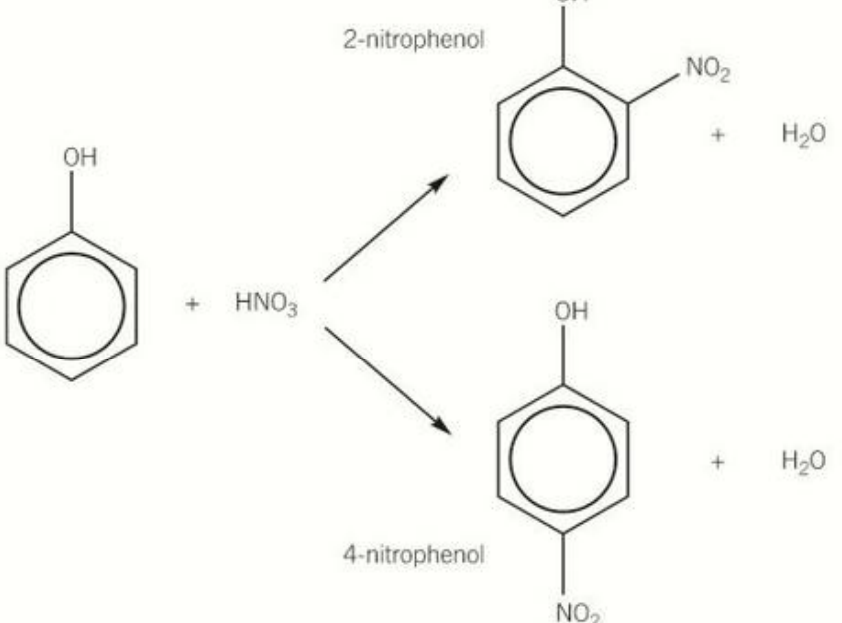
The reaction produces a mixture of two isomers:
- 2-nitrophenol (ortho-nitrophenol) - where the group is at position 2
- 4-nitrophenol (para-nitrophenol) - where the group is at position 4
Note
Conditions for nitration:
The reaction uses dilute nitric acid at room temperature. Concentrated sulfuric acid is not required, unlike the nitration of benzene.
The -OH group directs incoming electrophiles to the 2- and 4- positions (ortho and para positions), which is why these isomers are formed rather than the 3-position (meta) isomer.
Comparing reactivity with benzene
Both bromination and nitration proceed much more readily with phenol than with benzene:
| Feature | Benzene | Phenol |
|---|---|---|
| Bromination catalyst | Iron(III) bromide required | No catalyst needed |
| Bromination product | Bromobenzene (mono-substituted) | 2,4,6-tribromophenol (tri-substituted) |
| Nitration conditions | Concentrated + concentrated , heat | Dilute , room temperature |
| Electron density in ring | Lower | Higher (due to electron donation from oxygen) |
Important
Why the dramatic difference in reactivity?
The key reason for these differences is that the lone pair of electrons from the oxygen atom in the -OH group is donated into the π-system of the aromatic ring. This increases the electron density of the ring, making it more attractive to electrophiles. With higher electron density, the aromatic ring in phenol polarises bromine molecules sufficiently that no catalyst is needed. This is why phenol is so much more reactive than benzene in electrophilic substitution reactions.
Remember!
Summary
Key takeaways:
- Phenols have an -OH group bonded directly to the benzene ring; if -OH is on a side chain, it's an alcohol not a phenol
- Phenol is manufactured industrially via the cumene process: (86% yield)
- Phenol is a weak acid with mol dm⁻³ - more acidic than alcohols but less acidic than carboxylic acids
- Phenol reacts with sodium hydroxide: but does not react with sodium carbonate
- Phenol undergoes electrophilic substitution more readily than benzene due to electron donation from oxygen's lone pair into the ring
- Bromination needs no catalyst and produces 2,4,6-tribromophenol; nitration uses dilute and produces a mixture of 2- and 4-nitrophenol isomers
Exam focus checklist:
- Can you explain why phenols are more acidic than alcohols but less acidic than carboxylic acids?
- Can you write equations for all three manufacturing methods and state the percentage yields?
- Can you describe the observations when bromine water is added to phenol?
- Can you explain why no halogen carrier catalyst is needed for bromination of phenol?
- Can you name and draw the products of nitration of phenol?
- Can you compare the conditions for bromination/nitration of phenol versus benzene?