Carboxylic Acids (OCR A-Level Chemistry A): Revision Notes
📚Revision Notes
Carboxylic acids
Carboxylic acids are organic compounds that contain a carboxyl functional group, denoted as -COOH. These acids are found in many natural substances including vinegar (ethanoic acid), citrus fruits, and even in rhubarb leaves. They also serve as important starting materials in organic synthesis and are used to manufacture medicines such as aspirin.
The carboxyl group
The carboxyl group is the defining functional group of carboxylic acids. This group consists of two components joined together: a carbonyl group (C=O) and a hydroxyl group (O-H), both attached to the same carbon atom.
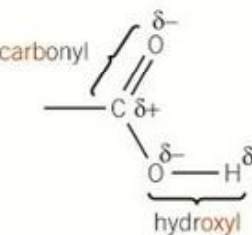
Both the C=O bond and the O-H bond are polar covalent bonds. The oxygen atoms are more electronegative than carbon and hydrogen, which creates partial negative charges (δ-) on the oxygen atoms and partial positive charges (δ+) on the carbon and hydrogen atoms. This polarity is crucial for understanding the properties and reactivity of carboxylic acids.
Important
The functional group is the carboxyl group as a whole (COOH), not the carbonyl and hydroxyl groups separately. When the OH group is attached directly to the carbon of the carbonyl group, the chemistry changes completely compared to having these groups in separate locations on a molecule.
Naming carboxylic acids
The nomenclature of carboxylic acids follows a systematic approach based on the longest carbon chain containing the carboxyl group. Here are the key rules:
- Identify the longest continuous carbon chain that includes the carboxyl carbon
- The carboxyl carbon is always designated as carbon-1 (C-1)
- Use the appropriate stem name for the carbon chain (meth-, eth-, prop-, but-, etc.)
- Add the suffix "-oic acid" to the stem name
- Number any branches or substituents from the carboxyl carbon
Example
Worked Example: Naming a Carboxylic Acid
Let's name the following compound systematically:
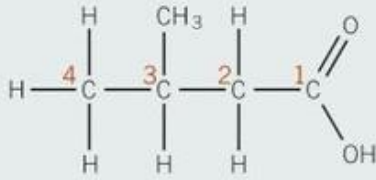
Step 1: Count the longest carbon chain. This molecule has four carbons in the longest chain, so the stem name is "but-".
Step 2: The -COOH functional group is at the end of the chain, confirming the suffix "-oic acid".
Step 3: Check for any branches or substituents. There is a methyl group (CH₃) attached to carbon-3 when counting from the carboxyl carbon.
Step 4: The prefix for a methyl group at carbon-3 is "3-methyl".
Step 5: Combine all parts: the compound is named 3-methylbutanoic acid.
Note
When the suffix begins with a vowel (as in "-oic acid"), the final "e" from the alkane chain ending is dropped. For example, "butane" becomes "butan-" before adding "-oic acid".
Physical properties of carboxylic acids
Solubility in water
The solubility of carboxylic acids in water depends on their ability to form hydrogen bonds and the length of their carbon chain.
Short-chain carboxylic acids (containing up to four carbon atoms) are completely soluble in water. This high solubility is due to the polar nature of the carboxyl group, which can form strong hydrogen bonds with water molecules.
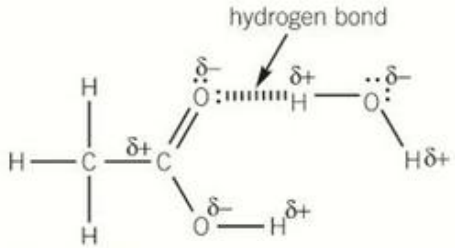
As shown in the diagram, hydrogen bonds form between:
- The partially positive hydrogen of the O-H group and the partially negative oxygen of water molecules
- The partially negative oxygen of the C=O group and the partially positive hydrogen of water molecules
However, as the number of carbon atoms in the chain increases, the solubility decreases significantly. This occurs because the non-polar hydrocarbon chain has a greater effect on the overall polarity of the molecule. Longer hydrocarbon chains are hydrophobic (water-repelling) and cannot form hydrogen bonds with water, which reduces the molecule's overall solubility.
Note
Dicarboxylic acids, which contain two carboxyl groups, have enhanced solubility compared to monocarboxylic acids of similar molecular mass. The presence of two polar carboxyl groups provides more sites for hydrogen bonding with water molecules, and these molecules are typically solids at room temperature that dissolve readily in water.
Acid strength and behaviour
Weak acid classification
Carboxylic acids are classified as weak acids. This means they undergo only partial dissociation when dissolved in water, establishing an equilibrium between the undissociated acid molecules and the ions produced.
The simplest carboxylic acid is methanoic acid (HCOOH), which contains just one carbon atom. When methanoic acid dissolves in water, it partially dissociates according to this equilibrium:
Important
The equilibrium lies well to the left, meaning that most of the acid molecules remain undissociated in solution. Only a small proportion of the molecules donate protons to form hydrogen ions and carboxylate ions.
The carboxylate ion
When a carboxylic acid loses a proton (H⁺), it forms a carboxylate ion. This negative ion is named by changing the "-ic acid" ending of the carboxylic acid name to "-ate".
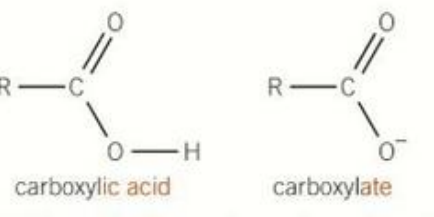
For example:
- Methanoic acid (HCOOH) forms the methanoate ion (HCOO⁻)
- Ethanoic acid (CH₃COOH) forms the ethanoate ion (CH₃COO⁻)
- Propanoic acid (CH₃CH₂COOH) forms the propanoate ion (CH₃CH₂COO⁻)
The carboxylate ion features a negatively charged oxygen atom where the proton was removed. This ion is stabilised by resonance, which contributes to the acidic nature of carboxylic acids.
Chemical reactions of carboxylic acids
Carboxylic acids participate in two main types of reactions: redox reactions with metals and neutralisation reactions with various bases. In all these reactions, carboxylic acids form carboxylate salts.
Redox reactions with metals
When aqueous solutions of carboxylic acids react with metals, a redox reaction occurs. In this reaction, hydrogen gas is evolved, and the metal dissolves as the carboxylate salt forms. You would observe effervescence (fizzing) as the hydrogen gas is released.
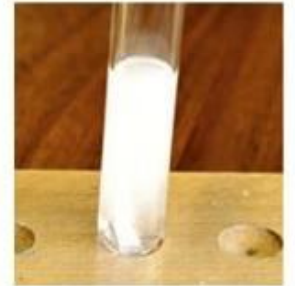
For example, when propanoic acid reacts with magnesium metal:
In this reaction:
- The magnesium is oxidised (loses electrons)
- The hydrogen ions from the acid are reduced (gain electrons) to form hydrogen gas
- The product is magnesium propanoate salt dissolved in water
Neutralisation with metal oxides
Carboxylic acids react with metal oxides in neutralisation reactions to form a salt and water. These are typical acid-base reactions.
For example, when aqueous ethanoic acid reacts with calcium oxide:
The products are calcium ethanoate (the salt) and water. The solid metal oxide reacts and dissolves to form an aqueous solution of the salt.
Neutralisation with alkalis
Carboxylic acids also neutralise alkalis (soluble bases) to form a salt and water. When two solutions react together, there may be no visible reaction, but an aqueous solution of the salt is formed.
For example, when ethanoic acid reacts with sodium hydroxide:
Overall equation:
Ionic equation:
Note
The ionic equation shows the essential chemistry: the hydrogen ions from the acid react with hydroxide ions from the alkali to form water. The sodium and ethanoate ions remain in solution as spectator ions.
Important
When writing formulae for salts, you can include or omit charges. If you do show charges, you must show them all, otherwise the equation will be unbalanced by charge. For example, both (CH₃CH₂COO⁻)₂Mg²⁺ and (CH₃CH₂COO)₂Mg are acceptable notations for magnesium propanoate.
Neutralisation with carbonates
When a carbonate is added to a carboxylic acid, carbon dioxide gas is evolved along with the formation of a salt and water. If the carboxylic acid is in excess, a solid carbonate would dissolve and disappear as the reaction proceeds.
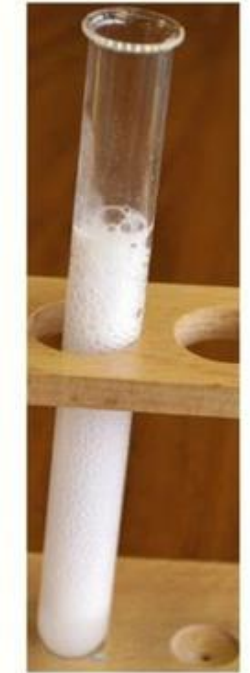
For example, when ethanoic acid reacts with aqueous sodium carbonate:
The characteristic observation is effervescence - bubbles of carbon dioxide gas are produced. The products are sodium ethanoate salt (in aqueous solution), water, and carbon dioxide gas.
Test for the carboxyl group
The neutralisation reaction of carboxylic acids with carbonates provides chemists with a reliable method for identifying the presence of a carboxyl group in an unknown organic compound.
The carbonate test:
- Add sodium carbonate solution (or solid sodium carbonate) to the unknown compound
- If the carboxyl group is present, effervescence will occur
- The bubbles of gas produced are carbon dioxide
Important
This test is particularly useful because carboxylic acids are the only common organic compounds that are sufficiently acidic to react with carbonates. This makes the test highly specific for distinguishing carboxylic acids from other organic compounds.
Phenols, for example, are weakly acidic but not acidic enough to react with carbonates. Other functional groups like alcohols, aldehydes, and ketones are not acidic at all and will not react with carbonates. Therefore, a positive carbonate test (production of CO₂ bubbles) is diagnostic for the presence of a carboxyl group.
Remember!
Summary
Key Points to Remember:
-
The carboxyl group (-COOH) consists of both a carbonyl group (C=O) and a hydroxyl group (O-H) attached to the same carbon atom; it is this combination that gives carboxylic acids their characteristic properties.
-
Short-chain carboxylic acids (up to 4 carbons) are water-soluble due to hydrogen bonding with water molecules, but solubility decreases as the hydrocarbon chain lengthens because the non-polar chain dominates the molecule's properties.
-
Carboxylic acids are weak acids that only partially dissociate in water to form H⁺ ions and carboxylate ions (named by changing "-ic acid" to "-ate").
-
These acids undergo typical acid reactions: redox with metals producing H₂ gas; neutralisation with metal oxides, alkalis, and carbonates producing carboxylate salts and water (plus CO₂ with carbonates).
-
The carbonate test (addition of Na₂CO₃ producing effervescence) is a diagnostic test for the carboxyl group, as carboxylic acids are the only common organic compounds acidic enough to react with carbonates.