Identifying Aldehydes and Ketones (OCR A-Level Chemistry A): Revision Notes
📚Revision Notes
Identifying Aldehydes and Ketones
Introduction to detecting carbonyl compounds
Aldehydes and ketones both contain the carbonyl functional group (C=O), which makes them chemically similar. However, there are specific tests that can help you identify whether an unknown compound contains a carbonyl group, and further tests can distinguish between aldehydes and ketones.
Note
The identification process involves two stages: first confirming the presence of a carbonyl group, then determining whether the compound is an aldehyde or ketone.
Two main reagents are used in this identification process:
- 2,4-dinitrophenylhydrazine (2,4-DNP) - detects the presence of any carbonyl group
- Tollens' reagent - specifically identifies aldehydes only
Testing for carbonyl groups using 2,4-DNP
What is Brady's reagent?
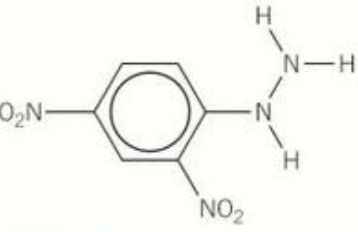
Brady's reagent is a solution that contains 2,4-dinitrophenylhydrazine (commonly abbreviated as 2,4-DNP) dissolved in methanol and sulfuric acid. This reagent appears as a pale orange solution and is used to detect the presence of carbonyl groups in both aldehydes and ketones.
Important
Safety note: Solid 2,4-DNP can be hazardous because friction or a sudden blow can cause it to explode. Always handle this chemical with care and use it only in solution.
Practical procedure for the 2,4-DNP test
Follow these steps to test for a carbonyl group:
- Add approximately 5 cm depth of 2,4-dinitrophenylhydrazine solution to a clean test tube (this is in excess)
- Using a dropping pipette, carefully add three drops of the unknown compound to the test tube
- Leave the test tube to stand and observe
- If no crystals form initially, add a few drops of sulfuric acid to encourage precipitation
- A yellow or orange precipitate indicates a positive result for the presence of an aldehyde or ketone
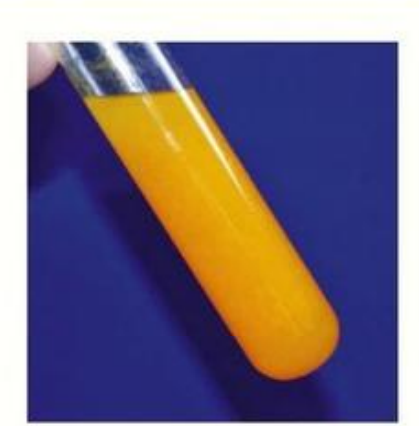
The formation of a coloured precipitate confirms that the unknown compound contains a carbonyl group. The precipitate formed is called a 2,4-dinitrophenylhydrazone derivative.
Understanding the chemical reaction
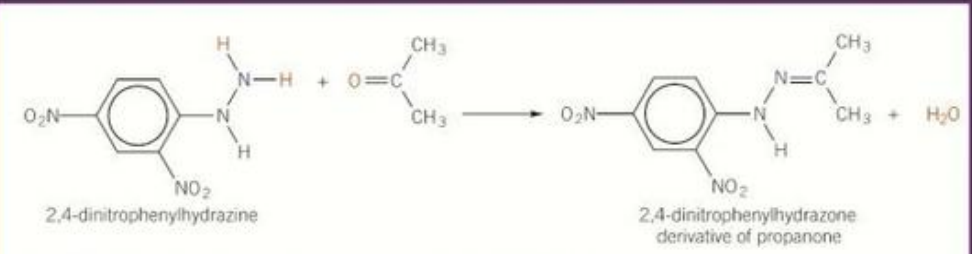
The reaction between 2,4-DNP and carbonyl compounds is a type of condensation reaction, meaning that two molecules join together with the elimination of a small molecule - in this case, water.
Note
The Reaction Mechanism:
The general mechanism involves:
- The nitrogen atom in the hydrazine group () acts as a nucleophile
- It attacks the slightly positive carbon atom in the carbonyl group
- The double bond is converted to a bond
- A water molecule () is eliminated
The equation for the reaction can be written as:
where and represent hydrogen atoms or alkyl groups. For aldehydes, one of these will be a hydrogen atom, while for ketones, both will be carbon chains.
Important
Exam tip: You don't need to memorise the structure of 2,4-DNP for your exam, but you should understand that it reacts with carbonyls to form a derivative with elimination of water. You may be given the equation in an exam question.
Distinguishing between aldehydes and ketones
Once you've confirmed that a compound contains a carbonyl group using 2,4-DNP, you can carry out a further test to determine whether it's specifically an aldehyde or a ketone. This test uses Tollens' reagent.
What is Tollens' reagent?
Tollens' reagent is a solution of silver nitrate () in aqueous ammonia. The silver is present as silver(I) ions, (aq), which act as an oxidising agent.
Important
Important: Tollens' reagent has a short shelf-life and must be prepared immediately before use. It should never be stored.
Preparing Tollens' reagent
To prepare fresh Tollens' reagent:
- Add 3 cm depth of aqueous silver nitrate, (aq), to a clean test tube
- Add aqueous sodium hydroxide to the silver nitrate until a brown precipitate of silver oxide, , forms
- Add dilute ammonia solution gradually until the brown precipitate just dissolves
- The resulting clear, colourless solution is Tollens' reagent and should be used immediately
Testing for aldehydes with Tollens' reagent
Follow this procedure to test whether a carbonyl compound is an aldehyde:
- Pour about 2 cm depth of the unknown solution into a clean test tube
- Add an equal volume of freshly prepared Tollens' reagent
- Place the test tube in a beaker of warm water heated to approximately 50°C
- Leave for 10-15 minutes and observe whether a silver mirror forms on the inside of the test tube
Results:
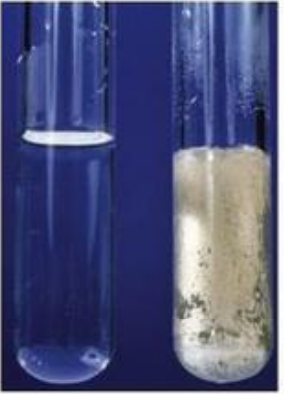
- If the unknown compound is an aldehyde, a silver mirror forms on the inside of the test tube
- If the unknown compound is a ketone, no reaction occurs and no silver mirror forms
The redox chemistry of Tollens' test
Tollens' reagent works because aldehydes can be oxidised to carboxylic acids, whereas ketones are resistant to oxidation under mild conditions. The test involves a coupled redox reaction.
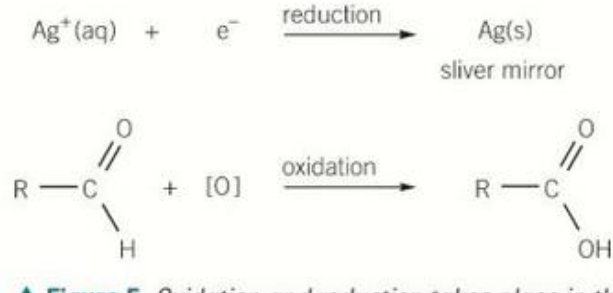
Reduction half-equation:
The silver ions are reduced to metallic silver, which deposits on the glass surface as a shiny mirror.
Oxidation half-equation:
The aldehyde is oxidised to a carboxylic acid. The symbol [O] represents the oxidising agent (which provides the oxygen).
Note
Understanding the redox process:
The aldehyde loses electrons (is oxidised) while the silver ions gain electrons (are reduced). This simultaneous oxidation and reduction is what makes this a redox reaction.
Remember: In organic chemistry, we use [O] to represent an oxidising agent rather than writing out the full oxidising agent formula.
Identifying specific carbonyl compounds by melting point
After confirming that an unknown compound contains a carbonyl group (using 2,4-DNP), you can identify the specific aldehyde or ketone by determining the melting point of its 2,4-dinitrophenylhydrazone derivative.
The recrystallisation and melting point procedure
- Filter the yellow/orange precipitate formed in the 2,4-DNP test to separate it from the solution
- Recrystallise the solid to produce pure crystals of the derivative
- Measure and record the melting point of the purified 2,4-dinitrophenylhydrazone
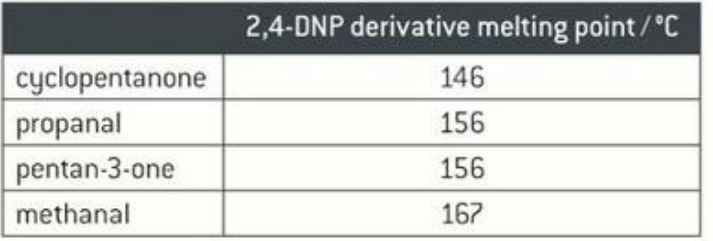
- Compare the measured melting point to values in a database or data table to identify the original carbonyl compound
Note
The table above shows example melting points for 2,4-DNP derivatives of various carbonyl compounds. Each carbonyl compound produces a derivative with a characteristic melting point, allowing for identification.
Exam note: In your exam, you may be provided with a data table of melting points and asked to identify an unknown compound. You won't need to memorise specific values, but you should understand the identification method.
Limitations of melting point identification
Not all carbonyl compounds can be reliably identified using only melting point data. Some compounds may have very similar melting points for their derivatives, making it difficult to distinguish between them.
Important
Important Limitation:
In cases where derivatives have similar melting points, additional tests (like Tollens' reagent to distinguish aldehydes from ketones) would be needed alongside the melting point determination.
Common exam mistakes to avoid
Important
Don't confuse the two tests: Remember that 2,4-DNP tests for any carbonyl group (both aldehydes and ketones), while Tollens' reagent specifically tests for aldehydes only
Don't forget the water: In the condensation reaction with 2,4-DNP, water is always eliminated - make sure to include as a product in your equations
Don't mix up oxidation and reduction: In Tollens' test, the aldehyde is oxidised (loses electrons) and silver ions are reduced (gain electrons)
Don't expect ketones to give a silver mirror: Only aldehydes react with Tollens' reagent because they can be oxidised to carboxylic acids
Summary
Summary
Key Points to Remember:
-
2,4-DNP (Brady's reagent) produces a yellow/orange precipitate with both aldehydes and ketones - it confirms the presence of a carbonyl group
-
The reaction with 2,4-DNP is a condensation reaction where a 2,4-dinitrophenylhydrazone derivative forms with elimination of water
-
Tollens' reagent specifically identifies aldehydes by forming a silver mirror through a redox reaction
-
Aldehydes are oxidised to carboxylic acids while silver ions are reduced to metallic silver in Tollens' test
-
Ketones do not react with Tollens' reagent because they resist oxidation under mild conditions
-
The melting point of the 2,4-DNP derivative can be used to identify the specific aldehyde or ketone present by comparison with data tables