Organic Synthesis (OCR A-Level Chemistry A): Revision Notes
📚Revision Notes
Further Synthetic Routes
Introduction
This topic brings together all the functional group chemistry you've studied throughout your organic chemistry course. You'll learn to identify multiple functional groups within complex molecules and plan multi-step synthetic routes to prepare target compounds from simple starting materials.
Note
Mastering synthetic routes requires combining knowledge from all areas of organic chemistry. Think of it as putting together a puzzle where each functional group transformation is a piece that connects to others.
Identifying functional groups in organic molecules
Being able to recognize functional groups within large molecules is essential for understanding their chemistry and planning synthesis routes. This skill forms the foundation of organic synthesis - you must identify where you're starting and where you need to go before planning your route.
Example
Worked Example: Aspartame
Aspartame is an artificial sweetener used in many food products. Its structure contains multiple functional groups that determine its properties:
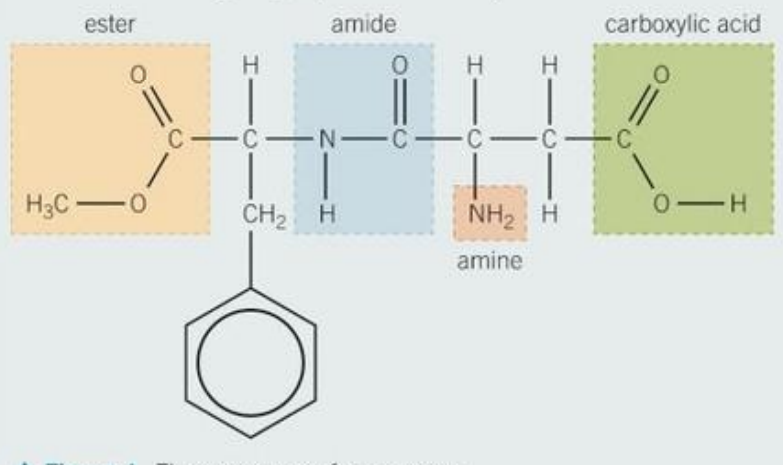
The molecule contains:
- An ester group () on the left side
- An amide group () in the centre, linking two parts of the molecule
- An amine group () attached to the carbon chain
- A carboxylic acid group () on the right side
- A benzene ring (phenyl group) attached via a bridge
Example
Worked Example: Capsaicin
Capsaicin is the compound responsible for the heat in chili peppers. Identifying its functional groups:
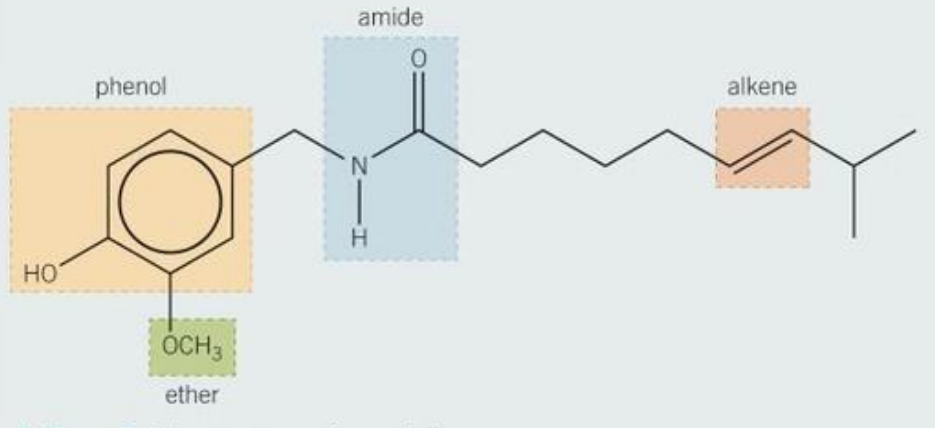
The molecule contains:
- A phenol group (benzene ring with attached) highlighted in orange
- An ether group (, a methoxy substituent) highlighted in green
- An amide group () highlighted in blue
- An alkene group ( double bond) highlighted in orange
Note
The ether group is beyond the scope of the A-Level specification but is included here for completeness. Focus on the functional groups you need to know: phenol, amide, and alkene.
The reactions of the main functional groups
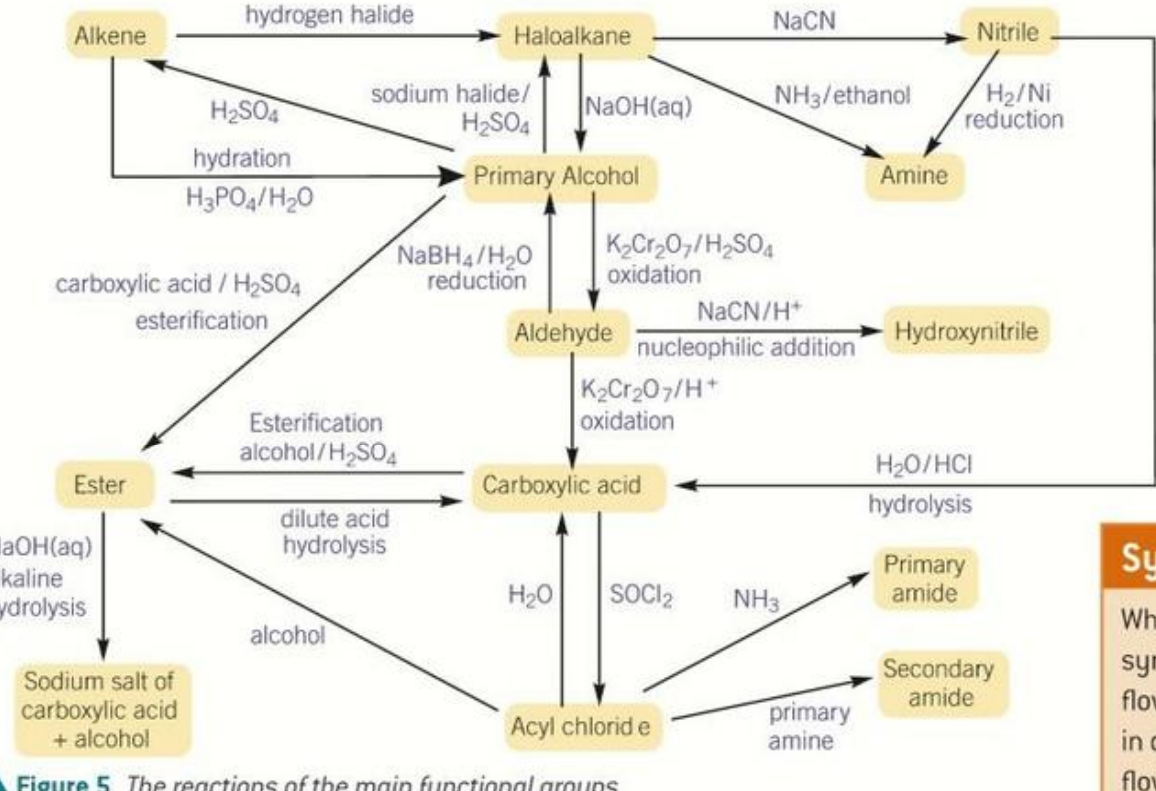
Understanding how functional groups can be interconverted is crucial for planning synthetic routes. The comprehensive flow chart below maps out all the key transformations:
Important
Learn this flowchart thoroughly! It shows all the possible conversions between functional groups. When planning a synthesis, ask yourself: "Can I get from functional group A to functional group B directly, or do I need intermediate steps?"
Key transformations to remember
Alkene reactions:
- Addition of hydrogen halide () produces a haloalkane
- Hydration with produces a primary alcohol
- Reaction with also produces an alcohol
Haloalkane reactions:
- Reaction with aqueous produces a primary alcohol
- Reaction with in ethanol produces a nitrile (chain extension by one carbon)
Note
Nitrile formation is your go-to method for chain extension! Remember that adds one carbon atom to your chain.
Primary alcohol reactions:
- Oxidation with produces an aldehyde (partial oxidation) or carboxylic acid (complete oxidation under reflux)
- Reduction with can reverse aldehyde back to alcohol
- Esterification with carboxylic acid and catalyst produces an ester
Aldehyde reactions:
- Further oxidation with produces a carboxylic acid
- Nucleophilic addition with produces a hydroxynitrile (chain extension)
- Reduction with produces a primary alcohol
Carboxylic acid reactions:
- Esterification with alcohol and produces an ester
- Reaction with (thionyl chloride) produces an acyl chloride
- Reaction with produces a primary amide (via acyl chloride intermediate)
Note
Acyl chlorides are highly reactive intermediates. They're the key to making both amides and esters from carboxylic acids efficiently.
Acyl chloride reactions:
- Reaction with produces a primary amide
- Reaction with primary amine produces a secondary amide
- Reaction with alcohol produces an ester
Ester reactions:
- Hydrolysis with (alkaline conditions) produces sodium salt of carboxylic acid and alcohol
- Hydrolysis with dilute acid produces carboxylic acid and alcohol
Nitrile reactions:
- Reduction with or produces a primary amine (chain extended by one carbon)
- Hydrolysis with produces a carboxylic acid (chain extended by one carbon)
The reactions of benzene and its derivatives
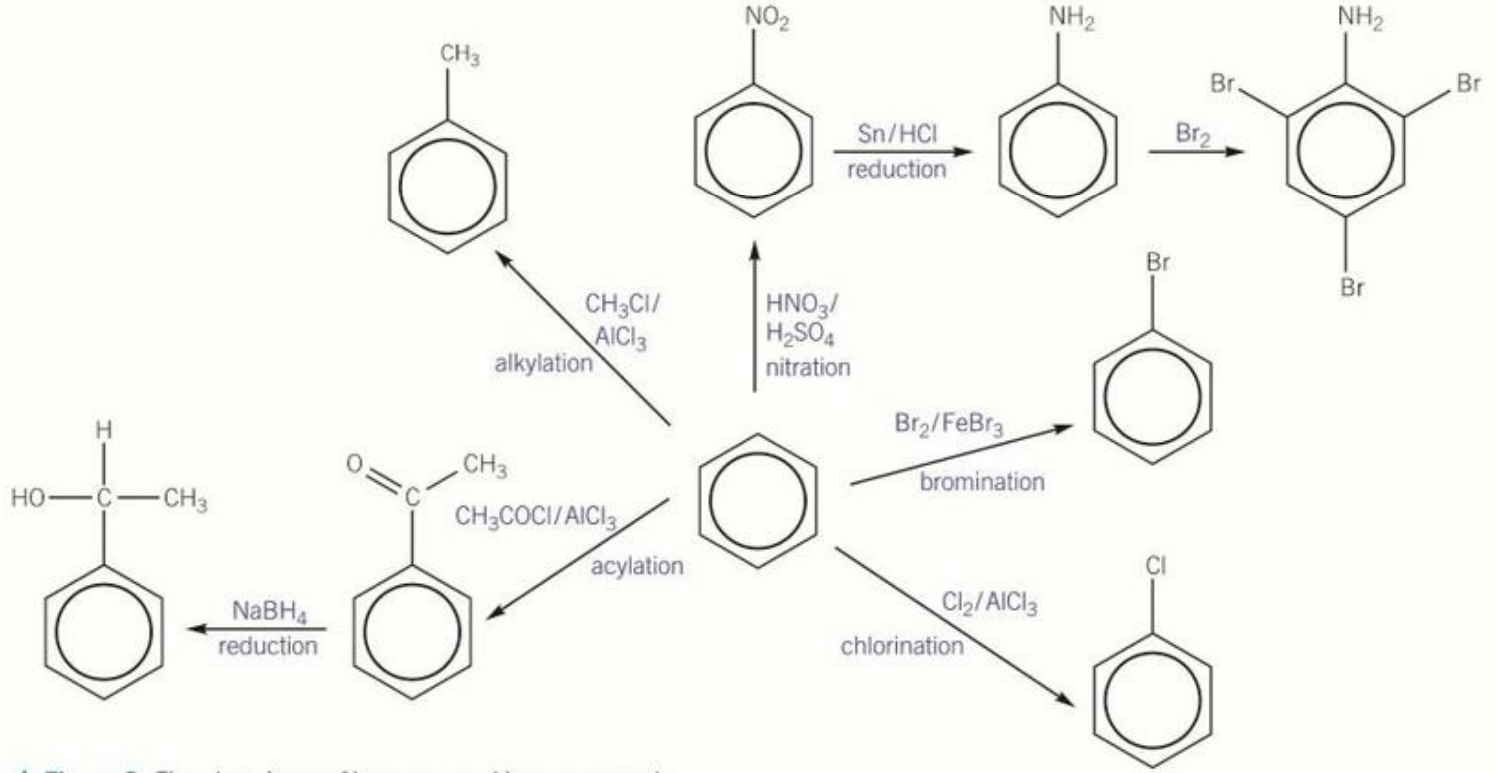
Benzene undergoes electrophilic aromatic substitution reactions. Understanding these transformations is essential for aromatic synthesis:
Key benzene reactions
Nitration:
- Reagents: Concentrated and concentrated
- Product: Nitrobenzene
- The acts as a catalyst to generate the electrophile
Alkylation (Friedel-Crafts):
- Reagents: Alkyl halide (e.g., ) with catalyst
- Product: Methylbenzene (toluene)
- is a halogen carrier that helps generate the electrophile
Acylation (Friedel-Crafts):
- Reagents: Acyl chloride (e.g., ) with catalyst
- Product: Ketone (e.g., acetophenone/phenylethanone)
- More reliable than alkylation as it avoids polysubstitution
Note
Friedel-Crafts acylation is preferred over alkylation because it stops after one substitution. Alkylation can continue to give multiple substitutions, making the product mixture difficult to separate.
Halogenation:
- Chlorination: with catalyst produces chlorobenzene
- Bromination: with catalyst produces bromobenzene
- The halogen carrier catalysts are essential for these reactions
Reactions of benzene derivatives
Reduction of nitrobenzene:
- Reagents: and concentrated , followed by neutralisation
- Alternative: with nickel catalyst
- Product: Aniline (phenylamine)
Tribromination of aniline:
- Reagents: at room temperature (no catalyst needed)
- Product: 2,4,6-tribromoaniline
- The group activates the benzene ring strongly
Important
Notice that aniline reacts with bromine water WITHOUT a catalyst. This is because the group is so activating that it makes the benzene ring much more reactive than benzene itself. This is a common exam question!
Reduction of ketones:
- Reagents: in methanol
- Converts carbonyl group to alcohol group
The reactions of phenol and its derivatives
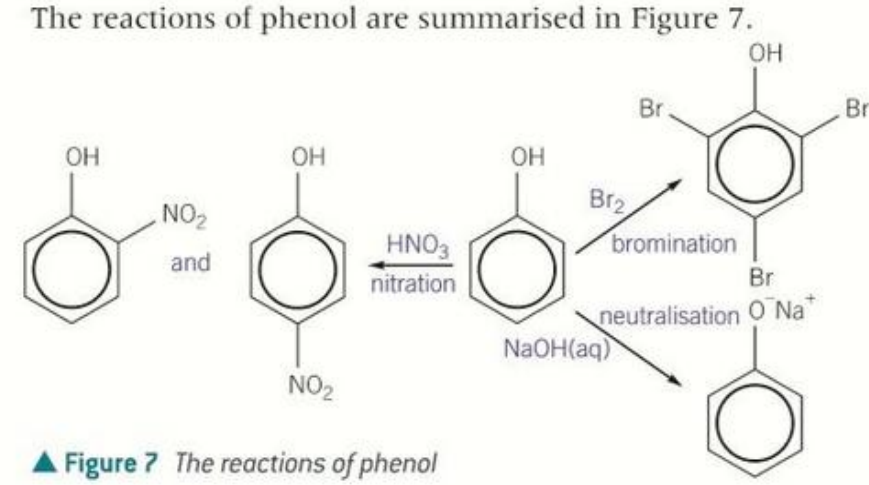
Phenol shows enhanced reactivity compared to benzene due to the electron-donating effect of the group:
Important
Phenol is much more reactive than benzene because the lone pair of electrons on the oxygen atom is donated into the benzene ring, increasing the electron density. This means phenol can react under much milder conditions than benzene.
Key phenol reactions
Nitration:
- Reagents: Dilute (much milder conditions than benzene)
- Product: Mixture of 2-nitrophenol and 4-nitrophenol
- Further nitration produces 2,4-dinitrophenol
- The group is a 2,4-directing group
Bromination:
- Reagents: at room temperature (no catalyst needed)
- Product: 2,4,6-tribromophenol (white precipitate)
- Immediate reaction showing how activated the benzene ring is
Note
The bromination of phenol happens so readily that it occurs immediately at room temperature with bromine water. The white precipitate of 2,4,6-tribromophenol is a distinctive test for phenol.
Neutralisation:
- Reagents:
- Product: Sodium phenoxide ()
- Phenol is a weak acid () due to resonance stabilization of the phenoxide ion
Organic synthesis and multi-step synthetic routes
Planning a synthesis requires systematic thinking about how to convert a starting material into a target molecule. This is where all your functional group knowledge comes together.
Approach to synthesis problems
- Identify functional groups in both the starting material and target molecule
- Work backwards from the target molecule (retrosynthetic analysis)
- Select appropriate reagents and conditions for each step
- Write balanced equations showing all intermediates
Note
Retrosynthetic analysis is the professional chemist's approach. Instead of asking "What can I make from this?", ask "What could I make this from?" This backwards thinking makes complex syntheses much easier to plan.
Example
Worked Example: Synthesis of Ethanamide from Chloroethane
Let's plan the conversion of an alcohol to a primary amide:
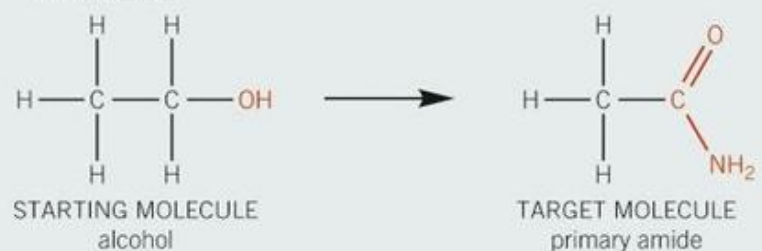
Step 1: Identify functional groups
- Starting molecule: Alcohol ( group)
- Target molecule: Primary amide ( group)
- Both molecules have the same carbon skeleton (2 carbons)
Step 2: Plan the synthetic route
Working backwards from the target:
- Primary amides are prepared from acyl chlorides (reaction with )
- Acyl chlorides are made from carboxylic acids (reaction with )
- Carboxylic acids can be prepared by oxidation of alcohols (using under reflux)
Step 3: Complete synthesis scheme

Example
Worked Example: Synthesis of Butanoic Acid from Propanal
This example requires carbon chain extension:
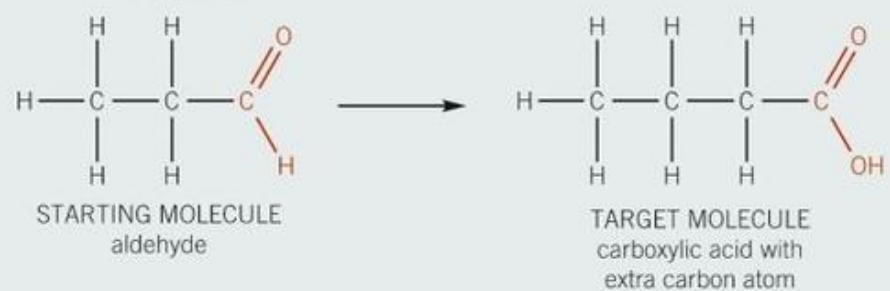
Step 1: Identify functional groups
- Starting molecule: Aldehyde (3 carbons)
- Target molecule: Carboxylic acid (4 carbons)
- Note: The target has one more carbon than the starting material
Step 2: Plan the synthesis
The key insight is that we need to extend the carbon chain by one carbon. The best route uses:
- Convert aldehyde to haloalkane (via alcohol intermediate)
- Nucleophilic substitution with cyanide to form nitrile (adds one carbon)
- Hydrolysis of nitrile to form carboxylic acid
Step 3: Detailed synthesis
Reduction of aldehyde:
Reagents: in water
Formation of bromoalkane:

Reagents: with concentrated , heat (produces in situ)
Nucleophilic substitution to form nitrile:
This is the chain extension step - the carbon in the cyanide group adds to the chain.
Hydrolysis of nitrile:

Reagents: Heat with dilute aqueous
The nitrile is hydrolysed to a carboxylic acid with the same carbon skeleton.
Example
Worked Example: Synthesis of 1-(3-aminophenyl)ethanol from Benzene
This complex synthesis combines aromatic chemistry with functional group transformations:
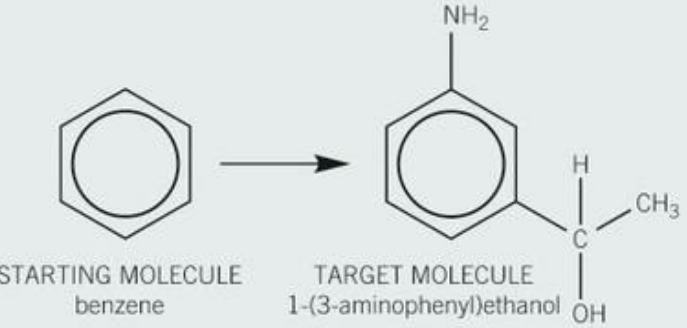
Step 1: Identify functional groups
- Starting material: Benzene (simple aromatic ring)
- Target molecule: Contains amine group () at position 3 (meta) and secondary alcohol side chain ()
Step 2: Plan the synthesis
Key considerations:
- The amine group must be in the meta position (position 3)
- To get meta-substitution, we need a meta-directing group
- The group is meta-directing, so nitration should come first
- The side chain can be added via Friedel-Crafts acylation
- The ketone can be reduced to an alcohol
- The nitro group can be reduced to an amine
Step 3: Complete synthesis scheme
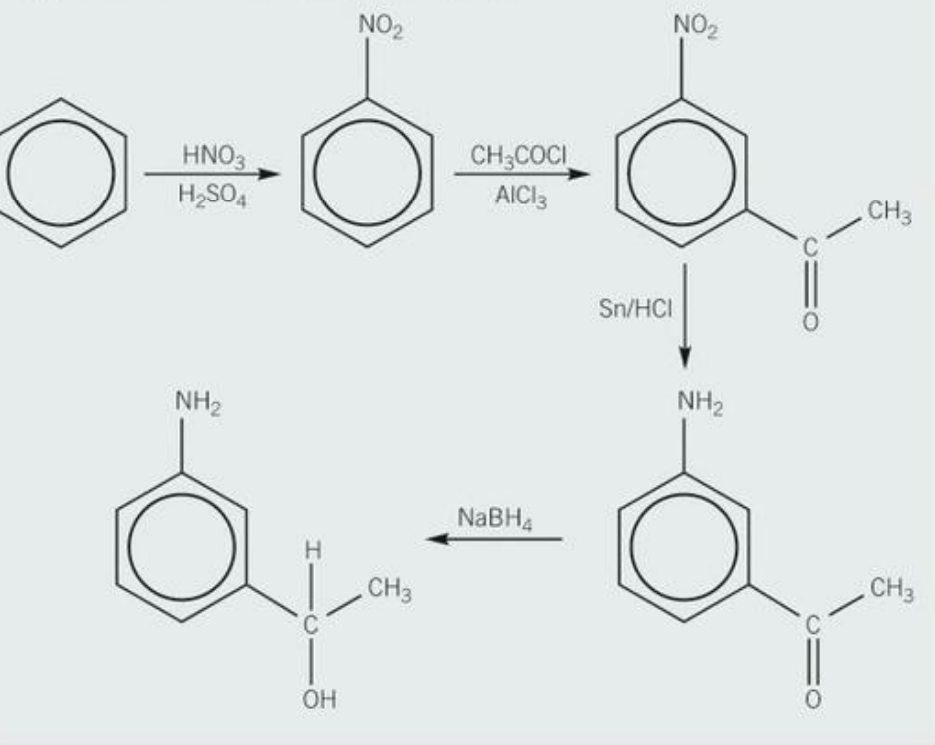
-
Nitration:
-
Friedel-Crafts acylation:
- The group directs the incoming acyl group to position 3 (meta)
-
Reduction of nitro group:
- This converts to
-
Reduction of ketone:
- This converts the carbonyl to a secondary alcohol
Important
Critical Point About Directing Groups:
The nitro group must be introduced first because it is a meta-directing group. The group is a 2,4-directing group.
If we reduced the nitro group first, the ketone would be directed to the wrong positions (2 and 4) instead of position 3. The order of steps is crucial in aromatic synthesis - always consider the directing effects of your functional groups!
Exam tips for synthesis questions
Planning your answer:
- Always identify functional groups in starting material and target first
- Count carbons - if the numbers don't match, you need chain extension or shortening
- Work backwards from the target molecule
- Show all intermediate structures clearly
- State reagents and conditions for each step
Important
Common Mistakes to Avoid:
- Forgetting to state conditions (e.g., "reflux", "heat", "concentrated")
- Incorrect order of steps (especially with directing groups in benzene chemistry)
- Not recognizing when chain extension is needed
- Missing intermediate steps in multi-step syntheses
- Confusing similar reagents (e.g., vs )
Note
Key Reagents to Remember:
- Oxidation: under reflux
- Reduction: (mild, for aldehydes/ketones), (strong, for everything), (for nitro groups)
- Acyl chloride formation:
- Chain extension: in ethanol, then hydrolyse
- Benzene reactions: Need halogen carriers (, ) or concentrated acids
Summary
Key Points to Remember:
-
Functional group identification is the first step in any synthesis problem - know your functional groups thoroughly (ester, amide, amine, carboxylic acid, phenol, aldehyde, ketone, nitrile, acyl chloride, haloalkane)
-
The flowchart of functional group interconversions is your roadmap for synthesis - learn how to convert between all major functional groups using appropriate reagents and conditions
-
Work backwards from the target molecule (retrosynthetic analysis) - this makes complex syntheses much easier to plan. Ask yourself: "What molecule could I make this from in one step?"
-
Carbon chain extension uses cyanide chemistry - reaction with adds one carbon atom via nitrile formation, which can then be hydrolysed to a carboxylic acid or reduced to an amine
-
Benzene chemistry requires careful planning of directing groups - nitro groups are meta-directing (positions 3,5), while amino and hydroxyl groups are 2,4-directing. The order of substitution matters for multi-step aromatic syntheses!