Application process (AQA GCSE Business): Revision Notes
📚Revision Notes
Application process
Understanding the application process
Choosing the right way to select new staff depends heavily on the type of role and the kind of person needed for the position. Using an inappropriate selection method could result in hiring someone unsuitable or missing out on the best candidate. Businesses must also consider legal requirements during recruitment, particularly laws that prevent discrimination.
Job advertisements
When recruiting from outside the company, businesses will almost always need to create a job advertisement. Job adverts serve several important purposes and aim to:
- Inform potential candidates about the available position
- Provide sufficient information to both inform and attract suitable applicants
- Help philtre out candidates who aren't suitable for the role
- Attract the highest number of appropriately qualified applicants possible
Important
It's crucial that job advertisements don't discriminate against any groups and must include clear instructions on how candidates can apply for the vacancy.
Types of application documents
Curriculum vitae (CV)
For many positions, businesses will request that candidates submit a curriculum vitae, commonly known as a CV. This is a document that candidates create themselves, containing key information about their background and qualifications.
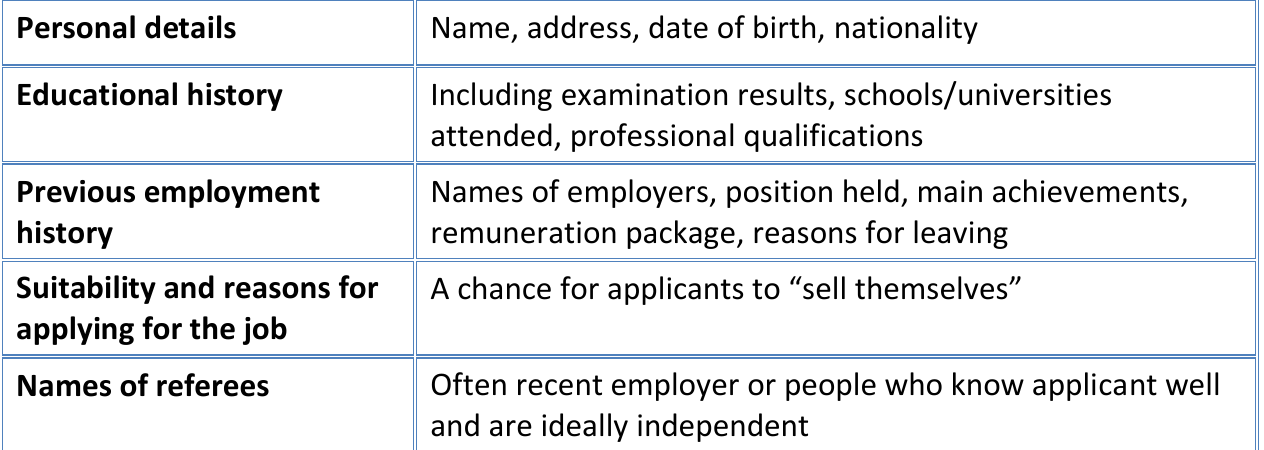 A well-structured CV typically includes five main sections, each serving a specific purpose in presenting the candidate's suitability for the role.
Note
Personal Details Section
The personal details section provides basic information such as the candidate's name, contact details, date of birth, and nationality. This allows employers to identify and contact the applicant.
Note
Educational History Section
Educational history demonstrates the candidate's academic background, including exam results, schools or universities attended, and any professional qualifications obtained. This helps employers assess whether the candidate meets the educational requirements for the position.
Note
Previous Employment History Section
Previous employment history outlines the candidate's work experience, including employer names, positions held, key achievements, salary details, and reasons for leaving previous roles. This section helps employers understand the candidate's career progression and relevant experience.
Note
Suitability Section
The suitability section gives candidates an opportunity to market themselves by explaining why they're right for the job. This is where applicants can highlight relevant skills, experience, and qualities that make them suitable for the position.
Note
Referees Section
Finally, the names of referees section provides contact details for people who can provide independent references about the candidate. These are typically recent employers or others who know the applicant well and can vouch for their character and abilities.
Application forms
Some businesses prefer to use their own application forms instead of, or alongside, CVs. These forms are designed by the employer and sent to candidates to complete. While application forms often request similar information to a CV, they offer several advantages to employers.
Note
Advantages of Application Forms
The main benefit of application forms is that businesses can tailor them to their specific requirements and ask particular questions that are most relevant to the vacant position. This allows employers to gather exactly the information they need to make informed decisions about candidates. Additionally, application forms ensure all candidates provide information in the same format, making it easier to compare applicants fairly.
Many application forms are now completed online, which can streamline the process for both employers and candidates.
Application analysis and shortlisting
Once a business has received all applications, they must be carefully reviewed and analysed. The most suitable candidates are then identified through a process called shortlisting.
Important
The Shortlisting Process
During shortlisting, employers compare applications against the job requirements and person specification to identify those candidates who best match what they're looking for. The shortlisted applicants are then typically invited to attend further selection activities, such as interviews or additional tests, to determine who should be offered the position.
This process ensures that only the most promising candidates progress to the next stage, making the selection process more efficient and focused.
Summary
Key Points to Remember:
- Job advertisements must inform, attract, philtre, and obtain suitable candidates while avoiding discrimination
- CVs contain five key sections: personal details, educational history, employment history, suitability statement, and referee details
- Application forms allow employers to ask specific questions tailored to their exact requirements
- Shortlisting involves analysing applications to identify the most suitable candidates for further assessment
- The application process helps businesses find the right person for the job while complying with legal requirements