Energy transfer (Edexcel GCSE Biology): Revision Notes
📚Revision Notes
Energy transfer
Note
In ecosystems, energy is transferred between organisms through food chains, but not all of the energy is passed on to the next level. At each trophic level (the position an organism occupies in a food chain), some energy is lost to less useful forms, and this affects the number of organisms at each level, limits the length of food chains, and shapes the pyramid of biomass.
Energy Transfer at Each Trophic Level:
Note
Energy flows through ecosystems via feeding relationships. However, as energy is passed from one trophic level to the next, some energy is lost in several ways:
- Respiration: Energy is used by organisms for life processes such as movement, growth, and reproduction. During respiration, some energy is lost as heat to the environment.
- Excretion: Some of the energy consumed by organisms is lost in waste products, such as urine or faeces.
- Uneaten parts: Not all parts of an organism are eaten (e.g., bones, roots, fur), so energy stored in these parts is not passed on to the next level.
Note
Only about 10% of the energy at one trophic level is passed on to the next level. This is known as the 10% rule, and it explains why energy transfer between trophic levels is inefficient.
Effects of Energy Loss on the Number of Organisms:
Because so much energy is lost at each trophic level, the amount of energy available decreases as you move up the food chain. This means that:
- Fewer organisms can be supported at each higher trophic level.
- Producers (plants) have the most energy available to them because they receive energy directly from the sun through photosynthesis. Therefore, there are typically more producers in an ecosystem than there are herbivores or carnivores.
- Primary consumers (herbivores) can support a smaller number of secondary consumers (carnivores), and so on up the food chain.
Limiting the Length of Food Chains:
Because energy is continually lost at each trophic level, there is a limit to how many levels can exist in a food chain.
- A typical food chain might have four to five levels (e.g., grass → rabbit → fox → eagle). Beyond this point, there is not enough energy left to support another trophic level.
- In longer food chains, the top predators have access to only a tiny fraction of the energy that was originally captured by producers.
Reasons for Biomass Loss during Transfer:
- Incomplete Consumption:
- Carnivores often cannot consume parts like bones, hooves, and claws, so not all biomass is transferred.
- Respiration:
- A significant portion of glucose consumed is used in respiration to release energy, producing carbon dioxide as a waste product rather than biomass.
- Excretion:
- Urea: A waste product formed from excess proteins, excreted in urine.
- Faeces: Herbivores, in particular, cannot digest all the plant material they eat, so undigested material is excreted as faeces.
Efficiency of Biomass Transfers
- Formula: Efficiency of biomass transfer can be calculated using:
- Population Impact: Because only a small percentage of biomass is transferred to each successive trophic level, there are typically fewer organisms at higher trophic levels.
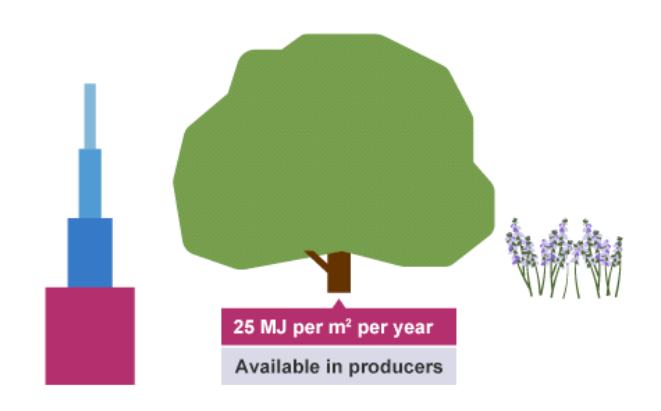
| How its lost: | |
|---|---|
| Glucose in respiration / store some in biomass | Plants convert small % of light energy (sun) into glucose which is used for respiration / stored in biomass |
| Energy stored as biomass | When an animal eats the plant/animal some energy is stored in biomass |
| Life processes – movement, respiration | Transfers energy for all life processes |
| Transferred to surroundings by heat | 'lost' to the food chain as isn't stored in biomass |
| Not all the organism gets eaten (bones) Not all of it can be digested (faeces) |
Energy lost= energy available at previous – energy transferred to next
How to interpret data on energy transfers
Arrows - Show the direction of energy transfer Numbers - Show amount of energy transferred
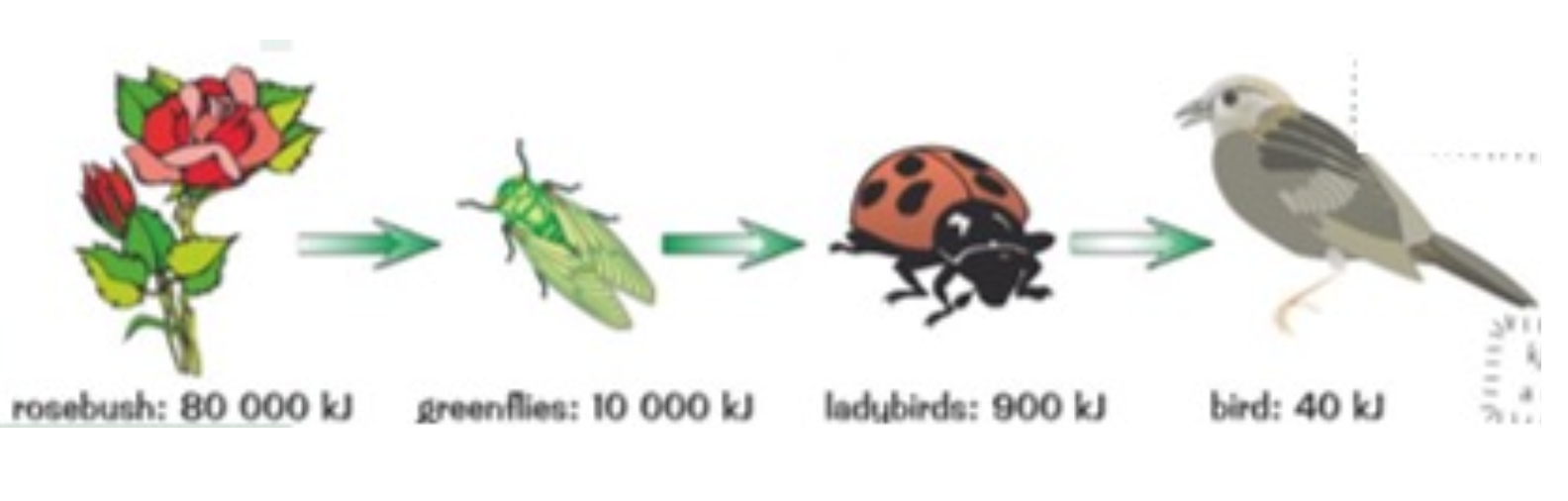
This explains why its rare to get food chains with more than 5 trophic levels as:
- lots of energy is lost at each stage so not enough to support more organisms after 4/5 stages
- Fewer organisms at each trophic level