Nitrogen cycle (Edexcel GCSE Biology): Revision Notes
📚Revision Notes
Nitrogen cycle
Why is nitrogen important?
Nitrogen is absolutely essential for all living things because it forms a key part of amino acids, which are the building blocks of proteins. Although nitrogen makes up roughly 78% of our atmosphere, plants face a major problem - they cannot directly absorb nitrogen gas () from the air.
Note
Plants cannot use atmospheric nitrogen directly! Instead, they need nitrogen to be converted into compounds like nitrates () that they can actually absorb through their roots.
This is where the nitrogen cycle becomes crucial. It's nature's way of recycling nitrogen and transforming it into forms that living organisms can use. Without this cycle, plants couldn't grow properly, and entire food webs would collapse.
The nitrogen cycle overview
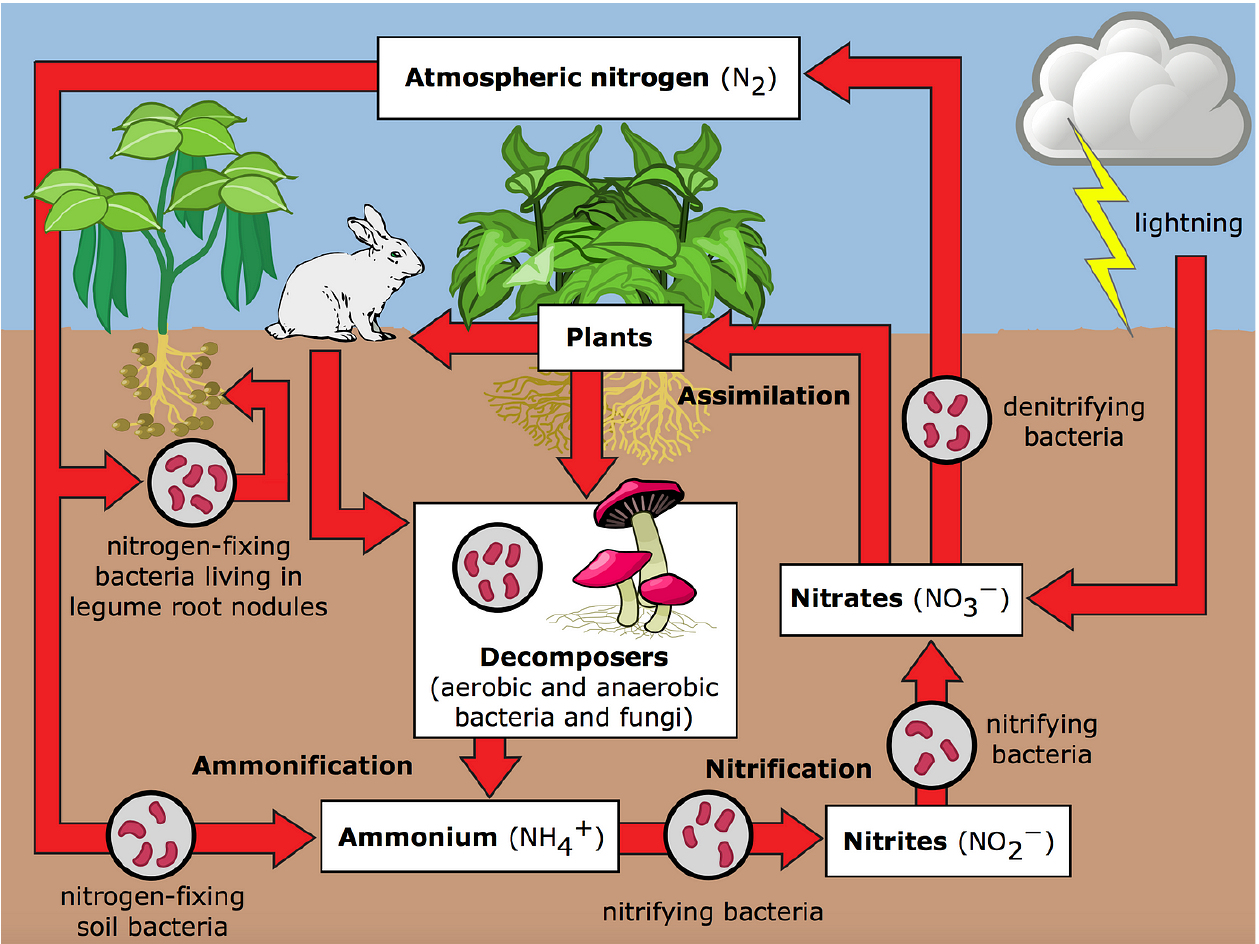
The nitrogen cycle involves several interconnected processes that move nitrogen between the atmosphere, soil, plants, and animals. Think of it as a continuous recycling system where nitrogen changes from one chemical form to another as it moves through different parts of the ecosystem.
Note
The diagram above shows how nitrogen moves through an ecosystem. Red arrows indicate the flow of nitrogen as it transforms from atmospheric nitrogen gas into various compounds and back again.
Key processes in the nitrogen cycle
Nitrogen fixation
This process converts nitrogen gas () from the atmosphere into compounds that plants can actually use. There are three main ways this happens:
Biological fixation occurs when special bacteria called nitrogen-fixing bacteria convert atmospheric nitrogen into ammonia (). These bacteria live either freely in the soil or in special bumps called root nodules on leguminous plants like peas, beans, and clover. The bacteria and plants have a mutually beneficial relationship - the bacteria get nutrients from the plant, while the plant receives nitrogen compounds in return.
Lightning fixation happens when the enormous energy in lightning bolts provides enough power to make nitrogen react with oxygen in the air, forming nitrates that fall to earth in rain.
Industrial fixation through the Haber process allows humans to manufacture ammonia from nitrogen and hydrogen gases. This ammonia is then used to create fertilisers that farmers spread on their crops.
Nitrification
This two-step process is carried out by nitrifying bacteria in the soil. First, they convert ammonia () into nitrites (), and then other nitrifying bacteria convert these nitrites into nitrates ().
Important
This process is important because nitrates are the form of nitrogen that plants can most easily absorb through their roots.
Assimilation
Plants absorb nitrates from the soil through their root systems and use them to build proteins and other nitrogen-containing molecules. When animals eat plants, they break down the plant proteins and rebuild them into their own body proteins. This transfers nitrogen up through the food chain.
Decomposition (ammonification)
When plants and animals die, or when animals produce waste, decomposer organisms like bacteria and fungi break down the nitrogen-containing proteins. This process releases ammonia back into the soil, where it can be converted into nitrates by nitrifying bacteria, continuing the cycle.
Denitrification
In waterlogged soils where oxygen is scarce, denitrifying bacteria convert nitrates back into nitrogen gas, which escapes into the atmosphere. While this completes the nitrogen cycle, it can reduce soil fertility because it removes nitrogen that plants could otherwise use.
Types of bacteria in the nitrogen cycle
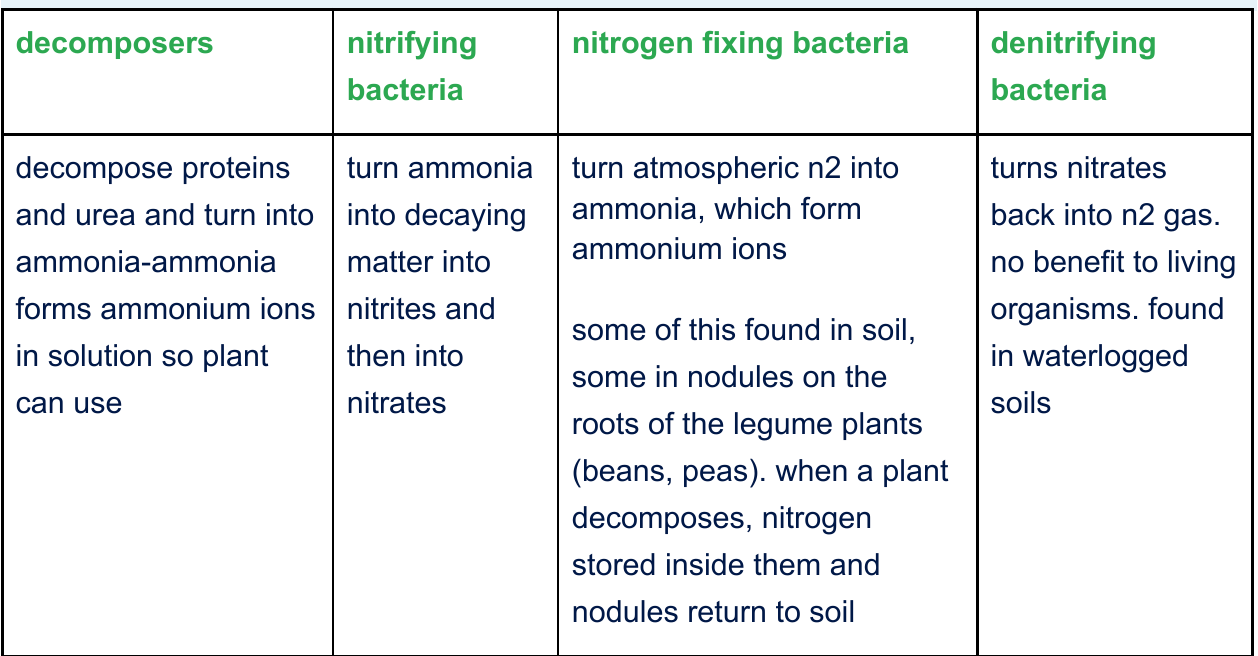
Different types of bacteria play specific and vital roles in keeping the nitrogen cycle functioning properly.
Note
Four essential types of bacteria power the nitrogen cycle:
Decomposer bacteria break down proteins and urea from dead organisms and animal waste, converting them into ammonia. This makes nitrogen available for other processes in the cycle.
Nitrifying bacteria perform the crucial job of converting ammonia into nitrites and then nitrates, creating the forms of nitrogen that plants can readily absorb.
Nitrogen-fixing bacteria are perhaps the most important, as they convert atmospheric nitrogen gas into ammonia. Some live freely in soil, while others form special partnerships with legume plants in root nodules.
Denitrifying bacteria work in oxygen-poor conditions to convert nitrates back into nitrogen gas, though this isn't beneficial for plant growth as it removes nitrogen from the soil.
How farmers increase nitrogen availability
Farmers use several strategies to ensure their crops have access to sufficient nitrogen for healthy growth.
Crop rotation
Farmers often use crop rotation to naturally boost soil nitrogen levels. They grow leguminous crops (like peas or beans) one year, which have nitrogen-fixing bacteria in their root nodules that enrich the soil. The following year, they plant other crops (like wheat or corn) that benefit from this increased nitrogen content. This reduces the need for expensive artificial fertilisers.
Fertilisers
Farmers can add nitrogen to their fields in two main ways:
Natural fertilizers like manure or compost provide organic matter that decomposes to release nitrogen into the soil. These are environmentally friendly but work more slowly.
Artificial fertilizers such as ammonium nitrate provide nitrogen directly to plants and work quickly to boost crop yields. However, they're expensive and can cause environmental problems like eutrophication if overused.
Important
Environmental Consideration: While artificial fertilisers boost crop yields quickly, overuse can lead to eutrophication in nearby water bodies, causing harmful algal blooms and oxygen depletion.
Summary
Key Points to Remember:
-
Nitrogen gas makes up 78% of the atmosphere, but plants cannot use it directly - it must be converted into nitrates first
-
The nitrogen cycle involves five main processes: nitrogen fixation, nitrification, assimilation, decomposition, and denitrification
-
Four types of bacteria are essential: decomposer bacteria, nitrifying bacteria, nitrogen-fixing bacteria, and denitrifying bacteria
-
Leguminous plants have a special relationship with nitrogen-fixing bacteria in their root nodules, naturally enriching soil
-
Farmers can increase nitrogen availability through crop rotation with legumes and by using natural or artificial fertilisers