Diffusion, Osmosis, and Active Transport (Edexcel GCSE Biology): Revision Notes
📚Revision Notes
Diffusion, Osmosis, and Active Transport
Diffusion
Note
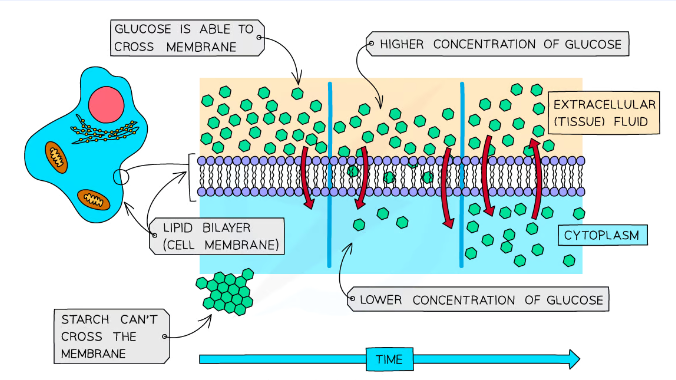
Diffusion is a fundamental process in biology where particles move from an area of higher concentration to an area of lower concentration until they are evenly spread out. This movement occurs naturally due to the random motion of particles and does not require energy from the cell, making it a type of passive transport.
Note
Key Points about Diffusion:
- Concentration Gradient:
- Diffusion occurs when there is a concentration gradient—a difference in the concentration of particles across a space.
- Particles move down the concentration gradient, from regions of higher concentration to regions of lower concentration.
- Types of Substances:
- Gases: Oxygen and carbon dioxide are small molecules that diffuse easily across cell membranes.
- Liquids: Some small molecules dissolved in water, such as glucose and amino acids, can also diffuse through membranes.
- Ions: Charged particles like sodium and potassium ions may require specific channels to diffuse through cell membranes.
- Diffusion in Cells:
- In biological systems, diffusion is crucial for the movement of substances in and out of cells.
- Oxygen: Diffuses from the alveoli in the lungs into the blood, where its concentration is lower.
- Carbon Dioxide: Diffuses from the blood into the alveoli to be exhaled, as its concentration is higher in the blood after respiration.
- Nutrients: In the small intestine, nutrients like glucose diffuse from the gut into the blood.
- Importance in Biology:
- Diffusion is essential for maintaining homeostasis—the stable internal conditions necessary for life.
- It allows cells to acquire the nutrients and oxygen they need while removing waste products like carbon dioxide.
Example
Examples of Diffusion in the Body:
- Gas Exchange: In the lungs, oxygen diffuses into the blood, and carbon dioxide diffuses out, enabling respiration.
Note
Diffusion is a simple but vital process that underpins many biological functions, ensuring that cells and organs receive the substances they need to function effectively.
Osmosis
Note
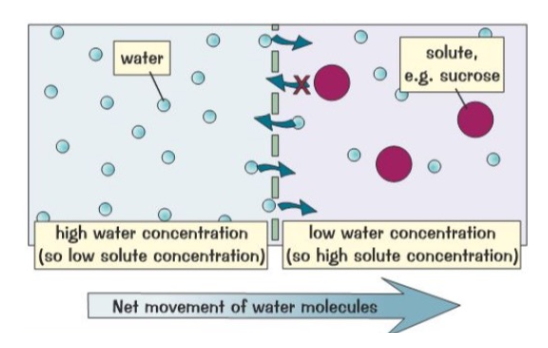
Water is able to move across cell membranes by osmosis- the movement of water from a less concentrated solution to a more concentrated one through a partially permeable membrane.
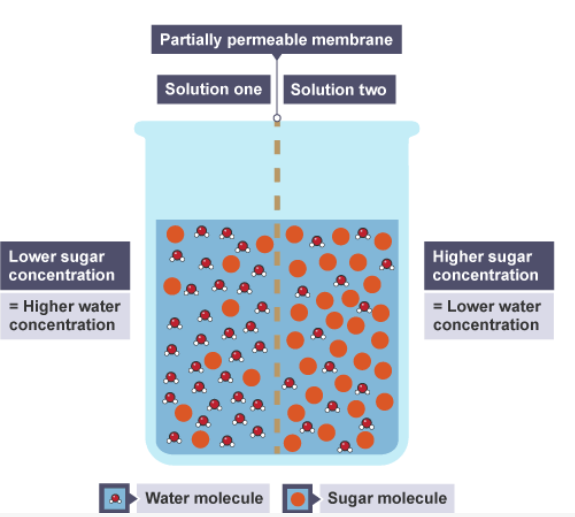
A dilute solution of sugar has a high concentration of water (and therefore a high water potential).
A concentrated solution of sugar has a low concentration of water (and therefore a low water potential).
Water moves from a dilute solution to a concentrated solution because it moves from an area of high water potential to low water potential- down the concentration gradient. It is passive (does not use energy).
The cytoplasm of a cell contains salts and sugars, so therefore when a cell is placed in a dilute solution, water will move in.
→ This situation can be modelled with a partially permeable membrane bag containing sugar molecules, with a glass tube placed in it with the top out of the water
→ This can be placed in solutions of varying concentrations in order to observe the movement of water in and out by looking at the level of the water in the tube
- If the concentration of sugar in external solution is the same as the internal, there will be no movement and the solution is said to be isotonic to the cell
- If the concentration of sugar in external solution is higher than the internal, water moves out, and the solution is said to be hypertonic to the cell
- If the concentration of sugar in external solution is lower than the internal, water moves in, and the solution is said to be hypotonic to the cell
Osmosis in animals:
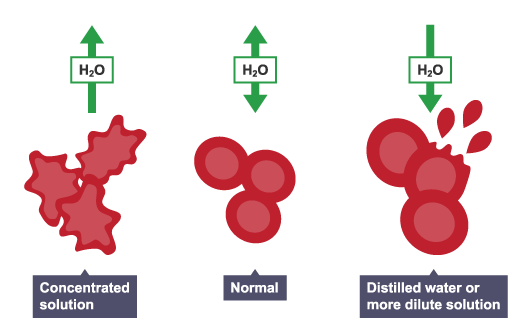
- If the external solution is more dilute (higher water potential), it will move into animal cells causing them to burst.
- On the other hand, if the external solution is more concentrated (lower water potential), excess water will leave the cell causing it to become shrivelled.
Osmosis in plants:
- If the external solution is more dilute, water will move into the cell and into the vacuole, causing it to swell, resulting in pressure called turgor (essential in keeping the leaves and stems of plants rigid).
- If the external solution is less dilute, water will move out of the cell and they will become soft. Eventually, the cell membrane will move away from the cell wall (called plasmolysis) and it will die.
Active Transport
Note
Active transport is the process by which particles move from an area of lower concentration to an area of higher concentration, going against their concentration gradient. Unlike diffusion, active transport is not a passive process; it requires energy, which is provided by respiration. This is why the process is termed "active."
Key Points:
Note
KEY POINTS: 5. Energy Requirement:
- Active transport requires energy because it moves particles against their natural tendency to diffuse from high to low concentration.
- This energy is provided by ATP (adenosine triphosphate), which is produced during cellular respiration.
Example
Examples of Active Transport:
-
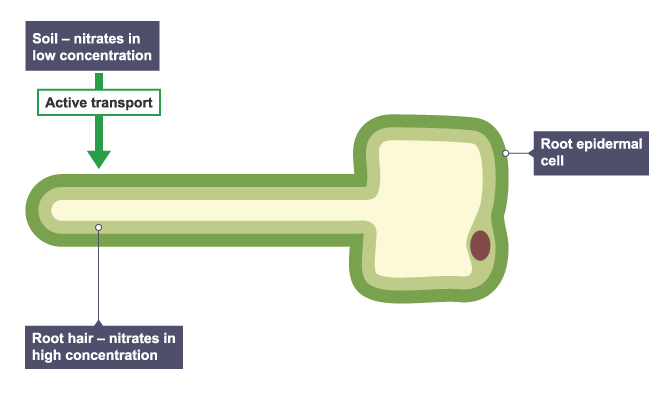
In Root Hair Cells:
-
Function: Root hair cells absorb water and essential mineral ions from the soil, which are crucial for healthy plant growth.
-
Challenge: The concentration of mineral ions is often higher inside the root hair cells than in the surrounding soil, so diffusion alone cannot move these ions into the cells.
-
Solution: Active transport is used to move these mineral ions into the root hair cells, even when the concentration gradient would naturally push them out. This process requires energy from respiration to function effectively.
-
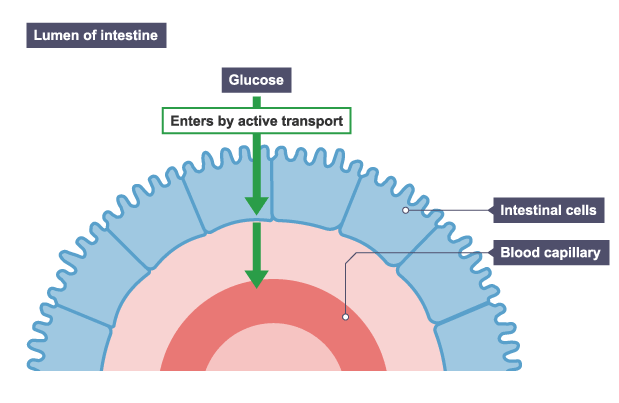
In the Gut:
-
Function: The gut absorbs nutrients such as glucose and amino acids from digested food into the bloodstream, where they can be transported to cells for energy and growth.
-
Challenge: Sometimes, the concentration of glucose and amino acids in the gut may be lower than in the blood, which would prevent diffusion from occurring.
-
Solution: Active transport is required to move these nutrients from the gut into the bloodstream against their concentration gradient. This ensures that the body can absorb all available nutrients, even when their concentrations are lower in the gut than in the blood.
Importance of Active Transport:
- Nutrient Absorption: Active transport allows cells to take in nutrients even when they are in lower concentrations outside the cell, ensuring that the body or plant gets the necessary nutrients for survival and growth.
- Maintaining Concentration Gradients: It helps maintain essential concentration gradients across cell membranes, which are crucial for processes like nerve impulse transmission and muscle contraction.
Note
Active transport is a vital biological process that ensures cells can acquire the necessary substances they need, even when conditions are not favourable for passive processes like diffusion. This ability to actively move substances is key to maintaining life functions in both plants and animals.