Current (Edexcel GCSE Physics Combined Science): Revision Notes
📚Revision Notes
Current
Electrical Current
Note
Electric current is a flow of electrical charge. Electrical charge is measured in Coulombs (C) and current is measured in amperes (A). The current can be thought of as the rate of flow of charge around the circuit. You can measure current using an ammeter. You can calculate the charge that has flown around a circuit in a certain time (s) using the following equation:
Note
Formula
- = charge flow in coulombs (C)
- = current in amps (A)
- = time in seconds (s)
Note
Remember that current will only flow through a circuit when it makes a complete loop.
Example
Example: Calculating Charge
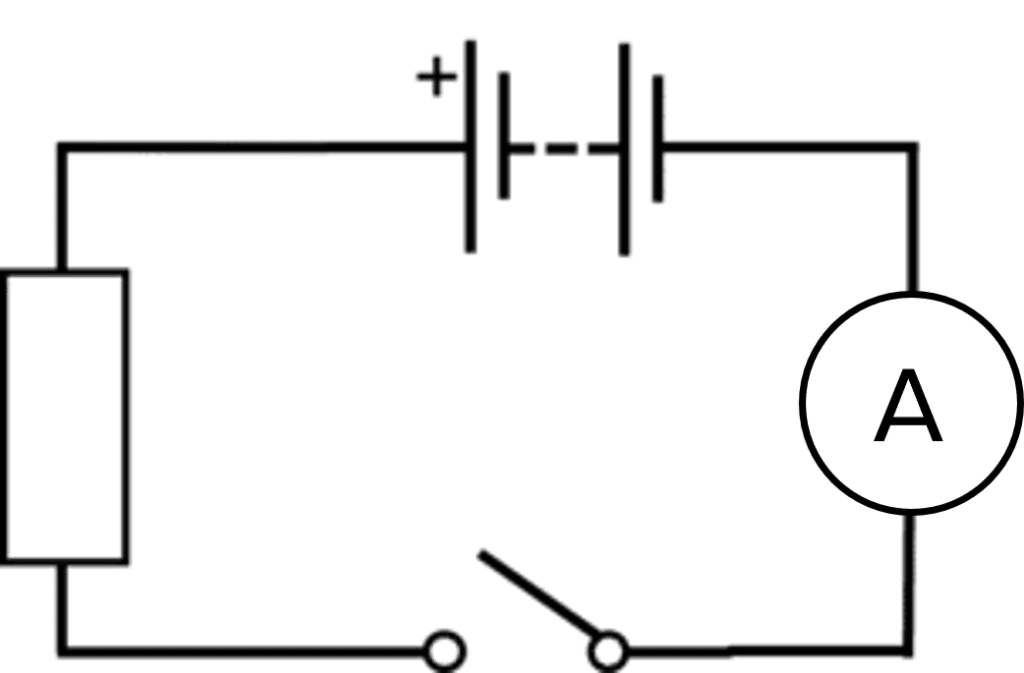
A student connects a battery to an ammeter and a resistor as shown in the diagram. The student closes the switch for 1 minute and then opens it again. During this minute, the ammeter reads 2.5 A.
Calculate the charge that flowed through the circuit during the time that the switch was closed.
[3 marks]
Key points:
Current: The flow of electrical charge around a circuit Potential difference: A driving force that pushes charge around. Unit is in v (volts) Resistance: Anything that slows flow down. The unit is in ohms
- Higher potential difference = higher current.
- Higher resistance = smaller current.
- The total charge is dependent on the current and time