The marketing mix (OCR GCSE Business): Revision Notes
📚Revision Notes
2.4 The marketing mix
The marketing mix includes 4 factors that businesses need to consider when making marketing decisions.
Product
Products can be tangible (physical) or non-tangible (service-based).
- Invention is creating and designing a product
- Innovation is turning an invention into reality
Product design
- Function - how the product works and its purpose
- Aesthetics - the look and feel of the product
- Economics - the cost of the materials or ingredients used
The product life cycle
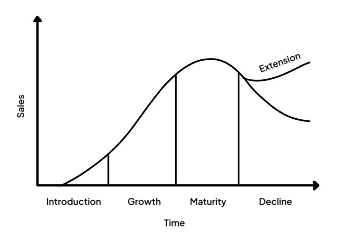
| Introduction | The product is new, which means the business needs to spend lots of money on promotion |
|---|---|
| Growth | There are a lot more sales of the product so any discounts or oers could lose money for the business |
| Maturity | The business has reached peak sales |
| Decline | Sales are starting to decline |
| Extension | A new product/variation is introduced which will need to be promoted heavily |
| Advantages | Disadvantages |
|---|---|
| Indicates to business when product extension is required | It is only an expected cycle so it may not be entirely accurate |
| Indicates when to spend more money on advertising | External factors are not taken into account |
Price
Factors that can influence pricing
- Product demand
- Competitor's pricing
- Quality of the product/service
- Brand reputation
- Cost of materials/ingredients
Pricing methods
Price skimming
Price skimming is where a business charges a large price for a product as it is better quality or more well-known than competitors.
| Advantages | Disadvantages |
|---|---|
| Makes customers feel good and likely to purchase again if they are satisfied | May be too expensive which could upset existing customers if price decreases later on |
Cost-plus pricing
Cost-plus pricing involves calculating the cost of manufacturing then adding profit on top to find the final price.
| Advantages | Disadvantages |
|---|---|
| Guaranteed to make a profit | Product may be too expensive compared to competitors |
Penetration pricing
Penetration pricing is where a business makes a product very cheap so that new customers will be willing to try it.
| Advantages | Disadvantages |
|---|---|
| Customers try the product and may switch from a competitor | May lose customers when price is eventually increased |
Competitor pricing
Competitor pricing is where a business sets their pricing based on their competitors, usually with the aim of convincing customers to switch brands.
| Advantages | Disadvantages |
|---|---|
| Increases market share as customers switch to your brand instead | Could result in a price war where businesses make a loss to be cheaper than competitors |
Promotional pricing
Promotional pricing is where a business sells a product at a lower price to sell old stock, such as a sale.
| Advantages | Disadvantages |
|---|---|
| Boosts sales and sells off old stock | Less profit and it could upset existing customers if price decreased since when they purchased it before |
Point of sale
Point of sale promotions are marketing promotions that are at a business's physical location. ● Price reductions
● Loss leaders - sell main product at a loss and charge more for accessories e.g. Printers and ink
● Competitions ● Free samples
Advertising
Advertising is where businesses try to inform customers and persuade them to purchase a product.
Social media
On social media, businesses can post about their offerings, run competitions and promotions and interact with customers.
| Advantages | Disadvantages |
|---|---|
| Easily measure interactions and statistics | Could be difficult to create effective posts |
| Free to start | Could be difficult to select correct platform |
Websites
If a business has their own website, they can use it to share details about the business such as opening hours, locations or contact details. They can also measure customer's engagement with cookies and use them to show them relevant adverts in the future.
| Advantages | Disadvantages |
|---|---|
| Customers can leave reviews to influence others to buy or visit | Customers may not visit the website or even know that it exists (waste of money) |
| No advertisements from competitors | May be difficult to appear on search engines so less customers would visit (wastes money) |
Newspapers
Businesses can advertise in local or national newspapers to target larger or smaller audiences. They can also use newspapers for different niches to target specific customers, such as a newspaper for teenagers or one for older generations.
| Advantages | Disadvantages |
|---|---|
| Enough space to provide an image and crucial information | Newspapers are becoming outdated and read less often |
| Works well for local businesses | Very expensive |
Leaflets
Leaflets are typically a cheaper way of advertising for local businesses.
| Advantages | Disadvantages |
|---|---|
| Cheaper than most other methods | Often thrown away (wastes money) |
| Visual and memorable if designed well | Could be ignored as passive advertising |
Television and radio
Advertising on TV and on the radio is usually much more expensive as businesses have to pay for the production of the advert as well as the broadcasting costs, so it is usually used by large businesses.
| Advantages | Disadvantages |
|---|---|
| Effective for large businesses | Very expensive |
| Seen by a large audience | Not suitable for small businesses |
Place
Physical distribution
Physical distribution is where a business delivers its product or services to the customer via warehouses, factories etc. beforehand.
Indirect method
Manufacturer → Wholesaler → Retailer → Customer
| Advantages | Disadvantages |
|---|---|
| Wholesaler ensures that the shop is not given too much stock | Retailers and manufacturers could make more profit by cutting out the wholesaler |
| Manufacturers can pay less delivery fees | Takes longer to reach final customer |
Sometimes, supermarkets do not use a wholesaler in order to make more profit:
Manufacturer → Retailer → Customer
Direct method
This method does not use retailers or wholesalers and is used when the manufacturer also sells their products themselves:
Manufacturer → Customer
| Advantages | Disadvantages |
|---|---|
| Customers pay less | Customers may not be able to visit in person so need to pay for delivery |
| Manufacturers make more profit | Some cheaper products are not worth paying for delivery, so customers may buy elsewhere |
Digital distribution
Digital distribution is delivering products or services digitally, such as music streaming, online games, eBooks or online courses.
| Advantages | Disadvantages |
|---|---|
| Customers can access instantly | Could be easily copied |
| Cheaper for customers and businesses as they don't need to pay rent or delivery | Risks of customer details being hacked which could ruin business reputation |
| Customers can purchase from anywhere in the world | Assumes that customers can access the internet |
How the marketing mix works together
- Price: The price may be reduced
- Product: Older products may need to be less expensive than newer ones
- Place: Incorporating more channels of distribution could lead to more sales
- Promotion: More products can be sold if more people know about them from promotion