Introduction to Physical and Chemical Change (Grade 10 NSC Matric Physical Sciences): Revision Notes
📚Revision Notes
Introduction to Physical and Chemical Change
What is matter and why does it change?
Matter surrounds us everywhere - from the desk you sit at to the air you breathe and the water you drink. All of these are examples of matter, but matter doesn't always stay the same. It can transform in many different ways. Understanding how matter changes is fundamental to chemistry, and there are two main types of changes we need to understand: physical changes and chemical changes.
Physical changes in matter
Definition and key concept
A physical change occurs when matter changes its form or appearance, but the particles that make up the substance remain exactly the same. Think of it this way - the molecules don't break apart or join together in new ways, they simply rearrange themselves.
Important
Definition: A physical change is one where the particles of the substances involved are not broken up in any way. During a physical change, the form of matter may change, but not its identity.
How physical changes work
When water is heated, for example, the temperature and energy of the water molecules increases. The liquid water then evaporates to form water vapour. Even though a change has occurred, the molecular structure of the water hasn't changed at all. This is a classic example of a physical change.
The equation for this change is:
Note
Notice how the formula stays the same - only the state symbol changes from (ℓ) for liquid to (g) for gas.
Key characteristics of physical changes
1. Arrangement of particles
When a physical change occurs, the compounds may rearrange themselves, but the bonds between atoms don't break. For example, when liquid water boils, the molecules move apart but each molecule stays intact. Water doesn't break up into hydrogen and oxygen atoms.
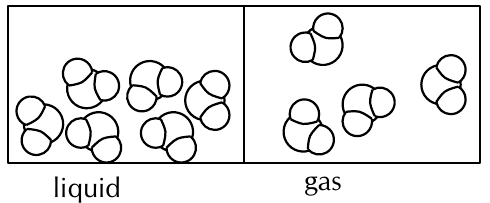
The diagram above shows how water molecules arrange differently in liquid and gas phases, but each individual molecule remains unchanged.
2. Conservation of mass
In a physical change, the total mass, number of atoms, and number of molecules always stay exactly the same. You'll always have the same number of molecules or atoms at the end of the change as you had at the beginning.
3. Energy changes
Energy changes do occur during physical changes, but these energy changes are normally much smaller than those that occur during chemical changes.
4. Reversibility
Physical changes are usually much easier to reverse than chemical changes. Methods such as filtration and distillation can reverse many physical changes. Changing temperature is another way to reverse a physical change. For example, if you dissolve salt in water, you can separate the mixture by filtration. Ice can be changed to liquid water and back again simply by changing the temperature.
Examples of physical changes
- State changes (melting, boiling, freezing)
- Dissolving one substance in another
- Energy transfer through conduction (heat moving through materials)
- Mixing substances together (where no new substances form)
Chemical changes in matter
Definition and key concept
When a chemical change takes place, completely new substances are formed in a chemical reaction. These new products may have very different properties from the substances that were present at the start of the reaction.
Important
Definition: Chemical change is the formation of new substances in a chemical reaction. One type of matter is changed into something completely different.
Examples of chemical changes
Let's examine two important examples of chemical changes: decomposition and synthesis reactions.
Decomposition of hydrogen peroxide
The breakdown of hydrogen peroxide (H₂O₂) to form water (H₂O) and oxygen gas (O₂) demonstrates a chemical change perfectly. In this reaction, the chemical bonds between oxygen and hydrogen atoms in H₂O₂ are broken, and new bonds form between hydrogen and oxygen (to form H₂O) and between oxygen atoms (to form O₂).

The equation for this reaction is:
Example
Worked Example: Decomposition of hydrogen peroxide experiment
Aim: To observe the decomposition of hydrogen peroxide when heated.
Method:
- Place a small amount of hydrogen peroxide (about 5 ml) in a test tube
- Set up apparatus with delivery tube to collect gas
- Carefully add a small amount of manganese dioxide (catalyst) to the hydrogen peroxide
- Observe the rapid gas production
Results: You should observe gas bubbling rapidly into the collection tube.
Conclusion: When hydrogen peroxide decomposes, it forms oxygen and water according to the equation:
Note that manganese dioxide acts as a catalyst - it speeds up the reaction but doesn't appear in the balanced equation because it isn't consumed.
Synthesis of water
The synthesis (formation) of water (H₂O) from hydrogen gas (H₂) and oxygen gas (O₂) is another excellent example of chemical change. The chemical bonds in the hydrogen and oxygen molecules are broken, and new bonds form to create water molecules.
Example
Worked Example: Synthesis of water experiment
Aim: To observe the synthesis of water from hydrogen and oxygen gases.
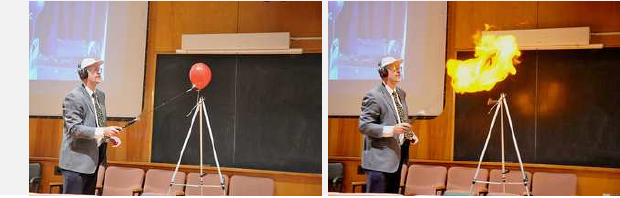
Method:
- Fill a balloon half with hydrogen gas
- Fill the remainder with oxygen gas (you can use breath as an alternative)
- Tie the balloon securely to a string
- Position the balloon safely away from people and objects
- Light a candle and carefully bring it near the balloon
Safety warning: This reaction is highly explosive and should only be done outdoors with proper safety equipment including ear protection.
Results: When the flame contacts the balloon, you'll see a bright flash and hear a loud bang.
Conclusion: A mixture of hydrogen and oxygen gases undergoes combustion to form water:
Synthesis of iron sulphide
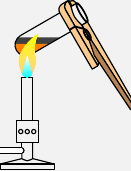
When iron and sulphur are heated together, they combine to form iron sulphide - a completely new substance with different properties from either iron or sulphur.
The equation is:
Example
Worked Example: Synthesis of iron sulphide experiment
Aim: To demonstrate the formation of iron sulphide from iron and sulphur.
Method:
- Measure quantities of iron filings and powdered sulphur and mix in a porcelain dish
- Place mixture in a test tube (about one-third full)
- Heat the test tube over a Bunsen burner, increasing heat gradually
- Remove from flame once reaction begins
- Allow to cool completely before breaking the test tube
- Examine the product's properties
Results: The mixture glows bright red during reaction. The final product (iron sulphide) is dark in colour and doesn't share properties of the original reactants - for example, it's no longer magnetic like iron was.
Conclusion: A synthesis reaction has occurred, creating an entirely new substance with different properties.
Key characteristics of chemical changes
1. Arrangement of particles
During chemical changes, the particles themselves change in some way. Using the hydrogen peroxide example, H₂O₂ molecules split into their component atoms. The number of particles changes because each H₂O₂ molecule breaks down into two water molecules (H₂O) and one oxygen molecule (O₂).
2. Energy changes
The energy changes during chemical reactions are much greater than those during physical changes. Energy is first used to break existing bonds, then energy is released when new bonds form.
3. Reversibility
Chemical changes are far more difficult to reverse than physical changes. When hydrogen peroxide decomposes into water and oxygen, it's almost impossible to get back to hydrogen peroxide using simple methods.
4. Mass conservation
Mass is conserved during chemical changes, but the number of molecules may change. In the hydrogen peroxide decomposition, every two molecules of hydrogen peroxide create three new molecules (two water molecules and one oxygen molecule).
Conservation laws in chemical changes
Understanding conservation is crucial for grasping chemical changes. Let's examine this using the hydrogen peroxide decomposition:
| Property | Reactants | Products |
|---|---|---|
| Mass is conserved | 4(1.01) + 4(16.0) = 68.04 | 2(18.02) + 2(16.0) = 68.04 |
| Atoms are conserved | 4 oxygen atoms, 4 hydrogen atoms | 4 oxygen atoms, 4 hydrogen atoms |
| Molecules | 2 molecules | 3 molecules |
| Energy changes | Energy taken in when bonds break | Energy given off when bonds form |
Important
This table demonstrates two fundamental laws:
- Law of conservation of mass: Total mass remains constant
- Law of conservation of atoms: The number of each type of atom stays the same
Comparing physical and chemical changes
| Aspect | Physical Change | Chemical Change |
|---|---|---|
| Particles | Rearrange but stay intact | Break apart and form new combinations |
| Energy changes | Smaller energy changes | Larger energy changes |
| Reversibility | Usually easy to reverse | Usually difficult to reverse |
| Mass | Always conserved | Always conserved |
| Number of molecules | Always stays the same | May change |
| Identity of substance | Stays the same | Changes to new substances |
Summary
Key Points to Remember:
-
Physical changes rearrange particles without breaking them apart - the substance keeps its identity but may change form (like ice melting to water)
-
Chemical changes create entirely new substances with different properties by breaking and forming chemical bonds (like hydrogen peroxide breaking down into water and oxygen)
-
Mass and atoms are always conserved in both types of changes - you'll always have the same total mass and the same number of each type of atom
-
Energy changes are much larger in chemical changes compared to physical changes because chemical bonds must be broken and formed
-
Physical changes are generally reversible using simple methods, while chemical changes are much harder to reverse and often require completely different reactions