Factors Influencing Customer Choice (HSC SSCE Business Studies): Revision Notes
📚Revision Notes
Factors Influencing Customer Choice
Understanding customer choice
Customer choice (also known as buying behaviour) refers to the decisions and actions consumers take when searching for, evaluating, selecting, and purchasing goods and services. Marketers need to understand what motivates individuals to choose one product over another so they can develop effective marketing strategies.
Note
There is an important distinction between market research and customer behaviour analysis:
- Market research answers: "Who are our customers?", "What do they buy?", "When do they buy?", and "How often do they buy?"
- Customer behaviour analysis goes deeper, asking: "Why do they buy?"
Understanding the factors that influence customer choice helps businesses predict trends and anticipate how consumers will respond to different marketing approaches. This deeper understanding moves beyond simple demographics and purchase patterns to explore the underlying motivations and influences that drive consumer decisions.
The four main influencing factors
Customer choice is shaped by four primary categories of influences:
- Psychological factors – internal forces within the individual
- Sociocultural factors – external pressures from other people and groups
- Economic factors – broader economic conditions affecting spending capacity
- Government factors – laws, regulations, and policies that shape the marketplace
Each of these factors interacts with the others, creating a complex web of influences that determine purchasing decisions. Successful marketing begins with understanding how these factors work together to shape consumer behaviour.
Note
Memory Aid: P-S-E-G
- Psychological
- Sociocultural
- Economic
- Government
Psychological influences
Psychological factors are internal forces within an individual that shape their buying behaviour. While these operate internally, they are also influenced by external sociocultural forces. There are five main psychological influences on customer choice.
Note
The Five Psychological Influences: P-M-A-P-L
- Perception
- Motives
- Attitudes
- Personality
- Learning
Perception
Perception is the process through which people select, organise, and interpret information to create meaning. What individuals perceive may differ significantly from objective reality – people see and hear the same things in different ways.
Example
Perception in Action: The Ferrari

One person might view a Ferrari as a symbol of achievement and success, while another sees it as unnecessarily ostentatious or wasteful. The same product, two completely different perceptions.
Because people often act based on their perceptions rather than reality, marketing managers work hard to create positive or favourable perceptions about their products. Consumers typically will not purchase products they perceive as inferior. Product perception is often shaped by advertising that creates specific images – such as trendy, luxurious, classy, fun, or rebellious. These perceived qualities may not reflect the actual product characteristics but rather how consumers interpret the marketing messages.
Motives
A motive is an individual's reason for doing something. Common motives that drive customer choice include:
- Comfort and convenience
- Health and safety
- Ambition and achievement
- Taste and pleasure
- Fear avoidance
- Amusement and entertainment
- Cleanliness
- Social approval
Marketing strategies often attempt to tap into these underlying motives. For instance, advertising might encourage consumers to want to emulate a sporting hero, thereby motivating them to purchase endorsed products. The goal is to align the product with motives that resonate with the target market.
Attitudes
An attitude is a person's overall feeling about an object or activity. Customer attitudes toward a business and its products significantly influence whether the marketing strategy succeeds or fails.
Important
The Impact of Attitudes on Marketing
- Positive attitudes reinforce brand preference and encourage repeat purchases
- Negative attitudes can force businesses to revise their entire marketing approach
Attitudes are powerful predictors of purchasing behaviour and can make or break a marketing campaign.
Personality and self-image
Personality refers to the collection of behaviours and characteristics that make up an individual. To some extent, personality influences the types and brands of products people buy. For example, clothing style, car choice, and jewellery preferences may all reflect personality traits.
Closely related to personality is self-image – how a person views themselves. Self-image is a major determinant of purchasing decisions. We all have a mental picture of who we are, and we reinforce this image through what we buy. The belief that "you are what you buy" is particularly prevalent among certain consumer groups, especially young people.
Note
The Power of Celebrity Endorsements
Marketers capitalise on the desire to express identity through purchases by highlighting the image value of their products. This is why celebrities and sportspeople are frequently used in product endorsements:
- Consumers want their self-image to reflect those they admire
- When consumers idolise a celebrity who supports a particular brand, they associate it with that person's success, beauty, and skill
- Consumers believe that using the product will give them similar desirable traits
Learning and brand loyalty
Learning refers to changes in an individual's behaviour caused by information and experiences. Much consumer behaviour is learned. When customers have direct experience with products, they form opinions based on that experience. For instance, the first time someone tastes a new soft drink flavour, they learn whether they enjoy it. Learning can also occur indirectly – seeing advertisements showing other people enjoying a product might lead consumers to assume they would enjoy it too.
To market products successfully, businesses must help customers learn about them. Successful marketing strategies assist customer learning in ways that encourage brand loyalty – when a favourable attitude toward a single brand results in repeat sales over time.
Important
The Learning-Loyalty Connection
Behaviour that results in satisfying outcomes tends to be repeated. When a customer:
- Buys a product
- Has a positive experience
- Is more likely to purchase that same brand again
This learned behaviour relates to habit formation, and there is a strong link between habits and brand loyalty.
Sociocultural influences
Whilst psychological influences are internal forces, sociocultural influences are external forces exerted by other people and groups that affect customer behaviour. There are four main sociocultural factors.
Note
The Four Sociocultural Factors: S-C-F-R
- Social class
- Culture
- Family
- Reference groups
Social class
Social class (or socioeconomic status) refers to a person's relative rank in society based on factors such as education, occupation, and income. Social class influences the type, quality, and quantity of products customers buy.
People from higher socioeconomic backgrounds typically are willing to purchase products perceived as prestigious. Higher income earners may buy luxury cars that symbolise their status and are more likely to shop in upmarket retail stores.
Example
Status Symbols in Action
Many women from higher socioeconomic groups spend significant amounts on designer handbags, which have become symbolic of status and earning power. These purchases are not just about functionality – they communicate social position and success.
Culture and subculture
Culture encompasses all the learned values, beliefs, behaviours, and traditions shared by a society. Culture influences buying behaviour because it permeates everything we do in everyday life. It determines what people wear, what and how they eat, and where and how they live.
Example
Cultural Influence on Food Marketing
The growing cultural emphasis on health and nutrition has led to increased marketing of:
- Low-fat products
- Sugar-free alternatives
- Fibre-enriched processed foods
Businesses must understand cultural values and adapt their products and marketing accordingly.
Family and roles
All individuals occupy different roles within families and the wider community. These roles significantly influence buying behaviour. Although gender roles are changing, market research shows that women still make most buying decisions related to healthcare products, food, and laundry supplies.
Interestingly, teenagers have emerged as a household's chief influencer, with parents often seeking their opinions on purchases. Studies show that teens wield the most influence in categories including:
- Clothes and shoes
- Music and books
- Food and beverages
- Household goods
- Travel and family excursions
Important
The Power of "Pester Power"
Approximately three-quarters of teens report influencing their parents' spending in these categories. This phenomenon, known as pester power, describes children's ability to influence parental purchases by repeatedly asking until they succeed.
Research indicates that of parents believe their children significantly influence spending decisions.
Reference groups
A reference group (or peer group) is a group of people with whom a person closely identifies, adopting their attitudes, values, and beliefs. Customer buying behaviour may change to align with the group's collective views and preferences.
Example
Reference Groups in Daily Life
- If a close friend shares a negative experience at a particular shop, you will probably change your buying behaviour based on this information
- If your peer group favours distinctive clothing styles, you are likely to make clothing purchases influenced by this group norm
The desire to fit in and gain approval from valued social groups is a powerful driver of consumer choice.
Economic influences
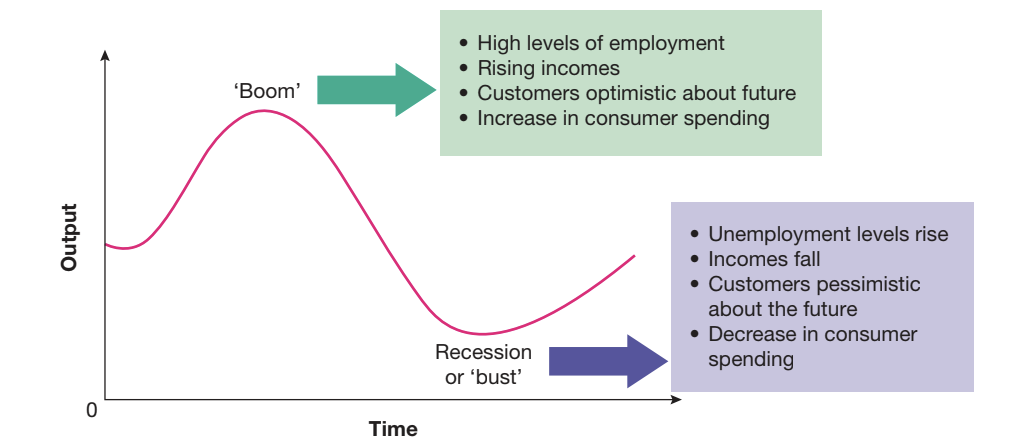
Economic forces have enormous impacts on both businesses and customers, affecting a business's capacity to compete and a customer's willingness and ability to spend. Economic activity fluctuates between periods of growth and contraction. The two main phases – boom and recession – influence the marketing environment in distinct ways.
Boom periods
A boom is characterised by low unemployment and rising incomes. During boom periods:
- Businesses and consumers are optimistic about the future
- Businesses increase production lines and intensify promotional efforts to gain market share
- Consumers are willing to spend because they feel secure about their jobs and income
- Marketing potential is large, with sales responding well to all forms of promotion
- Consumer confidence is high, leading to increased discretionary spending
Note
Marketing During Boom Times
In boom periods, the marketing environment is favourable for:
- Launching new products
- Expanding market share
- Premium pricing strategies
- Aggressive promotional campaigns
Consumer confidence creates opportunities for businesses to grow and innovate.
Recession periods
A recession sees unemployment rise and incomes fall dramatically. During recession periods:
- Customers and businesses lack confidence in the economy
- A mood of pessimism persists, especially if the recession is prolonged
- Customer and business spending reach very low levels
- Consumers become more price-conscious, seeking value and functional, long-lasting products
- Marketing plans should emphasise product value and usefulness
- Businesses focus on maintaining existing market share rather than expansion
- Survival becomes the main business goal
Example
Case Study: The Coronavirus Recession Impact
Australia's 2020 recession was the deepest since the Great Depression of the early 1930s. The economy contracted by in the three months from April to June 2020 – the biggest collapse since records began. This demonstrated how dramatically economic disruption can influence spending behaviour.
Immediate Impact:
Household consumption fell in the June quarter 2020, due partly to lockdowns and partly to general caution. Different industries experienced vastly different impacts:
- Transport services fell
- Accommodation fell
- Recreational and cultural services fell
Consumer Behaviour Shifts:
Many Australians switched to discount brands like Aldi and Costco, whilst discount department stores such as Big W and Kmart gained market share. Several spending trends emerged that may permanently reshape consumer behaviour:
- Food delivery increased above pre-pandemic levels
- Online shopping increased in July 2020 compared to July 2019
- Furniture and office equipment purchases rose above normal
- Home improvement spending increased
- Subscription television rose
- Streaming services, video games, and apps increased
This case study demonstrates how economic conditions can rapidly and dramatically reshape consumer priorities and spending patterns.
Government influences
Governments use economic policy measures to influence the level of economic activity. Depending on prevailing conditions, government policies can expand or contract economic activity, directly or indirectly affecting business operations and consumer spending habits.
Regulations and laws
Government regulations have a direct and immediate impact on marketing plans. Regulatory forces consist of laws (statutes) and regulatory bodies that can influence business behaviour. Such forces exert significant influence over marketing activities because breaking laws or regulations can result in financial penalties.
Important
Key Australian Marketing Legislation
Several important pieces of legislation influence marketing decisions in Australia:
- Competition and Consumer Act 2010 (Cwlth) (formerly the Trade Practices Act 1974)
- Sale of Goods Act 1923 (NSW)
- Fair Trading Act 1987 (NSW)
These laws protect consumers and ensure fair competition, requiring businesses to adjust their marketing strategies to comply with legal requirements.
Government stimulus measures
Government economic interventions can significantly influence consumer confidence and spending. During the coronavirus pandemic, the federal government released three major stimulus measures that had substantial impacts on consumer spending.
Example
Government Stimulus Programs During COVID-19
The Australian government implemented three major programs totalling over $100 billion:
JobKeeper – A wage subsidy scheme providing payments of $1,500 per fortnight to millions of eligible Australians. Payments were made via businesses impacted by COVID-19, enabling them to continue paying employees. This kept up to six million people employed, preventing a larger increase in unemployment.
JobSeeker – A social security payment for people looking for work or temporarily unable to work due to illness or injury. In March 2020, the government added a supplement of $550 per fortnight, effectively doubling the payment for new and existing recipients.
Economic Support Payment – A one-off payment of $750 to eligible recipients.
Impact on Consumer Behaviour:
These measures helped lift household incomes whilst 643,000 Australians lost their jobs, preventing an even deeper economic contraction and maintaining consumer spending capacity. The stimulus demonstrates how government policy can directly influence consumer confidence and choice during economic crises.
Exam guidance
When answering questions about factors influencing customer choice, consider:
- Identify which category of influence is most relevant (psychological, sociocultural, economic, or government)
- Explain how the specific factor operates to affect consumer decisions
- Apply your understanding to real business examples or case studies
- Analyse how multiple factors might interact to shape purchasing behaviour
- Evaluate which factors might be most significant in particular situations or for specific products
Note
Command Words to Watch For:
- Outline – Present main features or key points
- Explain – Relate cause and effect; make relationships clear
- Analyse – Identify components and the relationship between them; draw out implications
- Evaluate – Make a judgement about the value or effectiveness of something
Summary
Key Points to Remember:
- Customer choice refers to the decisions and actions consumers take when buying goods and services
- Four main factors influence customer choice: psychological, sociocultural, economic, and government factors
- Psychological influences (internal) include perception, motives, attitudes, personality/self-image, and learning
- Sociocultural influences (external) include social class, culture, family roles, and reference groups
- Economic influences vary between boom periods (optimism, high spending) and recession periods (pessimism, cautious spending)
- Government influences include regulations, laws, and economic policies that shape the marketplace
- Brand loyalty develops when positive experiences lead to repeat purchases
- Self-image and personality drive consumers to buy products that reflect how they see themselves
- Reference groups strongly influence buying behaviour, especially among young consumers
- Understanding these influences helps businesses predict consumer trends and develop effective marketing strategies