Evidence for Semi-conservative Replication (AQA A-Level Biology): Revision Notes
📚Revision Notes
Evidence for Semi-conservative Replication
Historical context and competing theories
When James Watson and Francis Crick determined the structure of DNA in 1953, they proposed that its complementary base pairing suggested a possible copying mechanism for genetic material. However, their idea needed experimental testing to prove which replication method was actually used.
Two main hypotheses existed for how DNA replication might occur:
Note
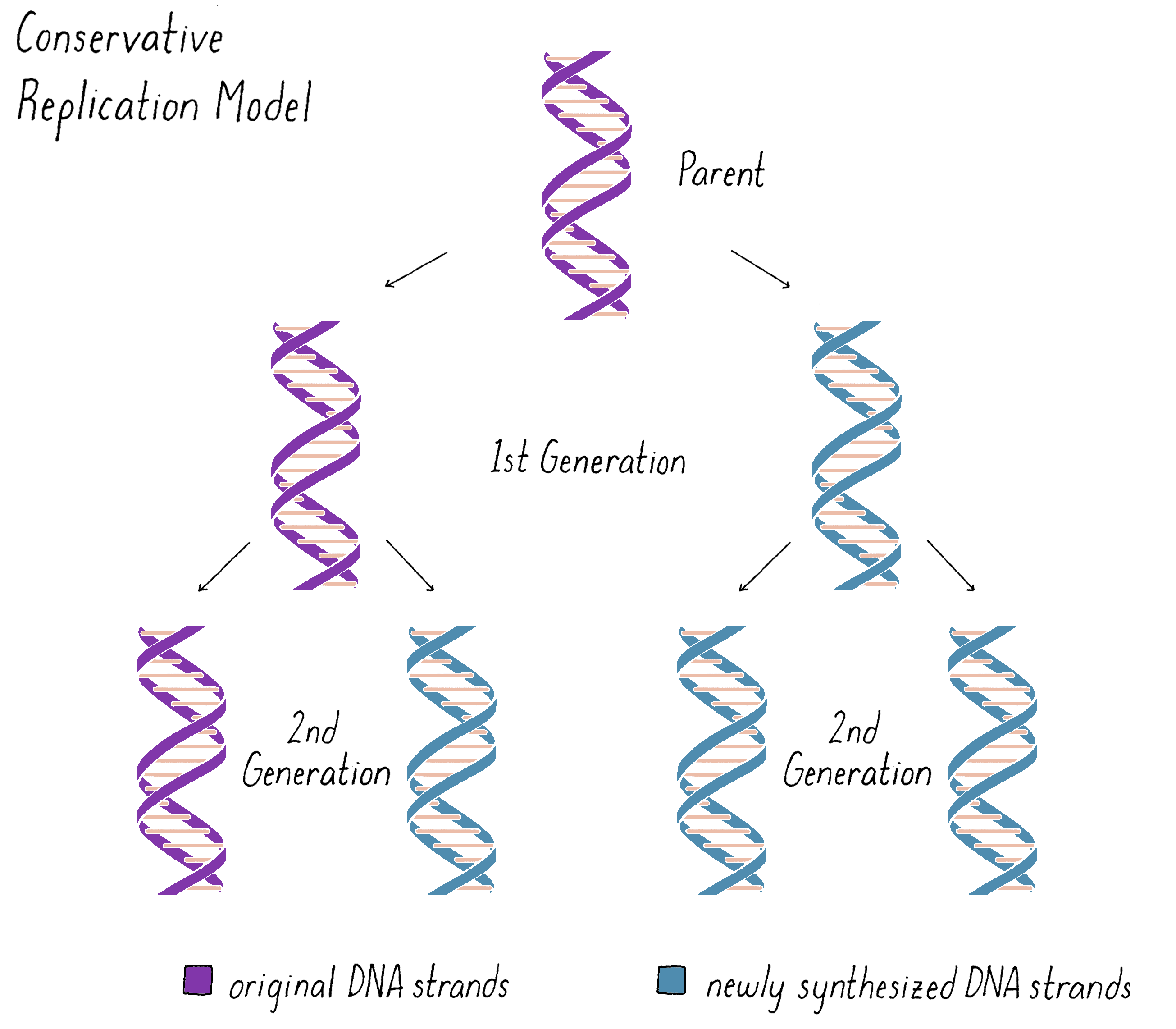
Conservative model: The original DNA molecule would remain completely intact whilst a separate daughter DNA copy would be built from entirely new deoxyribose, phosphate and organic bases. This would produce one molecule of completely original material and one molecule of entirely new material.
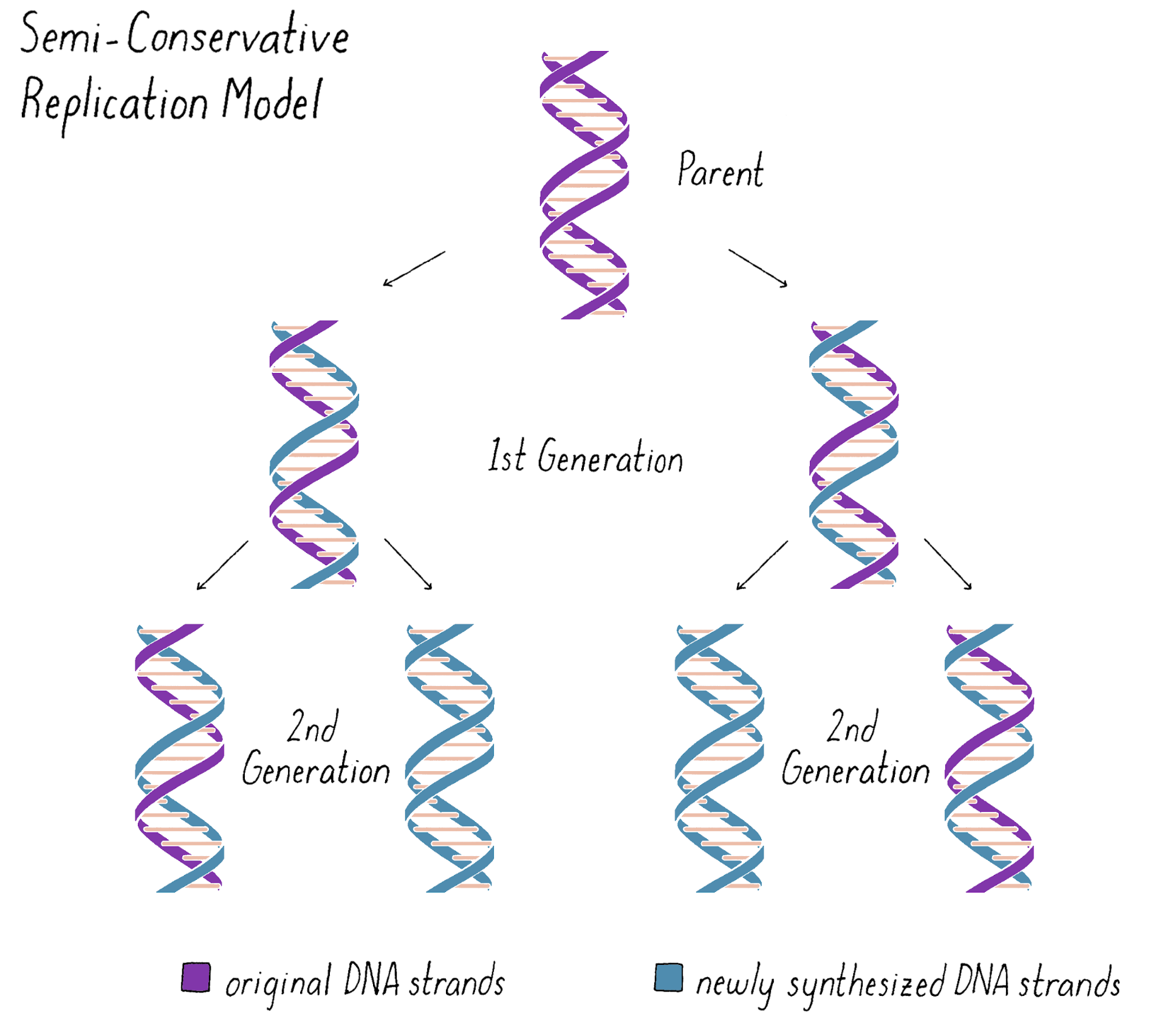
Semi-conservative model: The original DNA molecule would split into two separate strands, with each strand serving as a template for its missing half. Each new DNA molecule would therefore contain one strand of original material and one strand of new material.
The Meselson-Stahl experiment design
Matthew Meselson and Franklin Stahl designed an elegant experiment to test which replication model was correct. Their approach was based on three key facts:
- All DNA bases contain nitrogen
- Nitrogen exists in two forms: light nitrogen (¹⁴N) and heavy nitrogen (¹⁵N, an isotope)
- Bacteria incorporate nitrogen from their growth medium into any new DNA they synthesise
The experimental method involved:
- Growing bacteria on a medium containing heavy ¹⁵N for many generations, ensuring all parental DNA contained heavy nitrogen
- Transferring bacteria to a medium containing only light ¹⁴N for replication
- Extracting DNA samples after each generation
- Using density gradient centrifugation to separate DNA types - heavier DNA settles near the bottom of the centrifuge tube, lighter DNA near the top
Results across generations
Generation 0 (Control)
Bacteria grown entirely in ¹⁵N medium produced DNA that was completely heavy, settling at the bottom of the centrifuge tube.
Generation 1
After one round of replication in ¹⁴N medium, all DNA showed intermediate density - settling in the middle of the centrifuge tube. This indicated that every DNA molecule contained both heavy and light nitrogen.
Example
Worked Example: Generation 1 Analysis
Starting material: DNA with both strands containing ¹⁵N (heavy) Replication medium: Contains only ¹⁴N (light)
If semi-conservative replication occurs:
- Each original ¹⁵N strand serves as a template
- New strands are synthesised using ¹⁴N from the medium
- Result: Every DNA molecule has one ¹⁵N strand + one ¹⁴N strand = intermediate density
This matches the observed results perfectly!
Generation 2
After two rounds of replication in ¹⁴N medium, the DNA separated into two distinct bands:
- 50% showed intermediate density (hybrid molecules)
- 50% showed light density (completely ¹⁴N molecules)
Generation 3
The pattern continued with decreasing proportions of hybrid molecules and increasing proportions of light molecules.
Interpretation and conclusions
The results clearly supported the semi-conservative model:
Important
Critical Evidence Against Conservative Replication:
If replication were conservative, generation 1 would show two distinct bands (heavy parental DNA and light daughter DNA), not the single intermediate band observed. This definitively ruled out the conservative model.
The semi-conservative model perfectly explained the intermediate density in generation 1, where each DNA molecule contained one heavy parental strand and one light newly-synthesised strand. Generation 2 results confirmed this, showing exactly 50% hybrid molecules (containing one heavy strand) and 50% light molecules (both strands newly synthesised).
This experiment demonstrated that DNA replication is semi-conservative - each new DNA molecule consists of one original strand acting as a template and one newly synthesised complementary strand.
Links to DNA structure
This replication mechanism directly relates to the antiparallel double helix structure discovered by Watson and Crick, where complementary base pairing (A with T, G with C) allows each strand to serve as an accurate template for synthesising its partner strand.
Summary
Key Points to Remember:
- Semi-conservative replication means each new DNA molecule contains one original strand and one new strand
- The Meselson-Stahl experiment used nitrogen isotopes (¹⁴N and ¹⁵N) to track DNA through generations
- Density gradient centrifugation separated heavy DNA from light DNA based on density differences
- Results showed intermediate density DNA after one generation, proving semi-conservative replication
- This experiment elegantly demonstrated how scientific hypotheses are tested with carefully designed experiments