Passage of Action Potentials (AQA A-Level Biology): Revision Notes
📚Revision Notes
Passage of Action Potentials
Basic mechanism of propagation
When an action potential is generated, it travels rapidly along the axon as a wave of electrical activity. The action potential maintains constant amplitude throughout its journey, but the mechanism of propagation differs between myelinated and unmyelinated axons.
The propagation process works through localised circuits - as one region becomes depolarised, it stimulates adjacent areas of the membrane. This creates a travelling wave of depolarisation followed by repolarisation.
Note
The process is similar to a Mexican wave moving around a stadium where individual spectators don't physically move, but the wave pattern travels around the venue. This analogy helps visualise how the electrical signal propagates without the actual ions travelling the entire length of the axon.
Passage along unmyelinated axons
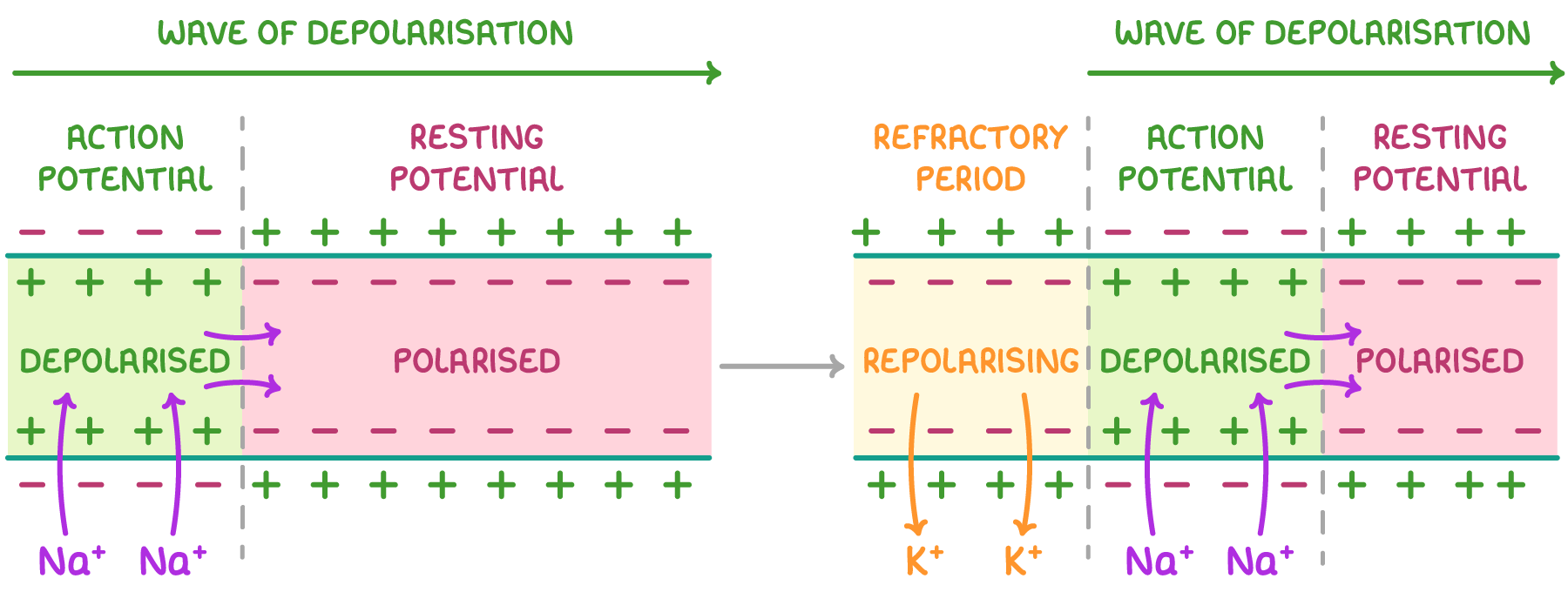
In unmyelinated nerve fibres, action potential propagation occurs as a continuous wave along the entire axon membrane. This process requires the action potential to depolarise every section of the axon membrane, making it relatively slow compared to myelinated conduction.
Example
Worked Example: Five Stages of Unmyelinated Conduction
Stage 1: Resting state
The axon membrane is polarised with sodium ions concentrated outside and potassium ions concentrated inside. The membrane potential is approximately .
Stage 2: Initial depolarisation
A stimulus triggers sodium voltage-gated channels to open, allowing sodium ions to flood into the axon. This creates a localised area of depolarisation and establishes local circuits of current flow.
Stage 3: Propagation begins
The electrical disturbance spreads to adjacent regions, causing more sodium channels to open further along the membrane. Behind the advancing wave, sodium channels begin to close and potassium channels open.
Stage 4: Wave continues
The action potential continues propagating along the axon whilst the original region undergoes repolarisation as potassium ions leave the cell, restoring the negative internal charge.
Stage 5: Recovery
The sodium-potassium pump actively transports ions back to their original positions, fully restoring the resting potential and preparing the membrane for the next impulse.
Passage along myelinated axons
Myelinated axons conduct action potentials much more efficiently due to the insulating properties of the myelin sheath. This fatty layer prevents ion exchange across most of the axon membrane, concentrating electrical activity at specific points.
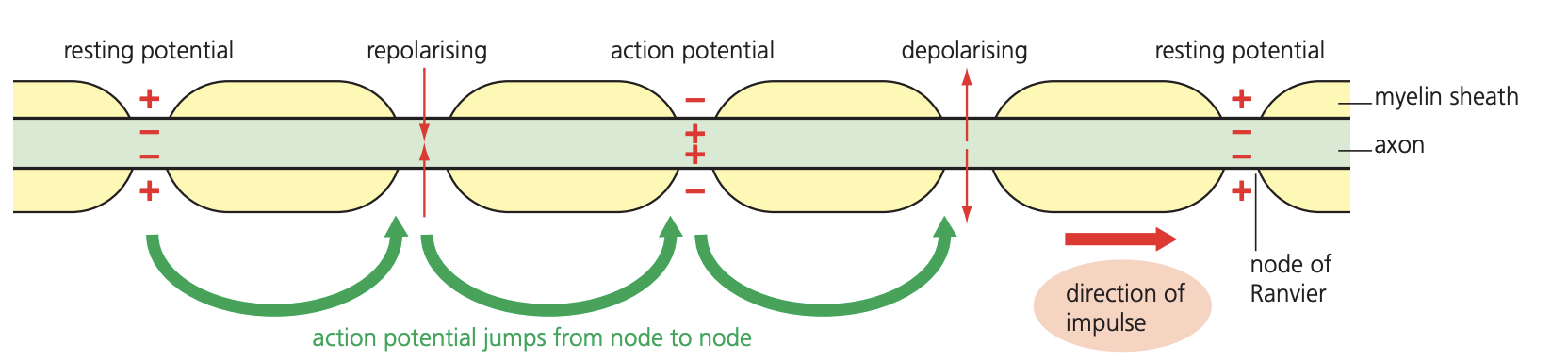
Nodes of Ranvier are gaps in the myelin sheath occurring every along the axon. These exposed regions contain high concentrations of sodium voltage-gated channels and are the only sites where depolarisation can occur.
Important
Saltatory Conduction describes how action potentials effectively "jump" from one node of Ranvier to the next. The electrical current flows rapidly through the low-resistance myelinated sections and regenerates at each node, creating a much faster transmission method.
The term "saltatory" derives from the Latin word "saltare," meaning to jump, reflecting how the electrical signal leaps between nodes rather than flowing continuously.
Note
Advantages of Saltatory Conduction:
- Increased speed: Action potentials travel faster as they don't need to depolarise every section of membrane
- Energy efficiency: Fewer ions need to be actively transported back to resting levels
- Signal maintenance: The myelin prevents signal degradation between nodes
Comparing conduction types
| Feature | Unmyelinated | Myelinated |
|---|---|---|
| Speed | Slower | Faster |
| Energy requirement | Higher | Lower |
| Propagation method | Continuous wave | Saltatory jumping |
| Sites of depolarisation | Entire membrane | Nodes of Ranvier only |
| Axon diameter needed | Larger for fast conduction | Smaller achieves fast conduction |
Summary
Key Points to Remember:
- Action potentials propagate as waves of depolarisation that maintain constant amplitude
- In unmyelinated axons, continuous propagation occurs along the entire membrane surface
- Myelinated axons use saltatory conduction, jumping between nodes of Ranvier for faster transmission
- The myelin sheath acts as electrical insulation, concentrating ion exchange at nodes only
- Saltatory conduction is more energy-efficient and allows faster signal transmission than continuous conduction