Reduction Formulae (AQA A-Level Further Maths): Revision Notes
📚Revision Notes
Reduction Formulae
What is a reduction formula?
A reduction formula is a special type of equation that expresses an integral in terms of similar integrals with lower indices, such as or . This creates a recursive relationship that allows you to break down complex integrals into simpler ones.
Note
Definition: A reduction formula for is an equation that relates to and/or . It can be repeatedly applied to reduce the integral to one that does not require integration by parts.
Reduction formulae are particularly useful when you need to integrate expressions of the form where repeated application of integration by parts would be extremely time-consuming. Instead of applying integration by parts multiple times manually, you can derive a formula once and then apply it repeatedly until you reach a simple integral you can evaluate directly.
Integration by parts formula
The foundation of reduction formulae is the integration by parts formula:
Important
This formula is essential because deriving a reduction formula typically involves applying integration by parts to the integral and then recognising that the resulting expression contains or .
How reduction formulae work
When you have an integral such as , applying integration by parts once gives you another integral that looks similar but with a lower power of . The key insight is that this new integral is actually , creating a relationship:
Note
You can then use this formula repeatedly, reducing to , then to , and so on, until you reach or , which are usually simple integrals you can evaluate directly.
Important: Reduction formulae can be used for both definite and indefinite integrals. For definite integrals, you substitute the limits at the appropriate stage after reaching the simplest form.
Deriving a reduction formula
To derive a reduction formula, follow these steps:
- Define your integral as with the appropriate function involving
- Apply integration by parts with carefully chosen and
- Simplify the expression and identify where or appears
- Rearrange to express explicitly in terms of lower-index integrals
Important
The choice of and is crucial. Generally, choose as the part containing the power , so that when you differentiate it, the power reduces.
Worked example 1: Logarithmic functions
Consider the integral . We need to prove that and use this to evaluate .
Example
Worked Example: Deriving and Using a Logarithmic Reduction Formula
Step 1: Apply integration by parts
Let and .
Then and .
Using the integration by parts formula:
Step 2: Evaluate the boundary term
The first term evaluates to 0 because when , , and as , .
The remaining integral is , so:
This is our reduction formula.
Step 3: Apply the formula repeatedly to find
Step 4: Calculate
Now we need .
Using integration by parts again with and :
Step 5: Find the final answer
Therefore:
Worked example 2: Functions with square roots
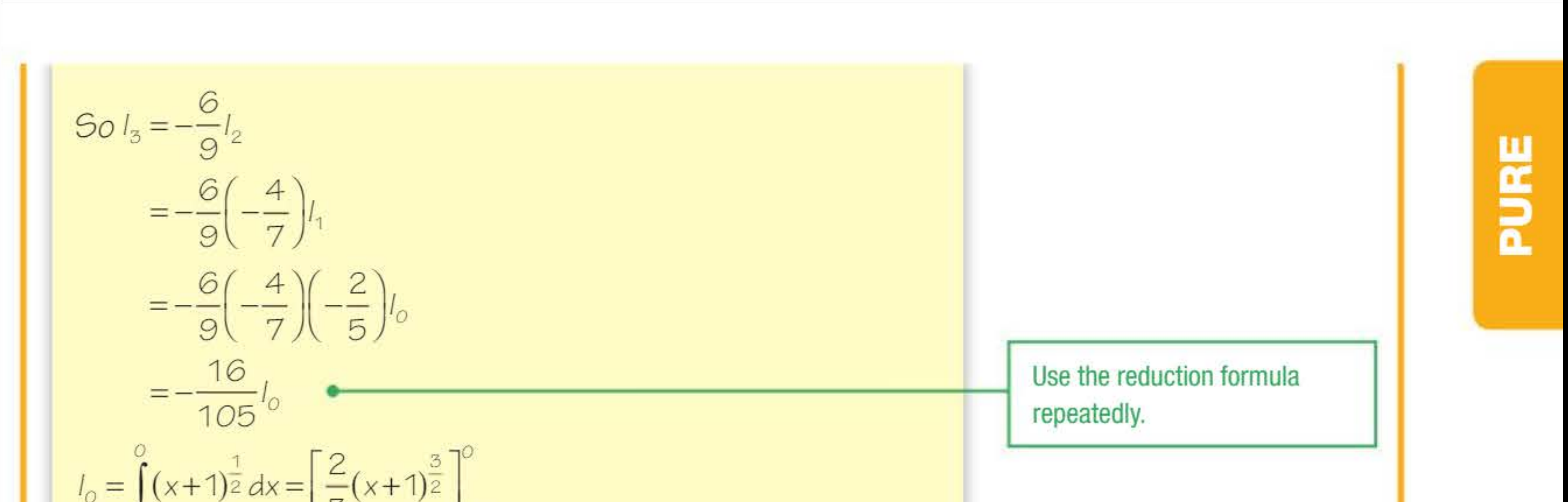
Given that , show that and evaluate .
Example
Worked Example: Deriving a Square Root Reduction Formula
Step 1: Rewrite and apply integration by parts
First, rewrite the integrand as .
Apply integration by parts with and .
Then and .
Using integration by parts:
The first term evaluates to 0 because both limits give .
Step 2: Manipulate to reveal and
Now rewrite :
Step 3: Rearrange to isolate
Example
Worked Example: Evaluating
Apply the formula repeatedly:
Calculate :
Find the final answer:
Worked example 3: Trigonometric functions
Find a reduction formula for and use it to find and .
Note
Sometimes the integrand is not initially in the form of a product of two functions. In such cases, you can split up the integral yourself. For example, write as .
Example
Worked Example: Deriving a Trigonometric Reduction Formula
Step 1: Split the function and apply integration by parts
Write and apply integration by parts.
Let and .
Then and .
Using integration by parts:
Step 2: Use the identity
Replace with :
Step 3: Rearrange to find the reduction formula
Example
Worked Example: Using the Formula to Find
Apply the formula repeatedly:
Now evaluate :
Therefore:
Example
Worked Example: Using the Formula to Find
Now evaluate :
Therefore:
Strategy for finding and using reduction formulae
When tackling problems involving reduction formulae, follow this systematic approach:
Step 1: Split up the function if necessary and integrate
If the integrand is not already in the form of a product of two functions, rewrite it. For example, write as or , depending on which form will be most useful.
Step 2: Find an expression for in terms of and/or
Apply integration by parts carefully, choosing and so that the power of reduces when you differentiate. After integration by parts, look for where or appears in your expression. You may need to factorise or use trigonometric identities to reveal the reduction formula.
Step 3: Use the formula repeatedly until you reach or
Keep applying your reduction formula to reduce the index. Continue until you reach either or , which should be integrals you can evaluate directly without integration by parts.
Step 4: Calculate or and use with your formula to find for the value of required
Evaluate the simplest integral ( or ) directly. Then substitute this value back into your chain of reductions to find the final answer for the required value of .
Key exam tips
Note
Tip 1: Rearranging the integrand
After applying the integration by parts formula, you may need to rearrange the integrand so that it is clearly in the form of and/or . Look for opportunities to factorise expressions or use trigonometric identities like .
Important
Tip 2: Watch your limits
For definite integrals, be very careful when substituting limits. Terms involving or similar problematic expressions often evaluate to when you consider the limit properly. For example, .
Note
Tip 3: Know when you're done
Recognise when you've reached or . These should be integrals you can evaluate directly, such as , , or .
Note
Tip 4: Check for algebraic errors
When applying the reduction formula repeatedly, it's easy to make arithmetic mistakes with fractions. Work carefully and consider simplifying at each step to keep expressions manageable.
Important
Tip 5: Even vs odd indices
In some reduction formulae (like the example), notice that relates to , not . This means even powers of eventually reduce to , while odd powers reduce to . Be prepared to evaluate both.
Summary
Summary
Key Points to Remember:
- A reduction formula relates to and/or , allowing you to break down complex integrals systematically.
- Derive reduction formulae using integration by parts, choosing and carefully so that the power reduces when you differentiate.
- Apply the reduction formula repeatedly until you reach a simple integral ( or ) that you can evaluate directly.
- Reduction formulae work for both definite and indefinite integrals – just remember to apply limits correctly for definite integrals.
- When working with trigonometric functions, you may need to use identities like to reveal the reduction formula structure.