Action of lenses (AQA A-Level Physics): Revision Notes
📚Revision Notes
Action of lenses
Introduction to lenses
A lens is a transparent block of material (glass or organic material in the eye) that refracts light passing through it. Lenses are used in many optical instruments including binoculars, telescopes, cameras, spectacles, magnifying glasses and microscopes to produce images.
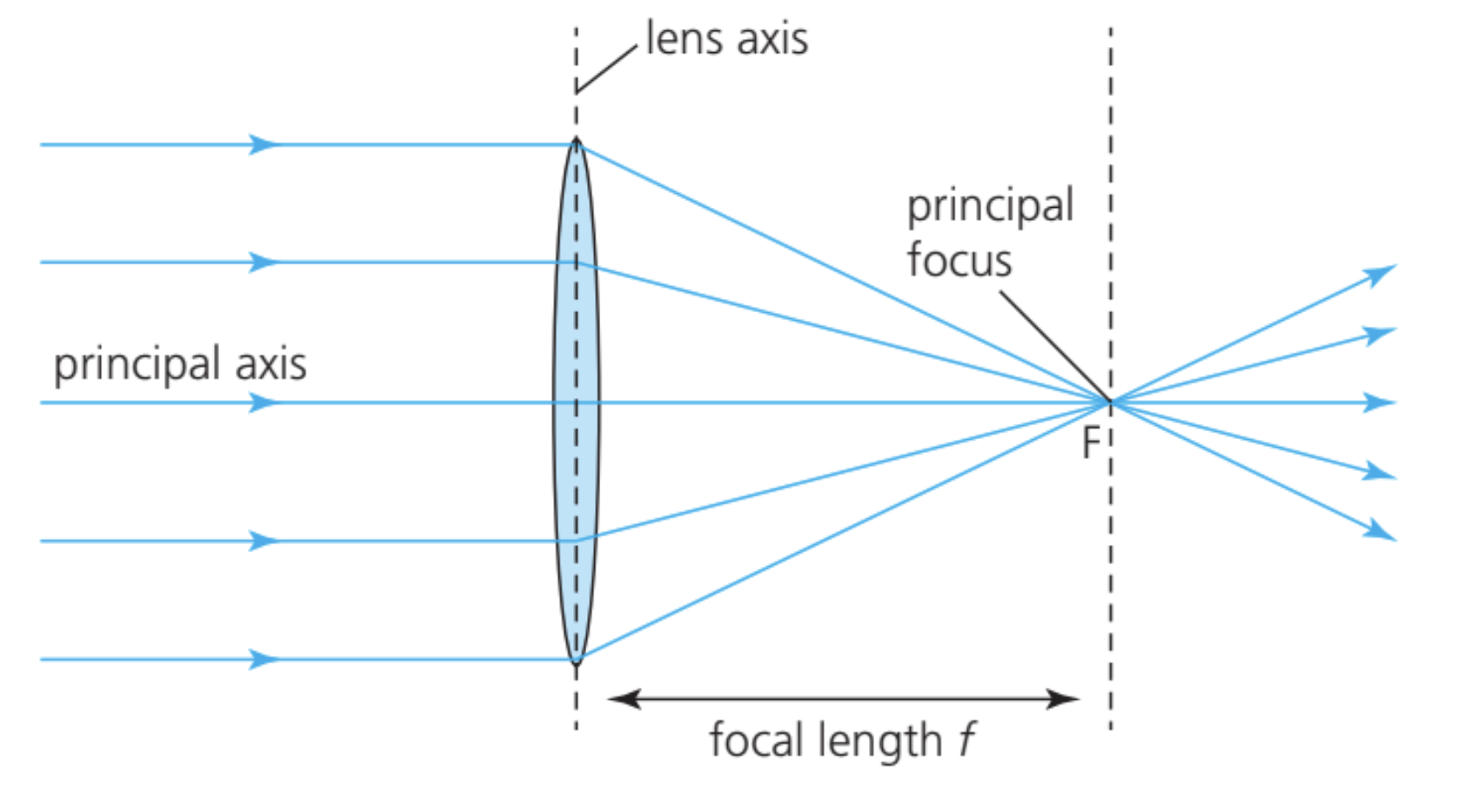
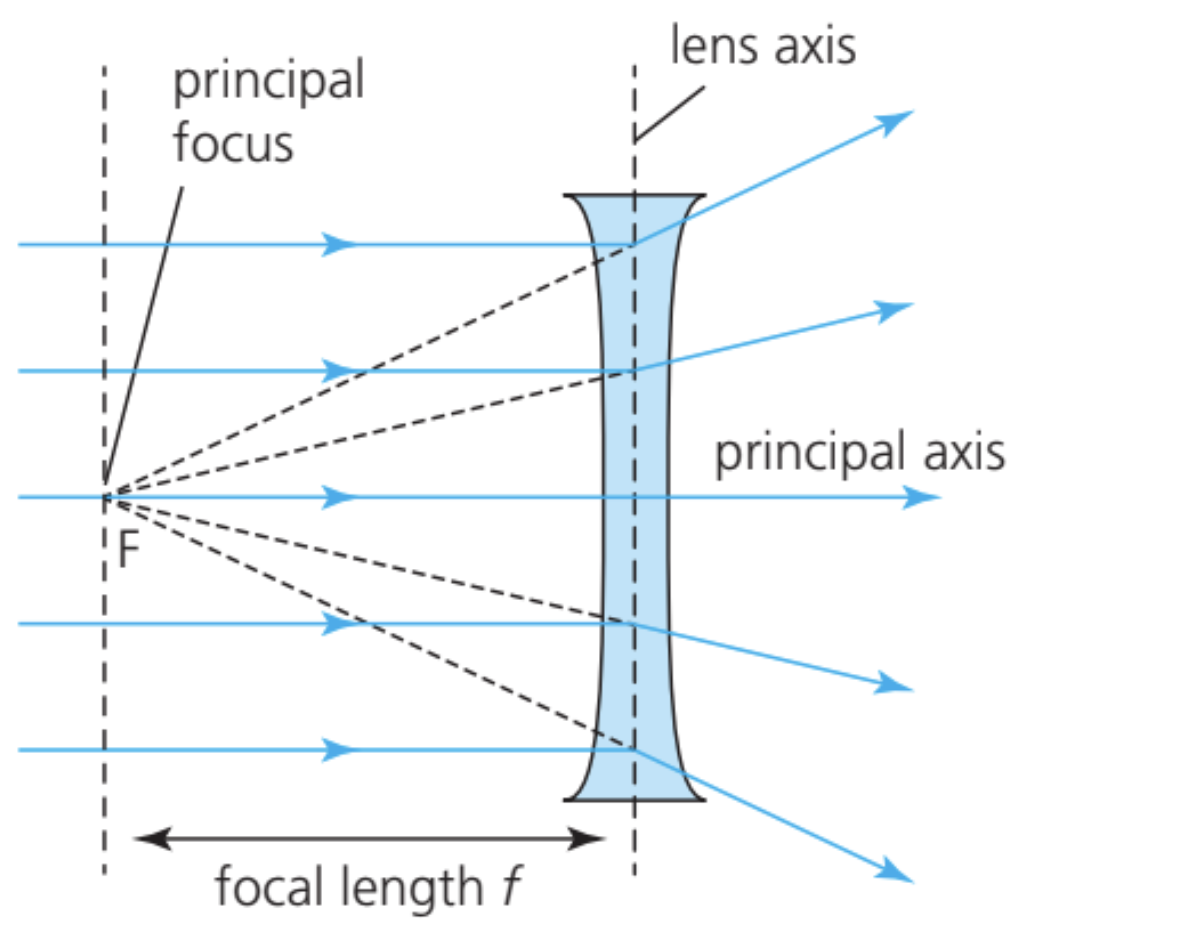
When working with lenses, it is important to understand some key terminology. A horizontal line passing through the centre of a lens, perpendicular to the lens surface, is the principal axis. The principal focus (F) is the point where light rays parallel to the principal axis either converge (for a converging lens) or appear to diverge from (for a diverging lens). The focal length (f) is the distance measured from the centre of the lens to the principal focus.
Note
A lens with a highly curved surface (small radius of curvature) has a shorter focal length than a flatter lens. This relationship between curvature and focal length is fundamental to understanding lens behaviour.
Types of lenses
Converging lenses (convex lenses)
A convex lens curves outward on both sides. When parallel rays of light pass through a convex lens, they bend inward and meet at a single point. Because the rays converge, this type is also called a converging lens.
Converging lenses can produce a real image. A real image is one where light rays actually pass through the image location, allowing it to be projected onto a screen or sensor. The lens in the human eye is a convex lens.
Diverging lenses (concave lenses)
A concave lens curves inward on both sides. When parallel rays pass through a concave lens, they spread outward or diverge. This type is therefore called a diverging lens.
Diverging lenses, when used alone, always produce a virtual image. A virtual image forms where light rays appear to come from, but no rays actually pass through that location. Virtual images cannot be projected onto a screen or detected by a sensor placed at the image position.
Important
Key Distinction: Real images form where light rays actually converge, while virtual images form where light rays only appear to originate from. This is why real images can be projected onto screens, but virtual images cannot.
Power of a lens
The power of a lens measures its ability to refract light. Power is defined by the equation:
where is the focal length measured in metres.
The unit of power is the dioptre (D), which is equivalent to . By convention, a converging lens has positive power, while a diverging lens has negative power.
Note
When multiple lenses or refracting surfaces are combined, the total refracting power equals the sum of the individual powers. This additive property is particularly useful in optical systems with multiple components.
The lens of the eye and accommodation
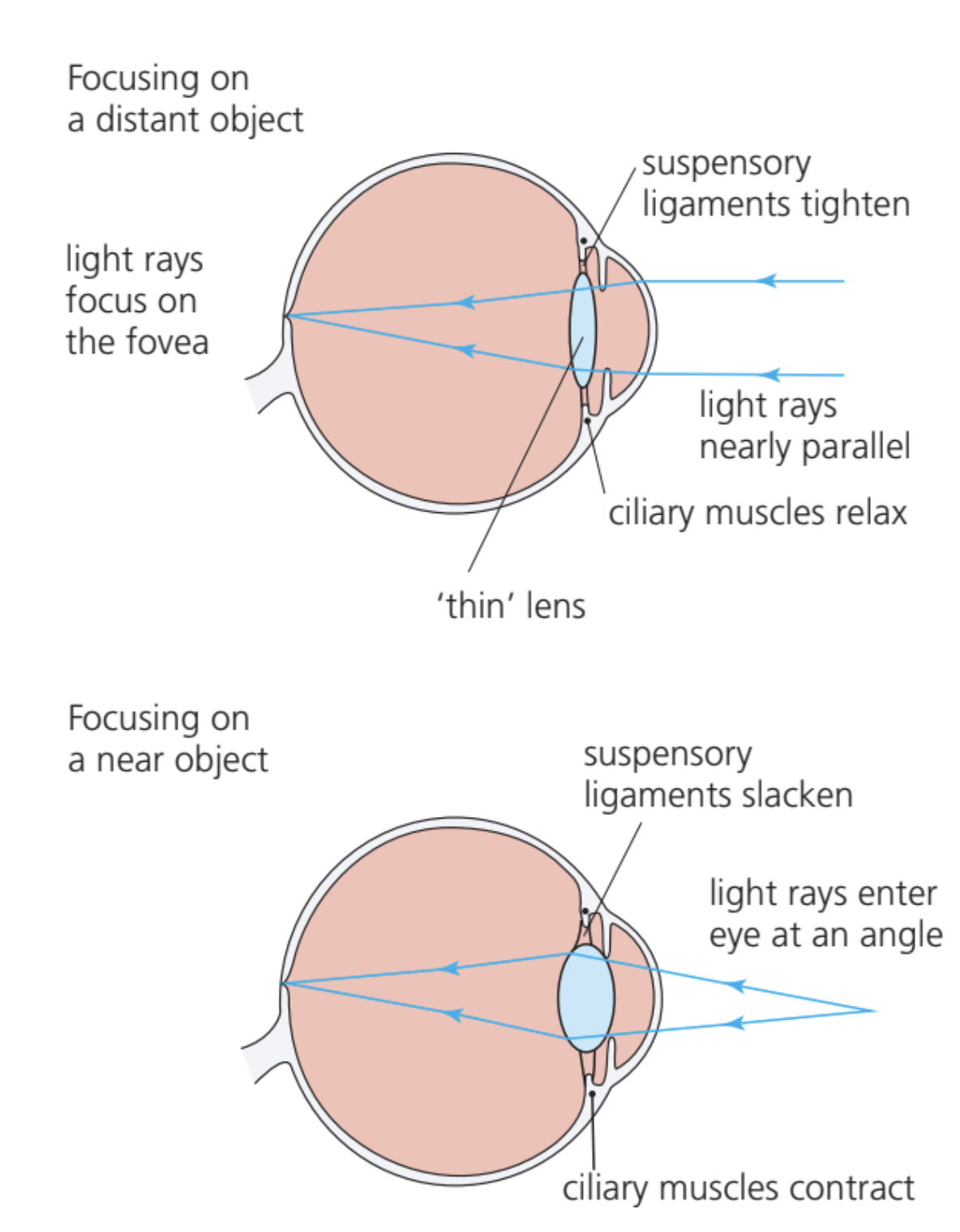
The eye lens converges incoming light rays so they focus precisely on the fovea of the retina. To maintain sharp focus for objects at different distances, the focal length of the eye lens must change.
Accommodation is the ability of the eye lens to change its focal length. This is achieved through the action of the ciliary muscle, which is connected to the lens by suspensory ligaments.
Note
The Accommodation Process:
When focusing on a distant object:
- The ciliary muscles relax
- The suspensory ligaments tighten
- The lens is pulled into a thinner, flatter shape
- The lens has lower power
- Light rays entering the eye are nearly parallel
When focusing on a near object:
- The ciliary muscles contract
- The suspensory ligaments slacken
- The lens becomes more curved
- The lens has greater power
- Light rays enter at steeper angles
The cornea has a refracting power of approximately +43 D. The eye lens has power ranging from +17 D (at its flattest) to about +31 D (at its most curved). Therefore, the total power of the eye varies from approximately +60 D to +74 D.
Near point and far point
There are limits to the range of distances at which the eye can focus.
- The near point is the closest distance at which the eye can bring an object into sharp focus. For a young, healthy eye, the near point is approximately 25 cm. As people age, the lens becomes stiffer, causing the near point to move further away.
- The far point is the furthest distance at which the eye can focus an object. For a normal eye, the far point is at infinity.
Important
Age-Related Changes: The progressive stiffening of the lens with age (a condition called presbyopia) reduces the eye's ability to accommodate, particularly affecting near vision. This is why many people need reading glasses as they age.
Ray diagrams
Ray diagrams provide a graphical method to determine where a lens will form an image. The diagrams are drawn to scale and show:
- The lens axis (vertical line)
- The principal axis (horizontal line)
- The principal foci F (marked on either side of the lens)
- The object (drawn as an arrow on the principal axis)
Three specific rays are traced from the object through the lens. The rules governing these rays differ for convex and concave lenses.
Ray diagram rules for a convex lens
- Ray 1: Any ray passing through the optical centre of the lens continues undeviated.
- Ray 2: A ray travelling parallel to the principal axis refracts through the principal focus on the opposite side of the lens.
- Ray 3: Any ray passing through the principal focus (before reaching the lens) refracts so it travels parallel to the principal axis.
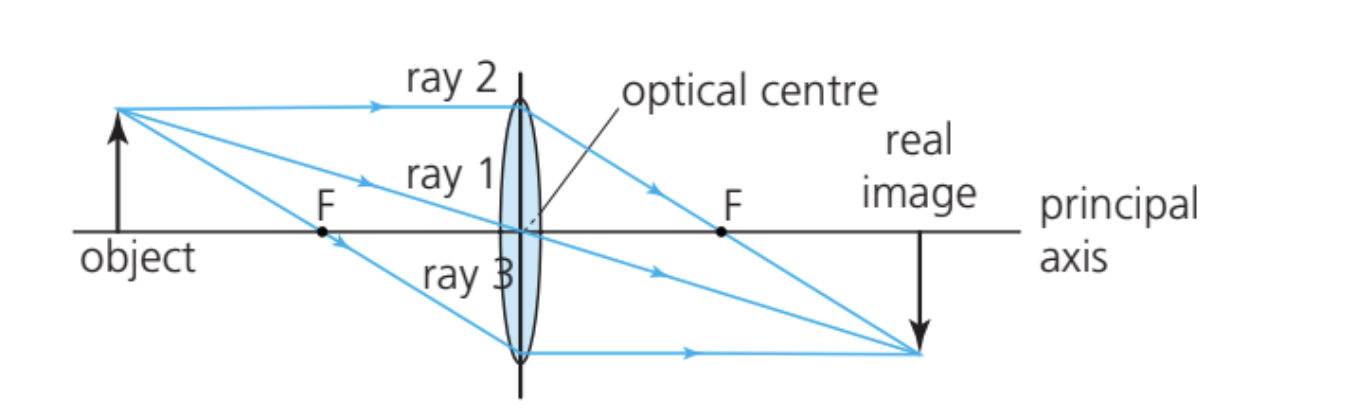
Where these three rays meet (or appear to meet) after passing through the lens indicates the location of the image. For a convex lens, when the object is beyond the focal length, a real, inverted image forms on the opposite side of the lens.
Ray diagram rules for a concave lens
- Ray 1: Any ray passing through the optical centre continues undeviated.
- Ray 2: A ray travelling parallel to the principal axis refracts away from the axis, appearing to come from the principal focus on the same side as the object.
- Ray 3: A ray directed toward the principal focus on the far side of the lens refracts so it travels parallel to the principal axis.
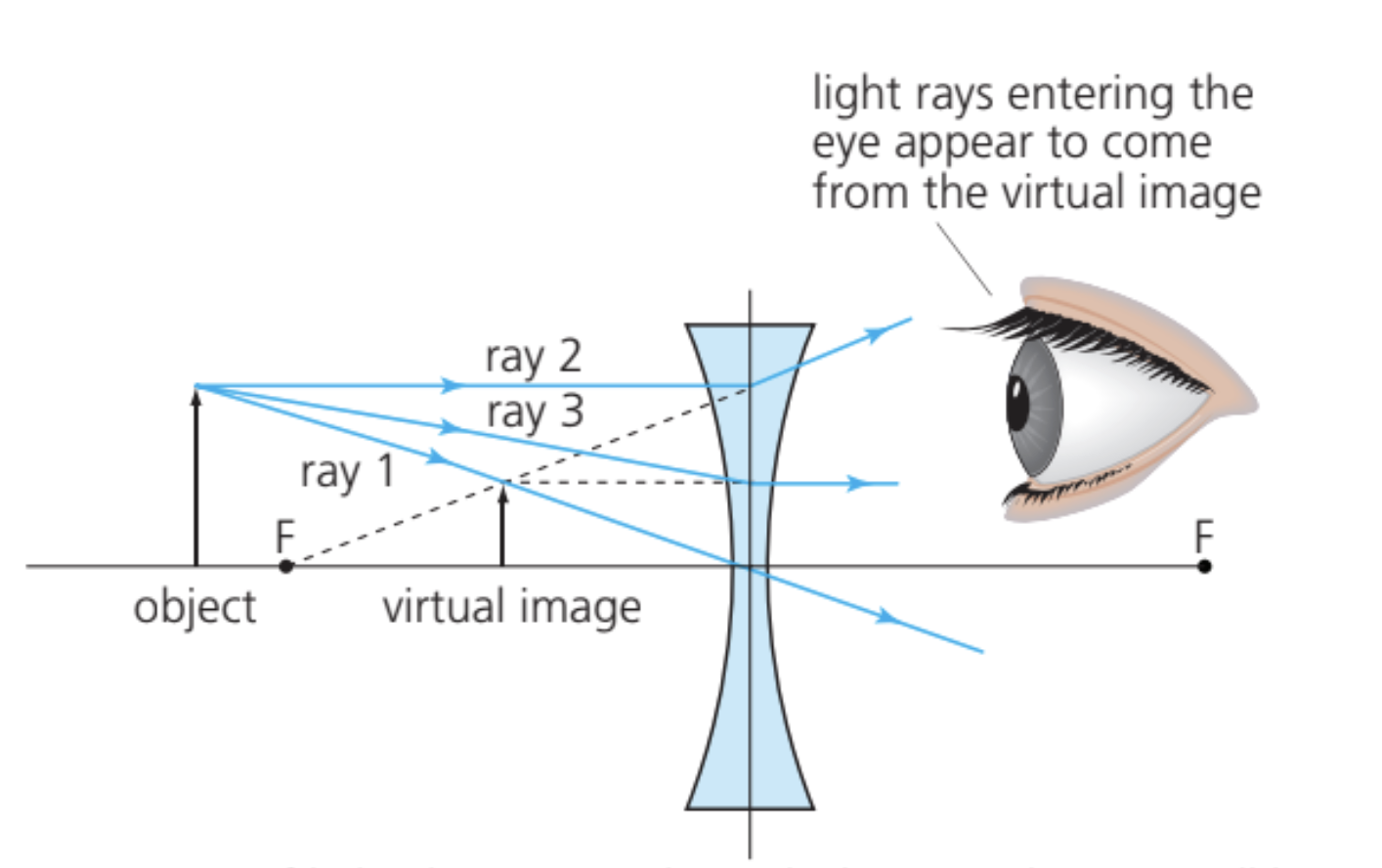
For a concave lens, the three rays diverge after passing through the lens. When traced backward, they appear to originate from a point on the same side of the lens as the object. This creates a virtual, upright image.
Virtual images from convex lenses
When an object is placed closer to a convex lens than its focal length, the lens produces a virtual image. The emerging rays diverge, but when traced backward, they appear to come from a point on the same side of the lens as the object. This virtual image is upright and magnified.
Note
This property of convex lenses is exploited in magnifying glasses. By placing an object within the focal length, a magnified, upright virtual image is produced that appears larger than the object itself.
The lens formula
The position of an image can be calculated using the lens formula:
where:
- = focal length of the lens
- = object distance (distance from object to lens)
- = image distance (distance from lens to image)
Sign convention
When using the lens formula, a sign convention applies:
- Positive v: The image is real, on the opposite side of the lens from the object, and inverted
- Negative v: The image is virtual, on the same side of the lens as the object, and upright
Important
For a concave lens, the focal length must be entered as a negative value (because diverging lenses have negative power). The resulting image distance is always negative, confirming the virtual nature of the image.
Example
Worked Example: Real Image Formation
A converging lens has a focal length of 10.0 cm. An object is placed 30.0 cm from the lens. Where will the image form?
Given: ,
Solution:
Rearranging the lens formula:
Answer: The image forms 15 cm from the lens on the opposite side from the object. It is real and inverted.
Example
Worked Example: Virtual Image Formation
The same lens () now has an object placed 5.0 cm away. Where is the image?
Given: ,
Solution:
Answer: The negative value indicates a virtual image located 10.0 cm from the lens, on the same side as the object. Looking through the lens toward the object, rays appear to originate from a point 10.0 cm behind the lens.
Magnification
The magnification of an image is the ratio of the image height to the object height:
Using geometry, magnification can also be expressed as:
where is the image distance and is the object distance.
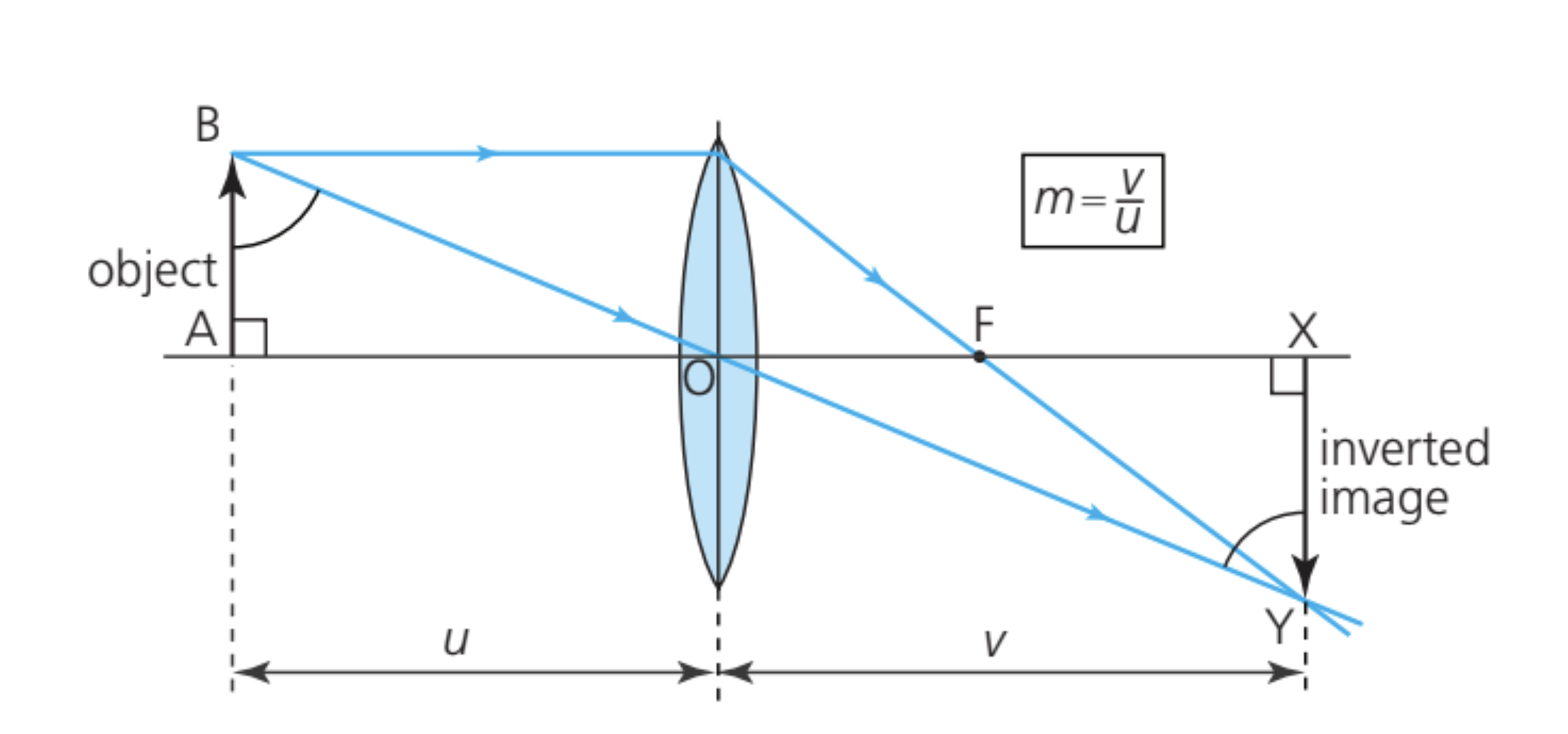
Note
When is negative (virtual image), the magnification is also negative, indicating the image is upright rather than inverted. The sign of magnification provides information about image orientation.
Example
Worked Example: Finding Image Size
A convex lens with focal length 20 cm produces an image of an object that is 30 cm tall and located 1 m (100 cm) from the lens. How tall is the image?
Solution:
Step 1: Find the image distance using the lens formula:
Step 2: Calculate magnification:
Step 3: Find the image height:
Answer: The image is 7.5 cm tall.
Summary
Key Points to Remember:
-
A convex (converging) lens bends parallel rays inward to meet at the principal focus; a concave (diverging) lens spreads parallel rays outward as if they came from the principal focus.
-
Power is calculated as (where is in metres) and measured in dioptres (D). Converging lenses have positive power; diverging lenses have negative power.
-
The lens formula relates focal length, object distance, and image distance: . A negative value for v indicates a virtual image.
-
Accommodation in the eye occurs when ciliary muscles change the lens shape, altering its focal length to focus on objects at different distances.
-
Magnification equals both the ratio of image height to object height and the ratio . Negative magnification indicates an upright, virtual image.