Photosynthesis, the Chloroplast, and Pigments (OCR A-Level Biology A): Revision Notes
📚Revision Notes
Photosynthesis, the Chloroplast, and Pigments
Introduction to photosynthesis
Photosynthesis represents one of the most important biochemical processes on Earth, converting light energy from the Sun into chemical energy stored in organic molecules. During this process, plants use inorganic molecules such as water and carbon dioxide to produce organic compounds, releasing oxygen gas as a by-product.
Note
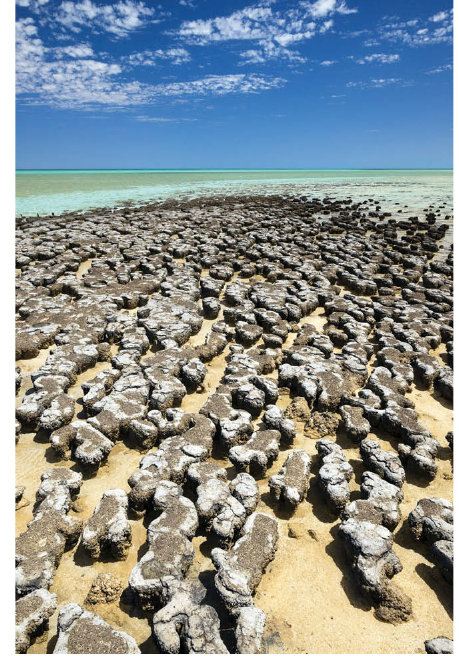
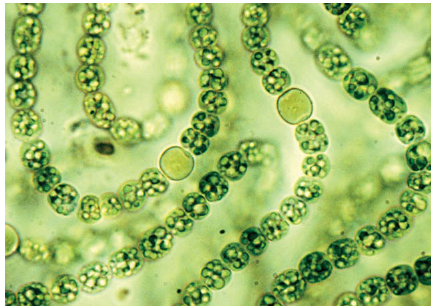
Stromatolites, such as those found at Shark Bay in Australia, provide evidence for the ancient origins of photosynthesis. These rock-like structures are formed by microbial mats containing photosynthetic microorganisms, including cyanobacteria and algae. Fossil stromatolites dating back million years are thought to have been responsible for introducing oxygen into Earth's atmosphere for the first time.
Endosymbiotic theory of chloroplast origin
Evidence strongly suggests that photosynthesis first arose in independent prokaryotic organisms. Over evolutionary time, these prokaryotes were incorporated into eukaryotic cells through a process called endosymbiosis, eventually becoming the chloroplasts we observe today.
Important
Evidence Supporting Endosymbiotic Theory:
This theory is supported by several compelling pieces of evidence:
- Chloroplasts reproduce only through division of pre-existing chloroplasts, independently of plant cell division.
- Chloroplasts possess their own genome consisting of a circular DNA loop, similar to modern prokaryotes.
- Chloroplasts contain their own ribosomes (70S ribosomes) and protein synthesis machinery, resembling prokaryotic systems. These ribosomes produce some of the proteins required by chloroplasts.
- Chloroplasts contain similar pigments to photosynthesizing cyanobacteria, suggesting a common evolutionary origin.
These structural and genetic similarities between chloroplasts and prokaryotes indicate that chloroplasts were once free-living organisms that became permanently integrated into plant cells as organelles.
Importance of photosynthesis
Photosynthesis serves multiple essential functions for life on Earth. It is the primary mechanism for capturing sunlight energy and converting it into a usable chemical form. This energy becomes stored in organic molecules that can be utilized by plants themselves and by animals that consume them. Photosynthesis therefore forms the foundation of most food chains, providing energy for consumers (organisms that obtain nutrients by feeding on other organisms) and decomposers (fungi and bacteria that break down dead organic matter into simple molecules such as carbon dioxide and ammonia).
The process is vital to most ecosystems and is particularly important for human agriculture, supporting both arable and livestock farming.
Note
Some ecosystems, such as deep-sea vent communities, do not rely on photosynthetic organisms. Instead, these communities depend on bacteria and archaeans that use chemical energy rather than light energy to synthesize complex organic compounds from simple inorganic molecules.
Relationship between photosynthesis and respiration
Photosynthesis plays a critical role in maintaining atmospheric balance. The process consumes carbon dioxide and releases oxygen, whereas aerobic respiration does the opposite, consuming oxygen and releasing carbon dioxide. This reciprocal relationship helps maintain constant levels of both gases in the atmosphere.
The chloroplast
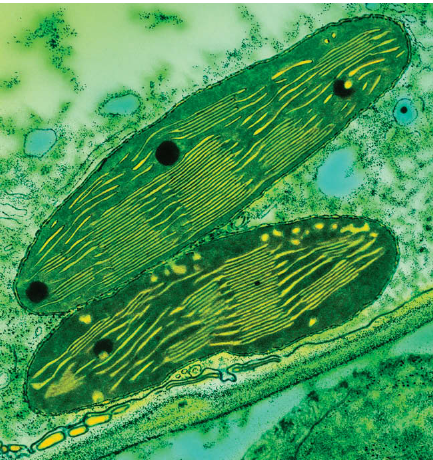
The chloroplast is the organelle where photosynthesis occurs in plant cells and some protoctista. Like mitochondria, chloroplasts are believed to have evolved from prokaryotes incorporated into eukaryotic cells through endosymbiosis, and this theory is supported by many structural similarities.
Structure and features of chloroplasts
Chloroplasts are relatively small organelles, measuring approximately in diameter, making them larger than mitochondria. They possess several distinctive structural features that enable them to carry out photosynthesis efficiently.
The chloroplast envelope
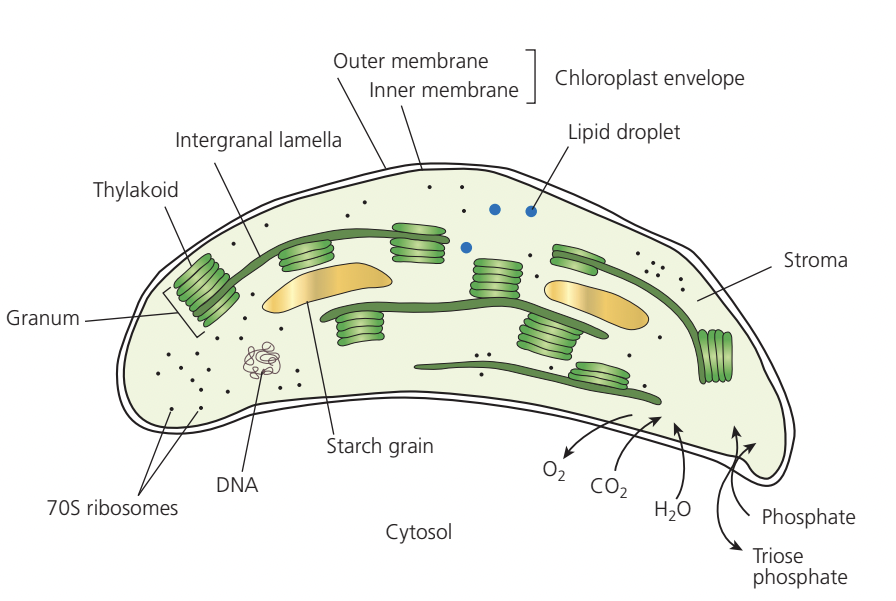
Chloroplasts possess a double membrane system known as the chloroplast envelope. The outer membrane is relatively permeable, allowing many small ions and molecules to pass through into the chloroplast. In contrast, the inner membrane is selectively permeable and relies on specific transport proteins to regulate which molecules can enter or leave. This controlled movement occurs between the stroma (the internal fluid) and the cytosol (the cell's cytoplasm).
Thylakoid membranes and grana
Unlike the folded inner membrane of mitochondria, chloroplasts contain a third internal membrane system. These membranes are folded into thin, interconnected plates called lamellae or thylakoids. In certain regions, these thylakoids stack upon each other to form structures called grana (singular: granum).
The flattened thylakoid membranes within grana carry the pigments required for photosynthesis, organized into structures called photosystems. These membranes also contain carrier molecules necessary for the light-dependent reactions.
Note
The granal stacks increase the total surface area of the thylakoid membranes, allowing numerous photosystems to be present for maximum light absorption. They also accommodate many electron carriers and ATP synthase enzymes, enabling the light-dependent reactions to proceed efficiently.
The lamellae connecting different granal stacks are called intergranal lamellae, which help maintain the structural organization of the chloroplast.
The stroma
The stroma is a gel-like medium that fills the space within the chloroplast, surrounding the granal stacks. It is similar in composition to the cytosol of eukaryotic cells. The stroma serves as the site for the light-independent stage of photosynthesis (also known as the Calvin cycle). It contains:
- Enzymes necessary to catalyze the light-independent reactions
- Starch grains (carbohydrate storage)
- Oil droplets (lipid storage)
- Circular DNA loops
- Small 70S ribosomes for protein synthesis
Note
The stroma's position surrounding the granal stacks facilitates rapid transfer of products from the light-dependent stage (occurring in the thylakoids) to the light-independent stage (occurring in the stroma).
Location of photosynthesis stages
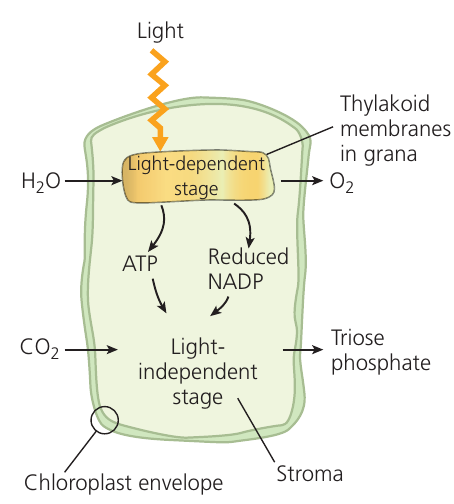
Photosynthesis occurs in two main stages, each taking place in different regions of the chloroplast:
Light-dependent stage:
- Occurs on the thylakoid membranes within the grana
- Light energy is trapped by reaction centres in the grana
- Produces ATP and reduced NADP
- Releases oxygen as a by-product
Light-independent stage:
- Occurs in the stroma
- Uses ATP and reduced NADP from the light-dependent stage
- Fixes carbon dioxide to produce triose phosphate
- Does not directly require light
Adaptations of chloroplasts for photosynthesis
| Structure | Adaptive feature |
|---|---|
| Stroma | A cytosol-like gel containing enzymes that catalyze the light-independent reactions. The stroma surrounds the grana and membranes, enabling rapid transfer of products from the light-dependent stage. |
| Grana | The granal stacks provide a large surface area for many photosystems, maximizing light absorption. They also accommodate high numbers of electron carriers and ATP synthase enzymes. The pigments for light-dependent reactions are organized within photosystems. |
| Inner membrane of chloroplast envelope | Contains transport proteins that control the movement of molecules between the stroma and cytoplasm, regulating what enters and exits the chloroplast. |
| DNA | Chloroplast DNA codes for some of the proteins and enzymes needed for photosynthesis. Other required proteins are coded by genes in the cell nucleus. |
| Ribosomes | Enable translation of proteins coded by chloroplast DNA, allowing the chloroplast to produce some of its own proteins. |
Photosynthetic pigments
The pigments involved in photosynthesis are located within the chloroplast and are arranged into light-harvesting complexes surrounding a reaction centre. These complexes form photosystems, which are funnel-shaped structures consisting of primary and accessory pigments held in precise positions by proteins.
Structure and function of photosystems
A photosystem is a funnel-shaped collection of accessory pigments with a reaction centre containing a complex of proteins and chlorophyll molecules at its base, embedded in the thylakoid membrane. The primary pigment at the reaction centre is chlorophyll a.
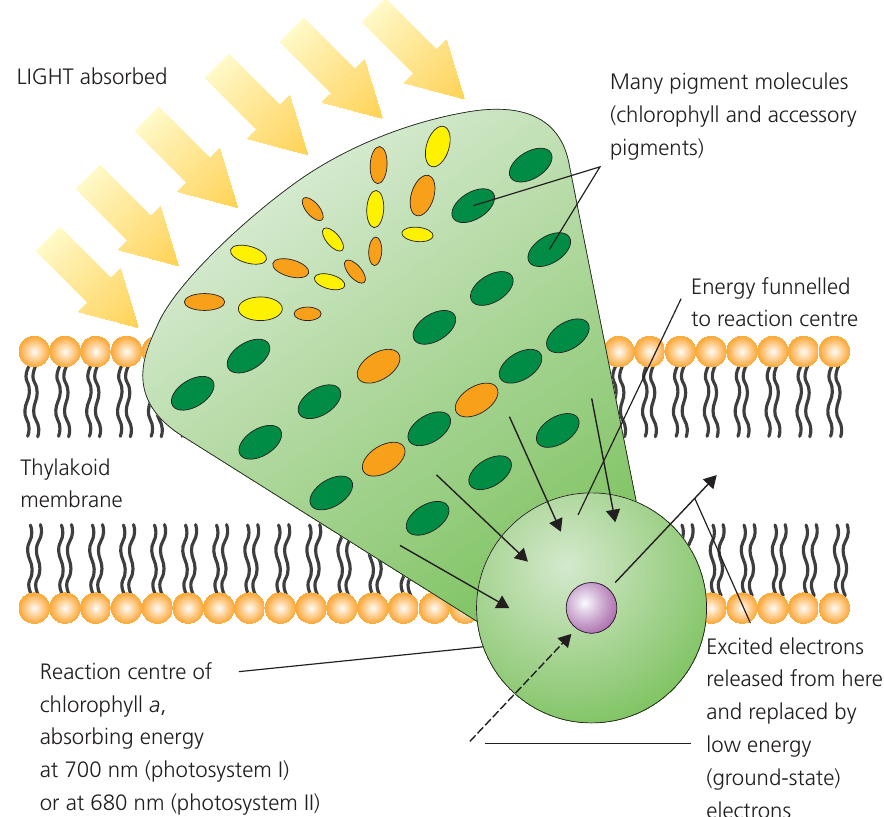
Pigment molecules absorb light at specific wavelengths. Each pigment has its own characteristic range of wavelengths that it can absorb, while reflecting others. The reflected wavelengths determine the color we observe when looking at leaves.
The light-harvesting complexes contain:
- Protein molecules that precisely position the pigments
- Chlorophyll a (the primary pigment)
- Accessory pigments such as chlorophyll b, carotenes, and xanthophylls
Note
These accessory pigments capture light energy and funnel it to the reaction centre, located at the base of the photosystem. This area is known as the primary reaction centre.
Types of photosystems
Two distinct types of reaction centres exist, both consisting of protein complexes combined with specialized forms of chlorophyll a molecules and cofactors:
Photosystem I (PSI), usually designated as P700:
- Contains chlorophyll a with maximum light absorption in the red region at
Photosystem II (PSII), usually designated as P680:
- Contains chlorophyll a with maximum light absorption at
The proteins in the light-harvesting complexes orientate the pigments precisely within the thylakoid membranes, ensuring efficient energy capture and transfer.
Chlorophyll structure
Chlorophyll is the main pigment involved in photosynthesis. It exists as two main forms: chlorophyll a (the primary pigment found at reaction centres) and chlorophyll b (an accessory pigment). Both forms trap light at specific wavelengths and reflect green light, which is why they do not absorb light in this wavelength range.
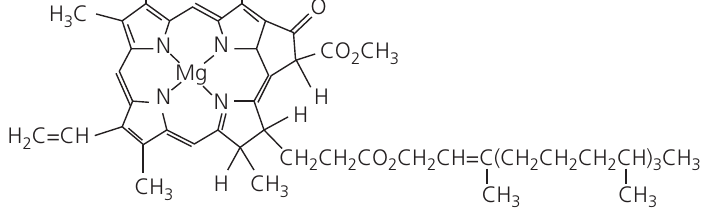
The molecular structure of chlorophyll consists of:
- A long hydrocarbon chain called a phytol tail
- A porphyrin group containing a magnesium atom at the centre
Note
This structure is similar to the haem group in haemoglobin, except chlorophyll contains magnesium rather than iron at its centre. The porphyrin ring system is responsible for light absorption, while the phytol tail anchors the molecule in the thylakoid membrane.
Accessory pigments
Accessory pigments work alongside chlorophyll a to capture light energy across a broader range of wavelengths. The main accessory pigments include:
Chlorophyll b:
- Absorbs light around and
- Reflects blue-green light
Carotenoids (carotene and xanthophyll):
- Lack the porphyrin ring structure but possess a long hydrocarbon chain
- Absorb blue light ()
- Reflect yellow and orange light
Important
These accessory pigments harvest light at their characteristic wavelengths and transfer this energy to the primary pigment, chlorophyll a. They do not participate directly in the light-dependent reactions; their sole function is light harvesting. Carotenoid pigments also have commercial applications as food dyes.
Absorption and action spectra
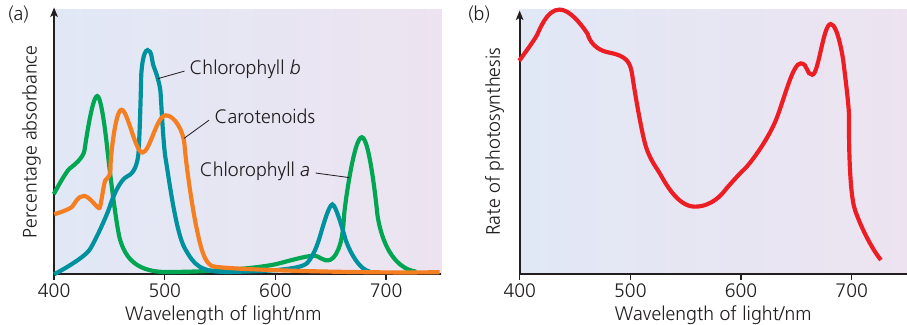
An absorption spectrum measures the wavelengths of light absorbed by different pigments. When comparing absorption spectra for chlorophyll a, chlorophyll b, and carotenoids, distinct patterns emerge:
- Chlorophyll a shows strong absorption in the blue () and red () regions
- Chlorophyll b has similar absorption peaks but at slightly different wavelengths
- Carotenoids absorb primarily in the blue region
An action spectrum shows the wavelengths of light that are most effective for photosynthesis (the rate of photosynthesis at different wavelengths).
Important
The close correspondence between the absorption spectra of photosynthetic pigments and the action spectrum for photosynthesis demonstrates that the light absorbed by these pigments is actually used to drive photosynthesis.
The presence of multiple pigments with different absorption characteristics allows plants to capture light energy across a wider range of wavelengths than would be possible with a single pigment.
Chromatography separation of pigments
Thin-layer chromatography (TLC) is an analytical technique used to separate photosynthetic pigments based on their physical properties. The method exploits differences in pigment solubility and polarity to achieve separation.
Chromatography principles
The technique uses a thin layer of adsorbent material spread onto a glass, plastic, or metal sheet. A solvent dissolves the pigments and moves them up the plate as it travels. Different pigments move at different rates depending on:
- Their solubility in the solvent
- Their adsorption to the adsorbent medium
- Their polarity
Experimental procedure
Example
Worked Example: Thin-Layer Chromatography Process
The chromatography process involves several key steps:
Step 1: Preparation
- Draw a pencil line across the plate just above where the solvent will initially reach
- A concentrated sample of chloroplast extract is spotted onto the pencil line
Step 2: Building the sample
- The spot is built up by adding small samples, drying between applications
- This creates a highly concentrated spot without spreading
Step 3: Setting up the chamber
- Place the plate into a chromatography chamber saturated with solvent vapor
- Position the plate so the pigment spot sits just above the solvent surface
Step 4: Separation
- As the solvent rises through the plate, it carries the pigments with it
- Different pigments travel at different rates based on their properties
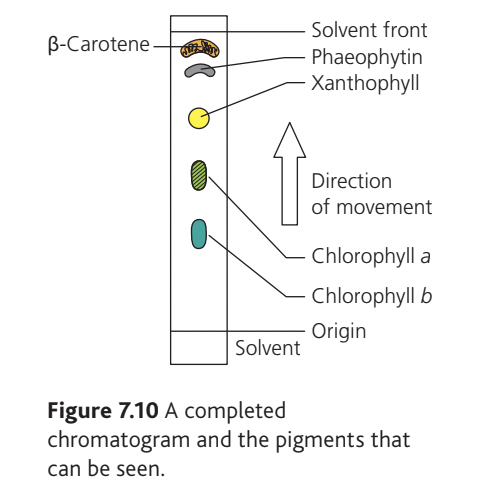
Step 5: Recording results
- When the solvent front nears the top, remove the plate
- Mark the solvent front with pencil
- Mark the front edge of each pigment band
Note
The chromatography chamber is saturated with solvent vapor before use to ensure even solvent movement and prevent evaporation from affecting the separation. The use of pencil rather than pen is essential because ink would dissolve in the solvent and interfere with the pigment separation.
Pigment identification
Several pigments can be detected and identified through chromatography:
- β-Carotene: an orange-yellow pigment (travels furthest)
- Phaeophytin: a grey-brown pigment, a component of the electron transport chain
- Xanthophyll: a yellow pigment
- Chlorophyll a: a yellow-green pigment
- Chlorophyll b: a blue-green pigment (travels least far)
Calculating Rf values
Pigments can be identified using Rf values (retention factor values). This ratio indicates the relative distance traveled by each pigment:
Note
While Rf values vary depending on the solvent used and the exact type of chromatogram, the order in which pigments separate remains constant. This consistency allows pigments to be identified reliably.
Summary
Key Points to Remember:
- Chloroplasts evolved through endosymbiosis, supported by evidence including their own circular DNA, 70S ribosomes, and independent division from plant cells.
- The chloroplast has a double membrane envelope, with the light-dependent stage occurring on thylakoid membranes in grana and the light-independent stage occurring in the stroma.
- Photosystems are funnel-shaped structures containing chlorophyll a at the reaction centre and accessory pigments (chlorophyll b, carotenoids) that capture light and transfer energy to chlorophyll a.
- Two photosystems exist: PSI (P700) with maximum absorption at and PSII (P680) with maximum absorption at .
- The close match between pigment absorption spectra and the photosynthesis action spectrum proves that absorbed light drives photosynthetic reactions, while multiple pigments allow capture of light across a broader wavelength range.