The Importance of Respiration (OCR A-Level Biology A): Revision Notes
📚Revision Notes
The Importance of Respiration
What is respiration and why is it essential?
Respiration is the biochemical process through which organisms transfer energy from organic molecules to support their energy requirements. This process enables life processes to continue at the rates necessary for survival. Without an adequate energy supply, metabolic reactions would occur too slowly to sustain life, or might not occur at all.
All living organisms - from single-celled bacteria to complex multicellular plants and animals - depend on respiration to maintain their cellular functions. The process involves a series of enzyme-controlled reactions that systematically break down energy-rich molecules, making their stored energy available in a usable form.
Note
Respiration is fundamentally different from breathing (ventilation). While breathing involves the mechanical movement of air in and out of lungs, cellular respiration refers to the biochemical reactions occurring within every living cell to release energy from organic molecules.
The evolution of energy metabolism
Understanding the importance of respiration requires examining how organisms have obtained energy throughout Earth's history. Before photosynthesis evolved approximately 3.8 billion years ago, Earth's atmosphere contained no oxygen. Early life forms had to obtain energy from sources other than sunlight.
These primitive organisms were similar to modern prokaryotes found in extreme environments today. They derived energy by oxidising various chemical compounds, producing 'energised' electrons that could be used in metabolic processes. This process, known as chemosynthesis, remains the primary energy source for many organisms living in environments where light is unavailable, such as deep-sea hydrothermal vents.
Note
Modern chemosynthetic organisms living near hydrothermal vents demonstrate how life could have existed on early Earth before photosynthesis evolved. These organisms thrive in complete darkness, deriving all their energy from chemical reactions rather than light.
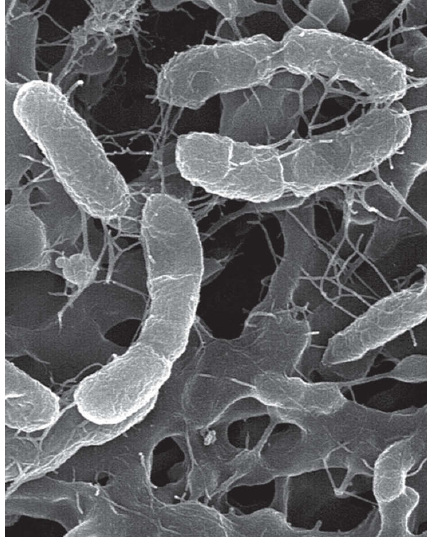
Energy sources in different organisms
Chemosynthetic organisms
Some bacteria continue to use chemical energy sources rather than light. For example, hydrogen-oxidising bacteria contain hydrogenase enzymes in their cell membranes and cytoplasm. These enzymes break down hydrogen gas () into electrons and protons. The electrons pass to electron carriers embedded in membranes, providing energy for proton pumping and ATP synthesis. The electrons also reduce NADP, creating reduced NADP. Through this mechanism, these bacteria indirectly generate both ATP and reduced NADP, which they use to fix carbon dioxide in the Calvin cycle - all without requiring light.
Other chemosynthetic organisms oxidise different chemical compounds. Nitrifying bacteria, for instance, obtain energy by oxidising nitrogen-containing compounds, playing vital roles in nutrient cycles within ecosystems.
Autotrophic organisms
Autotrophic organisms are those capable of fixing carbon dioxide to produce complex organic molecules. Green plants, some protoctists, and certain prokaryotes fall into this category. They use light energy to drive the formation of ATP and reduced NADP during photosynthesis, as covered in photosynthesis studies.
These organisms build up carbohydrates, proteins, and fats from simple inorganic starting materials. However, autotrophs cannot rely on photosynthesis constantly - they cannot photosynthesise in darkness or when conditions are unfavourable. Therefore, they must store some of the organic molecules they produce and later break them down through respiration to release energy when needed.
Important
Plants respire continuously, both day and night, even though they only photosynthesise during daylight hours. This is essential because plants need energy for cellular processes even when photosynthesis cannot occur.
Heterotrophic organisms
Heterotrophic organisms cannot fix carbon dioxide and instead depend entirely on ready-made organic compounds as their energy source. Animals, fungi, and many bacteria are heterotrophs. They obtain these organic molecules either by consuming plants directly (herbivores) or by eating other organisms that ultimately derived their energy from autotrophs (carnivores and omnivores).
This creates a fundamental dependency: heterotrophs rely directly or indirectly on the carbon-fixing activities of autotrophs. Without autotrophs producing organic molecules from inorganic materials, heterotrophs would have no energy source and could not survive.
The relationship between photosynthesis and respiration
In organisms capable of photosynthesis, respiration and photosynthesis function as complementary processes. They work together in a cyclical manner, with the products of one process serving as the reactants for the other.
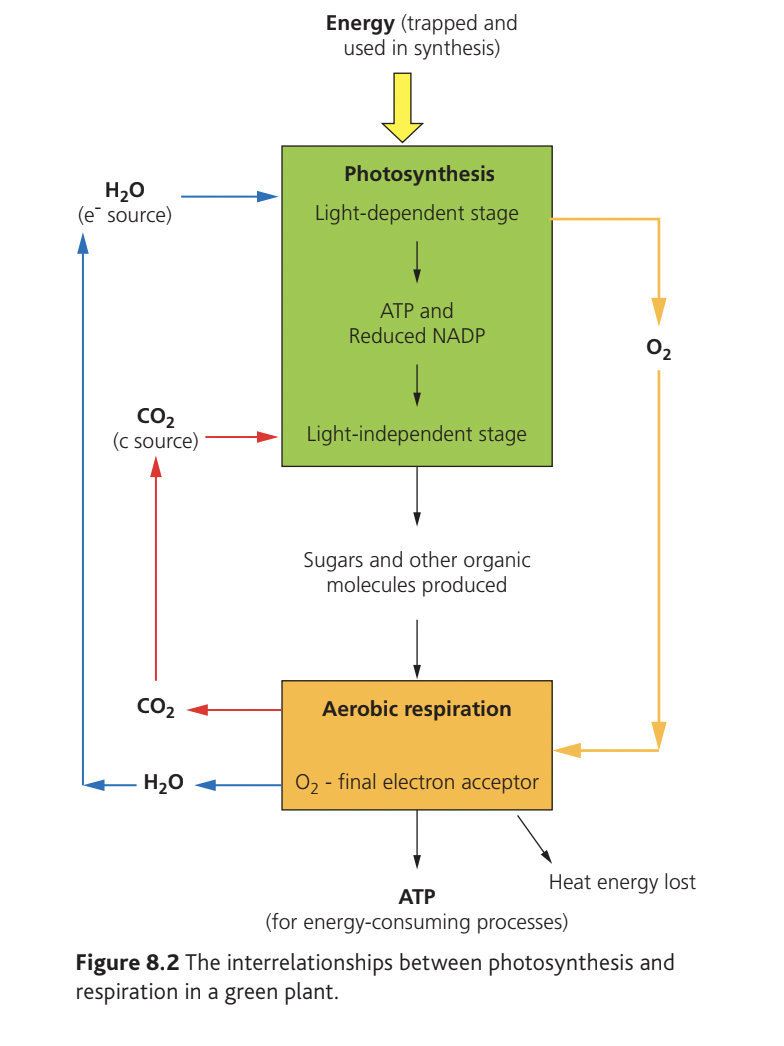
During photosynthesis, light energy is trapped and used to synthesise ATP and reduced NADP in the light-dependent stage. These energy carriers then drive the light-independent stage, where carbon dioxide is fixed to produce sugars and other organic molecules. Oxygen is released as a by-product.
During aerobic respiration, these organic molecules are broken down using oxygen as the final electron acceptor. The process releases carbon dioxide and water while transferring energy to ATP. Some energy is also lost as heat during these conversions.
Note
The Cyclical Nature of Photosynthesis and Respiration:
This cyclical relationship means that:
- Water used in photosynthesis is regenerated during respiration
- Carbon dioxide released during respiration is refixed during photosynthesis
- Oxygen produced in photosynthesis is consumed during respiration
- Organic molecules made in photosynthesis provide respiratory substrates
This demonstrates the elegant interconnection between these two fundamental life processes.
Why organisms need respiration
Organisms require a continuous supply of energy to carry out numerous life-sustaining processes. Respiration transfers energy from carbon-containing compounds to ATP, often called the 'energy currency' of cells. This accessible form of energy is required for:
- Active transport - moving substances against concentration gradients across membranes
- Activation of chemicals - providing activation energy for metabolic reactions
- Endocytosis and exocytosis - transporting large molecules across cell membranes via vesicles
- Movement - muscle contraction, ciliary and flagellar beating, cytoplasmic streaming
- Protein synthesis - assembling amino acids into polypeptides
- Cell division - replicating DNA, forming the spindle apparatus, and constructing new cell components
Without a steady ATP supply from respiration, these essential processes would cease, and the organism would die.
ATP: the universal energy currency
Structure of ATP
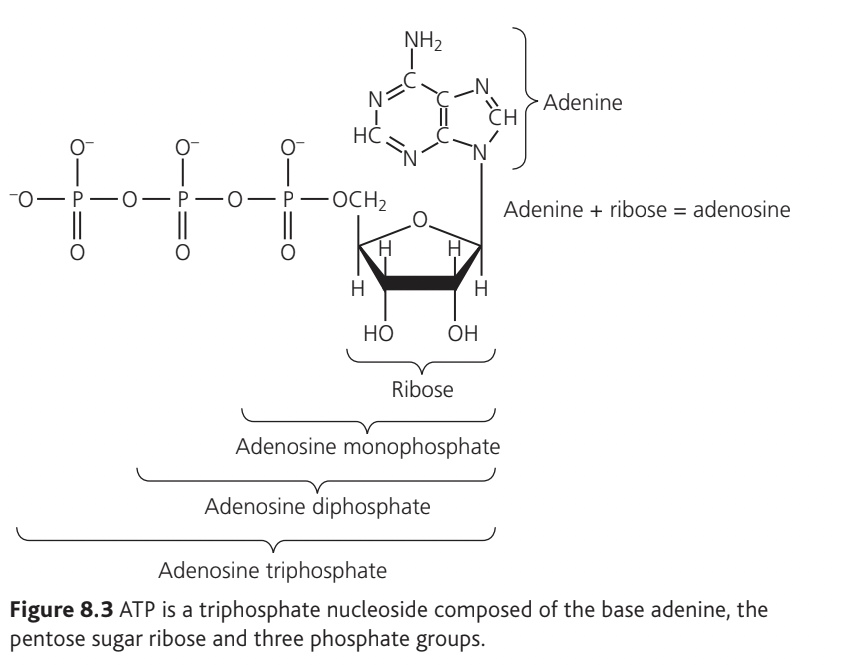
Adenosine triphosphate (ATP) is a nucleotide found in all living cells. It consists of three components joined together:
- Adenine - a nitrogenous base (a purine)
- Ribose - a five-carbon sugar (pentose)
- Three phosphate groups - attached in a chain
The adenine base joined to ribose sugar forms adenosine. When three phosphate groups attach to this adenosine unit, ATP is formed. The phosphate groups are bonded together by high-energy bonds.
The ATP cycle
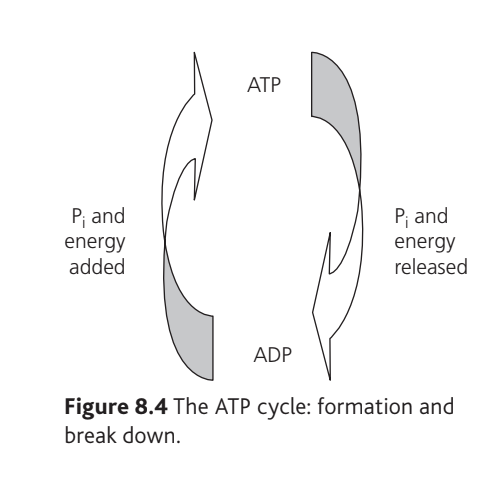
ATP functions as an immediate, short-term energy supply rather than a long-term storage molecule (carbohydrates and fats serve that purpose). The molecule participates in a continuous cycle of formation and breakdown within active cells.
ATP hydrolysis occurs when one phosphate group is removed from ATP by a hydrolysis reaction:
This reaction releases 30.5 kJ of energy per mole of ATP. The products are:
- ADP (adenosine diphosphate) - adenosine with two phosphate groups
- (inorganic phosphate) - a free phosphate group
- Energy - available for cellular work
The reverse reaction, ATP synthesis, occurs when energy is available from respiration:
Note
A further phosphate group can be removed from ADP through another hydrolysis reaction, releasing another 30.5 kJ of energy and producing adenosine monophosphate (AMP), which contains just one phosphate group.
Efficiency of ATP
The relatively small amount of energy released when ATP is hydrolysed () makes it remarkably efficient for cellular use. This controlled energy release offers several advantages:
Important
Why ATP's Small Energy Release is Beneficial:
- Minimal wastage - small packets of energy can be precisely matched to energy requirements
- No cellular damage - prevents overheating and structural damage that could result from releasing large amounts of energy rapidly
- Flexibility - cells can quickly obtain exactly the amount of energy needed
- Rapid availability - ATP breaks down in a single-step reaction
Cells constantly regenerate ATP from ADP and phosphate as energy becomes available from respiration, maintaining a continuous supply of this vital energy currency.
The role of coenzymes in respiration
While enzymes catalyse the many reactions in respiration, some of these reactions require additional molecules to function properly. These helper molecules are called coenzymes.
Coenzymes are non-protein organic molecules that bind to an enzyme's active site to assist its catalytic activity. They are particularly important in dehydrogenase enzymes, which catalyse oxidation and reduction reactions by removing or adding hydrogen atoms to substrates.
Note
Understanding Oxidation and Reduction:
In redox reactions:
- Oxidation is a chemical reaction in which hydrogen atoms or electrons are lost, or oxygen atoms are gained
- Reduction is a chemical reaction in which hydrogen atoms or electrons are gained, or oxygen atoms are lost
Memory aid: Remember "OIL RIG" - Oxidation Is Loss, Reduction Is Gain
When coenzymes accept hydrogen atoms, they become reduced. When they donate hydrogen atoms to another molecule, they become oxidised. The hydrogen atoms they carry later divide into protons () and electrons ().
NAD (nicotinamide adenine dinucleotide)
NAD is a vital hydrogen carrier molecule synthesised within cells. Its structure includes nicotinamide (derived from vitamin B3), two ribose sugars, adenine, and two phosphate groups.
During respiration, the nicotinamide portion of NAD accepts a pair of hydrogen atoms from substrates being oxidised. This converts NAD to its reduced form, reduced NAD (often written as NADH). The reduced NAD then carries these hydrogen atoms to other parts of the respiratory pathway where they are needed.
Note
NAD is mobile - it can move freely within the mitochondrial matrix. This mobility allows it to shuttle hydrogen atoms between different enzyme-catalysed reactions. NAD participates in all four stages of aerobic respiration, making it one of the most important coenzymes in cellular metabolism.
FAD (flavin adenine dinucleotide)
FAD has a similar role to NAD, acting as a hydrogen carrier in respiratory reactions. Its structure contains riboflavin (vitamin B2), adenosine, and two phosphate groups.
However, FAD differs from NAD in an important way: FAD is tightly bound to dehydrogenase enzymes embedded in the inner mitochondrial membrane. Because of this fixed position, FAD cannot pump hydrogen atoms into the intermembranal space like NAD can. Instead, reduced FAD returns hydrogen atoms directly to the mitochondrial matrix.
Important
The key difference between NAD and FAD is their mobility:
- NAD is mobile and can move freely through the mitochondrial matrix
- FAD is fixed to membrane-bound enzymes
This difference affects where and how each coenzyme operates in the respiratory pathway.
Coenzyme A
Coenzyme A (abbreviated as CoA) consists of adenosine, three phosphate groups, pantothenic acid (vitamin B5), and the amino acid cysteine.
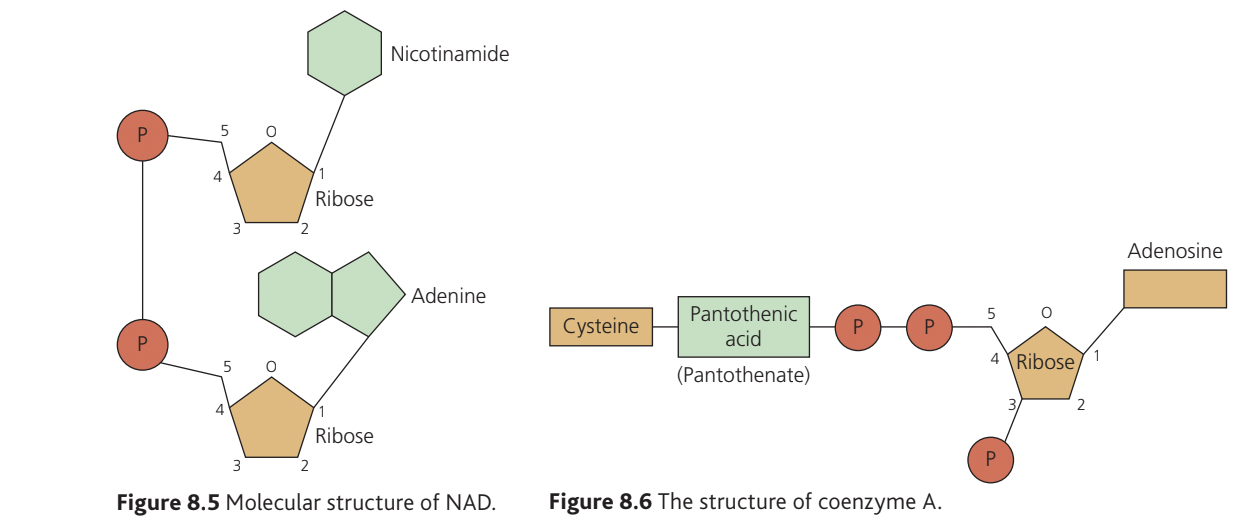
Unlike NAD and FAD, CoA does not carry hydrogen atoms. Instead, it carries acetyl groups - two-carbon fragments produced when pyruvate is broken down during the link reaction. CoA transports these acetyl groups to the Krebs cycle where they enter the oxidation pathway.
Note
CoA serves as an important entry point for other respiratory substrates. It can carry acetyl groups derived from fatty acid breakdown and some amino acid breakdown to the Krebs cycle, allowing these molecules to be respired for energy.
Summary
Key Points to Remember:
- Respiration is essential for life, transferring energy from organic molecules to ATP for cellular processes
- Photosynthesis and respiration are complementary processes - the products of one serve as reactants for the other
- ATP is the universal energy currency, releasing when hydrolysed to ADP and phosphate
- Coenzymes (NAD, FAD, and CoA) are non-protein helper molecules essential for respiratory reactions:
- NAD and FAD carry hydrogen atoms
- CoA carries acetyl groups