Properties of Alcohols (OCR A-Level Chemistry A): Revision Notes
📚Revision Notes
Properties of Alcohols
Introduction to the alcohol homologous series
Alcohols are organic compounds that contain the hydroxyl functional group, represented as . This functional group is responsible for determining both the physical and chemical characteristics of alcohol molecules.
Note
The hydroxyl group consists of an oxygen atom bonded to a hydrogen atom. When attached to a carbon chain, it creates the distinctive properties that distinguish alcohols from other organic compounds such as alkanes.
Common alcohols
Methanol () is the simplest member of the alcohol family. It is widely used as a high-performance fuel due to its efficient combustion properties. Additionally, methanol serves as an important chemical feedstock - a starting material in numerous industrial synthesis processes. It can be converted into polymers, paints, solvents, insulation materials, adhesives and many other useful products.
Ethanol (), the second member of the homologous series, is primarily known for its presence in alcoholic beverages. Beyond this, ethanol is also used as a fuel, a solvent, and a feedstock in chemical manufacturing.
Naming alcohols
When naming alcohols using IUPAC nomenclature, the suffix is added to the stem name of the longest carbon chain. The position of the hydroxyl functional group within the chain is indicated by a number placed before the suffix.
Example
Worked Example: Naming an alcohol with multiple hydroxyl groups
Consider the following alcohol structure:
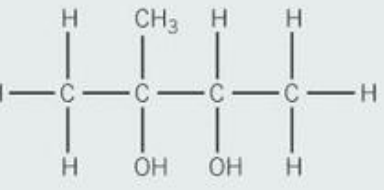
Step 1: Identify the longest carbon chain. In this case, there are four carbon atoms in the longest continuous chain, so the stem name is butane.
Step 2: Count the number of hydroxyl groups. There are two functional groups, so the suffix becomes (indicating two alcohol groups).
Step 3: Number the carbon chain to give the lowest numbers to the functional groups. The groups are located on carbons 2 and 3, giving the infix .
Step 4: Check if the suffix starts with a vowel. Since begins with a consonant, the alkane chain name is not shortened, remaining as butane.
Step 5: Identify any branches. There is a methyl group () attached to carbon 2. This requires the prefix to be added to the name.
Step 6: Combine all parts. The complete IUPAC name is 2-methylbutane-2,3-diol.
Physical properties of alcohols
Comparison with alkanes
When comparing alcohols with alkanes that have the same number of carbon atoms (for example, methanol and methane), several notable differences emerge:
Important
Key Differences Between Alcohols and Alkanes:
- Alcohols are less volatile than alkanes
- Alcohols have higher melting points than alkanes
- Alcohols have higher boiling points than alkanes
- Alcohols have greater water solubility than alkanes
These differences become less pronounced as the length of the carbon chain increases. As the hydrocarbon portion grows larger, the influence of the hydroxyl group becomes relatively smaller, and alcohols begin to resemble alkanes more closely in their properties.
Polarity and intermolecular forces
The differences in physical properties between alcohols and alkanes can be explained by examining the polarity of bonds and the resulting intermolecular forces.
In alkanes:
- The bonds are non-polar because carbon and hydrogen have very similar electronegativity values
- The entire alkane molecule is therefore non-polar
- Non-polar molecules only experience very weak London dispersion forces (also called van der Waals forces)
In alcohols:
- The bond is polar because oxygen is significantly more electronegative than hydrogen
- This creates a partial negative charge () on the oxygen atom and a partial positive charge () on the hydrogen atom
- The alcohol molecule is therefore polar
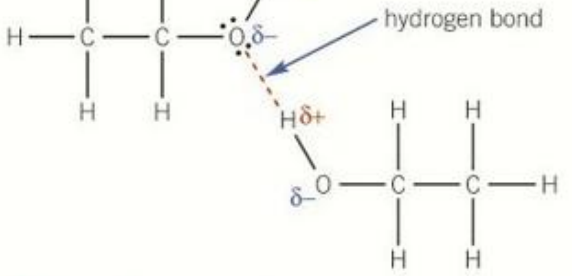
- Polar alcohol molecules experience weak London forces but also form much stronger hydrogen bonds between the polar groups
Note
The diagram above shows how hydrogen bonding occurs between ethanol molecules. The partially positive hydrogen atom of one molecule is attracted to the partially negative oxygen atom of another molecule, creating a hydrogen bond (shown as a dotted line).
Volatility and boiling points
The presence of hydrogen bonding between alcohol molecules has a significant effect on their volatility and boiling points.
In the liquid state, intermolecular hydrogen bonds hold alcohol molecules together. To convert the liquid into a gas (vaporisation), these hydrogen bonds must be broken. This requires considerably more energy than overcoming the weaker London forces present in alkanes.
Important
As a result, alcohols have:
- Lower volatility than alkanes with the same number of carbon atoms (they do not evaporate as easily)
- Higher boiling points than comparable alkanes
The graph below illustrates this relationship:
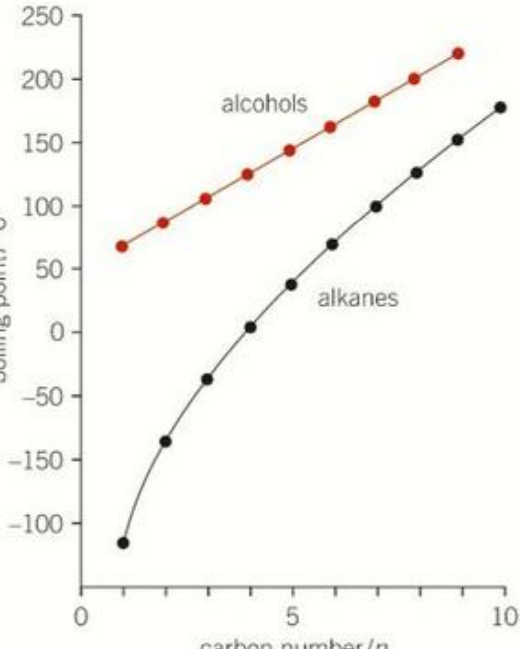
The data clearly shows that alcohols (shown in red/brown) consistently have higher boiling points than alkanes (shown in black) with the same number of carbon atoms. Both groups show an increase in boiling point as chain length increases, but alcohols maintain significantly higher values throughout.
Effect of increasing chain length: As the carbon chain becomes longer, the contribution of the hydroxyl group to the overall properties decreases. The non-polar hydrocarbon portion becomes more significant, and the alcohols begin to resemble alkanes more closely. This is why the gap between the two lines in the graph gradually narrows for longer chains.
Note
Key concept: Compounds with low boiling points are volatile - they can easily be converted from liquid to gas. The higher the boiling point, the lower the volatility.
Solubility in water
The ability of a compound to form hydrogen bonds with water molecules greatly affects its water solubility.
Alkanes are non-polar molecules and cannot form hydrogen bonds with water. Consequently, alkanes are not soluble in water.
Alcohols, however, are polar molecules due to their hydroxyl groups. The group can form hydrogen bonds with water molecules, as illustrated below:
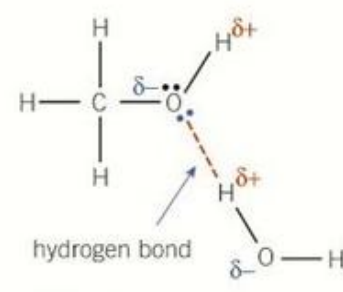
This diagram shows how the partially negative oxygen atom of the alcohol can attract the partially positive hydrogen atoms of water molecules, while the partially positive hydrogen of the alcohol's hydroxyl group can attract the partially negative oxygen of water. These hydrogen bonding interactions enable the alcohol to dissolve.
Small alcohols such as methanol and ethanol are completely soluble in water because hydrogen bonds readily form between the polar hydroxyl group and water molecules.
Effect of chain length on solubility: As the hydrocarbon chain increases in size, the influence of the hydroxyl group becomes relatively smaller. The non-polar hydrocarbon portion dominates the molecule's behaviour, and the solubility of longer-chain alcohols decreases. They begin to behave more like hydrocarbons, which are insoluble in water.
Real-world application: ethylene glycol
Note
Real-World Application: De-icing Fluids
Ethylene glycol, also known as ethane-1,2-diol, is an important diol (an alcohol with two hydroxyl groups):
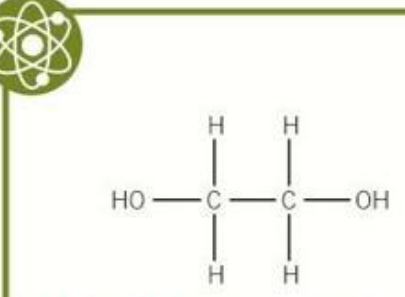
This compound is used in de-icing fluids for aircraft windscreens. The mixture works because:
- Pure water freezes at
- Pure ethane-1,2-diol freezes at
- When mixed together, the freezing point of the solution can be as low as
This significantly lowered freezing point allows the mixture to melt ice rapidly, even in very cold conditions. The presence of two hydroxyl groups gives ethane-1,2-diol excellent water solubility and the ability to form extensive hydrogen bonding networks, which contributes to its effectiveness as a de-icing agent.
Classification of alcohols
Important
Alcohols are classified as primary, secondary, or tertiary. This classification system is crucial because it determines how the alcohol will react with oxidising agents (covered in the next topic).
The classification depends on the number of hydrogen atoms and alkyl groups attached to the carbon atom that bears the hydroxyl functional group.
Primary alcohols
In a primary alcohol, the group is attached to a carbon atom that is itself attached to:
- Two hydrogen atoms, AND
- One alkyl group (or no carbon atoms in the case of methanol)
Methanol is a special case: it has three hydrogen atoms attached to the carbon bearing the hydroxyl group and no other carbon atoms attached. Despite this, it is still classified as a primary alcohol.
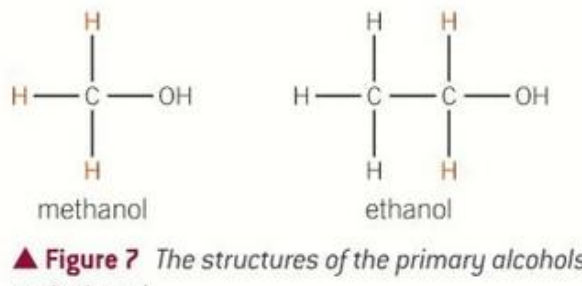
The diagram shows the structures of methanol and ethanol, the two simplest primary alcohols in the homologous series.
Secondary alcohols
In a secondary alcohol, the group is attached to a carbon atom that is attached to:
- One hydrogen atom, AND
- Two alkyl groups
Common examples include propan-2-ol and pentan-3-ol:
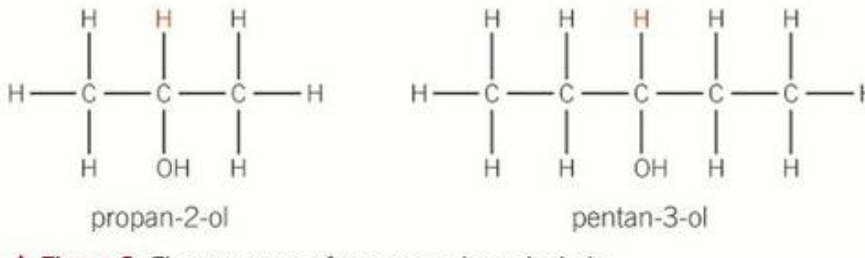
Notice that in both structures, the carbon atom bearing the hydroxyl group has one hydrogen atom and two carbon-containing groups attached to it.
Tertiary alcohols
In a tertiary alcohol, the group is attached to a carbon atom that is attached to:
- No hydrogen atoms, AND
- Three alkyl groups
Examples include 2-methylpropan-2-ol and 2-methylbutan-2-ol:
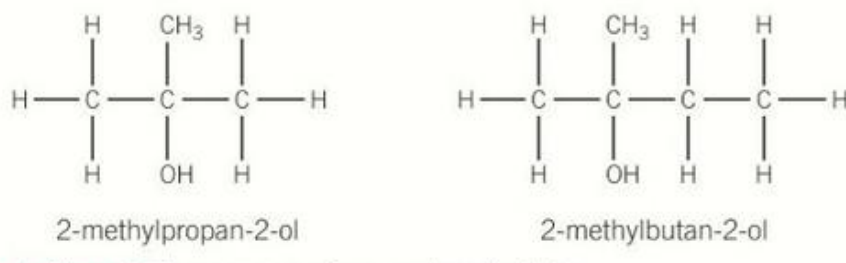
In these structures, the carbon bearing the hydroxyl group is bonded to three other carbon atoms and no hydrogen atoms.
Summary
Summary of Alcohol Classification
| Type of alcohol | Number of H atoms | Number of alkyl groups |
|---|---|---|
| Primary | 2 (3 for methanol) | 1 (0 for methanol) |
| Secondary | 1 | 2 |
| Tertiary | 0 | 3 |
The ability to recognise these three different classes of alcohol is essential for predicting how alcohols will behave in oxidation reactions, which you will study in subsequent topics.
Key Takeaways
Summary
Key Points to Remember:
- The hydroxyl group () is the functional group that defines alcohols and determines their physical and chemical properties
- Alcohols have higher boiling points, lower volatility, and greater water solubility than alkanes with the same number of carbon atoms due to hydrogen bonding
- Hydrogen bonds form between the polar groups in alcohol molecules, and between alcohols and water molecules
- As the carbon chain length increases, the influence of the hydroxyl group decreases, and alcohols become more like alkanes in their properties
- Alcohols are classified as primary (2H, 1 alkyl), secondary (1H, 2 alkyl), or tertiary (0H, 3 alkyl) based on the carbon bearing the group
- Understanding alcohol classification is crucial for predicting their behaviour in oxidation reactions