Electrophilic Addition in Alkenes (OCR A-Level Chemistry A): Revision Notes
📚Revision Notes
Electrophilic Addition in Alkenes
What is electrophilic addition?
Alkenes commonly undergo addition reactions to form saturated compounds. The mechanism by which this occurs is known as electrophilic addition, and understanding this process is essential for predicting and explaining the behaviour of alkenes in organic reactions.
The double bond in an alkene creates a region of high electron density. This occurs because the double bond contains π-electrons (pi-electrons) in addition to the σ-bond (sigma-bond). The π-electrons exist in a cloud above and below the plane of the molecule, making them readily available to interact with other species.
Note
The π-electrons in a double bond are less tightly held than the σ-bond electrons, making them more reactive and accessible to electrophiles. This is why the double bond is the site of chemical reactivity in alkenes.
This electron-rich region is highly attractive to electrophiles. An electrophile is a species that is electron-deficient and seeks to accept a pair of electrons. Electrophiles can be either positive ions or molecules containing an atom with a partial positive charge (). When an electrophile approaches an alkene, the π-electrons are attracted to it, initiating the addition reaction.
Important
Definition of Electrophile:
An electrophile is an atom or group of atoms that is attracted to an electron-rich centre and accepts an electron pair. An electrophile is usually a positive ion or a molecule containing an atom with a partial positive () charge.
Addition of hydrogen halides to alkenes
The reaction mechanism
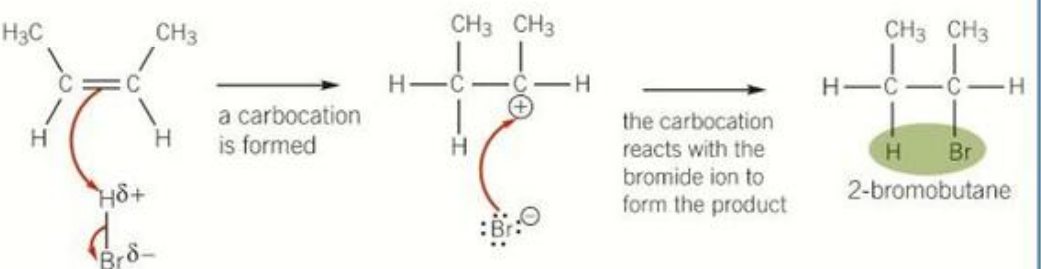
Hydrogen halides (such as , , or ) are polar molecules that readily undergo electrophilic addition with alkenes. Let's examine the reaction between but-2-ene and hydrogen bromide as a detailed example.
In hydrogen bromide, bromine is more electronegative than hydrogen, creating a polar bond with a dipole: . This makes the hydrogen atom partially positive and therefore electrophilic.
Example
Mechanism: Addition of HBr to But-2-ene
Step 1: The π-electrons in the double bond are attracted to the partially positive hydrogen atom. As these electrons move towards the hydrogen, the double bond breaks.
Step 2: A new bond forms between one of the carbon atoms from the original double bond and the hydrogen atom.
Step 3: Simultaneously, the bond undergoes heterolytic fission. In this type of bond breaking, both electrons in the bond move to the bromine atom, forming a bromide ion ().
Step 4: At this point, a carbocation intermediate has formed. A carbocation is a species containing a positively charged carbon atom. This carbon has only three bonds and carries a positive charge.
Step 5: The bromide ion, which is negatively charged and therefore nucleophilic, is attracted to the positively charged carbocation.
Step 6: The ion donates a pair of electrons to form a new bond, creating the final addition product: 2-bromobutane.
This mechanism demonstrates several key principles of electrophilic addition: the breaking of the π-bond, formation of a carbocation intermediate, and the role of heterolytic fission in generating a nucleophile that completes the reaction.
Note
Heterolytic fission is the breaking of a covalent bond where both electrons move to one of the atoms, creating two oppositely charged ions. This is different from homolytic fission, where each atom takes one electron.
Addition of halogens to alkenes
Understanding non-polar electrophiles
Alkenes can also react with non-polar molecules such as bromine () through electrophilic addition. At first glance, this might seem surprising since is a non-polar molecule with no permanent dipole. However, the mechanism involves a crucial concept called an induced dipole.

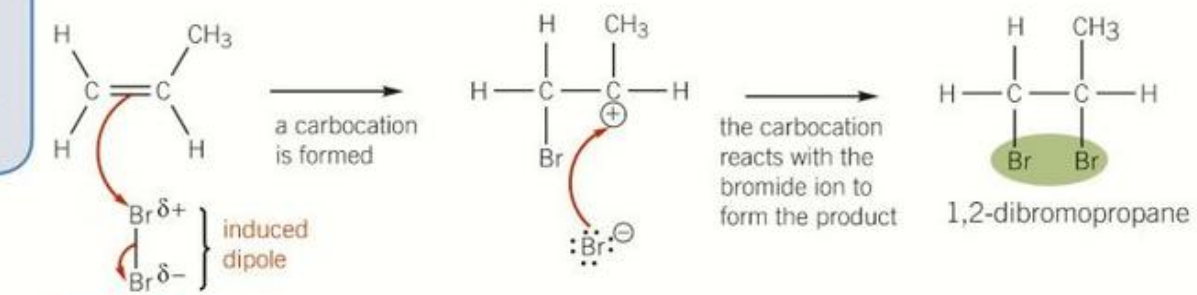
When a bromine molecule approaches an alkene, the electrons in the π-bond repel the bonding electrons in the bond. This repulsion pushes the electron pair in the bond away, causing it to become unevenly distributed. One end of the bromine molecule becomes slightly positive () while the other becomes slightly negative (). This temporary separation of charge is the induced dipole.
Important
Induced Dipole Formation:
Non-polar molecules like can become polarized when they approach the electron-rich π-bond of an alkene. The electron density of the π-electrons repels the electrons in the halogen-halogen bond, creating a temporary dipole. This allows non-polar molecules to act as electrophiles.
The bromination mechanism
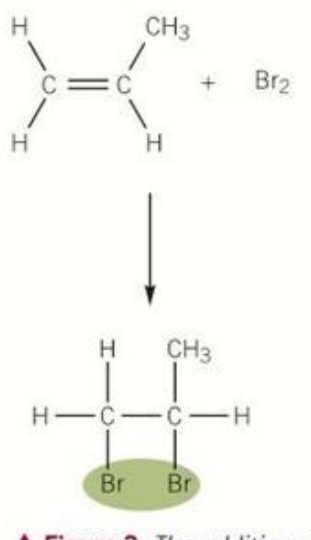
Let's examine the complete mechanism for the reaction between propene and bromine:
Example
Mechanism: Addition of Br₂ to Propene
Step 1: As bromine approaches the alkene, the π-electrons induce a dipole in the bond, creating .
Step 2: The π-electrons are attracted to the end of the molecule, causing the double bond to break.
Step 3: A bond forms between one carbon atom (from the original double bond) and a bromine atom.
Step 4: The bond breaks by heterolytic fission, with both electrons moving to the end, forming a bromide ion ().
Step 5: A carbocation intermediate and a bromide ion are now present.
Step 6: The ion attacks the carbocation, forming a bond and producing the final product: 1,2-dibromopropane.
This reaction beautifully illustrates how non-polar molecules can act as electrophiles when the appropriate conditions exist. The key is the initial interaction between the electron-rich alkene and the polarizable halogen molecule.
Markownikoff's rule
Predicting major products
When an unsymmetrical alkene reacts with an unsymmetrical reagent (such as ), two different products are theoretically possible. For instance, when propene reacts with hydrogen bromide, the bromine could attach to either carbon atom that was originally part of the double bond, giving either 1-bromopropane or 2-bromopropane.
In 1870, Russian chemist Vladimir Markownikoff discovered a pattern that allows us to predict which product predominates.
Important
Markownikoff's Rule:
When a hydrogen halide adds to an unsymmetrical alkene, the hydrogen atom attaches to the carbon atom in the double bond that already has the greater number of hydrogen atoms (or equivalently, the smaller number of carbon chains attached).
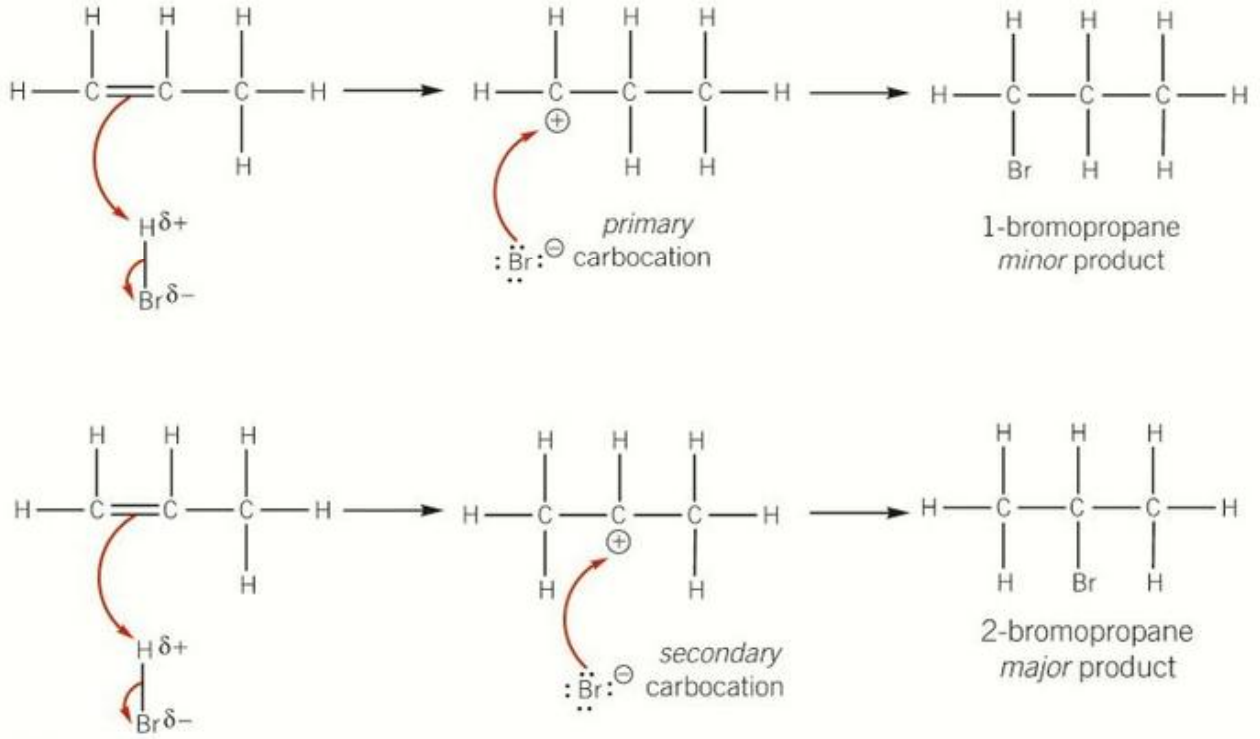
The mechanism shows why this pattern occurs. Electrophilic addition proceeds through a carbocation intermediate, and two different carbocations can potentially form:
- A primary carbocation: The positive charge is on a carbon atom at the end of a chain (attached to only one other carbon)
- A secondary carbocation: The positive charge is on a carbon atom attached to two other carbon atoms
When propene reacts with , the secondary carbocation forms preferentially because it is more stable than the primary carbocation. Since the major product forms via the more stable carbocation intermediate, 2-bromopropane (from the secondary carbocation) is the major product, while 1-bromopropane (from the primary carbocation) is the minor product.
Note
Remember the pattern:
"The hydrogen goes to the carbon with more hydrogens" - This simple phrase helps you remember which way Markownikoff's rule works. The major product always forms through the most stable carbocation intermediate.
Carbocation stability
Why structure matters
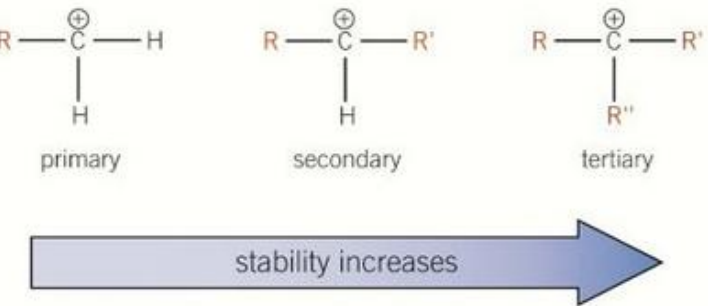
Understanding carbocation stability is crucial for predicting reaction outcomes and explaining Markownikoff's rule. Carbocations are classified according to how many alkyl groups (represented by ) are attached to the positively charged carbon atom:
- Primary carbocation: One alkyl group attached ()
- Secondary carbocation: Two alkyl groups attached ()
- Tertiary carbocation: Three alkyl groups attached ()
Important
Carbocation Stability Order:
This order is fundamental to understanding reaction mechanisms and predicting products in electrophilic addition reactions.
The reason for stability differences
This stability order exists because of the electron-donating ability of alkyl groups. Each alkyl group attached to the carbocation can donate electron density towards the positive charge. This process is sometimes called the inductive effect.
When electron density is donated towards the positive charge, the charge becomes spread out over a larger area (the alkyl groups). The more the charge is dispersed, the more stable the carbocation becomes. Since tertiary carbocations have three alkyl groups donating electrons, they have the most charge dispersal and are therefore most stable. Primary carbocations have only one alkyl group, so the positive charge is more concentrated and the ion is less stable.
Note
The Inductive Effect Explained:
Alkyl groups (, , etc.) are electron-donating groups. When attached to a positively charged carbon, they push electron density towards the positive charge through σ-bonds. This delocalizes (spreads out) the positive charge, making the carbocation more stable. More alkyl groups = more electron donation = greater stability.
This explains Markownikoff's rule perfectly: when hydrogen halides add to unsymmetrical alkenes, the reaction proceeds through the most stable carbocation intermediate, which determines the structure of the major product. The addition occurs in such a way as to form the most stable carbocation possible, leading to the observed regioselectivity.
Practical implications
Understanding carbocation stability helps chemists:
- Predict major and minor products in addition reactions
- Explain why certain reactions occur preferentially
- Design synthetic routes that exploit carbocation intermediates
- Understand reaction mechanisms in more complex organic transformations
Key reactions summary
Summary
Essential Reaction Types:
For exam purposes, ensure you can write balanced equations for:
1. Alkene + Hydrogen halide
- Example: (major product)
- Mechanism: Via carbocation intermediate
- Type of bond fission: Heterolytic
2. Alkene + Halogen
- Example:
- Mechanism: Via induced dipole, then carbocation
- Type of bond fission: Heterolytic
Common exam mistakes
Important
Avoid These Common Errors:
1. Drawing mechanisms: Always start curly arrows from bonds or lone pairs, and point them towards where electrons are moving. Draw arrow heads clearly at the destination atom.
2. Carbocation charge: Remember to show the positive charge explicitly on carbocation intermediates - don't forget this crucial detail.
3. Induced dipole: With , many students forget to show the polarization ( and ) that occurs as it approaches the alkene.
4. Markownikoff's rule: The rule is about where the hydrogen goes, not where the halogen goes. Hydrogen adds to the carbon with more hydrogen atoms already attached.
5. Stability order: Don't confuse carbocation stability with other stability orders. Remember: tertiary is most stable for carbocations.
Remember!
Summary
Key Points to Remember:
-
Alkenes undergo electrophilic addition because the π-electrons in the double bond create an electron-rich region that attracts electrophiles (electron-deficient species).
-
The mechanism proceeds through a carbocation intermediate formed after the π-bond breaks and an initial bond forms to the electrophile. This carbocation is then attacked by a nucleophile to complete the addition.
-
Non-polar molecules like Br₂ can act as electrophiles through induced dipole formation - the electron-rich π-bond repels electrons in the approaching molecule, creating a temporary dipole.
-
Markownikoff's rule predicts the major product when unsymmetrical reagents add to unsymmetrical alkenes: the hydrogen attaches to the carbon with more hydrogen atoms (or fewer alkyl groups), because this forms the more stable carbocation intermediate.
-
Carbocation stability increases with substitution: tertiary (three R groups) > secondary (two R groups) > primary (one R group), due to the electron-donating inductive effect of alkyl groups spreading the positive charge.