Reactions of Alkenes (OCR A-Level Chemistry A): Revision Notes
📚Revision Notes
Reactions of Alkenes
Why are alkenes more reactive than alkanes?
Alkenes display much greater reactivity compared to alkanes, and this difference stems from the nature of the carbon-carbon double bond. The double bond consists of two distinct components: a sigma (σ) bond and a pi (π) bond. Understanding the structure and properties of these bonds helps explain why alkenes readily undergo addition reactions.
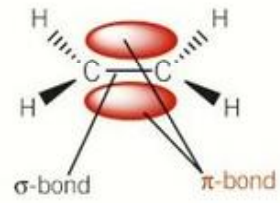
The sigma bond forms from the direct overlap of atomic orbitals along the axis between the two carbon atoms. In contrast, the pi bond arises from the sideways overlap of p orbitals, creating regions of electron density above and below the plane of the sigma bond. This positioning is crucial because the pi electrons are more exposed and accessible to attacking reagents than the electrons in the sigma bond.
Bond strength comparison
We can quantify the relative weakness of the pi bond by examining bond enthalpy values:
Note
Bond Enthalpy Comparison:
- A C—C single bond (σ-bond only) in ethane has a bond enthalpy of
- A C=C double bond (σ-bond + π-bond combined) has a bond enthalpy of
- Therefore, the π-bond alone has a bond enthalpy of:
This calculation reveals that the pi bond is significantly weaker than the sigma bond. The lower bond enthalpy means less energy is required to break the pi bond, making it the reactive site in alkene molecules. During chemical reactions, the pi bond breaks whilst the sigma bond remains intact, allowing new bonds to form with the attacking reagents.
Understanding addition reactions
Addition reactions represent the characteristic reaction type for alkenes. In an addition reaction, two reactant molecules combine to form a single product molecule. The process involves breaking the pi bond and forming two new sigma bonds to the carbon atoms that were originally connected by the double bond. The product molecule is saturated, meaning it contains only single bonds.
Alkenes undergo addition reactions with several different types of reagents:
- Hydrogen gas (in the presence of a nickel catalyst)
- Halogens such as chlorine and bromine
- Hydrogen halides including HCl and HBr
- Steam (in the presence of an acid catalyst)
In each case, the small molecule adds across the double bond, converting the unsaturated alkene into a saturated product.
Hydrogenation of alkenes
Hydrogenation involves the addition of hydrogen gas across the carbon-carbon double bond. This reaction requires specific conditions: the alkene must be mixed with hydrogen and passed over a nickel catalyst heated to (approximately ). The nickel acts as a heterogeneous catalyst, providing a surface on which the reaction can occur more readily.
The hydrogenation mechanism
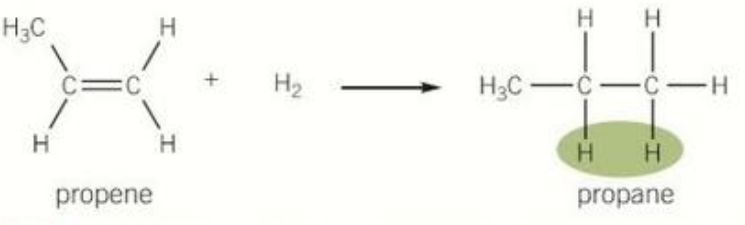
During hydrogenation, hydrogen molecules add across the double bond, converting the alkene into an alkane. Let's examine what happens when propene undergoes hydrogenation:
Example
Worked Example: Hydrogenation of Propene
The equation for this transformation can be written as:
The two hydrogen atoms add to the carbon atoms that formed the double bond, creating a saturated alkane product (propane). This type of reaction is sometimes called catalytic hydrogenation.
Hydrogenation of molecules with multiple double bonds
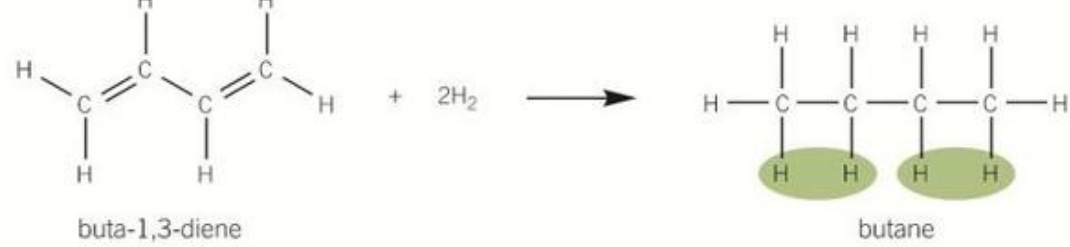
When an alkene contains more than one double bond, all of the double bonds can undergo hydrogenation if sufficient hydrogen is present. Consider buta-1,3-diene, which contains two carbon-carbon double bonds:
Example
Worked Example: Complete Hydrogenation of Buta-1,3-diene
This molecule requires two molecules of hydrogen to completely hydrogenate both double bonds:
Each double bond reacts with one molecule of hydrogen, producing butane as the final saturated product.
Industrial application: margarine production
Note
Industrial Application: Margarine Production
The hydrogenation of alkenes has important industrial applications, particularly in the food industry. Vegetable oils contain long-chain unsaturated hydrocarbon molecules with carbon-carbon double bonds in the cis configuration. When hydrogen gas is bubbled through the oil in the presence of a nickel catalyst, many of these double bonds become hydrogenated, forming saturated carbon chains.
The hydrogenated products have higher melting points and are more solid at room temperature, which is why the process transforms liquid vegetable oils into semi-solid margarine. The more complete the hydrogenation, the firmer the final margarine product becomes.
Halogenation of alkenes
Alkenes react rapidly with halogens at room temperature through an addition mechanism. This reaction is particularly important because it provides a simple chemical test for the presence of unsaturation.
Reaction with bromine
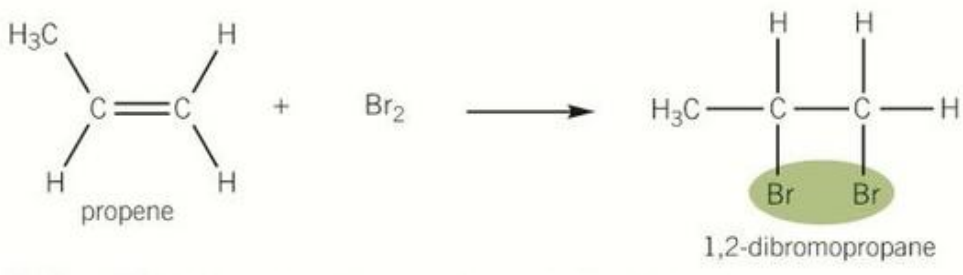
When propene reacts with bromine, an addition reaction occurs to form a dihaloalkane:
Example
Worked Example: Halogenation of Propene
The equation shows:
The product, 1,2-dibromopropane, contains bromine atoms on adjacent carbon atoms. The name indicates this - the "1,2-dibromo" part tells us that bromine atoms are attached to carbons 1 and 2.
Testing for unsaturation with bromine water
Important
The Bromine Water Test for Unsaturation
The reaction between alkenes and bromine provides a reliable test for carbon-carbon double bonds:
- Bromine water is an orange solution
- When added dropwise to a sample containing an alkene, the bromine adds rapidly across the double bond
- As the reaction proceeds, the orange colour disappears (decolourises), producing a colourless solution
- This colour change indicates the presence of a C=C bond and confirms that the compound is unsaturated
If the same test were carried out with a saturated compound (containing only C-C single bonds), no addition reaction would occur and the orange colour would persist. This makes bromine water an excellent diagnostic tool for distinguishing between alkenes and alkanes.
The test works because the reaction is an addition rather than a substitution. Any compound containing a C=C bond will decolourise bromine water through this addition mechanism.
Addition reactions with hydrogen halides
Alkenes react with hydrogen halides (such as HCl and HBr) at room temperature to form haloalkanes. The hydrogen halide can be used as a gas, or alkenes can react with concentrated solutions of hydrogen halides in water (concentrated hydrochloric or hydrobromic acid).
Formation of multiple products
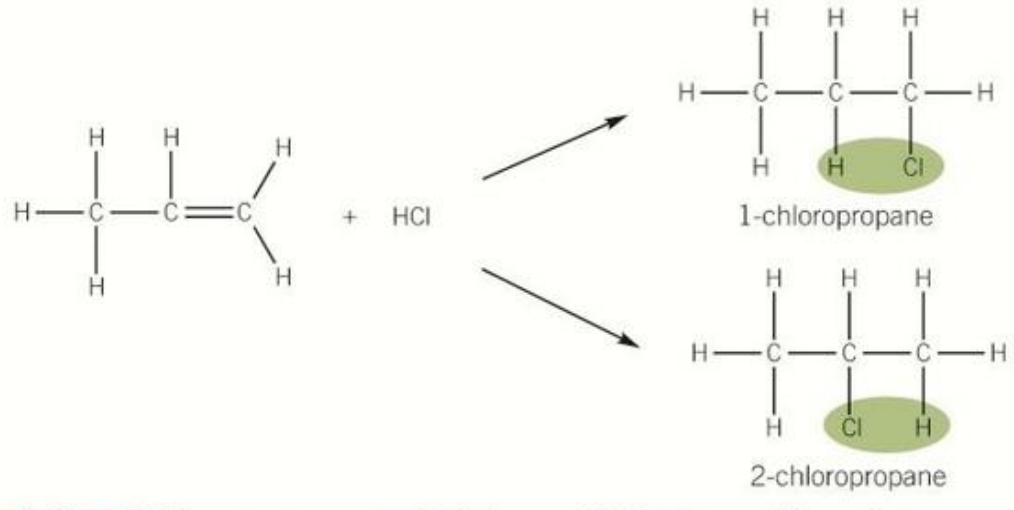
When an unsymmetrical alkene reacts with a hydrogen halide, two different products can form. Consider the reaction between propene and hydrogen chloride:
Example
Worked Example: Reaction of Propene with Hydrogen Chloride
The reaction can be represented as:
The two possible products are:
- 1-chloropropane (chlorine attached to the end carbon)
- 2-chloropropane (chlorine attached to the middle carbon)
This happens because the hydrogen atom and the chlorine atom can add to either carbon of the double bond. With an unsymmetrical alkene like propene, these two arrangements produce different structural isomers.
In practice, one product typically predominates over the other, but both are possible products of the reaction. You will explore the reasons for this preference when you study reaction mechanisms in more detail.
Hydration reactions of alkenes
Hydration involves the addition of water across the carbon-carbon double bond to produce alcohols. This reaction requires steam (gaseous water, ) and an acid catalyst, typically phosphoric acid (). Concentrated sulfuric acid can also serve as the acid catalyst.
Formation of alcohols
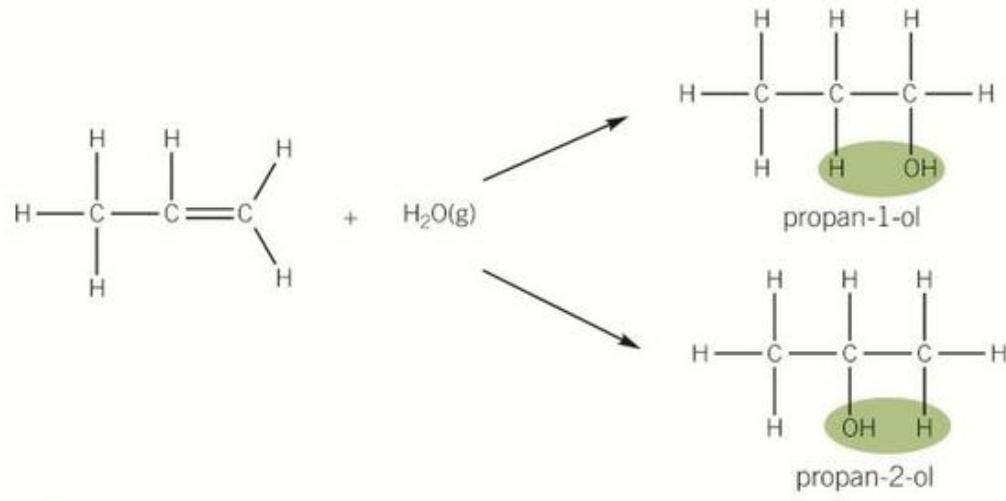
When propene undergoes hydration, the water molecule adds across the double bond:
Example
Worked Example: Hydration of Propene
The general equation is:
Similar to the reaction with hydrogen halides, two products can form from this unsymmetrical alkene:
- Propan-1-ol (a primary alcohol with the -OH group on the end carbon)
- Propan-2-ol (a secondary alcohol with the -OH group on the middle carbon)
The hydroxyl group (-OH) and hydrogen atom add to the two carbon atoms that formed the double bond. The acid catalyst facilitates the reaction but is not consumed in the overall process.
Industrial significance
Note
Industrial Application: Ethanol Production
The hydration of alkenes has considerable industrial importance. The large-scale production of ethanol for industrial use relies on the hydration of ethene:
This process provides a synthetic route to ethanol that doesn't involve fermentation, making it suitable for producing ethanol as an industrial solvent and chemical feedstock.
Summary of reaction conditions
To successfully predict and carry out these reactions, you need to remember the specific conditions required for each type:
| Reaction type | Reagent | Conditions | Product type |
|---|---|---|---|
| Hydrogenation | Nickel catalyst, | Alkane | |
| Halogenation | or | Room temperature | Dihaloalkane |
| Hydrogen halide addition | HCl or HBr (gas or conc. solution) | Room temperature | Haloalkane |
| Hydration | (steam) | or catalyst | Alcohol |
Important
Common Exam Errors to Avoid
Students often make several mistakes when working with alkene addition reactions:
-
Forgetting the catalyst: Hydrogenation requires a nickel catalyst and won't proceed without it. Similarly, hydration needs an acid catalyst.
-
Wrong conditions: Don't confuse the conditions for different reactions. For example, using room temperature for hydrogenation or suggesting a nickel catalyst for hydration.
-
Incorrect products with multiple double bonds: Remember that each double bond in a molecule can undergo reaction. Buta-1,3-diene needs two molecules of hydrogen, not one.
-
Naming errors: When naming products, ensure you correctly identify which carbon atoms have gained the new groups. Use systematic IUPAC nomenclature.
-
Forgetting both possible products: When an unsymmetrical alkene reacts with HCl, HBr, or , remember that two structural isomers can form.
Summary
Key Points to Remember:
-
Alkenes are more reactive than alkanes because the π-bond (bond enthalpy = ) is weaker than the σ-bond and breaks more easily during reactions
-
All alkene addition reactions involve breaking the π-bond whilst the σ-bond remains intact, converting unsaturated alkenes into saturated products
-
Four key addition reactions occur: hydrogenation (, Ni catalyst, ), halogenation ( or , room temperature), hydrogen halide addition (HCl/HBr, room temperature), and hydration (, acid catalyst)
-
Bromine water provides a diagnostic test for unsaturation - the orange colour decolourises when a C=C bond is present
-
Unsymmetrical alkenes produce two possible structural isomers when reacting with HCl, HBr, or because the two parts of the reagent can add to either end of the double bond