Introduction to Reaction Mechanisms (OCR A-Level Chemistry A): Revision Notes
📚Revision Notes
Introduction to reaction mechanisms
Understanding how chemical reactions occur is essential in organic chemistry. While a chemical equation tells you what reactants are used and what products are formed, it doesn't reveal the step-by-step process of how the reaction actually happens. This is where reaction mechanisms come in - they show us the pathway a reaction takes and how electrons move during the process.
Types of bond fission
Before we can understand reaction mechanisms, we need to know how covalent bonds break. A covalent bond consists of a shared pair of electrons between two atoms. When a reaction occurs, these bonds must break, and they can do so in two different ways: homolytic fission or heterolytic fission.
Note
The way a bond breaks determines what species are formed and significantly affects the reaction pathway. Understanding these two breaking patterns is fundamental to predicting and explaining organic reaction mechanisms.
Homolytic fission
In homolytic fission, a covalent bond breaks in such a way that each atom receives one electron from the bonded pair. This creates an equal split of the electrons.
When this happens:
- Each atom ends up with a single unpaired electron
- Species with unpaired electrons are called radicals
- Radicals are highly reactive due to their unpaired electron
Example
Homolytic Fission of Ethane
When ethane undergoes homolytic fission:
The dot notation () represents the unpaired electron on each radical. Note that radicals are not charged - they're neutral species with an odd number of electrons.
Heterolytic fission
In heterolytic fission, the covalent bond breaks unevenly - one atom takes both electrons from the bonded pair, while the other atom receives none.
When this occurs:
- The atom that takes both electrons becomes a negative ion (anion)
- The atom that loses both electrons becomes a positive ion (cation or carbocation if it's a carbon atom)
- This type of fission produces charged species rather than radicals
Example
Heterolytic Fission of Chloromethane
When chloromethane undergoes heterolytic fission:
The carbon atom forms a positively charged carbocation, while the chlorine atom becomes a chloride ion. Heterolytic fission typically occurs in polar bonds where one atom is more electronegative than the other.
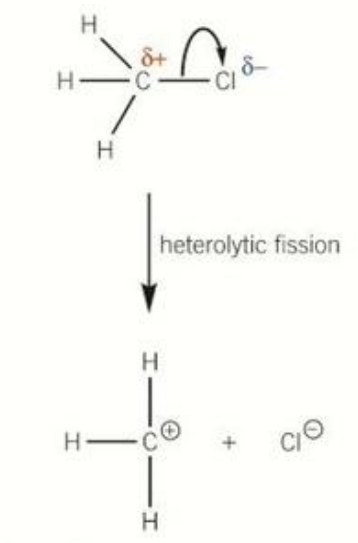
In this diagram, you can see the partial charges ( and ) on the carbon and chlorine before the bond breaks. The chlorine is more electronegative, so it attracts the electron pair more strongly. When the bond breaks heterolytically, both electrons move to the chlorine, as shown by the curly arrow.
Reaction mechanisms and curly arrows
A reaction mechanism shows the detailed step-by-step pathway of how a reaction proceeds, including the movement of electrons. This is crucial information that a simple chemical equation cannot provide.
Curly arrows
To show electron movement in mechanisms, chemists use curly arrows. These arrows are essential tools for understanding organic reactions:
- A full curly arrow (with a full arrowhead) represents the movement of an electron pair
- The arrow starts from where the electrons are initially located
- The arrow points to where the electrons are moving to
- Curly arrows always show electron movement, never atom movement
In heterolytic fission, curly arrows show how the electron pair moves from the bond to one of the atoms. For example, in the breaking of a carbon-chlorine bond, a curly arrow would start at the C-Cl bond and point toward the chlorine atom, showing that both electrons move to chlorine.
Important
Common Arrow-Drawing Mistakes
Always draw curly arrows carefully - they should start from a bond or a lone pair of electrons, not from an atom itself. Common mistakes include starting arrows from atomic symbols or drawing arrows pointing the wrong direction.
Fish-hook arrows
When dealing with homolytic fission and radicals, a different type of arrow is used:
- A fish-hook arrow (with half an arrowhead) represents the movement of a single electron
- These are used in radical mechanisms
- Each breaking bond requires two fish-hook arrows (one electron going to each atom)
Example
Homolytic Fission Using Fish-Hook Arrows
When bromine undergoes homolytic fission:
Two fish-hook arrows would show one electron moving to each bromine atom.
Three main types of organic reactions
Organic reactions can be classified into three main categories based on what happens during the reaction: addition, substitution, and elimination. Understanding these reaction types helps you predict products and understand mechanisms.
Addition reactions
In an addition reaction, two molecules combine to form a single product. This type of reaction is characteristic of compounds containing double bonds, such as alkenes.
Key features:
- Two reactant molecules join together
- The double bond in the alkene breaks
- One product molecule is formed
- Nothing is lost from the reactants
Example
Addition Reaction: Hydration of But-2-ene
When but-2-ene reacts with water, the water molecule adds across the double bond to form butan-2-ol (a secondary alcohol):
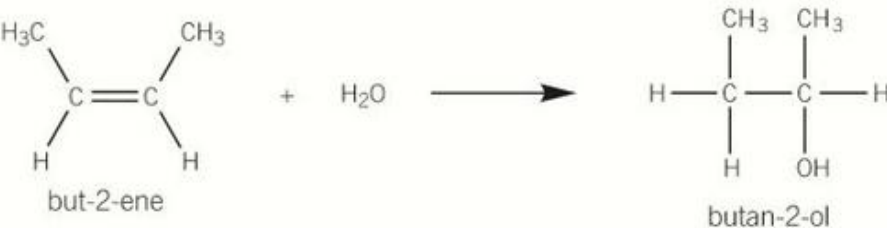
In this reaction:
- The double bond in but-2-ene breaks
- Water adds across this bond
- The product is a saturated alcohol
- No atoms are removed from either reactant
Note
Addition reactions are common in alkene chemistry and are important in the synthesis of alcohols and other organic compounds. The double bond provides the reactive site where molecules can add across.
Substitution reactions
In a substitution reaction, one atom or group of atoms in a molecule is replaced by a different atom or group of atoms.
Key features:
- One functional group is exchanged for another
- An atom or group leaves the molecule (leaving group)
- A different atom or group takes its place (entering group)
- The carbon skeleton usually remains unchanged
Example
Nucleophilic Substitution of 1-Bromopropane
When 1-bromopropane reacts with hydroxide ions, the bromine atom is replaced by a hydroxyl group to form propan-1-ol:
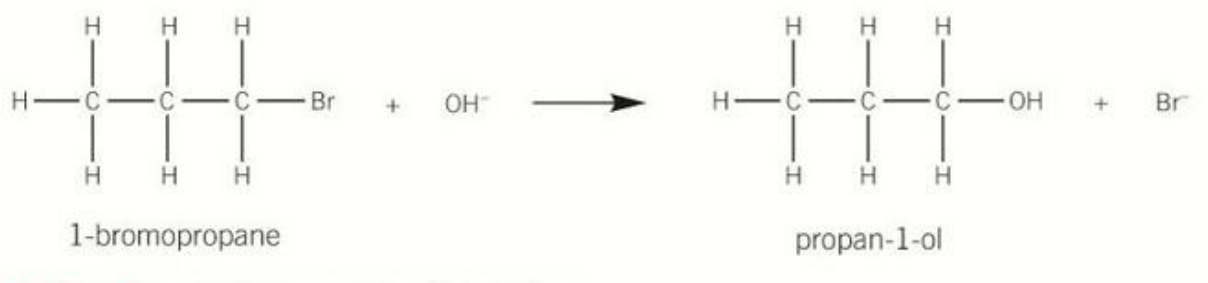
In this reaction:
- The bromine atom (leaving group) is replaced
- The hydroxide ion (nucleophile) takes its place
- The carbon chain structure remains intact
- A bromide ion is produced as a by-product
Substitution reactions are particularly important in haloalkane chemistry and in converting one functional group to another.
Important
Identifying Substitution Components
In substitution reactions, always identify what is leaving and what is substituting. The hydroxide ion is a nucleophile (electron-pair donor), so this is specifically a nucleophilic substitution reaction.
Elimination reactions
In an elimination reaction, a small molecule is removed from a larger molecule. This typically results in the formation of a double bond.
Key features:
- A small molecule (often water or hydrogen halide) is removed
- The parent molecule loses atoms
- A double bond usually forms
- Two products are formed: the main organic product and the small eliminated molecule
Example
Elimination Reaction: Dehydration of Propan-1-ol
When propan-1-ol is heated with an acid catalyst (such as concentrated sulfuric acid), a water molecule is eliminated to form propene:
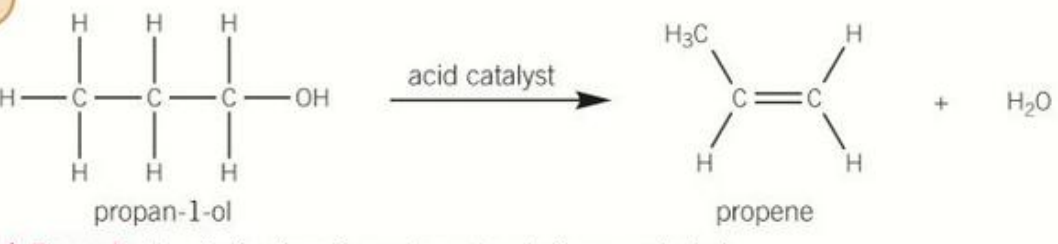
In this reaction:
- A water molecule () is eliminated
- The alcohol loses an H from one carbon and OH from an adjacent carbon
- A double bond forms between these two carbon atoms
- The product is an alkene (propene)
Elimination reactions are important for converting alcohols to alkenes and are often the reverse of addition reactions.
Important
Don't Confuse Elimination with Substitution
Students sometimes confuse elimination with substitution. Remember: elimination removes a small molecule and creates a double bond, while substitution exchanges one group for another without forming a double bond.
Practical applications
These three reaction types form the foundation of organic synthesis:
- Addition reactions are used to convert alkenes (unsaturated) into alcohols and other functional groups
- Substitution reactions allow chemists to transform one functional group into another while maintaining the carbon skeleton
- Elimination reactions enable the creation of double bonds, converting saturated compounds to unsaturated ones
Understanding which conditions favour each reaction type is crucial for synthetic planning and will be developed further as you study specific functional groups.
Summary
Key Points to Remember:
- Homolytic fission splits a bond evenly, giving each atom one electron and forming radicals (species with unpaired electrons)
- Heterolytic fission splits a bond unevenly, with one atom taking both electrons, forming a positive ion (carbocation) and a negative ion
- Curly arrows show the movement of electron pairs in reaction mechanisms - they should start from bonds or lone pairs, not from atoms
- Addition reactions involve two molecules joining to form one product (common in alkenes)
- Substitution reactions involve one atom or group being replaced by another (common in haloalkanes)
- Elimination reactions involve removing a small molecule from a larger one, usually forming a double bond (converting alcohols to alkenes)