Organohalogen Compounds in the Environment (OCR A-Level Chemistry A): Revision Notes
📚Revision Notes
Organohalogen Compounds in the Environment
Introduction to organohalogen compounds
Organohalogen compounds, also called halogenated compounds, are molecules containing at least one halogen atom (such as chlorine, fluorine, or bromine) bonded to a carbon chain. These compounds have become important in modern industry due to their useful properties, but they have also raised significant environmental concerns.
Note
Unlike many organic molecules, organohalogen compounds are rarely found naturally. They do not break down easily in the environment, which means they can persist for long periods and accumulate. This persistence has made them a major focus of environmental chemistry.
Uses of organohalogen compounds
Organohalogen compounds have found widespread applications across various industries due to their chemical stability and useful properties.
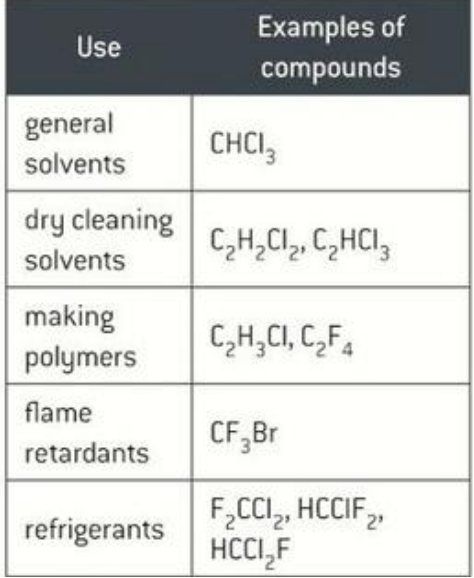
The main uses include:
- General solvents: Chloroform () has been used as a solvent in laboratories and industry
- Dry cleaning solvents: Chlorinated derivatives of ethane and ethene, such as and , are effective at dissolving oils and grease
- Polymer production: Vinyl chloride () is used to manufacture PVC plastic, while tetrafluoroethylene () produces PTFE (Teflon)
- Flame retardants: Compounds like bromotrifluoromethane () reduce the flammability of materials
- Refrigerants and propellants: Various chlorofluorocarbons (CFCs) such as , , and have been used in cooling systems and aerosol sprays
Organohalogen compounds are also widely employed in pesticides to protect crops from insects and disease.
The ozone layer
Structure and importance of the ozone layer
The ozone layer is a critical component of Earth's atmosphere, located in the stratosphere at altitudes between approximately 10 and 40 km above the surface.
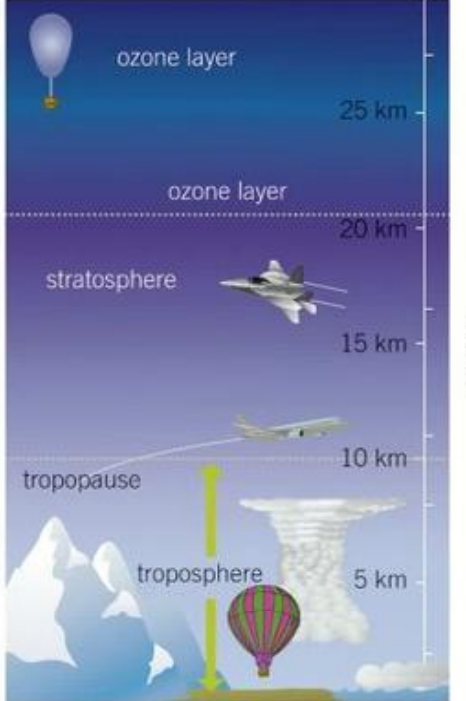
Although ozone makes up only a tiny fraction of the atmospheric gases, it performs a vital protective function.
Important
The ozone layer absorbs most of the biologically harmful ultraviolet-B (UV-B) radiation from the Sun. UV-B radiation is particularly damaging because it can:
- Cause genetic damage to living cells
- Significantly increase the risk of skin cancer in humans
- Damage plant life and marine ecosystems
Without the ozone layer, only a small amount of UV-B would be filtered out, allowing much more to reach Earth's surface. This would have devastating consequences for all living organisms.
Natural ozone formation and breakdown
In the stratosphere, ozone exists in a natural equilibrium where it is continuously formed and broken down. This balance is driven by ultraviolet radiation.
Initially, very high-energy UV radiation breaks oxygen molecules into highly reactive oxygen radicals:
These oxygen radicals are extremely reactive and can combine with oxygen molecules to form ozone:
The ozone itself can then be broken down by further UV radiation, releasing oxygen molecules and oxygen radicals:
Note
In this steady state, the rate at which ozone forms equals the rate at which it breaks down, maintaining a protective concentration. However, human activities, particularly the release of certain chemicals, have disrupted this delicate equilibrium.
CFCs and ozone layer depletion
What are CFCs and why are they stable?
Chlorofluorocarbons (CFCs) and hydrochlorofluorocarbons (HCFCs) were once the most widely used compounds in refrigeration, air conditioning, and aerosol propellants. Their popularity stemmed from their exceptional chemical stability.
CFCs are remarkably stable because of the strong carbon-halogen bonds within their molecular structure. The high bond strength means these compounds do not react easily with other chemicals. While this stability is useful for industrial applications, it creates a serious environmental problem.
How CFCs reach the stratosphere
Due to their stability and unreactive nature, CFCs can remain in the lower atmosphere (troposphere) for many years or even decades. During this time, they gradually diffuse upward through the atmospheric layers. Eventually, they reach the stratosphere where the ozone layer exists.
Note
The long residence time in the troposphere means that CFCs released today may not reach the stratosphere for many years. This creates a time lag between CFC emissions and their environmental impact.
Photodissociation of CFCs
Once CFCs reach the stratosphere, they encounter intense UV radiation that provides enough energy to break chemical bonds. This process is called photodissociation or photolysis.
The carbon-chlorine () bond has the lowest bond enthalpy in CFC molecules, making it the bond most likely to break first. When UV radiation strikes a CFC molecule, it undergoes homolytic fission, breaking the bond and forming free radicals.
Example
Worked Example: Photodissociation of a CFC
When dichlorodifluoromethane is exposed to UV radiation in the stratosphere, the bond breaks:
The dot () represents an unpaired electron, indicating a free radical. Even though oxygen radicals () are not typically drawn with a radical dot, they are still radicals.
The chlorine radical mechanism
The chlorine radicals () formed by photodissociation are extremely reactive. They can attack ozone molecules, initiating a chain reaction that depletes the ozone layer.
Example
Worked Example: The Chlorine Radical Mechanism
The breakdown occurs through two propagation steps:
Propagation step 1:
A chlorine radical reacts with an ozone molecule, breaking it down into an oxygen molecule and a chlorine oxide radical ().
Propagation step 2:
The chlorine oxide radical then reacts with an oxygen radical, regenerating the original chlorine radical and producing another oxygen molecule.
Overall reaction:
This overall equation is identical to the natural ozone breakdown process, but the presence of chlorine radicals dramatically accelerates the rate.
Catalytic effect of chlorine radicals
Important
The key problem with chlorine radicals is that they act as catalysts. In propagation step 2, the chlorine radical is regenerated, meaning it can go on to attack another ozone molecule in propagation step 1. This creates a repeating cycle where the same chlorine radical participates in multiple reactions.
Scientists estimate that a single CFC molecule can lead to the destruction of approximately 100,000 ozone molecules before the chlorine radical is finally removed from the cycle. This enormous multiplication effect explains why even relatively small amounts of CFCs can cause significant ozone depletion.

In 1973, chemists Frank Sherwood Rowland and Mario Molina began investigating the impact of CFCs on the atmosphere. They discovered that CFCs were responsible for catalysing ozone breakdown. Their groundbreaking work earned them the Nobel Prize in Chemistry in 1995.
Other contributors to ozone depletion
Nitrogen oxide radicals
CFCs are not the only culprits in ozone depletion. Nitrogen oxide radicals ( and ) also catalyse the breakdown of ozone through a similar mechanism to chlorine radicals.
Note
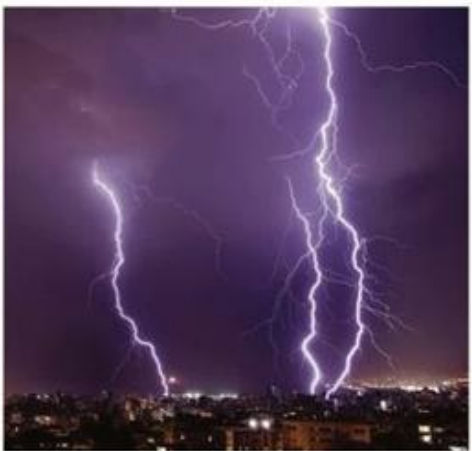
Nitrogen oxide radicals are formed naturally during lightning strikes and also result from aircraft emissions in the stratosphere. Unlike CFCs which are entirely human-made, nitrogen oxides have both natural and anthropogenic sources.
The mechanism involves two propagation steps:
Example
Worked Example: The Nitrogen Oxide Radical Mechanism
Propagation step 1:
A nitrogen monoxide radical reacts with ozone, forming a nitrogen dioxide radical and oxygen.
Propagation step 2:
The nitrogen dioxide radical reacts with an oxygen radical, regenerating the nitrogen monoxide radical and producing oxygen.
Overall equation:
This demonstrates that nitrogen oxide radicals also act as catalysts, with the radical regenerated at the end of the cycle. Like chlorine radicals, nitrogen oxide radicals can destroy many ozone molecules before being removed from the catalytic cycle.
Environmental action and alternatives
The Montreal Protocol
Recognition of the serious threat posed by ozone depletion led to international action. In 1987, the Montreal Protocol was signed by countries around the world. This landmark agreement introduced measures to phase out CFCs almost completely.
Note
The protocol allowed for a limited number of applications where suitable alternatives could not be found, but it set strict deadlines for eliminating CFCs from most uses. The Montreal Protocol is considered one of the most successful international environmental agreements.
Alternatives to CFCs
The search for environmentally safer alternatives to CFCs has led to the development of several replacement compounds:
For refrigeration and air conditioning:
- Hydrocarbons (such as butane and propane)
- Ammonia
- Carbon dioxide
Important
These alternatives do not contain chlorine atoms, so they cannot contribute to ozone depletion through the chlorine radical mechanism.
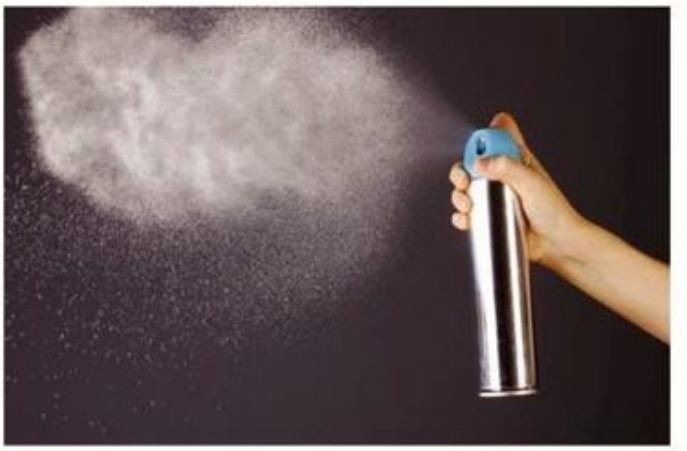
For aerosol propellants: Some manufacturers have developed pump-action spray dispensers that do not require propellant gases at all. Where aerosols are still used, the propellant is more likely to be a hydrocarbon such as butane rather than a CFC.
Brominated flame retardants
Brominated flame retardants (BFRs) are organobromine compounds commonly used in electronics to reduce fire risk. They are found in circuit boards, outer coverings of devices, and cables.
However, organobromine compounds are now under increased scientific scrutiny. Research suggests they may be toxic and could interfere with the proper functioning of the human endocrine (hormone) system. As awareness of these risks has grown, major technology companies have taken action.
Note
Both Apple and Dell have claimed to have significantly reduced or eliminated environmentally damaging flame retardants from their products. They have also stopped using PVC, another organohalogen polymer, in their manufacturing processes.
Remember!
Summary
Key Points to Remember:
- Organohalogen compounds contain halogen atoms bonded to carbon chains and are used in solvents, refrigerants, polymers, and flame retardants
- The ozone layer in the stratosphere (10-40 km altitude) protects life on Earth by absorbing harmful UV-B radiation that can cause skin cancer and genetic damage
- CFCs are very stable due to strong carbon-halogen bonds, allowing them to persist in the atmosphere for years before reaching the stratosphere
- UV radiation in the stratosphere causes photodissociation of CFCs, breaking C-Cl bonds to form highly reactive chlorine radicals ()
- Chlorine radicals catalyse ozone depletion through a two-step propagation mechanism, with each chlorine radical capable of destroying approximately 100,000 ozone molecules
- Nitrogen oxide radicals from lightning and aircraft also contribute to ozone depletion through a similar catalytic mechanism
- The 1987 Montreal Protocol successfully phased out most CFC use, leading to the development of safer alternatives including hydrocarbons, ammonia, and CO₂ for refrigeration and pump-action dispensers for sprays