Carboxylic Acid Derivatives (OCR A-Level Chemistry A): Revision Notes
📚Revision Notes
Carboxylic Acid Derivatives
Introduction to carboxylic acid derivatives
Carboxylic acid derivatives are a family of organic compounds that share an important structural feature called the acyl group. These compounds are called "derivatives" because they can all be converted back into their parent carboxylic acid through a reaction called hydrolysis (breaking down with water).
Note
Definition of Carboxylic Acid Derivatives
A derivative of a carboxylic acid is a compound that can be hydrolysed to form the parent carboxylic acid. This ability to regenerate the original acid is what unites this family of compounds.
The acyl group has the structure , where R represents an alkyl or aryl group. This carbonyl carbon () is the reactive center in all these compounds.
There are four main types of carboxylic acid derivatives you need to know:
- Esters ()
- Acyl chlorides ()
- Acid anhydrides ()
- Amides ( or or )
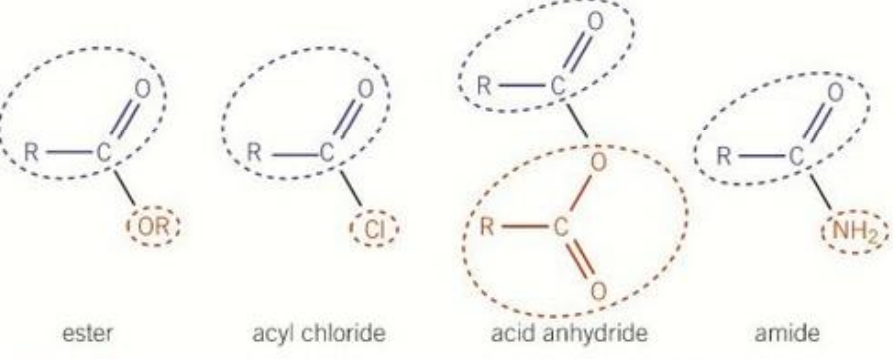
Each derivative contains the acyl group bonded to different atoms or groups. The identity of these attached groups determines the properties and reactivity of each derivative.
Esters
Structure and nomenclature
Esters contain the functional group , where the acyl group is bonded to an oxygen atom, which is in turn bonded to an alkyl or aryl group. Esters are typically colorless liquids with pleasant, sweet, fruity smells. Many natural esters occur in fruits and flowers, giving them their characteristic aromas.
Note
Naming Esters: The Two-Part Approach
To name an ester, you need to identify both the alcohol part and the carboxylic acid part:
- First, identify the alkyl chain attached to the single-bonded oxygen atom - this comes from the alcohol
- Then identify the carboxylic acid part
- Remove the "-oic acid" suffix from the carboxylic acid name and replace it with "-oate"
- Put the alcohol part first, followed by the acid part
Memory tip: "Alcohol first, Acid last"
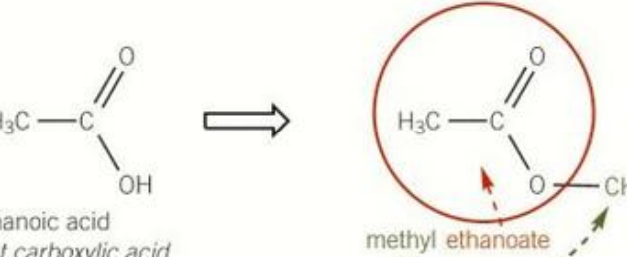
For example, when ethanoic acid reacts with methanol, it forms methyl ethanoate. The "methyl" part comes from methanol, and the "ethanoate" part comes from ethanoic acid.
Acyl chlorides
Structure and nomenclature
Acyl chlorides (also called acid chlorides) are highly reactive compounds where the group of a carboxylic acid has been replaced by a chlorine atom. They are extremely useful reagents in organic synthesis because they readily react with nucleophiles to form other carboxylic acid derivatives.
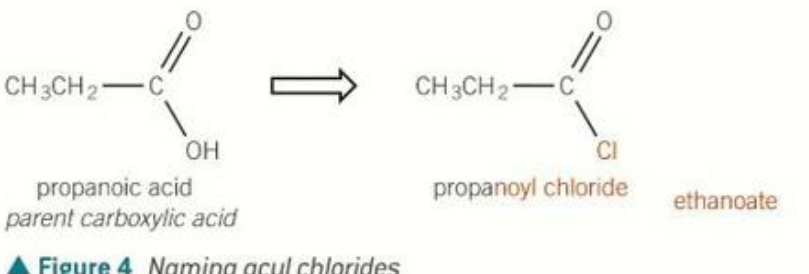
To name an acyl chloride:
- Start with the name of the parent carboxylic acid
- Remove the "-oic acid" suffix
- Add "-oyl chloride"
For example, propanoic acid becomes propanoyl chloride.
The chlorine atom makes these compounds much more reactive than the parent carboxylic acids, which is why they are so useful in synthesis reactions.
Acid anhydrides
Structure and formation
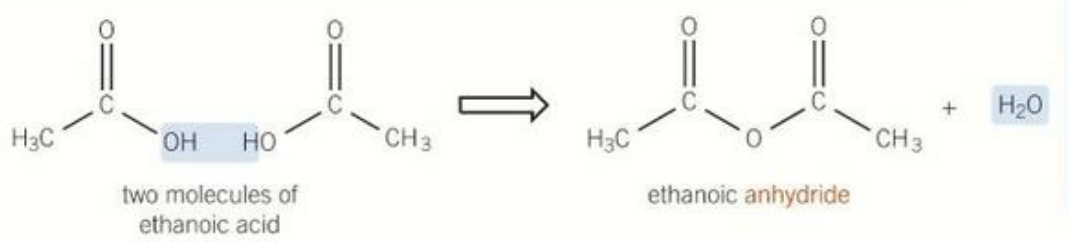
An acid anhydride contains two acyl groups bonded together through an oxygen atom. The name "anhydride" means "without water", which gives us a clue about how these compounds are formed.
Acid anhydrides are produced when two carboxylic acid molecules combine with the loss of one water molecule. This is a condensation reaction. For example, two molecules of ethanoic acid can react to form ethanoic anhydride plus water.
Note
Understanding Acid Anhydride Structure
The structure of acid anhydrides may look complex, but remembering that it's essentially "two carboxylic acids without water" helps you understand and draw these compounds. Acid anhydrides are less reactive than acyl chlorides but can still be used to synthesize esters and amides, particularly in situations where acyl chlorides might be too reactive.
Amides
Amides contain a carbonyl group bonded directly to a nitrogen atom. The nitrogen may have hydrogen atoms attached (primary amide, ), one alkyl group (secondary amide, ), or two alkyl groups (tertiary amide, ).
In this course, you'll mainly encounter primary and secondary amides formed from reactions of acyl chlorides with ammonia or primary amines. We'll look at these reactions in detail later.
Esterification
The esterification reaction
Esterification is the reaction between an alcohol and a carboxylic acid to produce an ester and water. This is a condensation reaction because a small molecule (water) is eliminated when two larger molecules combine.
Important
Reaction Conditions for Esterification
The reaction conditions are:
- Heat under reflux (to maintain constant temperature while allowing the reaction to occur)
- A few drops of concentrated sulfuric acid () as a catalyst
- The acid catalyst speeds up the reaction but isn't consumed
The general equation is:
Here's a specific example showing the formation of ethyl propanoate from propanoic acid and ethanol:

The ester name derives from both reactants - "ethyl" from ethanol and "propanoate" from propanoic acid.
Important characteristics of esterification
The key features of esterification you need to remember:
- The reaction is reversible, shown by the symbol
- The position of equilibrium typically doesn't favor products completely
- Esters often have pleasant, fruity odors and occur naturally in fruits
- The molecular formula of ethyl propanoate is
Important
Exam Tip: Writing Esterification Equations
When writing esterification equations, always include the reaction conditions (heat, catalyst) and remember to write it as a reversible reaction with the symbol.
Hydrolysis of esters
Hydrolysis means "breaking down with water." Esters can be hydrolyzed using either acidic or alkaline conditions, but these two methods give different results.
Acid hydrolysis
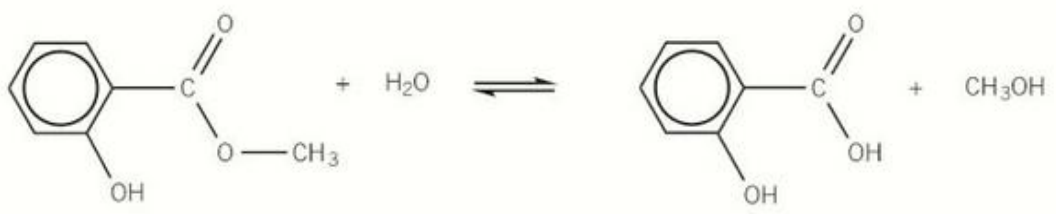
In acid hydrolysis, the ester is heated under reflux with dilute aqueous acid. The acid acts as a catalyst. This reaction is simply the reverse of esterification:
Example
Worked Example: Acid Hydrolysis of an Ester
Key points about acid hydrolysis:
- It's a reversible reaction (equilibrium established)
- The products are a carboxylic acid and an alcohol
- An acid catalyst is required
- The reaction needs heating under reflux
Alkaline hydrolysis (saponification)
Alkaline hydrolysis uses aqueous hydroxide ions () instead of acid. This reaction is also called saponification and is irreversible.
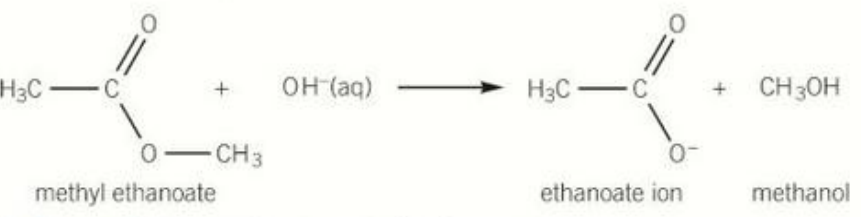
When an ester reacts with hydroxide ions:
- A carboxylate ion (not a carboxylic acid) is formed
- An alcohol is also produced
- The reaction goes to completion (irreversible)
Example
Worked Example: Alkaline Hydrolysis
For example, with sodium hydroxide solution as the alkali, sodium ethanoate salt is formed:
Notice the single arrow () indicating this is an irreversible reaction.
Important
Key Difference Between Acid and Alkaline Hydrolysis
Acid hydrolysis produces a carboxylic acid (reversible reaction, )
Alkaline hydrolysis produces a carboxylate salt (irreversible reaction, )
Don't confuse these two types of hydrolysis in your exam. Remember that alkaline hydrolysis produces an ionic salt, not a neutral carboxylic acid, which is why it's irreversible.
Acyl chlorides and their reactions
Preparation of acyl chlorides
Acyl chlorides can be prepared directly from their parent carboxylic acids using thionyl chloride (). The reaction must be carried out in a fume cupboard because the products and are harmful gases that are evolved during the reaction.
The general equation is:
Example
Worked Example: Preparing Propanoyl Chloride
Propanoic acid reacts with thionyl chloride to form propanoyl chloride:
Notice that two gaseous products are evolved, making this a vigorous reaction that must be performed with proper safety precautions.
Why acyl chlorides are so reactive
Important
Understanding the High Reactivity of Acyl Chlorides
Acyl chlorides are extremely reactive compounds because:
- The chlorine atom is a good leaving group
- The carbonyl carbon () is electron-deficient ()
- They readily react with nucleophiles (electron-rich species)
- They maintain the double bond through the reaction
This high reactivity makes acyl chlorides excellent reagents for synthesizing other carboxylic acid derivatives like esters and amides with high yields.
Reaction with alcohols to form esters
Acyl chlorides react vigorously with alcohols at room temperature to produce esters. No catalyst is needed, unlike in esterification with carboxylic acids.
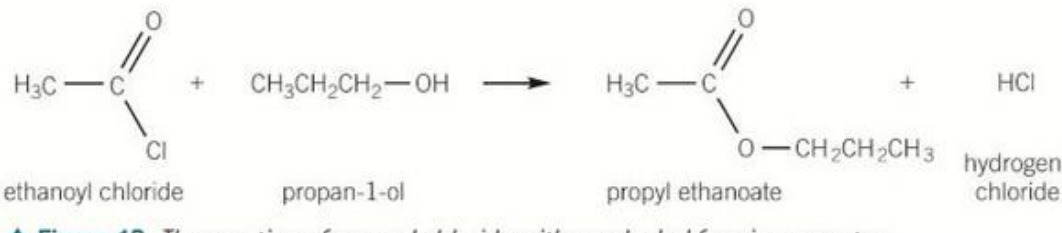
The general equation is:
Example
Worked Example: Forming an Ester from an Acyl Chloride
Ethanoyl chloride reacts with propan-1-ol to form propyl ethanoate and hydrogen chloride gas.
Advantages over direct esterification:
- Much faster reaction
- Goes to completion (not reversible)
- No catalyst needed
- Higher yields
Reaction with phenols to form esters
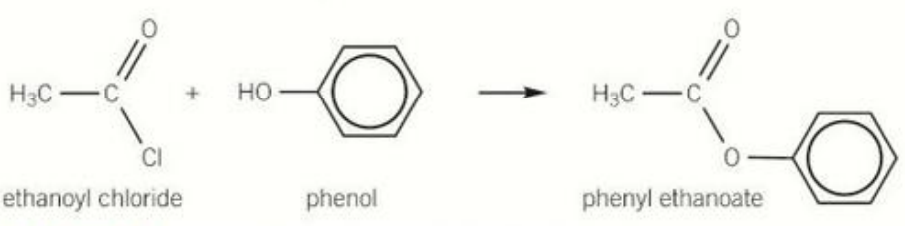
Carboxylic acids are not reactive enough to form esters with phenols directly. However, acyl chlorides and acid anhydrides are sufficiently reactive to react with phenols to produce phenyl esters.
Note
Important Synthetic Route
Neither reaction requires an acid catalyst. For example, ethanoyl chloride reacts with phenol to form phenyl ethanoate plus .
This is an important synthetic route because it's the only practical way to make esters from phenols.
Reaction with water to form carboxylic acids
When water is added to an acyl chloride, a violent reaction occurs with the evolution of dense, steamy hydrogen chloride fumes. A carboxylic acid is formed.
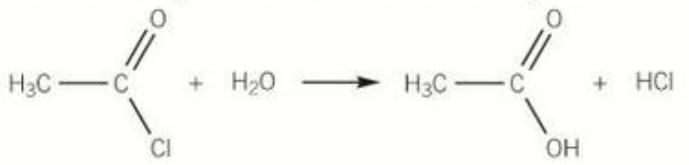
The general equation is:
Example
Worked Example: Acyl Chloride + Water
Important
Safety Warning
This reaction is so vigorous that you should never add water directly to an acyl chloride. The steamy fumes produced are toxic and corrosive gas.
Reaction with ammonia to form primary amides
Ammonia can act as a nucleophile by donating its lone pair of electrons. When acyl chlorides react with ammonia, primary amides are formed.
Two moles of ammonia are needed for each mole of acyl chloride:
- One molecule acts as the nucleophile to form the amide
- The second molecule neutralizes the produced, forming ammonium chloride ()
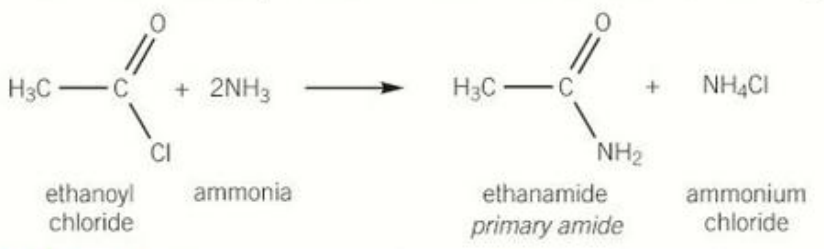
The equation is:
Example
Worked Example: Forming a Primary Amide
Ethanoyl chloride reacts with excess ammonia to produce ethanamide (a primary amide) and ammonium chloride.
Reaction with primary amines to form secondary amides
Primary amines () also act as nucleophiles and react with acyl chlorides in the same way as ammonia. However, the product is a secondary amide because the nitrogen atom is attached to two carbon atoms.
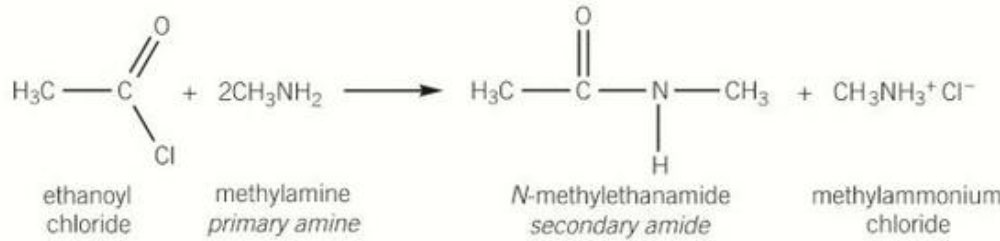
Again, two moles of amine are required:
Example
Worked Example: Forming a Secondary Amide
Ethanoyl chloride reacts with methylamine to form N-methylethanamide (a secondary amide) plus methylammonium chloride.
Note: The "N-" prefix in the name indicates that the methyl group is attached to the nitrogen atom, not to a carbon in the main chain.
Important
Remember the Stoichiometry
Always remember that two equivalents of ammonia or amine are needed - one to form the amide and one to neutralize the produced.
Reactions of acid anhydrides
Acid anhydrides undergo similar reactions to acyl chlorides with alcohols, phenols, water, ammonia, and amines. The key difference is that acid anhydrides are less reactive than acyl chlorides, making them useful when a gentler reagent is needed.
Example
Worked Example: Acid Anhydride Reaction
Ethanoic anhydride can react with phenol to form phenyl ethanoate:
Notice that one of the products is ethanoic acid, not as with acyl chlorides. This makes the reaction less vigorous and easier to control in some laboratory preparations.
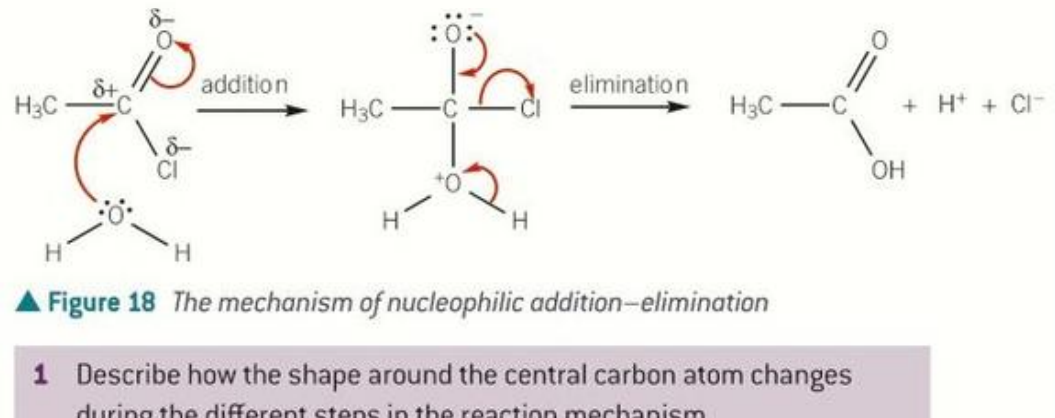
Mechanism of nucleophilic addition-elimination
The reactions of acyl chlorides with nucleophiles all follow the same mechanism called nucleophilic addition-elimination. This is an important mechanism that combines features of both carbonyl chemistry and halogenoalkane chemistry.
Step 1: Addition
The nucleophile (such as water, ammonia, or an alcohol) has a lone pair of electrons. This lone pair is attracted to and donated to the carbon atom in the group of the acyl chloride.
Note
Key Events in the Addition Step
- A dative covalent bond forms between the nucleophile and the carbonyl carbon
- The -bond of the group breaks
- A negatively charged intermediate is formed
- The shape around the carbon changes from trigonal planar to tetrahedral
Step 2: Elimination
In the elimination step:
- A lone pair of electrons on oxygen reforms the double bond
- This causes the chloride ion () to leave as a leaving group
- A proton () is also lost to complete the elimination
- The shape returns to trigonal planar around the carbon
For simplicity, the loss of and are often shown together in the second step.
Note
Why It's Called Nucleophilic Addition-Elimination
The mechanism is called nucleophilic addition-elimination because:
- First, the nucleophile adds to the carbonyl carbon
- Then, the chloride ion is eliminated
Important
Shape Changes During the Mechanism
The carbon atom changes from trigonal planar (120° bond angles) in the reactant, to tetrahedral (109.5° angles) in the intermediate, back to trigonal planar in the product.
Exam tip: When drawing mechanisms, always show:
- Curly arrows starting from lone pairs or bonds
- Partial charges ( and ) on atoms
- The tetrahedral intermediate
- Both steps clearly labeled
Summary
Summary
Key Points to Remember
Carboxylic acid derivatives all contain the acyl group () and can be hydrolyzed back to carboxylic acids: esters, acyl chlorides, acid anhydrides, and amides
Esterification requires heating an alcohol with a carboxylic acid in the presence of concentrated catalyst - it's a reversible reaction that produces sweet-smelling esters
Hydrolysis of esters can be carried out under acidic conditions (reversible, produces carboxylic acid and alcohol) or alkaline conditions/saponification (irreversible, produces carboxylate salt and alcohol)
Acyl chlorides are highly reactive and useful synthetic reagents - they react readily with alcohols, phenols, water, ammonia, and amines to form esters, carboxylic acids, and amides without needing catalysts or harsh conditions
Nucleophilic addition-elimination mechanism involves two steps: nucleophile adds to the carbonyl carbon (forming a tetrahedral intermediate), then elimination of the chloride ion regenerates the double bond - remember the shape changes from trigonal planar → tetrahedral → trigonal planar