Choosing the marketing mix (AQA GCSE Business): Revision Notes
📚Revision Notes
Choosing the marketing mix
Understanding the marketing mix
The marketing mix is a fundamental concept that describes how businesses combine four key elements to reach their customers effectively. These four elements are commonly known as the "4 Ps": product, price, place, and promotion. The term "mix" is used because each element influences the others, and businesses must ensure that all four work together harmoniously to appeal to their target customers.
Understanding how these elements interact is crucial for creating successful marketing strategies. For instance, when a business uses high-quality materials in their product, this often justifies charging a higher price. Similarly, if a company runs an advertising campaign in a specific region, they must ensure their distribution network can deliver the product to that area before customers become disappointed.
Note
The interconnected nature of the marketing mix elements means that businesses cannot focus on just one element in isolation. Every decision about product features, pricing, distribution, or promotion will impact the other elements and must be carefully coordinated.
How the elements work together
The marketing mix elements are interconnected in various ways. When businesses develop new product features, they typically need promotional activities to highlight these improvements to customers. The relationship between these elements means that changes to one aspect often require adjustments to others.
Consider how promotion and distribution must be coordinated. If a business launches an advertising campaign in a particular geographical area, they must ensure their distribution channels can supply that region adequately. This coordination prevents customer frustration and maintains the brand's reputation.
Important
Coordination is Critical: Failing to align marketing mix elements can lead to customer disappointment and damage to brand reputation. For example, promoting a product in an area where it's not available will frustrate potential customers and waste promotional resources.
Real-world example: Premier Inn
To illustrate how the marketing mix works in practice, let's examine how Premier Inn, a popular hotel chain, applies these principles.
Example
Worked Example: Premier Inn's Marketing Mix
Premier Inn's approach demonstrates how each element of the marketing mix supports their overall strategy:
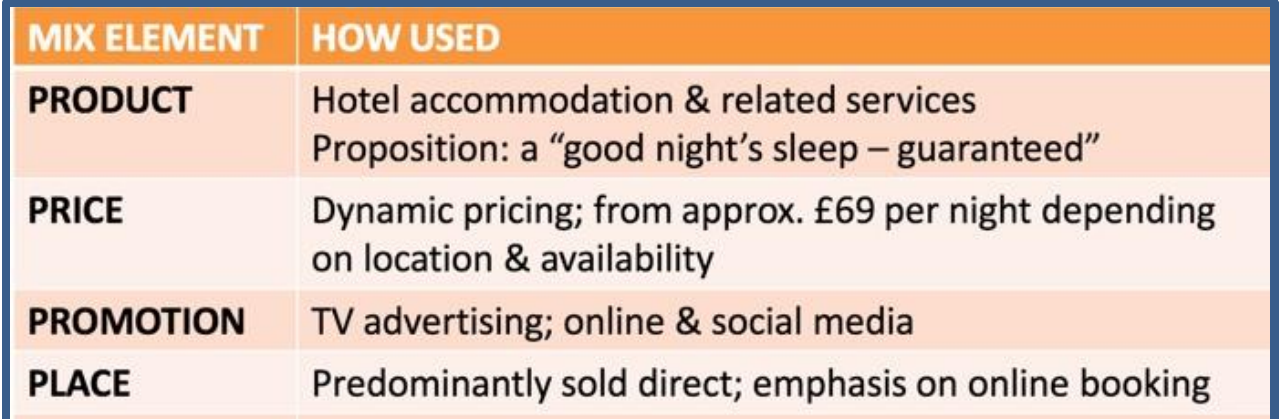
Product: Hotel accommodation with a clear value proposition of guaranteeing "a good night's sleep"
Price: Dynamic pricing strategy starting from approximately £69 per night, varying based on location and availability
Promotion: Television advertising combined with online and social media channels to reach potential customers
Place: Direct sales with particular focus on online booking systems for customer convenience
Characteristics of an effective marketing mix
An effective marketing mix possesses several key characteristics that contribute to business success. Firstly, it must meet customer needs by providing products or services that solve problems or fulfil desires. Secondly, the mix should help achieve the business's marketing objectives, whether these involve increasing sales, building brand awareness, or entering new markets.
Additionally, an effective marketing mix maintains balance and consistency across all four elements. This means that the quality and positioning of the product should align with the pricing strategy, promotional messages, and distribution channels. Finally, a well-designed marketing mix provides competitive advantage, helping the business stand out from rivals and attract customers.
Important
Key Characteristics of Effective Marketing Mix:
- Meets customer needs effectively
- Achieves marketing objectives
- Maintains balance and consistency across all elements
- Provides competitive advantage over rivals
It's important to recognise that marketing mixes vary significantly between businesses and industries, and they also evolve over time as market conditions change.
Different emphasis across industries
Different types of businesses naturally emphasise different elements of the marketing mix based on their industry characteristics and competitive environment.
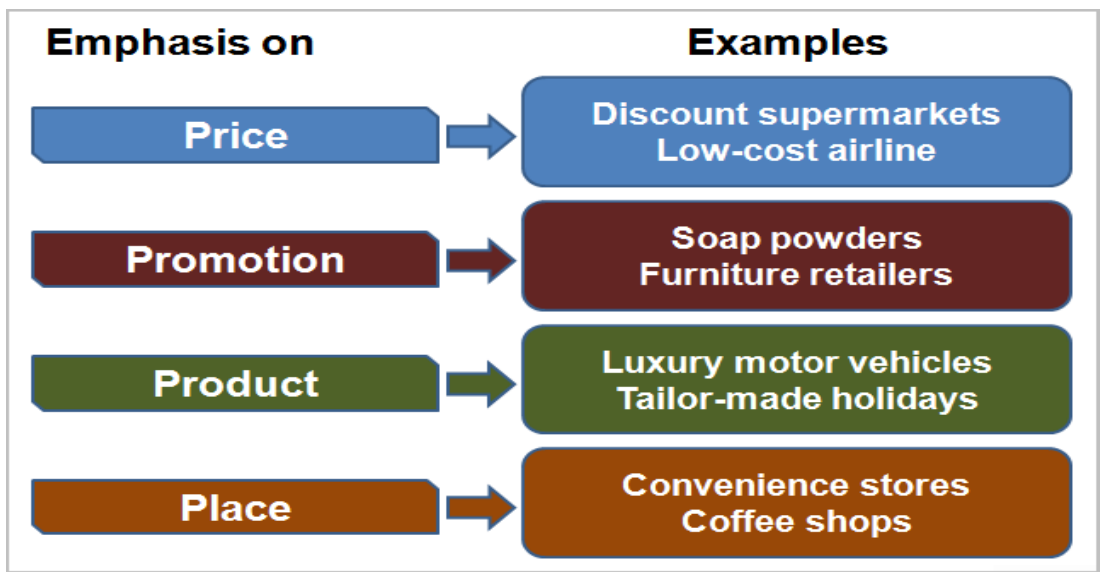
Some businesses prioritise price as their main competitive advantage. Discount supermarkets and low-cost airlines are prime examples of companies that compete primarily on offering lower prices than their competitors. These businesses structure their entire operations around cost efficiency to maintain their pricing advantage.
Other businesses focus heavily on promotion to differentiate themselves. Companies selling soap powders and furniture retailers often invest significantly in advertising and promotional activities because their products may be similar to competitors', making marketing communication crucial for attracting customers.
Note
Industry-Specific Emphasis Examples:
- Price-focused: Discount supermarkets, low-cost airlines
- Promotion-focused: Soap powder manufacturers, furniture retailers
- Product-focused: Luxury vehicle manufacturers, tailor-made holiday providers
- Place-focused: Convenience stores, coffee shops
Product-focused businesses emphasise quality, innovation, or uniqueness in their offerings. Luxury motor vehicle manufacturers and companies providing tailor-made holidays compete primarily on the distinctive features and superior quality of their products rather than on price.
Finally, some businesses compete mainly on place or convenience. Convenience stores and coffee shops often succeed because of their strategic locations and accessibility rather than having the lowest prices or most unique products.
Adapting the marketing mix over time
The marketing mix isn't static - it must evolve as market conditions change. Economic factors, consumer preferences, and competitive pressures all influence how businesses should balance their marketing elements.
For example, coffee shops currently often compete based on location convenience, but this emphasis might shift if economic conditions change. If consumers become less affluent or if competition intensifies significantly, coffee shops might need to prioritise price competitiveness over location advantages to maintain their customer base.
Note
Factors Driving Marketing Mix Changes:
- Economic conditions and consumer spending power
- Changing consumer preferences and behaviours
- Competitive pressures and new market entrants
- Technological developments and market innovations
This adaptability demonstrates why businesses must regularly review and adjust their marketing mix strategies. What works today might not be effective tomorrow, so successful businesses remain flexible and responsive to changing market conditions.
Summary
Key Points to Remember:
- The marketing mix consists of four interconnected elements: product, price, place, and promotion - each affects the others
- An effective marketing mix meets customer needs, achieves marketing objectives, maintains balance, and provides competitive advantage
- Different industries emphasise different elements based on their competitive environment and customer expectations
- Marketing mixes must evolve over time as market conditions, consumer preferences, and competitive pressures change
- Successful businesses coordinate all four elements to create a cohesive strategy that appeals to their target customers