3D shapes (AQA GCSE Maths): Revision Notes
📚Revision Notes
3D shapes
Understanding three-dimensional shapes is essential for GCSE geometry. These shapes have length, width, and height, making them different from flat 2D shapes. You need to learn their names, properties, and how to work with them mathematically.
Common 3D shapes
There are several important 3D shapes you must be able to identify and name. Each shape has distinct characteristics that make it unique.
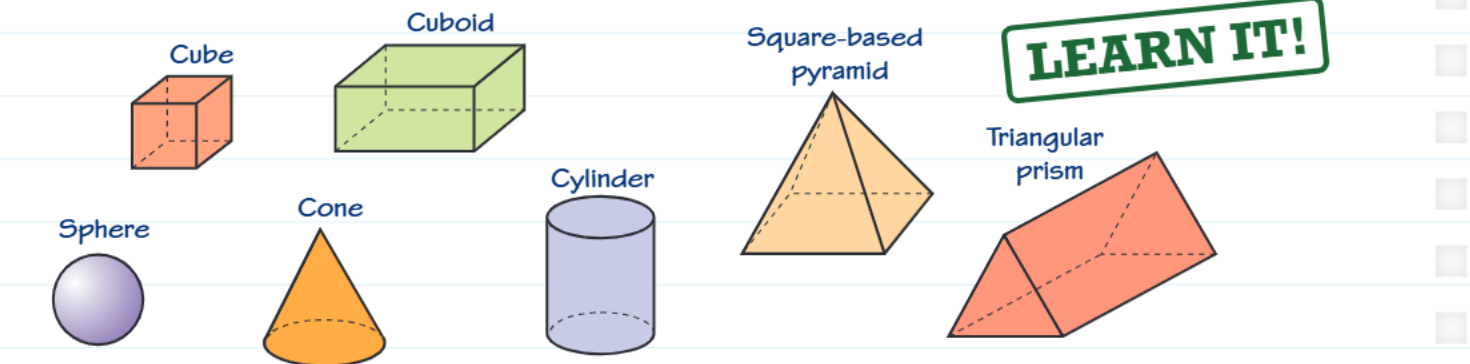
The main 3D shapes you need to know are:
- Cube - a solid with six square faces of equal size
- Cuboid - a rectangular solid with six rectangular faces (also called a rectangular prism)
- Sphere - a perfectly round solid, like a ball
- Cone - a solid with a circular base that tapers to a point
- Cylinder - a solid with two parallel circular faces connected by a curved surface
- Square-based pyramid - a solid with a square base and four triangular faces meeting at a point
- Triangular prism - a solid with two parallel triangular faces connected by rectangular faces
Note
When drawing 3D shapes, hidden edges are often shown using dashed lines. This helps you visualise the complete shape even when some parts would normally be hidden from view.
Properties of 3D shapes
All 3D shapes have three important properties that you need to understand and be able to count.
Faces are the flat surfaces of a 3D shape. For example, a cube has six faces, all of which are squares.
Edges are the lines where two faces meet. Think of them as the "seams" of the shape. A cube has twelve edges.
Vertices are the corner points where edges meet.
Important
The word "vertex" becomes "vertices" when plural. This is a common source of confusion in exams, so remember this important distinction!
Understanding these properties helps you analyse and describe 3D shapes accurately. You might be asked to count these features in exam questions, so practice identifying them on different shapes.
Surface area of cuboids
The surface area of a 3D shape is the total area of all its faces added together. For cuboids, this calculation follows a specific method.
A cuboid has six faces, and opposite faces are equal in area. This means there are really only three different face sizes to calculate. If you label the three different face areas as A, B, and C, then:
To find each face area, multiply the length and width of that face.
Example
Worked Example: Finding Surface Area of a Cuboid
For a cuboid measuring 6cm × 4cm × 3cm:
Step 1: Calculate each face area
- Face A = 6 × 3 = 18 cm²
- Face B = 6 × 4 = 24 cm²
- Face C = 4 × 3 = 12 cm²
Step 2: Apply the formula Surface area = 2(18) + 2(24) + 2(12) = 36 + 48 + 24 = 108 cm²
This method works because you're calculating each type of face once, then doubling it since each face appears twice on the cuboid.
Working with 3D shape problems
In exam questions, you might need to identify shapes, count their properties, or calculate measurements. Always read the question carefully and show your working clearly.
When counting edges, faces, or vertices, it can help to sketch the shape and mark each feature as you count it. This prevents you from missing any or counting them twice.
Important
Common Mistakes to Avoid:
- Forgetting to include units in your final answer
- Not showing all working steps in surface area calculations
- Miscounting properties when shapes are shown from unusual angles
For surface area problems, break the calculation into steps. Find the area of each different face type, then use the formula. Always include units in your final answer and check that your answer makes sense.
Remember that some shapes might be shown from unusual angles or with different orientations, but their properties remain the same. Practice identifying shapes regardless of how they're positioned.
Summary
Key Points to Remember:
- Learn the names of all seven common 3D shapes and be able to identify them from diagrams
- Faces are flat surfaces, edges are where faces meet, vertices are corner points (plural of vertex)
- Surface area of a cuboid = where A, B, C are the areas of the three different faces
- Hidden edges are shown with dashed lines in diagrams
- Always show your working in calculations and include units in your answers