Angles in polygons (AQA GCSE Maths): Revision Notes
📚Revision Notes
Angles in polygons
Understanding angles in polygons is essential for GCSE geometry problems. Polygon questions focus on interior angles and exterior angles, and knowing the key formulas will help you solve problems quickly and accurately.
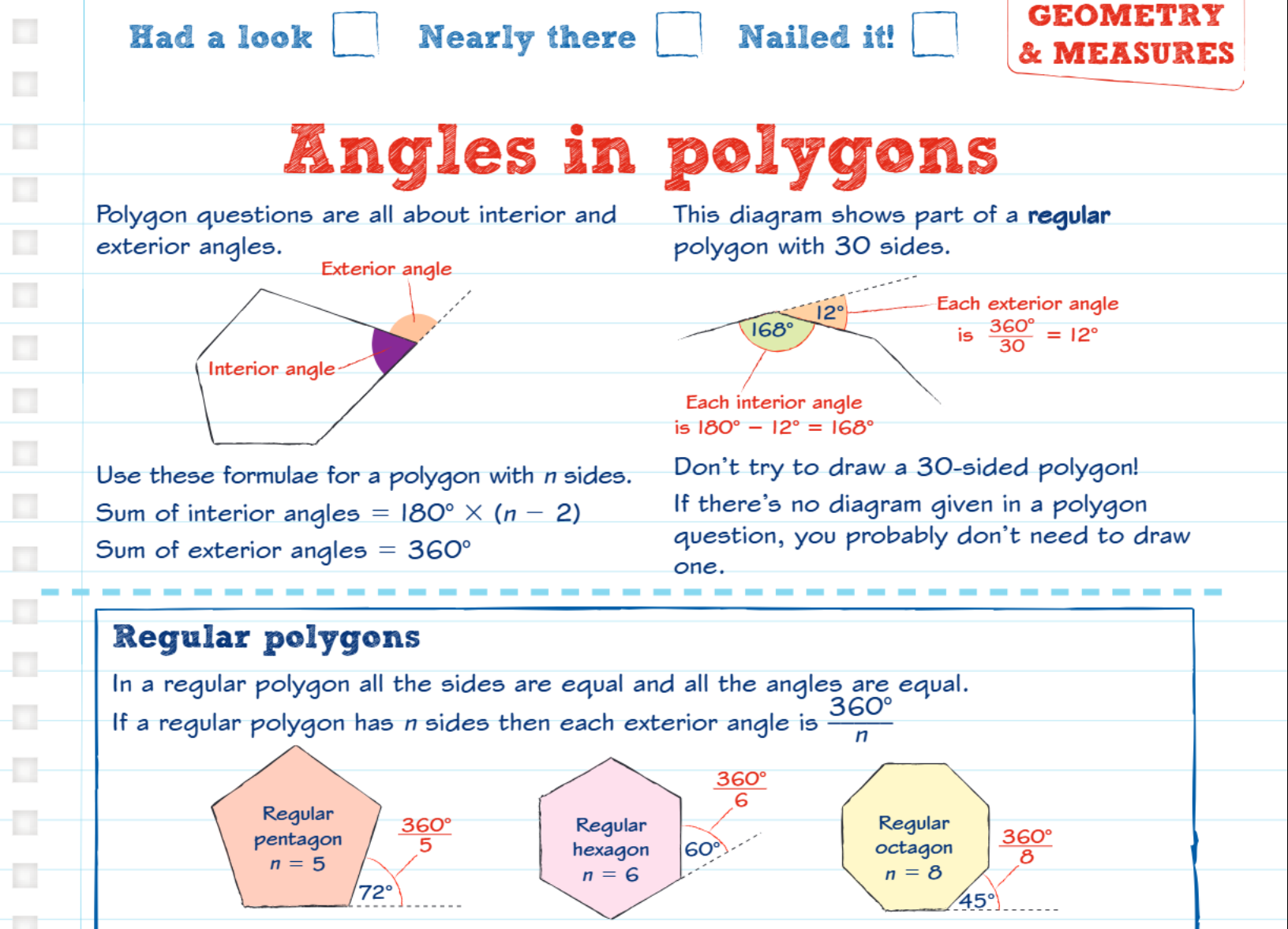
What are interior and exterior angles?
Interior angles are the angles inside a polygon, formed between two adjacent sides.
Exterior angles are the angles outside the polygon. They form a straight line with the corresponding interior angle, creating an important relationship.
Note
Key Relationship: Interior angle + exterior angle = 180°
This is because they form angles on a straight line, which always sum to 180°.
Key formulas for polygons
These essential formulas work for any polygon with sides and are crucial for solving polygon problems:
Note
Essential Polygon Formulas:
- Sum of interior angles =
- Sum of exterior angles =
The exterior angle formula is particularly useful because it's the same for all polygons - exterior angles always add up to 360°, like making one complete turn around the shape.
Regular polygons
A regular polygon has all sides equal and all angles equal. This makes calculations much simpler.
For a regular polygon with sides:
- Each exterior angle =
- Each interior angle = - exterior angle
Note
Common Regular Polygons:
- Regular pentagon (5 sides): Each exterior angle =
- Regular hexagon (6 sides): Each exterior angle =
- Regular octagon (8 sides): Each exterior angle =
Solving polygon problems
When working with polygon problems, exterior angles are often easier to use than interior angles. You can find exterior angles first, then use the fact that angles on a straight line add up to 180° to find interior angles.
Example
Worked Example: Finding the Number of Sides
A regular polygon has interior angles of 156°. Find the number of sides.
Step 1: Find the exterior angle Exterior angle =
Step 2: Use the exterior angle formula So
Answer: The polygon has 15 sides.
Important
Exam Tips:
- Don't try to draw complex polygons - if there's no diagram given, you probably don't need to draw one
- Use exterior angles when possible - they're often simpler to work with
- Check your answer by substituting back into the original formula
- Show your working clearly - polygon problems often carry several marks
Summary
Key Points to Remember:
- Interior angles are inside the polygon, exterior angles are outside
- Sum of interior angles = where is the number of sides
- Sum of exterior angles = for any polygon
- Regular polygons have equal sides and equal angles
- Each exterior angle of regular polygon =