Congruent triangles (AQA GCSE Maths): Revision Notes
📚Revision Notes
Congruent triangles
What are congruent triangles?
Congruent triangles are triangles that are exactly the same shape and size. When two triangles are congruent, all their corresponding sides and angles are equal.
Note
To prove that two triangles are congruent, you need to show that one of four specific conditions is satisfied. These conditions ensure that the triangles must be identical in shape and size.
The four conditions for congruence
1. SSS (Side-Side-Side)
SSS means all three corresponding sides of the triangles are equal in length.
If you can show that each side of one triangle matches the length of the corresponding side in another triangle, then the triangles are congruent.
2. AAS (Angle-Angle-Side)
AAS means two corresponding angles and one corresponding side are equal.
You need two angles and the side that corresponds to one of these angles to be the same in both triangles.
3. SAS (Side-Angle-Side)
SAS means two corresponding sides and the angle between them are equal.
Important
The angle must be positioned between the two equal sides. This is called the included angle. If the angle is not between the two sides, the SAS condition cannot be used.
4. RHS (Right-Angle-Hypotenuse-Side)
RHS applies only to right-angled triangles. You need:
- Both triangles to have a right angle
- The hypotenuse (longest side) to be equal in both triangles
- One other corresponding side to be equal
Note
RHS is a special case that only works with right-angled triangles because the right angle and hypotenuse provide unique constraints that ensure congruence.
Common sides
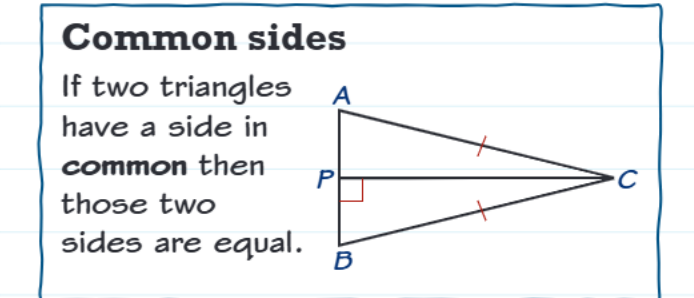
When two triangles share a side, that side is automatically equal in both triangles. This is called a common side.
Note
About Common Sides:
If two triangles have a side in common, you can use this as one of your equal sides when proving congruence. This is particularly useful because you don't need to measure or prove that this side is equal - it's the same physical line segment in both triangles.
Worked example
Example
Worked Example: Proving Congruence Using RHS
Consider two triangles ABD and BDC that share side BD.
Step 1: Identify the triangle type Both triangles are right-angled triangles
Step 2: Check the hypotenuse Both have the same hypotenuse length (6cm)
Step 3: Identify equal sides Side BD is common to both triangles, so it's equal in both
Step 4: Apply the condition Therefore the triangles satisfy the RHS condition and are congruent
Exam technique
Note
Exam Strategy for Congruence Proofs:
When explaining why triangles are congruent in an exam, follow this systematic approach:
- State which condition you're using (SSS, AAS, SAS, or RHS)
- Identify the equal parts - list which sides or angles are the same and why
- Write your conclusion - state that the triangles satisfy the condition and are therefore congruent
You can use abbreviations like SSS, AAS, SAS, and RHS in your answers to save time.
Summary
Key Points to Remember:
- Congruent triangles are exactly the same shape and size
- Four conditions can prove congruence: SSS, AAS, SAS, and RHS
- For SAS, the angle must be between the two equal sides
- RHS only works with right-angled triangles
- Common sides are automatically equal when triangles share them