Constructions 1 (AQA GCSE Maths): Revision Notes
📚Revision Notes
Constructions 1
What are geometric constructions?
Geometric constructions are precise drawings made using only a compass and straightedge (ruler). In GCSE maths, you'll be asked to construct perpendicular lines in three main ways. These constructions must be accurate and you must show all your working by leaving construction lines visible.
Note
The key to successful geometric constructions is precision and showing your method. Every construction line and arc you draw is part of your answer and demonstrates your understanding of the process.
Equipment needed
Before starting any construction, make sure you have:
- Compass with stiff arms - essential for drawing accurate arcs
- Sharp pencil - for clear, precise lines
- Transparent ruler - to draw straight lines and measure if needed
Important
Using proper equipment is crucial for accurate constructions. Poor quality compasses that slip or wobble will make it impossible to achieve the precision required for GCSE level work.
Types of perpendicular constructions
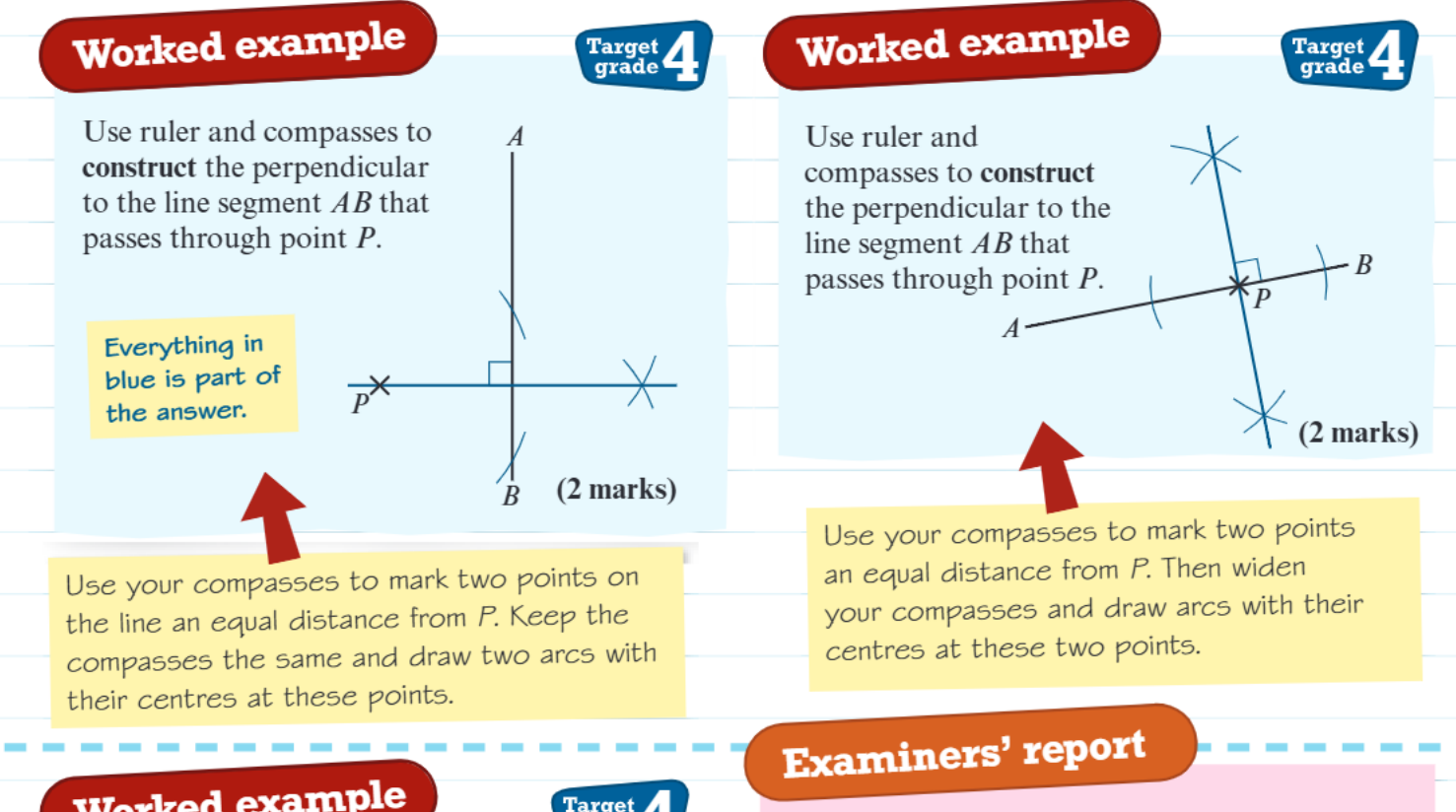
There are three main types of perpendicular line constructions you need to master:
1. Perpendicular through a point on a line
This construction creates a line that passes through a given point P on line segment AB and meets AB at a right angle.
Example
Worked Example: Constructing a Perpendicular Through a Point on a Line
Step 1: Place your compass point on P Step 2: Draw two arcs that intersect the line AB on both sides of P, keeping the same compass width Step 3: From each intersection point, draw arcs above and below the line using the same compass width Step 4: Where these arcs intersect, draw a straight line through these points and point P
2. Perpendicular from a point not on a line
This construction creates a perpendicular line from point P to line segment AB, where P is not on the line.
Example
Worked Example: Constructing a Perpendicular From a Point Not on a Line
Step 1: Place your compass point on P Step 2: Draw an arc that intersects line AB at two points Step 3: Keep the compass the same width Step 4: From each intersection point on AB, draw arcs on the opposite side of the line from P Step 5: Where these arcs intersect, draw a line from P through this intersection point
3. Perpendicular bisector of a line segment
A perpendicular bisector cuts a line segment exactly in half at a right angle.
Example
Worked Example: Constructing a Perpendicular Bisector
Step 1: Open your compass to more than half the length of line AB Step 2: Place the compass point on A and draw arcs above and below the line Step 3: Without changing the compass width, place it on B and draw arcs above and below Step 4: Where the arcs intersect, draw a straight line through both intersection points
Exam technique and common mistakes
Key exam tips:
- Always show construction lines - these are part of your answer and earn marks
- Keep your compass width constant when drawing arcs for each step
- Draw intersecting arcs clearly - they should cross definitively, not just touch
- Use a ruler for final lines but leave all construction arcs visible
What examiners look for:
- Accurate arc intersections
- All construction lines visible
- Correct final perpendicular line
- Neat, clear working
Important
Common Mistakes to Avoid:
- Erasing construction arcs - you lose marks for this
- Changing compass width during a construction
- Not making arcs long enough to intersect clearly
- Drawing faint lines that are hard to see
These mistakes are frequently seen in exam papers and can cost you valuable marks even if your final answer is correct.
Construction checklist
Before submitting your work, check you have:
- ✓ Used good compasses with stiff arms
- ✓ Used a sharp pencil throughout
- ✓ Used a transparent ruler for straight lines
- ✓ Marked any required angles clearly
- ✓ Labelled any required lengths
- ✓ Shown all construction lines and arcs
Summary
Key Points to Remember:
- Perpendicular lines meet at exactly and this must be achieved through accurate construction, not estimation
- Always leave your construction marks visible - they're part of your answer and demonstrate your method
- Practice with proper equipment - good compasses are essential for accurate work
- Take your time with intersections - make sure arcs cross clearly to avoid errors
- Construction questions typically carry 2 marks - one for method and one for accuracy