Constructions 2 (AQA GCSE Maths): Revision Notes
📚Revision Notes
Constructions 2
What you need to know
Geometric constructions are accurate drawings made using only a ruler and compasses. These are essential skills for your GCSE exam and you must be able to perform all of these constructions precisely.
You will need to know how to construct triangles with given measurements, create angle bisectors, and construct specific angles. Each construction follows a systematic method that ensures accuracy.
Note
All geometric constructions must follow systematic methods to ensure accuracy. The key is to understand the geometric principles behind each construction, not just memorise the steps.
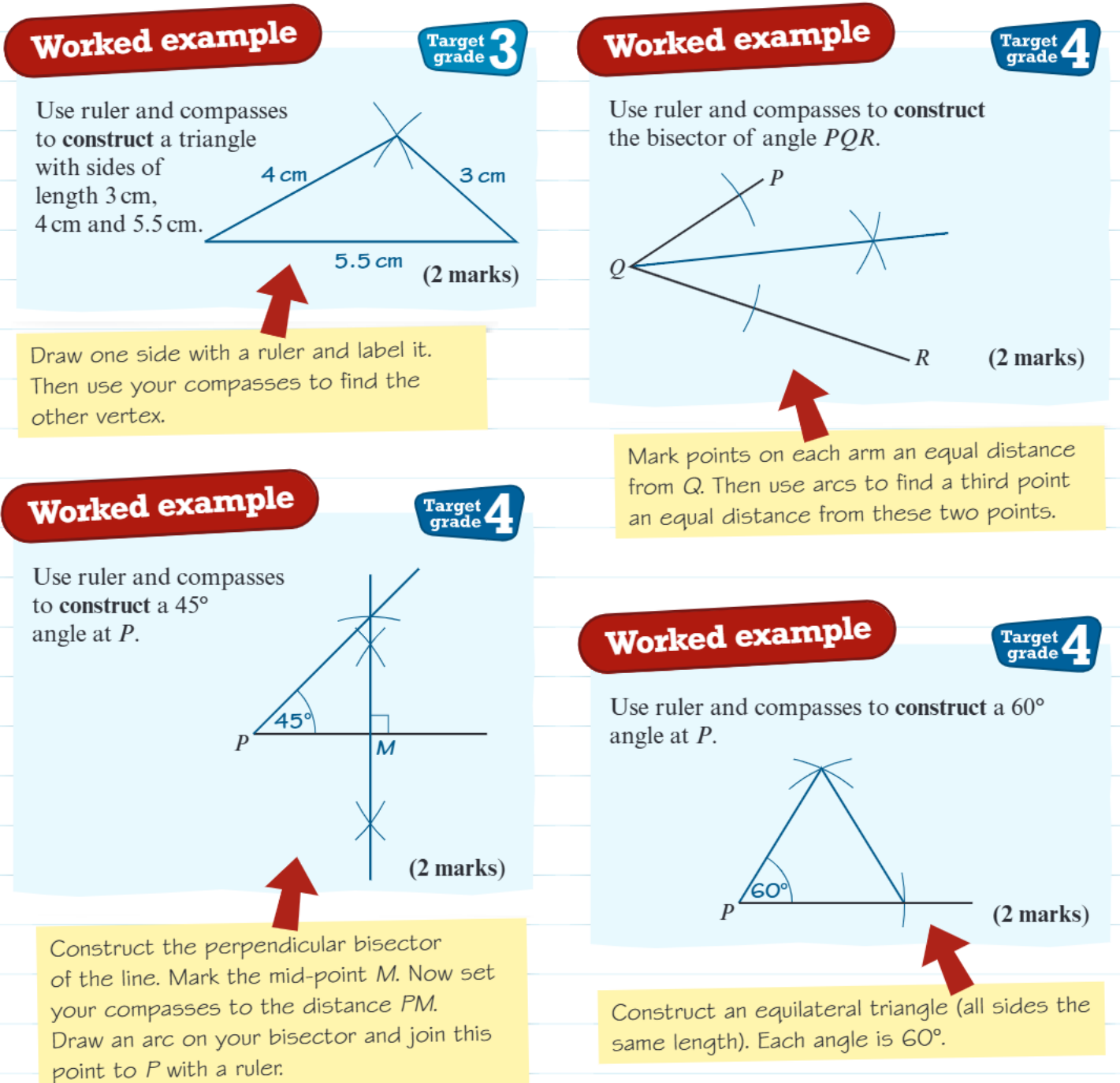
Constructing triangles with given side lengths
When you need to construct a triangle with specific side measurements, this method uses the principle that the sides of a triangle are fixed distances from each vertex.
Example
Worked Example: Constructing a Triangle with Given Side Lengths
Follow this systematic approach:
- Draw the base - Use your ruler to draw one side and label it with the correct measurement
- Set your compass - Open your compass to the length of the second side
- Draw an arc - Place the compass point at one end of your base line and draw an arc
- Repeat for the third side - Set your compass to the third side length and draw another arc from the other end of the base
- Find the intersection - Where the two arcs cross is your third vertex
- Complete the triangle - Draw lines to connect all three vertices
This method works because it uses the principle that the sides of a triangle are fixed distances from each vertex.
Constructing angle bisectors
An angle bisector is a line that divides an angle into two equal parts. This construction works because you're creating two congruent triangles, ensuring the angle is split exactly in half.
Example
Worked Example: Constructing an Angle Bisector
- Mark equal distances - Place your compass point at the angle's vertex and mark equal distances along both arms of the angle
- Draw intersecting arcs - From each marked point, draw arcs that intersect between the angle arms
- Draw the bisector - Use your ruler to draw a line from the vertex through the point where the arcs intersect
Constructing specific angles
Creating a 45° angle
To construct a 45° angle, you use the perpendicular bisector method. This creates a angle because you're bisecting a right angle.
Example
Worked Example: Constructing a 45° Angle
- Draw a baseline - Draw a horizontal line and mark point P on it
- Construct a perpendicular - Use the perpendicular bisector construction to create a angle
- Find the midpoint - Mark the midpoint M on your perpendicular line
- Set compass distance - Set your compass to the distance PM
- Draw an arc - Draw an arc from this distance and connect to point P
Creating a 60° angle
To construct a 60° angle, you use the properties of an equilateral triangle. This method works because equilateral triangles always have three 60° angles.
Example
Worked Example: Constructing a 60° Angle
- Draw a baseline - Draw a horizontal line with point P marked
- Create an equilateral triangle - Use your compass to construct a triangle where all sides are equal
- Mark the angle - The angle at P will be exactly because all angles in an equilateral triangle are
Creating a 30° angle
To construct a 30° angle, you bisect a angle:
Example
Worked Example: Constructing a 30° Angle
- First construct 60° - Follow the method above to create a angle
- Bisect the 60° angle - Use the angle bisector construction to divide it in half
- Result - Each half will be exactly
Exam tips
Important
Critical Exam Advice:
- Always use a sharp pencil for accuracy
- Keep your compass settings consistent throughout each construction
- Don't erase your construction lines - examiners want to see your working
- Label your angles and measurements clearly
- Practice these constructions until you can do them quickly and accurately
Remember!
Summary
Key Points to Remember:
- Constructions use only ruler and compasses - no protractors or other measuring tools allowed
- Triangle construction - draw one side first, then use arcs to find the third vertex
- Angle bisectors divide angles exactly in half using intersecting arcs from equal distances
- 60° angles come from equilateral triangles where all angles are equal
- 30° and 45° angles are created by bisecting 60° and 90° angles respectively