Loci (AQA GCSE Maths): Revision Notes
📚Revision Notes
Loci
A locus represents all the points that meet a particular geometric rule or condition. The plural of locus is loci. You can draw loci accurately using a ruler and compass, and points can lie inside regions rather than just on lines or curves.
Note
Understanding loci is fundamental to solving many geometric problems involving distance, position, and movement. The key is recognising that a locus shows all possible positions that satisfy your given condition.
Types of loci
Understanding different types of loci helps you solve geometric problems involving distance and position relationships.
Circle locus
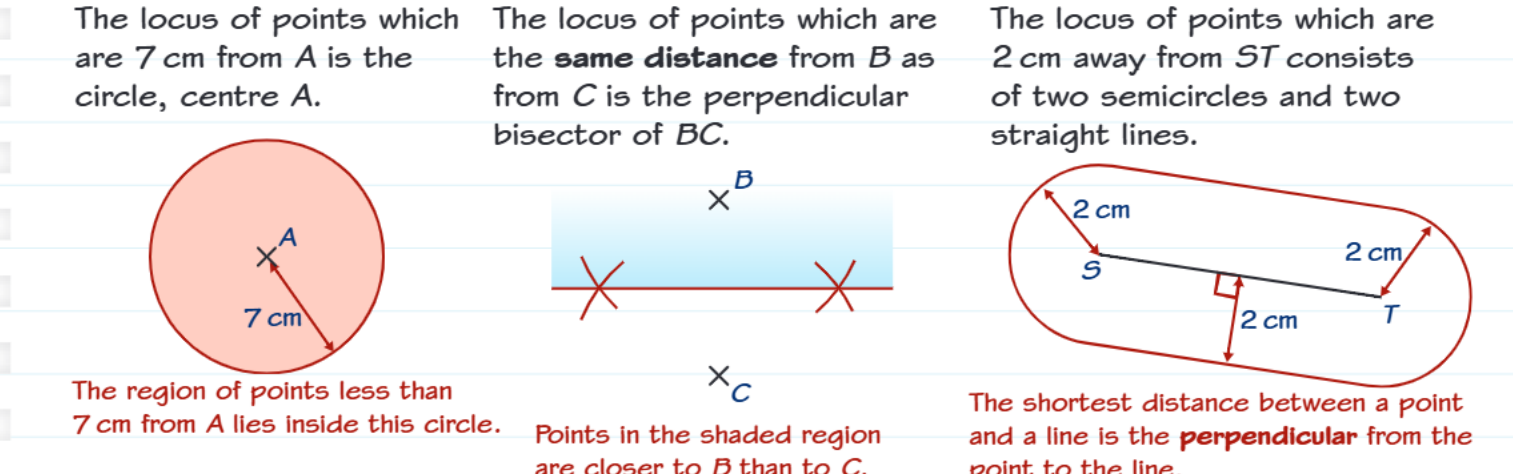
When you need to find all points at a fixed distance from a given point, the answer is always a circle. The given point becomes the centre, and the fixed distance becomes the radius.
For example, if you want all points exactly 7 cm from point A, you draw a circle with centre A and radius 7 cm. Points inside this circle are less than 7 cm from A, while points outside are more than 7 cm away.
Important
Key Principle: All points at exactly the same distance from a central point will always form a perfect circle. This is one of the most fundamental relationships in geometry.
Perpendicular bisector locus
The perpendicular bisector shows all points that are exactly the same distance from two given points. This creates a straight line that cuts through the middle of the line segment joining the two points at a right angle.
If you have points B and C, any point on the perpendicular bisector of BC will be exactly the same distance from both B and C. Points on one side of this line are closer to B, while points on the other side are closer to C.
Note
The perpendicular bisector is particularly useful in real-world applications like finding the optimal location for a facility that needs to be equally accessible from two different points.
Distance from line segment locus
When finding all points at a fixed distance from a line segment, you create a shape that looks like a racetrack. This consists of two parallel straight lines (the same distance from each end of the original segment) connected by semicircles at each end.
The shortest distance between any point and a line is always the perpendicular distance from that point to the line.
Combining conditions
You can solve problems where points must satisfy more than one condition at the same time. This typically involves shading a region that meets all the given requirements.
For example, you might need to find points that are:
- More than 6 cm from point D, AND
- Closer to line BC than to line AD
The solution would be the overlap of both individual loci conditions.
Note
When combining conditions, always draw each locus separately first, then identify where they overlap. The intersection of these regions gives you your final answer.
Worked examples
Example
Worked Example: Beach and Lifeguard Problem
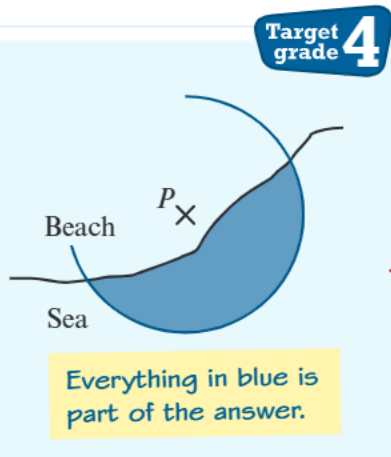
This problem involves finding a region where public swimming is allowed. The condition states that swimming is permitted in areas of the sea less than 30 m from the lifeguard tower at point P.
Step 1: Use the given scale (1 cm represents 20 m)
Step 2: Calculate the distance on the diagram 30 m ÷ 20 m/cm = 1.5 cm on the diagram
Step 3: Set your compass to 1.5 cm
Step 4: Draw a circle with centre at point P
Step 5: Shade the part of this circle that covers the sea area
Exam tip: Always check the scale carefully and set your compass accurately by placing the point on top of your ruler at the 0 mark.
Example
Worked Example: Triangle Rotation Problem
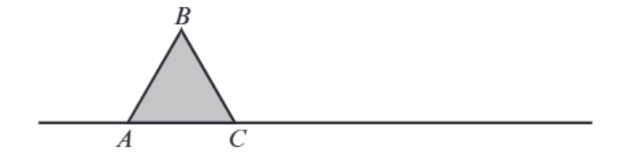
This example shows how to find the locus of a vertex during rotation. When triangle ABC is rotated 120° clockwise about point C, then 120° clockwise about point B, vertex A traces out a curved path.
Step 1: Start with your compass point at C
Step 2: Draw an arc to show where A moves during the first rotation (120°)
Step 3: Move your compass point to B
Step 4: Draw another arc from A's new position (another 120° rotation)
Step 5: The complete path shows the locus of point A
This demonstrates how complex movements can be broken down into simple rotational steps.
Construction techniques
When drawing loci, accuracy is essential for obtaining correct solutions.
Important
Critical Construction Rules:
- Use a compass for all circular arcs and circles
- Use a ruler for straight lines and measuring distances
- Set your compass carefully by placing the point exactly on the ruler's zero mark
- Keep your compass setting fixed while drawing each complete locus
- Never guess measurements - always use the scale provided
The quality of your construction directly affects the accuracy of your solution. Take time to measure carefully and use your tools correctly.
Summary
Key Points to Remember:
- A locus is the set of all points satisfying a geometric condition
- Circle loci show points at a fixed distance from a centre point
- Perpendicular bisectors show points equidistant from two given points
- Line segment distance creates racetrack-shaped regions with parallel lines and semicircular ends
- You can combine conditions to find regions satisfying multiple requirements
- Always use compass and ruler for accurate construction
- The shortest distance from a point to a line is always perpendicular to that line