Measuring lines (AQA GCSE Maths): Revision Notes
📚Revision Notes
Measuring lines
What you need to know
Measuring lines accurately is a fundamental skill in geometry. You must be able to use a ruler to measure straight lines precisely and draw lines to specific lengths. This is essential for solving geometry problems and will appear in your GCSE exam.
Important
Critical Skills Required:
- Using a ruler to measure straight lines precisely
- Drawing lines to specific lengths
- Converting between millimetres and centimetres
- Estimating lengths using known measurements
How to measure lines with a ruler
When measuring any line segment, follow this systematic approach to ensure accuracy:
Step 1: Position your ruler correctly Place the zero mark (0) of your ruler exactly at the starting point of the line you want to measure. This alignment is crucial for getting the right measurement.
Step 2: Read the measurement carefully Look at where the line ends on your ruler scale. Always measure to the nearest millimetre for maximum accuracy.
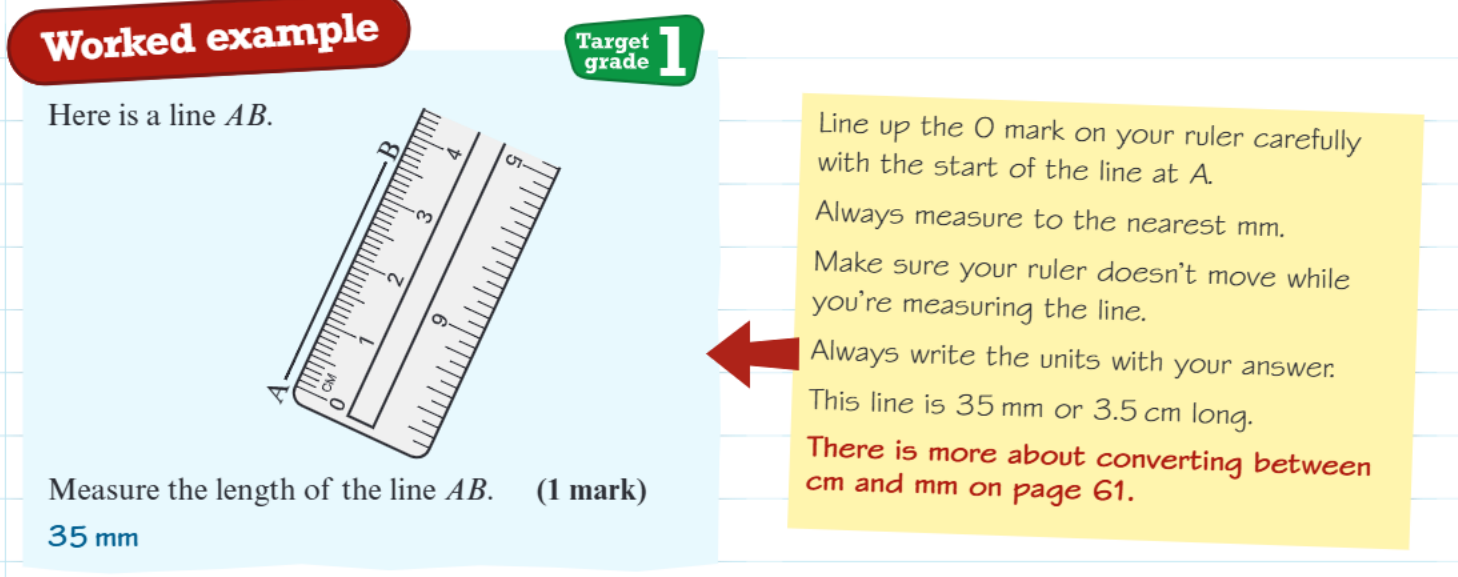
Step 3: Record your answer with units Write down your measurement and always include the units (mm or cm). Remember that you can express the same length in different units - for example, 35 mm is the same as 3.5 cm.
Note
Unit Conversion Reminder:
- 1 cm = 10 mm
- To convert mm to cm: divide by 10
- To convert cm to mm: multiply by 10
Key tips for accurate measurement
Note
Essential Measurement Tips:
- Keep your ruler steady - Don't let it move while you're taking the measurement
- Use the correct units - Check whether the question asks for millimetres (mm) or centimetres (cm)
- Measure to the nearest mm - This gives you the most precise measurement possible
- Double-check your alignment - Make sure the 0 mark lines up perfectly with the start of your line
Drawing lines checklist
When you need to draw lines to specific lengths, use this systematic approach to ensure accuracy:
Note
Pre-Drawing Checklist:
Before you start:
- Check whether you're working in centimetres or millimetres
- Use a sharp pencil for precise lines
- Make sure your ruler is placed firmly on the paper
When drawing:
- Start your line exactly at the 0 mark on your ruler
- Hold your ruler steady throughout the process
- Draw to the nearest millimetre
- Label the length you have drawn clearly
Estimating lengths
Sometimes you'll need to estimate measurements when you can't measure directly. You can use lengths you already know to work out unknown measurements.
How estimation works: If you know the size of one object in a diagram, you can use it to estimate the size of other objects by comparing them. This works because everything in the diagram is drawn to the same scale.
Example
Worked Example: Scale Estimation
Given information: A person in a diagram is 3 cm tall and represents a real height of 1.8 metres.
Problem: If a cliff in the same diagram is 12 cm tall, what is the real cliff height?
Step 1: Find the relationship between diagram and person The cliff is times taller than the person
Step 2: Apply this to the real height Real cliff height = metres
Answer: The cliff is 7.2 metres tall
This method works because everything in the diagram is drawn to the same scale, allowing you to use proportional reasoning to find unknown measurements.
Exam tips
Important
Essential Exam Strategy:
- Always include units in your final answer - marks are often lost for missing units
- Show your working when estimating - this can earn you marks even if your final answer isn't perfect
- Use a sharp pencil for drawing - this makes your lines more accurate
- Check your measurements twice - small errors in measuring can affect your whole calculation
Summary
Key Points to Remember:
- Always align the 0 mark on your ruler with the start of the line you're measuring
- Measure to the nearest millimetre for maximum accuracy
- Include units (mm or cm) in all your answers
- Keep your ruler steady while measuring to avoid errors
- You can estimate unknown lengths by comparing them to measurements you know